
Protecting Florida Restaurants From Property, Liability, Employee, and Operational Risks
What Is Florida Restaurant Insurance?
Florida Restaurant Insurance is a combination of commercial insurance coverages designed to protect restaurants and other food-service businesses from the property, liability, employee, and operational risks that can arise from running a restaurant.
It is not one standardized policy. The coverage a restaurant needs can vary based on its size, location, ownership of the building, lease requirements, cooking methods, equipment, alcohol sales, employees, delivery operations, catering activities, property values, and other exposures.
A restaurant insurance program may include General Liability Insurance, Commercial Property Insurance, Business Income and Extra Expense coverage, Equipment Breakdown Insurance, Food Spoilage coverage, Workers’ Compensation Insurance, Liquor Liability Insurance, Commercial Auto Insurance, Cyber Insurance, Employment Practices Liability Insurance, Commercial Crime Insurance, and Umbrella or Excess Liability.
Some restaurants may qualify for a Business Owners Policy (BOP) that combines certain property and liability coverages into one policy. Other restaurants may need separate policies or endorsements because of factors such as alcohol sales, higher property values, delivery services, unique cooking operations, multiple locations, prior claims, or other underwriting considerations.
Interactive Graphic

Liquor Liability
Risk Factor
Any establishment that sells, serves, or assists in the purchase or use of liquor is open to a liability claim as a consequence of someone getting inebriated to the extent that injuries or property damage result.
Solution
If you are in the business of selling or serving alcohol, it is critical that you protect yourself from potential financial losses by obtaining a liquor liability insurance policy. Having the right policy in place could help cover your legal costs, court fees, and any civil or criminal damages stemming from an incident involving liquor.
Valet Parking
Risk Factor
Providing a valet service is convenient for your guests, but damaging a vehicle or property, or causing injury, is a very real risk associated with offering this service.
Solution
Obtain a general liability policy to protect your business from lawsuits by a third party. Be certain that a garagekeepers legal liability policy is also in effect with adequate limits to cover any physical damage to a guest's vehicle or other vehicles on-site. If you are using an independent valet service, obtain a certificate of insurance to verify they have the proper coverage with adequate limits. Also make sure that your business is named as an additional insured under their policy.
Business Income
Risk Factor
In the event of a covered cause of loss, most policies include coverage for the income you cannot collect. What happens if one of your key suppliers, such as your food or beverage distributor, is incapable of supplying you with what you need to keep your business running?
Solution
Make sure that your business income insurance includes contingent business income coverage to protect against the loss of potential earnings to your restaurant caused by the inability of a key vendor to provide a component necessary for the completion or execution of your services.
Employment Practice Liability Insurance (EPLI)
Risk Factor
On average, it's estimated that three out of five businesses will be sued by their employees. Restaurants, just like any other business, are vulnerable from the pre-hire process through to a possible reduction in workforce. Claims can stem from just about anything, such as someone taking a "joke" the wrong way and being offended.
Solution
Coverage to protect you against this risk normally comes as a standalone policy. The right coverage is critical to your risk management process as it protects against discrimination, wrongful termination, sexual harassment, and other employment-related allegations. Typically, the policy will cover your business as well as your directors and officers. Third party coverage is an added option, usually accomplished via a policy endorsement, and addresses claims made by customers or vendors against you from acts committed by employees.
Sign Coverage
Risk Factor
Exterior signs associated with your business are vulnerable to fire, vandalism, and weather. Most commercial property policies offer a sublimit of coverage for signs, but it might not be enough.
Solution
Evaluate your sign exposures and determine if your existing commercial property insurance policy provides sufficient coverage. If not, increase the policy limit as required.
Systems Breakdown Insurance
Risk Factor
Equipment such as freezers, stoves, dishwashers, and air conditioning units are vital when running a restaurant. If a power surge or mechanical failure results in equipment breakdown, your business can experience expensive repairs and lost income.
Solution
Make sure you maintain systems breakdown insurance, including business interruption and spoilage coverage so that you can get your business up and running again without suffering financial setbacks.
Flooding
Risk Factor
As exposed by Superstorm Sandy and other significant weather events in recent years, flooding can occur in almost any location and to any business. Are you protected?
Solution
Flood insurance is typically not included in a commercial property insurance policy, but can generally be added by endorsement as long as the property is not in a high risk flood zone. If coverage is excluded from the policy, you should look into the cost to add it. If your property is in a high risk flood zone, you will need to obtain a standalone policy. In either case, it’s important to have coverage.
Cyber Liability
Risk Factor
Just about all businesses rely on technology in some way; it's increasingly used to store sensitive information, such as credit cards, passwords, and social security numbers. However, you're at risk if this information is lost, stolen, or compromised. In fact, you may even be legally obligated to alert those impacted by the breach and possibly pay for any financial loss incurred.
Solution
Experiencing a data breach is often not a question of if but when. Securing a cyber liability policy can offer coverage for expenses associated with compliance regarding data breach notification laws, securing legal counsel to advise on incident response, credit monitoring services, and paying for regulatory defense, as well as penalties arising from privacy law violations.
Improvements and Betterments
Risk Factor
Most restaurant owners remember to insure their contents, such as tables and chairs, but do not factor in the cost of the improvements they have made when selecting a building or contents limit.
Solution
If you have done or are considering a renovation to your restaurant, factor the cost into the building limit if you own the building or contents limit if you lease.
Food Contamination / Spoilage Coverage
Risk Factor
A power outage, mechanical failure, or other covered event can cause food to spoil, which then must be discarded.
Solution
This coverage will cover the replacement cost of the spoiled food. Most policies include coverage, but you should confirm the limit is sufficient.
Employee Theft
Risk Factor
Two things a restaurant has easily accessible are food and money. Employees have been known to run scams to pocket money or steal food to take home or give away to friends and family members.
Solution
Make sure you have coverage for employee theft. This can help compensate you for some of your financial losses.
Commercial Auto / Hired and Non-Owned Auto Liability
Risk Factor
If your restaurant offers food delivery service, whether the drivers are using their own vehicles or those owned by the company, you can be named in a lawsuit as a result of injury or damage caused by them while making a delivery for you.
Solution
A business auto insurance policy should be maintained if the vehicles are owned by the company. If employees are using their own vehicles to make deliveries, then hired and non-owned auto liability coverage should be maintained. Both will defend you if you are named in a lawsuit as a result of an employee getting into an accident while making a delivery for you.
Workers' Compensation
Risk Factor
If one of your employees receives an injury or becomes ill due to a work-related occurrence, you are required by law to have the proper coverage in place.
Solution
Workers' compensation protects your employees should a job-related injury or sickness occur during the course of employment. This coverage is required by law and may vary by area, so be sure that you understand your obligations for all physical locations where your business operates in and all physical locations where you hire your employees.
Restaurant Risks Extend Beyond the Dining Room
Restaurant insurance is important because many of the most serious losses can begin outside the obvious customer-facing areas of the business.
A customer could slip on a wet floor, a kitchen fire could damage the building and equipment, refrigeration failure could spoil inventory, or a covered property loss could force the restaurant to close temporarily and lose income. Restaurants may also face foodborne illness claims, employee injuries, alcohol-related liability, cyber incidents involving payment systems, employee theft, or vehicle accidents connected to deliveries or other business use.
These risks are not necessarily covered by the same policy. A General Liability policy, for example, serves a different purpose from Commercial Property, Workers’ Compensation, Liquor Liability, or Cyber Insurance. That is why restaurant coverage should be built around the actual operation instead of assuming one policy protects every exposure.
Coverage Should Reflect How the Restaurant Operates
A small coffee shop can have very different insurance needs from a full-service restaurant with deep fryers, alcohol sales, delivery drivers, outdoor seating, catering operations, or valet parking.
Insurers may look at factors such as the type of food served, cooking methods, seating capacity, annual revenue, number of employees, alcohol sales, kitchen equipment, refrigeration systems, delivery activity, catering, building construction, prior claims, and the insurance requirements contained in the restaurant’s lease or other contracts.
The goal is to structure coverage around the restaurant’s real exposures so that the property, liability, income, employee, and operational risks are considered together rather than treated as unrelated policies.
Which Florida Food Businesses May Need Restaurant Insurance?
Restaurant Insurance can apply to a wide range of food-service businesses, not only traditional full-service restaurants.
The appropriate coverage depends on how the business operates, what food or beverages it serves, whether alcohol is sold, how food is prepared, whether customers dine on the premises, and whether the business provides delivery, catering, or other services away from its primary location.
Businesses that may need Restaurant Insurance include:
-
Full-service restaurants
-
Fast-casual and quick-service restaurants
-
Cafés and coffee shops
-
Bakeries and dessert shops
-
Pizzerias
-
Bars and grills
-
Delis and sandwich shops
-
Breakfast and brunch restaurants
-
Seafood restaurants
-
Food halls and food-court operators
-
Takeout and delivery-focused restaurants
-
Caterers
-
Food trucks and mobile food businesses
-
Other commercial food-service operations
Different Restaurant Types Create Different Risks
A coffee shop with limited cooking may present a very different insurance exposure from a restaurant with deep fryers, open-flame cooking, alcohol sales, and late-night hours.
Likewise, a catering business that transports food and equipment to off-site events may need coverage for exposures that do not exist at a restaurant operating entirely from one fixed location. A food truck may have significant Commercial Auto and mobile-equipment exposures, while a bar and grill may need more attention paid to Liquor Liability and late-night operations.
The type of restaurant also affects property risk. Commercial kitchens can contain expensive refrigeration systems, ovens, fryers, ventilation equipment, point-of-sale systems, furniture, inventory, and tenant improvements that may need to be properly valued and insured.
Insurance Should Match the Actual Operation
The industry label alone does not determine the right coverage.
Two restaurants with similar annual sales can require very different insurance programs because of differences in cooking methods, alcohol revenue, seating capacity, delivery activity, building construction, hours of operation, employee count, property values, and contractual requirements.
A restaurant insurance program should therefore be built around what the business actually does rather than simply selecting a standard package based on the word “restaurant.”
What Types of Insurance Can a Florida Restaurant Need?
A Florida restaurant may need several types of commercial insurance because its risks can involve customers, employees, property, equipment, food, vehicles, alcohol service, technology, and interruptions to normal operations.
The exact combination depends on the restaurant’s size, location, lease, services, cooking methods, alcohol sales, delivery activity, number of employees, and other business characteristics.
Common restaurant coverages may include:
-
General Liability Insurance for certain third-party bodily injury, property damage, and products-completed operations claims.
-
Commercial Property Insurance for buildings, furniture, fixtures, equipment, inventory, and other covered business property.
-
Business Income and Extra Expense coverage to help address certain lost income and continuing expenses after a covered property loss disrupts operations.
-
Equipment Breakdown Insurance for certain sudden mechanical, electrical, or pressure-system breakdowns involving covered equipment.
-
Food Spoilage coverage for qualifying losses involving food or other perishable inventory.
-
Workers’ Compensation Insurance for qualifying employee work-related injuries and illnesses.
-
Liquor Liability Insurance for restaurants that sell or serve alcoholic beverages and face alcohol-related liability exposures.
-
Commercial Auto Insurance for restaurant-owned vehicles used for deliveries, catering, errands, or other business purposes.
-
Hired and Non-Owned Auto coverage when rented vehicles or employee-owned vehicles are used for restaurant business.
-
Cyber Insurance for certain data breaches, payment-system incidents, cyberattacks, and other technology-related losses.
-
Employment Practices Liability Insurance (EPLI) for certain employment-related claims such as discrimination, harassment, or wrongful termination.
-
Commercial Crime Insurance for certain losses involving employee theft, forgery, fraud, or other covered dishonest acts.
-
Umbrella or Excess Liability Insurance for additional liability limits above certain underlying policies.
Some Restaurants May Qualify for a Business Owners Policy
Many smaller or moderate-sized restaurants may be eligible for a Business Owners Policy (BOP) that combines certain General Liability and Commercial Property coverages, often with additional options available by endorsement.
A BOP can be a convenient foundation, but it should not be assumed to include every restaurant exposure. Liquor liability, workers’ compensation, cyber, commercial auto, equipment breakdown, spoilage, crime, and other specialized risks may need to be added separately or written under different policies.
Coverage Needs Can Change as the Restaurant Changes
Restaurant insurance should be reviewed when the business expands, changes its menu or cooking operations, adds alcohol service, begins delivery or catering, purchases new equipment, remodels the premises, opens another location, or changes its lease.
A restaurant that started as a small café may eventually develop exposures that require a broader insurance program.
The most effective approach is to review the restaurant as a complete operation and then determine which coverages should work together.
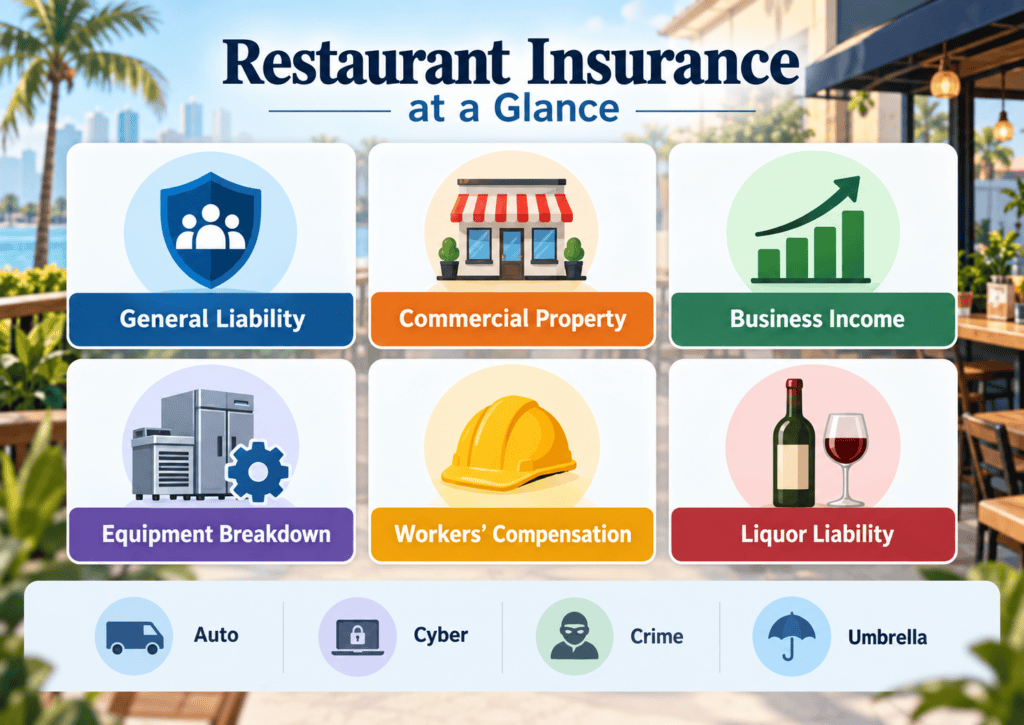 Restaurant insurance may combine several types of coverage depending on the property, employees, operations, alcohol service, vehicles, and other risks of the business.
Business Owners Policy (BOP) for Restaurants
A Business Owners Policy (BOP) can provide a practical insurance foundation for many eligible restaurants by combining certain property and liability coverages into one commercial policy.
Rather than purchasing every basic coverage separately, a BOP commonly brings together Commercial Property Insurance and General Liability Insurance, often with Business Income coverage and other optional endorsements available depending on the insurer.
For an eligible restaurant, this can simplify the insurance program while still allowing important coverage to be tailored to the operation.
What Can a Restaurant BOP Include?
Depending on the carrier and policy form, a restaurant BOP may include or offer coverage for:
-
The building, if the restaurant owns it
-
Furniture, fixtures, and business personal property
-
Kitchen equipment and appliances
-
Inventory and supplies
-
Tenant improvements and betterments
-
General Liability
-
Products-completed operations
-
Business Income and Extra Expense
-
Certain equipment breakdown exposures
-
Certain spoilage exposures
-
Other endorsements designed for food-service businesses
The exact coverage should be confirmed from the policy rather than assuming every BOP includes the same protection.
Why a BOP Can Work Well for Restaurants
Restaurants often have both significant property exposures and frequent interaction with customers.
A single event can affect several parts of the business at once. For example, a kitchen fire could damage equipment and inventory, force the restaurant to close temporarily, and create additional expenses while repairs are completed.
A properly structured BOP can help coordinate several of those core exposures within one policy.
A BOP Does Not Cover Every Restaurant Risk
A Business Owners Policy should usually be viewed as a foundation, not a complete restaurant insurance program.
Depending on the operation, separate coverage may still be needed for exposures such as Liquor Liability, Workers’ Compensation, Commercial Auto, Hired and Non-Owned Auto, Cyber Insurance, Employment Practices Liability, Commercial Crime, Flood Insurance, or Umbrella and Excess Liability.
Restaurants with higher alcohol sales, delivery operations, catering, unusual cooking methods, larger property values, multiple locations, or other complex exposures may also require coverage outside a standard BOP.
Not Every Restaurant Qualifies for a BOP
Insurance companies have their own eligibility rules for Business Owners Policies.
Underwriters may consider factors such as the restaurant’s annual sales, square footage, cooking methods, fire-protection systems, alcohol sales, hours of operation, seating capacity, building characteristics, prior claims, and other exposures.
A restaurant that does not qualify for one carrier’s BOP may still have other commercial insurance options available.
Review the BOP as Part of the Entire Restaurant Program
The most important question is not simply whether a restaurant can obtain a BOP, but whether the coverage inside it matches the business’s actual risks.
Limits, deductibles, exclusions, property valuation, Business Income protection, equipment coverage, spoilage provisions, and liability terms should all be reviewed alongside any separate restaurant policies.
A BOP can be an efficient starting point, but it should be structured around the restaurant rather than treating every food-service business the same.
General Liability Insurance for Restaurants
General Liability Insurance is one of the core coverages for most restaurants because it can help protect the business against certain third-party bodily injury, property damage, and personal and advertising injury claims.
Restaurants interact with customers, vendors, delivery drivers, and other visitors every day. A relatively routine incident—such as a customer slipping on a wet floor or property being damaged during restaurant operations—can lead to medical expenses, legal costs, settlements, or judgments.
What Can Restaurant General Liability Insurance Cover?
Depending on the policy and circumstances, General Liability Insurance may help address claims involving customer injuries, damage to someone else’s property, certain personal and advertising injuries, medical payments, products-completed operations, and legal defense costs associated with covered claims.
Common restaurant liability situations can include:
-
A customer slipping on a wet or greasy floor
-
A patron falling because of an uneven walking surface
-
A server accidentally damaging a customer’s property
-
A customer being injured by furniture, fixtures, or other restaurant property
-
A claim arising from food sold or served by the restaurant
-
Certain advertising or personal injury allegations
Whether a specific claim is covered depends on the policy language, exclusions, endorsements, and facts of the loss.
Premises Liability Is a Major Restaurant Exposure
Restaurants can have significant premises liability exposure because customers move through entrances, dining rooms, restrooms, patios, parking areas, and other spaces throughout the day.
Spills, wet floors, crowded walkways, damaged flooring, inadequate lighting, loose mats, or other conditions can contribute to customer injuries.
General Liability Insurance can provide important protection for covered premises-related claims, but restaurants should also maintain strong housekeeping, inspection, and safety procedures to reduce the likelihood of accidents.
Products-Completed Operations Coverage
General Liability policies commonly include a products-completed operations component that can be particularly important for restaurants because the food and beverages they sell can create liability after they have been served or taken off the premises.
A customer who alleges illness or bodily injury caused by food prepared or sold by the restaurant may potentially bring a products-related liability claim.
Legal Defense Can Be an Important Part of the Coverage
Even when a restaurant disputes responsibility for an accident, defending a lawsuit can be expensive.
Depending on the policy and claim, General Liability Insurance may help pay covered legal defense costs, settlements, or judgments.
Restaurants should review whether defense costs are paid in addition to the liability limit or reduce the available limit because policy structures can differ.
What General Liability Insurance Does Not Replace
General Liability Insurance should not be treated as protection for every restaurant exposure.
For example, it generally does not replace Workers’ Compensation for employee injuries, Commercial Property Insurance for the restaurant’s own property, Commercial Auto Insurance for owned vehicles, or specialized coverage for certain alcohol-related, cyber, employment, pollution, or other exposures.
This is why restaurant insurance is typically built from multiple coordinated coverages rather than relying on General Liability alone.
Limits Should Reflect the Restaurant’s Exposure
The appropriate General Liability limits can depend on the restaurant’s size, customer traffic, contractual requirements, alcohol exposure, locations, operations, and other risk characteristics.
A landlord, lender, franchise agreement, vendor, or other contract may also establish minimum liability limits or require additional insured status.
Restaurant owners should compare not only the premium, but also the limits, exclusions, endorsements, deductible or retention provisions when applicable, and how the policy coordinates with Umbrella or Excess Liability coverage.
Foodborne Illness and Products-Completed Operations Coverage
Foodborne illness is one of the more serious liability exposures a restaurant can face because a claim may involve allegations that food prepared, sold, or served by the business caused a customer to become sick or injured.
For many restaurants, this type of third-party bodily injury claim may fall within the products-completed operations coverage provided by a Commercial General Liability policy, subject to the policy terms, exclusions, limits, and facts of the claim.
How Products-Completed Operations Coverage Can Apply
Products-completed operations coverage generally addresses certain bodily injury or property damage claims arising from a business’s products after they have been sold, served, or otherwise left the business’s possession.
For a restaurant, that can be particularly important when a customer alleges illness or injury after consuming food prepared or sold by the restaurant.
Examples could include allegations involving contaminated food, improper food handling, undercooked ingredients, allergens, or other food-related conditions that allegedly caused bodily injury.
Coverage is not automatic simply because a customer becomes ill. The insurer will evaluate the allegations, policy language, exclusions, and facts surrounding the incident.
Foodborne Illness Claims Can Extend Beyond the Restaurant
A restaurant’s products liability exposure does not necessarily end when a customer leaves the premises.
A claim could arise from food consumed through:
-
Takeout
-
Delivery
-
Catering
-
Off-premises events
-
Packaged food sold by the restaurant
This is one reason products-completed operations coverage can be important even for restaurants with limited dine-in service.
Allergies and Ingredient-Related Claims
Restaurants may also face claims involving food allergies or ingredients.
For example, a customer might allege that food contained an ingredient that was not disclosed, that a special preparation request was not followed, or that cross-contact contributed to an allergic reaction.
Whether a resulting claim is covered depends on the policy and circumstances, but these incidents illustrate why restaurants should have both appropriate liability insurance and strong food-preparation procedures.
Liability Coverage Is Different From Contamination or Recall Coverage
A General Liability policy may help address certain third-party bodily injury claims arising from food sold or served by the restaurant, but it should not be assumed to cover every financial consequence of a contamination event.
A restaurant could also face losses involving spoiled inventory, product disposal, cleanup, shutdown expenses, lost income, reputational harm, or a product recall.
Those exposures may require separate coverage, endorsements, or specialized policies.
Multiple Customers Can Increase the Severity of a Loss
A foodborne illness event can potentially affect more than one customer.
If several people allege illness from the same food item, batch, event, or period of service, the restaurant may face multiple claims arising from the same underlying occurrence.
For that reason, restaurants should review not only whether products-completed operations coverage is included, but also the applicable limits and how the policy defines an occurrence and aggregate.
Risk Management Still Matters
Insurance is only one part of managing foodborne illness exposure.
Restaurants should maintain appropriate food-safety procedures, employee training, temperature controls, cleaning practices, ingredient handling, allergen protocols, and documentation.
Good procedures cannot eliminate every claim, but they can help reduce the likelihood and severity of a food-related loss.
Commercial Property Insurance for Restaurants
Commercial Property Insurance can help protect a restaurant’s building, equipment, furniture, inventory, and other covered business property against certain causes of physical loss or damage.
For restaurants, property exposure can be significant because a single location may contain expensive cooking equipment, refrigeration systems, ventilation systems, point-of-sale technology, furniture, décor, food inventory, and tenant improvements.
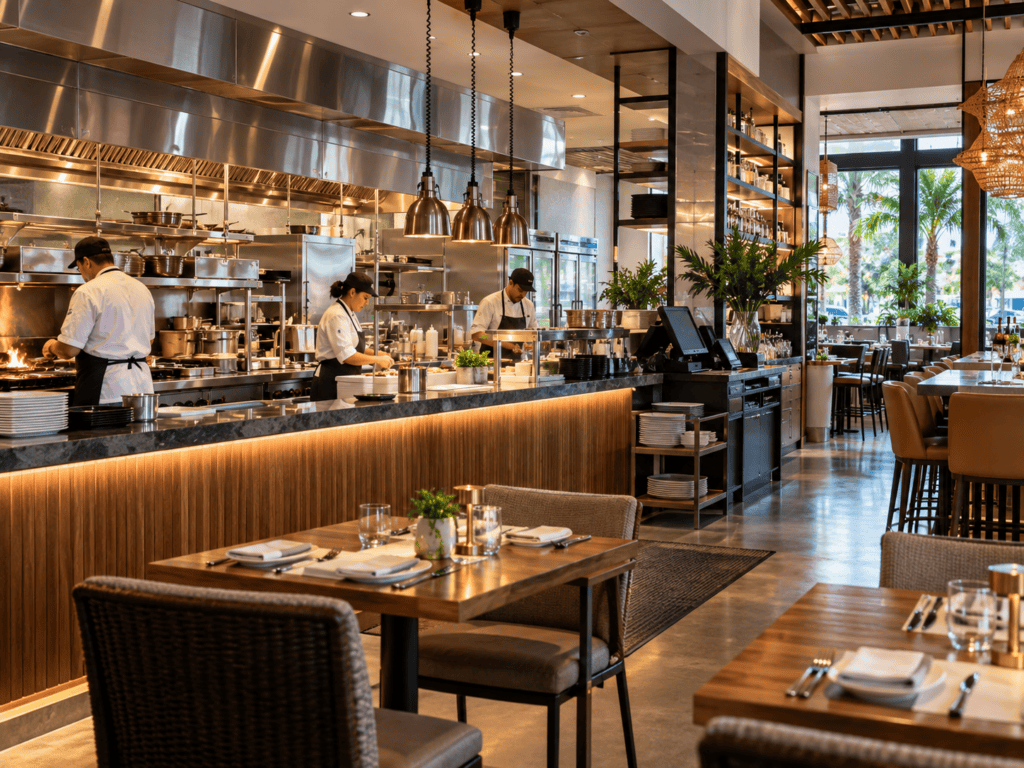 Restaurant property can include valuable kitchen equipment, refrigeration systems, furniture, technology, inventory, and tenant improvements.
What Restaurant Property Can Be Insured?
Depending on the policy and whether the restaurant owns or leases the premises, Commercial Property Insurance may cover property such as the building, kitchen equipment, refrigeration units, furniture, fixtures, computers, point-of-sale systems, inventory, supplies, signage, and certain tenant improvements.
A restaurant that owns the building may need coverage for both the structure and its business personal property. A tenant may primarily need coverage for its own property, improvements, and other interests not insured by the landlord.
Kitchen Equipment Can Represent a Major Property Exposure
Commercial kitchens often contain some of the restaurant’s most valuable property.
Ovens, ranges, fryers, grills, refrigeration systems, freezers, dishwashing equipment, ventilation hoods, fire-suppression systems, ice machines, and other specialized equipment can be costly to repair or replace after a covered loss.
The restaurant should review whether these items are properly included in the insured values rather than relying on an estimate that no longer reflects current replacement costs.
Fire Is a Significant Restaurant Risk
Restaurants can have substantial fire exposure because of cooking equipment, grease, open flames, electrical systems, and ventilation systems.
A kitchen fire can damage far more than the area where it starts. Smoke, heat, water from fire suppression, and firefighting efforts can affect dining areas, equipment, inventory, walls, ceilings, and neighboring property.
Commercial Property Insurance may help pay for covered physical damage, while Business Income and Extra Expense coverage may address certain financial losses if the restaurant must temporarily close because of a covered property loss.
Tenant Improvements Should Not Be Overlooked
Restaurants frequently invest heavily in leased spaces.
Build-outs may include custom bars, flooring, lighting, walls, plumbing, electrical improvements, kitchen installations, counters, cabinetry, and other permanent improvements.
These improvements may not automatically be the landlord’s responsibility to insure.
A restaurant tenant should review its lease and policy carefully to determine who is responsible for insuring improvements and betterments and how those items will be valued after a loss.
Property Valuation Matters
The amount of insurance selected should reflect the cost of replacing or repairing the restaurant’s covered property.
Policies may use different valuation methods, including replacement cost or actual cash value.
Replacement cost coverage generally focuses on the cost to repair or replace covered property with property of similar kind and quality, subject to the policy terms. Actual cash value may account for depreciation.
The valuation method can have a substantial effect on how much the restaurant receives after a covered loss.
Restaurants Should Review Their Values Regularly
Restaurant property values can change over time as equipment is replaced, dining areas are remodeled, new technology is installed, or construction costs increase.
An insurance program that was adequate several years ago may no longer reflect the cost of rebuilding or replacing the restaurant’s property today.
Reviewing building values, equipment, inventory, furniture, and tenant improvements periodically can help reduce the risk of being underinsured after a major loss.
Restaurant Equipment, Furniture, Inventory, and Tenant Improvements
Restaurants often invest heavily in physical property that goes beyond the building itself. Even when the premises are leased, the restaurant may own substantial equipment, furniture, inventory, décor, and improvements that need to be properly insured.
These values should be reviewed carefully because replacing a commercial kitchen or rebuilding a customized restaurant interior after a covered loss can be expensive.
Restaurant Equipment
Restaurant equipment may include items such as cooking appliances, refrigeration equipment, freezers, ice machines, dishwashers, ventilation systems, point-of-sale hardware, and other specialized equipment used in daily operations.
Some equipment may fall within Commercial Property coverage, while certain mechanical or electrical breakdowns may require Equipment Breakdown Insurance or another endorsement. The distinction matters because a piece of equipment can be damaged by an external covered cause of loss or fail because of an internal mechanical or electrical problem.
Furniture, Fixtures, and Décor
Dining tables, chairs, booths, counters, shelving, lighting, decorative fixtures, and other furnishings can represent a meaningful portion of a restaurant’s property value.
Restaurants should consider both the quantity and replacement cost of these items, especially if the dining area has custom-built or higher-end finishes.
Food, Beverages, and Other Inventory
Inventory may include food, beverages, ingredients, paper goods, cleaning supplies, packaging, and other items held for restaurant operations.
Inventory values can fluctuate significantly based on season, volume, special events, or purchasing cycles. Restaurants with substantial refrigerated or frozen inventory should also consider how spoilage exposure is addressed.
Tenant Improvements and Betterments
A restaurant operating from leased space may spend substantial amounts improving the property.
These improvements can include custom kitchens, bars, counters, flooring, lighting, electrical work, plumbing, walls, built-in cabinetry, and other alterations made for the restaurant’s use.
The lease may assign responsibility for certain improvements differently between the landlord and tenant, so the restaurant should understand who is expected to insure them and how the policy will value them after a covered loss.
Accurate Property Values Matter
Restaurant property values should not be based solely on what the equipment or furnishings originally cost.
Replacement costs can change because of inflation, supply-chain conditions, labor expenses, building code requirements, and the cost of specialized commercial equipment.
A restaurant that underestimates these values may face a significant gap after a major loss.
Review Property Values as the Restaurant Changes
Property values should be reviewed when the restaurant remodels, buys new equipment, expands seating, upgrades technology, changes its kitchen layout, or makes significant leasehold improvements.
The goal is to keep the insured values aligned with what the restaurant actually owns and would need to replace.
Equipment Breakdown Insurance
Restaurants depend on equipment that must operate reliably every day. Refrigeration systems, freezers, ovens, electrical panels, HVAC systems, ice machines, boilers, and other mechanical or electrical equipment can create substantial losses when they suddenly fail.
Equipment Breakdown Insurance can help protect against certain losses caused by covered mechanical, electrical, or pressure-system breakdowns that may not be handled the same way as ordinary Commercial Property claims.
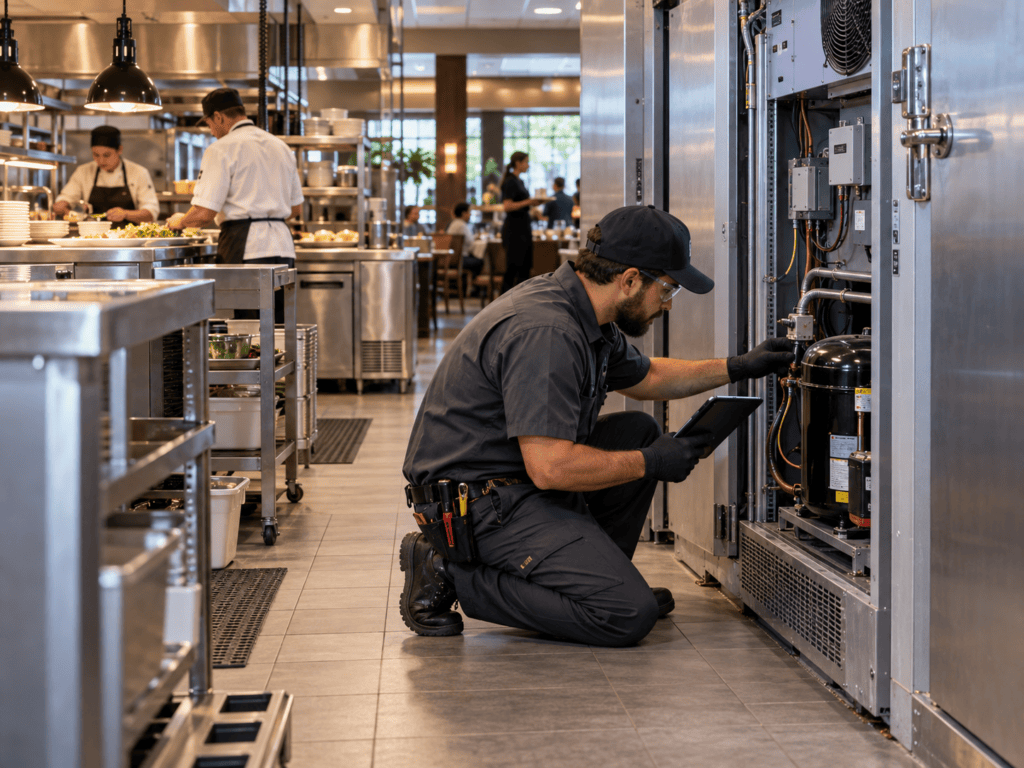 Equipment Breakdown coverage can be important when critical restaurant refrigeration, electrical, mechanical, or other covered equipment suddenly fails.
How Equipment Breakdown Coverage Differs From Commercial Property Insurance
Commercial Property Insurance generally responds to covered external causes of loss, such as fire or certain storm damage.
Equipment Breakdown coverage is designed for certain internal failures, such as electrical arcing, mechanical breakdown, motor burnout, or pressure-system failure.
For example, if a refrigeration unit is damaged by a covered electrical failure, Equipment Breakdown Insurance may help address the damaged equipment and other covered consequences, depending on the policy.
Why Equipment Breakdown Matters for Restaurants
Restaurants rely heavily on equipment that can be expensive to repair and difficult to operate without.
A failure involving a walk-in cooler, freezer, HVAC system, electrical system, cooking equipment, or other critical machinery can interrupt service, damage food inventory, and potentially force the restaurant to close until repairs are completed.
Depending on the policy, Equipment Breakdown coverage may help with more than the damaged equipment itself. Certain policies may also provide protection for related business income, extra expense, or spoilage losses caused by a covered breakdown.
Refrigeration and Electrical Systems Deserve Special Attention
Refrigeration equipment is especially important because a breakdown can create both repair costs and inventory loss.
Restaurants should review whether the policy addresses:
-
Refrigeration equipment
-
Electrical panels and wiring
-
Motors and compressors
-
HVAC systems
-
Boilers or pressure equipment
-
Other critical mechanical systems
Coverage can vary significantly by carrier and form, so the specific insured equipment and causes of breakdown should be reviewed carefully.
Equipment Breakdown Is Not a Maintenance Policy
Equipment Breakdown Insurance should not be treated as a substitute for routine maintenance.
Wear and tear, corrosion, deterioration, deferred maintenance, and gradual equipment failure may be excluded or limited.
Restaurants should continue to maintain, inspect, and service critical equipment even when Equipment Breakdown coverage is in place.
Coverage Should Be Reviewed With Spoilage and Business Income
A restaurant equipment failure can trigger several types of loss at the same time.
The restaurant may need to repair damaged machinery, replace spoiled food, and absorb lost income while the equipment is being restored.
For that reason, Equipment Breakdown coverage should be reviewed together with Food Spoilage coverage and Business Income and Extra Expense protection rather than as an isolated policy feature.
Food Spoilage and Contamination Coverage
Food spoilage can create a meaningful financial loss for a restaurant because perishable inventory may become unusable after a refrigeration failure, power interruption, contamination event, or other covered cause.
The restaurant may lose not only the food itself, but also the time and expense required to replace inventory and restore normal operations.
How Food Spoilage Coverage Can Help
Depending on the policy, Food Spoilage coverage may help reimburse a restaurant for certain losses involving perishable stock that becomes unusable because of a covered event.
Examples may include loss caused by:
-
A covered refrigeration breakdown
-
Certain electrical failures
-
Certain utility-service interruptions
-
Temperature changes following a covered equipment failure
-
Other covered causes specified by the policy
The exact trigger matters. Spoilage is not automatically covered simply because food becomes unsafe or unusable.
Contamination Is a Different Exposure
Contamination can involve more than physical spoilage.
A restaurant may need to discard food because of contamination, suspected contamination, a health-department directive, or another event that creates a food-safety concern.
Whether those losses are covered depends on the policy language. Some situations may require a separate endorsement or specialized contamination coverage.
This is why it is important to distinguish between spoilage, which often involves loss of perishable inventory, and contamination, which can involve a broader operational or public-health event.
Utility Failure Can Create Significant Loss
Restaurants are especially vulnerable to power interruptions because refrigeration, freezers, ventilation, cooking equipment, and point-of-sale systems may all depend on continuous utility service.
If a power failure causes food to spoil, coverage may depend on where the interruption originated and whether the policy includes off-premises utility-service protection.
A standard property policy should not automatically be assumed to cover every utility-related spoilage loss.
Spoilage Limits and Deductibles Matter
Food Spoilage coverage may be subject to its own limit, deductible, waiting period, or conditions.
Restaurants with large refrigerated or frozen inventories should review whether the available limit is realistic for the maximum amount of food that could be lost at one time.
A busy restaurant, catering operation, or multi-location business may have a significantly different spoilage exposure from a small café.
Coverage Should Be Coordinated With Equipment Breakdown and Business Income
A single incident can create several types of loss.
For example, a refrigeration breakdown may damage the equipment, spoil food inventory, and force the restaurant to close temporarily.
That type of event may involve Equipment Breakdown, Food Spoilage, and Business Income coverage at the same time.
The restaurant should review how these coverages interact rather than assuming one policy provision will address the entire loss.
Utility Service Interruption and Off-Premises Power Failure
Restaurants depend heavily on electricity, gas, water, refrigeration, communications, and other utility services. When one of those services is interrupted, the business may be unable to cook, preserve food, process payments, serve customers, or operate normally.
The insurance challenge is that the cause of the interruption may occur away from the restaurant’s premises. A standard Commercial Property policy may not automatically cover losses simply because a utility outage affects the business.
How Off-Premises Utility Coverage Can Help
Utility Service Interruption coverage can provide protection when a covered loss at an off-premises utility provider causes a qualifying interruption at the restaurant.
Depending on the policy, this may involve services such as electricity, gas, water, communications, or other utilities needed for restaurant operations.
The exact coverage can vary significantly. Some policies may cover only direct physical damage to restaurant property, while others may also address certain Business Income, Extra Expense, or spoilage losses resulting from the interruption.
The Cause of the Outage Matters
Coverage may depend on what caused the utility service to fail.
For example, an outage resulting from covered physical damage to a utility substation or transmission equipment may be treated differently from a planned shutdown, fuel shortage, rolling blackout, equipment maintenance, or another excluded cause.
Restaurants should review both the covered causes of loss and the utility-related exclusions rather than assuming every power outage is insured.
Transmission Lines Can Be an Important Limitation
Some policies distinguish between damage occurring at the utility’s generating station and damage involving overhead transmission or distribution lines.
That distinction can be important after storms, hurricanes, or other events that damage utility infrastructure away from the restaurant.
If the policy excludes certain transmission-line losses, the restaurant could still experience a significant interruption without having coverage for the resulting income or spoilage loss.
Power Failure Can Create Multiple Restaurant Losses
A prolonged outage can affect much more than the lights.
Refrigerated and frozen food may become unusable, cooking equipment may be unavailable, point-of-sale systems may stop functioning, customers may need to be turned away, and the restaurant may lose income while still paying certain ongoing expenses.
This is why utility interruption coverage should be reviewed together with Food Spoilage, Equipment Breakdown, and Business Income and Extra Expense coverage.
Waiting Periods and Coverage Limits Matter
Utility-related coverage may be subject to a waiting period, separate limit, deductible, sublimit, or specific distance requirement between the restaurant and the utility property that was damaged.
A restaurant should understand how long the interruption must last before coverage begins and how much protection is available once the policy responds.
Review the Utility Exposure Before a Loss
Restaurants that rely heavily on refrigeration, freezers, electric cooking equipment, digital ordering systems, or high volumes of perishable inventory may have greater exposure to utility interruptions.
A restaurant insurance review should consider not only what happens inside the building, but also how dependent the operation is on outside utility providers and whether the policy extends protection to those off-premises exposures.
Business Income and Extra Expense Coverage
A serious property loss can affect a restaurant long after the fire, storm, or other physical damage occurs. Even if the building and equipment can be repaired, the restaurant may lose revenue while continuing to pay certain expenses during the interruption.
Business Income and Extra Expense coverage can help address some of those financial consequences when restaurant operations are suspended or reduced because of a covered property loss.
How Business Income Coverage Can Help
Business Income coverage is generally designed to replace certain income the restaurant would have earned if a covered loss had not interrupted normal operations.
Depending on the policy and circumstances, coverage may help with continuing expenses such as payroll, rent, certain loan obligations, taxes, and other normal operating costs that continue even while the restaurant is closed or operating at reduced capacity.
For example, if a covered kitchen fire forces a restaurant to close while repairs are completed, Business Income coverage may help replace qualifying lost income during the covered period of restoration.
What Is Extra Expense Coverage?
Extra Expense coverage can help pay certain additional costs a restaurant reasonably incurs to continue operating or reduce the length of a business interruption after a covered loss.
A restaurant might incur extra expenses to temporarily relocate part of the operation, rent replacement equipment, expedite repairs, obtain temporary refrigeration, or take other reasonable steps intended to resume service sooner.
The policy determines which expenses qualify and how much coverage is available.
The Cause of the Shutdown Matters
Business Income coverage is generally tied to a covered cause of physical loss or damage.
A restaurant closing because of a covered fire may present a very different insurance situation from one closing because of poor sales, routine maintenance, an excluded flood loss, a utility outage not covered by the policy, or another event that does not satisfy the policy’s coverage requirements.
This is why Business Income coverage should be reviewed together with the restaurant’s Commercial Property, Equipment Breakdown, Food Spoilage, Utility Service Interruption, and other related coverages.
The Period of Restoration Matters
Business Income coverage does not ordinarily continue indefinitely.
Policies commonly define a period of restoration that determines when covered Business Income protection begins and when it ends. The period may be affected by the time reasonably required to repair, rebuild, or replace damaged property, subject to the policy terms.
Restaurant owners should also review whether a waiting period applies before Business Income coverage begins.
Restaurants Can Take Longer to Reopen Than Expected
Reopening a restaurant after a major property loss can involve more than repairing visible damage.
The business may need to replace specialized equipment, complete inspections, obtain permits, restore utilities, rebuild tenant improvements, reinstall kitchen systems, and satisfy applicable health, fire, or building requirements before reopening.
For that reason, the amount and duration of Business Income coverage should be considered carefully rather than based only on how quickly the physical repairs initially appear likely to take.
Partial Closures Can Also Matter
A restaurant does not necessarily have to be completely shut down to experience a significant income loss.
A covered event might close the kitchen while limited service continues, eliminate outdoor seating, reduce usable dining space, or prevent the restaurant from operating at its normal capacity.
Whether and how the policy responds depends on the coverage terms and the effect of the covered loss on business operations.
Business Income Limits Should Reflect the Actual Restaurant
Business Income protection should be based on realistic financial information.
Restaurants should consider revenue, operating expenses, payroll, seasonal fluctuations, expected growth, and how long a major loss could realistically disrupt operations.
A restaurant with strong seasonal business, substantial fixed expenses, or specialized equipment that takes months to replace may need different protection from a smaller operation that can reopen more quickly.
Ordinance or Law Coverage After a Restaurant Property Loss
A restaurant can suffer a covered property loss and still face additional rebuilding costs that are not fully addressed by ordinary Commercial Property Insurance.
That can happen when damaged property must be repaired or rebuilt to comply with current building codes, fire codes, accessibility requirements, electrical standards, plumbing requirements, ventilation rules, or other laws and ordinances that apply at the time of reconstruction.
Ordinance or Law Coverage can help address certain additional costs created by those requirements, depending on the policy.
Why This Coverage Can Matter for Restaurants
Restaurants often have highly specialized build-outs.
Commercial kitchens may include ventilation hoods, suppression systems, electrical upgrades, plumbing, grease-management systems, refrigeration, cooking equipment, and other installations that must satisfy current code requirements.
If an older restaurant suffers a major covered loss, rebuilding exactly as it existed before may not be permitted.
The restaurant may be required to upgrade parts of the property even if those upgrades were not part of the original damage.
Undamaged Portions of the Building Can Also Create Costs
A major loss does not always damage an entire building.
In some cases, local code requirements may require demolition or modification of undamaged portions of a structure as part of the rebuilding process.
Without appropriate Ordinance or Law coverage, some of those additional costs may fall outside the ordinary property claim.
Ordinance or Law Coverage Can Address Different Types of Expense
Depending on the policy, coverage may help address certain costs involving:
-
Loss in value of an undamaged portion of the building
-
Demolition of undamaged property
-
Increased cost of construction needed to comply with current laws or codes
The exact structure and limits can vary by insurer and policy form.
Restaurant Build-Outs Can Make Code Upgrades Expensive
Restaurants can be especially sensitive to code-related rebuilding expenses because of the complexity of commercial kitchens and customer areas.
After a significant loss, the business may need to upgrade:
-
Electrical systems
-
Plumbing
-
Fire suppression
-
Ventilation and exhaust
-
Accessibility features
-
Emergency exits
-
Restrooms
-
Structural components
-
Other building systems
Those costs can be substantial, particularly in older buildings or heavily customized restaurant spaces.
Lease Responsibility Should Be Reviewed
Restaurants operating in leased locations should review the lease carefully.
The landlord may be responsible for some building repairs while the tenant may be responsible for improvements, equipment, code upgrades, or other costs.
The insurance program should be reviewed in light of those contractual responsibilities.
Coverage Limits Should Reflect the Property
Ordinance or Law coverage is often subject to separate limits.
Restaurants should consider the age of the building, extent of tenant improvements, local code requirements, and the cost of rebuilding specialized kitchen and dining areas when selecting limits.
A restaurant in an older building with extensive improvements may have a greater ordinance or law exposure than a newer location built to more recent standards.
Liquor Liability Insurance for Florida Restaurants
Florida restaurants that sell or serve alcoholic beverages can face liability exposures that are different from ordinary premises or food-service risks.
Liquor Liability Insurance can help protect a restaurant against certain claims alleging bodily injury or property damage arising from the sale or service of alcohol, subject to the policy terms, exclusions, limits, and facts of the claim.
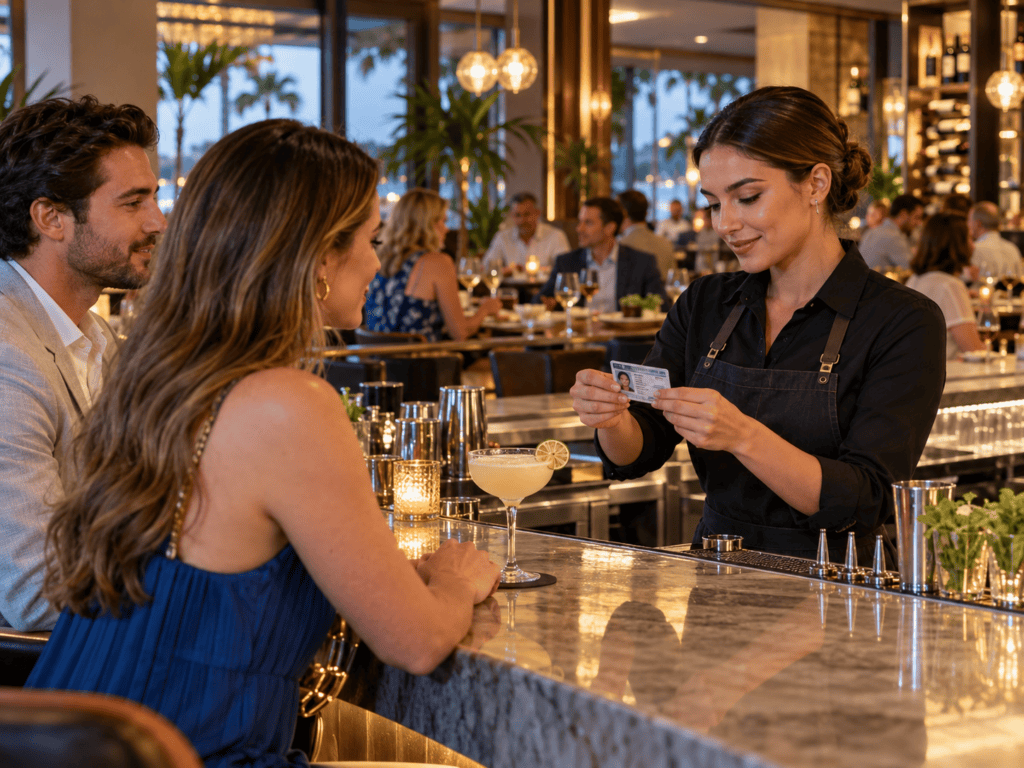 Restaurants that serve alcohol should combine appropriate Liquor Liability coverage with responsible alcohol-service procedures.
Why Liquor Liability Matters
Alcohol-related claims can be severe because they may involve automobile accidents, assaults, falls, or other injuries occurring after alcohol has been served.
A restaurant may face allegations that it served alcohol improperly, failed to follow its procedures, or otherwise contributed to an incident involving an intoxicated patron.
Even when the restaurant disputes responsibility, defending an alcohol-related claim can be costly.
General Liability May Not Be Enough
A standard General Liability policy should not automatically be assumed to cover liability arising from the sale or service of alcoholic beverages.
Restaurants that are in the business of selling or serving alcohol may encounter liquor-liability exclusions or limitations in their General Liability coverage.
For that reason, restaurants serving beer, wine, or spirits should review whether separate Liquor Liability coverage is needed.
What Can Liquor Liability Insurance Cover?
Depending on the policy, Liquor Liability Insurance may help address certain claims involving bodily injury or property damage allegedly caused by an intoxicated person after alcohol was sold or served by the insured restaurant.
Coverage can also include legal defense for covered claims, subject to the policy terms and limits.
The exact protection can vary considerably between insurers, so restaurants should review exclusions, assault-and-battery provisions, defense costs, limits, deductibles or retentions, and any conditions tied to alcohol service.
Restaurants With Higher Alcohol Exposure May Need More Review
A restaurant where alcohol represents a small portion of sales may present a different underwriting exposure from a bar, nightclub, sports bar, or restaurant with significant late-night alcohol service.
Insurers may consider factors such as alcohol sales as a percentage of total revenue, hours of operation, entertainment, security, prior incidents, employee training, and whether the establishment serves primarily food, alcohol, or both.
These factors can affect eligibility, premium, limits, and policy terms.
Alcohol-Service Procedures Still Matter
Insurance does not replace responsible alcohol-service practices.
Restaurants should maintain procedures for checking identification, training employees, recognizing signs of intoxication, documenting incidents when appropriate, and complying with applicable alcohol laws and licensing requirements.
Strong procedures can help reduce risk and may also be relevant during underwriting.
Florida Law Treats Alcohol Liability Differently From Some States
Florida does not impose broad automatic liability on every business that serves alcohol to an adult who later causes injury.
Florida Statute §768.125 generally limits liability for injury or damage resulting from an adult’s intoxication, but identifies important exceptions involving the willful and unlawful furnishing of alcohol to a person who is not of lawful drinking age and knowingly serving a person habitually addicted to alcohol.
Because the legal standard is specific, restaurants should avoid assuming that Florida’s law either eliminates liquor liability exposure or creates liability every time an intoxicated patron causes harm.
How Does Florida’s Alcohol Liability Law Affect Restaurants?
Florida’s alcohol liability law is more limited than the broad “dram shop” liability found in some states, but restaurants that sell or serve alcohol can still face significant exposure.
Under Florida Statute §768.125, a person who sells or furnishes alcoholic beverages to someone of lawful drinking age generally does not become liable solely because that person later causes injury or damage as a result of intoxication. The statute identifies two important exceptions: liability may arise when alcohol is willfully and unlawfully furnished to someone who is not of lawful drinking age or when alcohol is knowingly served to a person habitually addicted to alcohol.
Serving Alcohol to Someone Under Age 21
Florida law generally prohibits selling, giving, serving, or permitting alcoholic beverages to be served to a person under 21 years of age. It also prohibits permitting a person under 21 to consume alcoholic beverages on licensed premises, subject to the provisions of Florida law.
For a restaurant, this makes age-verification procedures particularly important. Employees responsible for alcohol service should understand the restaurant’s identification procedures and when a sale or service should be refused.
An incident involving alcohol furnished to someone under lawful drinking age can create consequences beyond an ordinary customer-service issue, including potential regulatory, criminal, and civil exposure depending on the circumstances.
Knowingly Serving a Person Habitually Addicted to Alcohol
The second exception in §768.125 concerns knowingly serving alcohol to a person who is habitually addicted to alcoholic beverages.
This is different from simply alleging that a customer appeared intoxicated on one particular occasion. The statutory language specifically addresses knowingly serving someone habitually addicted to alcohol.
Whether that standard is satisfied in an actual claim depends on the facts and applicable law.
Florida Law Does Not Eliminate Alcohol-Related Risk
A restaurant should not interpret Florida’s limited statutory liability as meaning alcohol service creates little or no risk.
An alcohol-related incident can still lead to a lawsuit, investigation, legal defense costs, insurance claims, licensing issues, and significant disruption to the business even when liability is disputed.
Claims can also involve allegations beyond the alcohol service itself, such as negligent security, premises liability, employee conduct, or other circumstances surrounding an incident.
Liquor Liability Insurance Still Matters
Because serious alcohol-related claims can occur, restaurants serving beer, wine, or spirits should review whether their insurance program includes appropriate Liquor Liability protection.
Important policy provisions can include the liability limit, defense coverage, exclusions, assault-and-battery provisions, alcohol-sales classifications, deductibles or retentions, and any requirements imposed by landlords, franchise agreements, lenders, or other contracts.
A restaurant should not assume that Florida’s statutory protections make Liquor Liability Insurance unnecessary.
Responsible Alcohol-Service Practices Are Important
Insurance should work alongside strong operating procedures.
Restaurants that serve alcohol should have consistent practices for checking identification, training employees, refusing unlawful sales, managing difficult situations, documenting significant incidents when appropriate, and complying with Florida alcohol licensing and service requirements.
These procedures can help reduce the likelihood of an alcohol-related incident and can also be important when an insurer evaluates the restaurant’s exposure.
For more information about Florida’s laws concerning the sale or service of alcoholic beverages to people under age 21, review Florida Statute §562.11 on the Florida Legislature’s official website.
Workers’ Compensation Insurance for Florida Restaurants
Restaurants can have substantial employee injury exposure because workers may spend long shifts around hot cooking surfaces, sharp tools, slippery floors, heavy supplies, refrigeration equipment, and fast-moving kitchen and dining areas.
Workers’ Compensation Insurance can help provide benefits to employees who suffer qualifying work-related injuries or occupational illnesses. Depending on the circumstances, benefits may include necessary medical care, a portion of lost wages, disability benefits, rehabilitation services, and benefits to eligible dependents following a work-related death.
When Is Workers’ Compensation Required for a Florida Restaurant?
Restaurants are generally considered non-construction businesses for Florida Workers’ Compensation purposes.
Florida generally requires a non-construction employer with four or more employees, whether full-time or part-time, to carry Workers’ Compensation Insurance. The Florida Department of Financial Services notes that the requirement can depend on the number of employees and the organization of the business.
Business owners can affect the employee count in some situations. For example, non-exempt corporate officers or LLC members may count as employees, while qualifying corporate officers or LLC members may be able to obtain an exemption from Florida Workers’ Compensation requirements. Sole proprietors and partners in non-construction businesses are treated differently under Florida law and may elect coverage.
Because ownership structure and exemptions can change how the rules apply, a restaurant should confirm its specific obligations rather than relying only on the number of people working at the location.
Common Restaurant Employee Injuries
Restaurant employees can be exposed to injuries involving burns, cuts, slips and falls, lifting, repetitive movements, falling objects, kitchen equipment, and other workplace hazards.
A cook could suffer a serious burn, a server could slip on a wet kitchen floor, or an employee unloading supplies could injure a back or shoulder. When an injury qualifies as work-related, Workers’ Compensation may provide benefits according to Florida law and the applicable policy.
Workers’ Compensation Is Different From General Liability
Workers’ Compensation primarily addresses qualifying injuries and illnesses involving employees.
General Liability Insurance, by comparison, generally addresses certain bodily injury and property damage claims involving customers and other third parties.
For example, an employee who slips in the kitchen while working may present a Workers’ Compensation claim, while a customer who slips in the dining room may present a General Liability claim.
Restaurants commonly need both coverages because they protect against different exposures.
Part-Time Employees Still Matter
Restaurants frequently rely on part-time employees, seasonal workers, and changing schedules.
For purposes of Florida’s general non-construction coverage threshold, both full-time and part-time employees can count toward the requirement.
This is particularly important for restaurants whose staffing levels change throughout the year or increase during tourist seasons, holidays, special events, or periods of growth.
Employee Classification and Payroll Should Be Accurate
Workers’ Compensation premiums are influenced by factors that can include employee classifications, payroll, claims history, and the type of work employees perform.
Restaurants should provide accurate information about their workforce and notify the insurer when job duties or payroll change materially. Florida’s Department of Financial Services also advises employers to report changes in employee job duties or increases in payroll to the insurance carrier.
Accurate classifications can help reduce problems during audits and help ensure that the policy reflects the restaurant’s actual operations.
Safety Practices Still Matter
Workers’ Compensation Insurance does not replace workplace safety.
Restaurants can reduce employee injuries by maintaining appropriate procedures for kitchen safety, slip-and-fall prevention, lifting, knife handling, hot surfaces, equipment use, cleaning, and employee training.
Good safety practices can help protect employees and may also improve the restaurant’s overall loss history.
For more information about Florida Workers’ Compensation coverage requirements, review the Florida Department of Financial Services Division of Workers’ Compensation Coverage Requirements.
Employment Practices Liability Insurance (EPLI)
Restaurants can face employment-related claims involving hiring, scheduling, discipline, termination, workplace conduct, and interactions between managers and employees.
Employment Practices Liability Insurance (EPLI) can help protect a restaurant against certain claims brought by employees, former employees, or job applicants alleging wrongful employment practices, subject to the policy terms, exclusions, limits, and circumstances of the claim.
What Can EPLI Cover?
Depending on the policy, EPLI may respond to allegations involving discrimination, harassment, retaliation, wrongful termination, failure to hire or promote, and other covered employment-related conduct.
Coverage may also include legal defense costs associated with covered claims. Because employment disputes can be expensive to defend even when the restaurant believes it acted appropriately, the defense provisions of the policy can be especially important.
Why Restaurants Can Have Significant Employment Exposure
Restaurants often employ a large and changing workforce that may include managers, servers, bartenders, cooks, hosts, dishwashers, delivery employees, and other staff working different shifts.
Frequent hiring, employee turnover, promotions, schedule changes, disciplinary decisions, and terminations can create many opportunities for workplace disputes.
Claims can also arise from interactions between coworkers or allegations involving supervisors and managers.
Harassment and Discrimination Claims
An employee may allege that workplace decisions or conduct involved unlawful discrimination or harassment.
Depending on the policy and claim, EPLI may help respond to covered allegations involving areas such as hiring, promotion, discipline, termination, or workplace behavior.
Restaurants should not rely on insurance alone. Written policies, employee training, consistent documentation, appropriate complaint procedures, and prompt investigation of workplace concerns can all be important parts of managing employment risk.
Retaliation Claims Can Follow a Workplace Complaint
Employment claims do not always begin with a termination.
An employee may allege retaliation after reporting harassment, discrimination, safety concerns, wage issues, or other workplace matters.
Restaurants should have clear procedures for receiving complaints and should document how significant employment decisions are made and communicated.
Wage and Hour Claims Need Separate Attention
Restaurants should not assume that a standard EPLI policy provides broad coverage for every wage-and-hour dispute.
Claims involving minimum wage, overtime, tips, tip pooling, meal periods, employee classification, or other compensation issues may be excluded or subject to limited defense-cost coverage depending on the policy.
Restaurants with tipped employees should review these exposures carefully and maintain accurate payroll and employment records.
Third-Party Employment Practices Coverage
Some EPLI policies may also offer protection for certain claims brought by customers, vendors, or other third parties alleging harassment or discrimination by restaurant employees.
This can be relevant for restaurants because employees interact extensively with the public.
Third-party coverage is not included in every EPLI policy, so it should be reviewed specifically when comparing options.
EPLI Can Be Written in Different Ways
Employment Practices Liability coverage may be purchased as a separate policy or, in some cases, added to another commercial insurance policy by endorsement.
Coverage can differ significantly in areas such as:
-
Who qualifies as an insured
-
Defense-cost treatment
-
Deductibles or retentions
-
Third-party claims
-
Prior acts
-
Reporting requirements
-
Exclusions
-
Coverage limits
Restaurants should compare the actual policy terms rather than assuming all EPLI coverage is the same.
Claims-Made Requirements Matter
Many EPLI policies are written on a claims-made basis.
That means coverage can depend on when the claim is first made and reported, as well as any applicable retroactive date or prior-acts provisions.
A restaurant changing insurers or allowing EPLI coverage to lapse should understand how those dates may affect protection for incidents that occurred in the past but are reported later.
Strong Employment Practices Can Help Reduce Risk
Insurance should be combined with good management practices.
Restaurants should consider maintaining written employment policies, training supervisors, documenting disciplinary actions, applying workplace rules consistently, investigating complaints promptly, and keeping accurate personnel records.
These steps can help reduce employment disputes and provide important documentation if a claim occurs.
Cyber Insurance, POS Systems, and Customer Data
Restaurants increasingly depend on technology to process payments, manage reservations, accept online orders, communicate with customers, track inventory, and operate point-of-sale systems.
That dependence creates cyber exposures that may not be fully addressed by General Liability or Commercial Property Insurance.
Cyber Insurance can help protect a restaurant from certain financial losses and liabilities arising from data breaches, ransomware, network intrusions, payment-system compromises, and other covered cyber incidents.
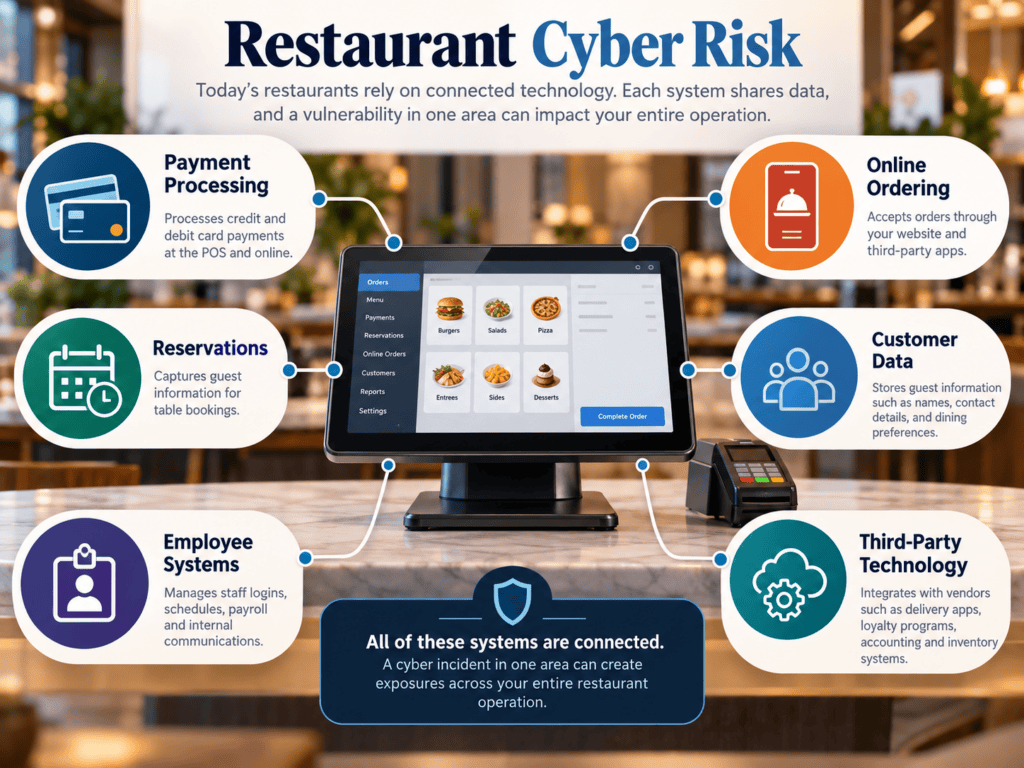 Restaurant technology can connect payment systems, online ordering, reservations, customer information, and third-party platforms, creating several potential cyber exposures.
Why Restaurants Can Be Attractive Cyber Targets
Restaurants often process large numbers of credit and debit card transactions and may store or transmit customer, employee, and business information through multiple systems.
A restaurant’s technology environment may include point-of-sale terminals, online ordering platforms, reservation systems, loyalty programs, payroll systems, Wi-Fi networks, mobile devices, and third-party vendors.
A cyber incident affecting any of these systems can disrupt operations and potentially expose sensitive information.
Point-of-Sale Systems Create Important Exposure
Point-of-sale systems are essential to most restaurant operations, but they can also become a target for cybercriminals.
A compromised POS system could potentially expose payment-card information, interrupt transaction processing, or allow malicious software to spread through connected systems.
Restaurants should understand who manages and secures their POS environment, how software updates are handled, and which responsibilities belong to the restaurant versus the technology provider.
What Can Cyber Insurance Cover?
Depending on the policy, Cyber Insurance may help with certain costs involving data-breach response, forensic investigation, customer notification, credit-monitoring services, cyber extortion, ransomware response, data restoration, business interruption, and certain third-party liability claims.
Coverage can vary significantly by policy.
Some policies may provide stronger protection for network interruption or ransomware, while others may place separate limits or conditions on those exposures.
Business Interruption Can Extend Beyond Physical Damage
A restaurant does not need to suffer a fire or other physical property loss to experience a serious shutdown.
A ransomware attack, network failure, or compromised POS system could prevent the restaurant from processing payments, accepting online orders, accessing reservations, or operating normally.
Cyber Business Interruption coverage may help address certain income losses caused by a covered cyber event, subject to waiting periods, limits, and other policy conditions.
Third-Party Vendors Can Create Additional Risk
Restaurants often rely on outside companies for online ordering, delivery platforms, reservations, payment processing, payroll, cloud systems, and other technology services.
A cyber incident affecting one of those vendors can sometimes create financial or operational consequences for the restaurant even when the restaurant’s own network was not directly attacked.
Restaurants should review whether their Cyber policy addresses certain dependent business interruption or contingent cyber exposures involving third-party technology providers.
Payment-Card Obligations Should Be Reviewed Carefully
A payment-card breach can lead to more than customer notification expenses.
Depending on the circumstances, a restaurant may face forensic costs, contractual assessments, card-replacement expenses, penalties, or other obligations associated with payment-card processing agreements.
Not every Cyber policy handles these exposures the same way, so restaurants should review payment-card related coverage and sublimits carefully.
Cyber Coverage Does Not Replace Good Security Practices
Cyber Insurance should work alongside practical security controls.
Restaurants should use strong passwords, multifactor authentication where available, regular software updates, secure backups, employee training, access controls, payment-system security, and procedures for responding to suspicious activity.
Insurers may also require certain cybersecurity controls before offering coverage or may condition coverage on representations made in the application.
Review Cyber Coverage as Technology Changes
Restaurant technology can change quickly.
Adding online ordering, mobile payments, loyalty programs, new POS systems, delivery integrations, cloud-based scheduling, or additional locations can change the restaurant’s cyber exposure.
Cyber coverage should be reviewed as the business adopts new technology or becomes more dependent on digital systems.
Employee Theft and Commercial Crime Insurance
Restaurants handle cash, payment cards, inventory, gift cards, vendor payments, and other assets every day. That creates opportunities for losses involving employee dishonesty, theft, fraud, or other criminal acts.
Commercial Crime Insurance can help protect a restaurant against certain financial losses caused by covered dishonest or fraudulent acts, depending on the policy form, limits, exclusions, and circumstances of the loss.
Employee Theft Can Be Difficult to Detect
Employee theft does not always involve someone simply taking cash from a register.
Losses can arise through manipulated refunds, unauthorized discounts, falsified vendor payments, inventory theft, fraudulent expense activity, misuse of gift cards, or other schemes that may continue for some time before they are discovered.
Because restaurant operations often involve multiple shifts, high transaction volume, and frequent employee access to cash and inventory, internal controls can be especially important.
What Can Commercial Crime Insurance Cover?
Depending on the policy, Commercial Crime Insurance may provide protection for certain losses involving:
-
Employee theft or dishonesty
-
Theft of money or securities
-
Forgery or alteration
-
Certain computer-related fraud
-
Certain funds-transfer fraud
-
Other covered criminal acts
The exact coverage varies by insurer and policy form. Some protections may need to be added separately or may be subject to different limits.
Employee Theft Coverage Is Different From General Property Coverage
Commercial Property Insurance generally protects physical business property against covered causes of loss, but it may not provide broad protection for money or property stolen through employee dishonesty.
Commercial Crime Insurance is designed to address certain theft and fraud exposures that standard property coverage may exclude or handle differently.
This distinction is important because the loss may involve money or inventory that physically disappears without the type of external event normally associated with a property claim.
Restaurants Should Review Who Has Access to Money and Systems
Restaurants may give different employees access to cash drawers, safes, POS systems, online banking, payroll, gift-card platforms, vendor accounts, and inventory.
The greater the number of employees with financial access, the more important it becomes to establish clear controls.
Practical controls may include separating financial duties, limiting system permissions, reviewing refunds and voids, reconciling deposits, monitoring inventory, and requiring approval for significant transactions.
Management Controls Can Reduce Crime Exposure
Insurance should not replace internal controls.
Restaurants should consider procedures such as regular reconciliations, restricted access to cash and banking systems, independent review of financial records, inventory controls, password security, and prompt investigation of unusual transactions.
These practices can help reduce both the likelihood and duration of dishonest activity.
Limits Should Reflect the Potential Financial Loss
A restaurant should consider how much money, inventory, gift-card value, or other property could reasonably be exposed to theft or fraud.
A small café with limited cash handling may have a very different exposure from a multi-location restaurant group with higher revenues, multiple managers, online banking access, and significant inventory.
Commercial Crime limits should therefore be based on the restaurant’s actual financial and operational exposure rather than selected automatically.
Restaurant Delivery, Commercial Auto, and Hired & Non-Owned Auto
Restaurants that use vehicles for deliveries, catering, supply runs, banking, or other business errands can create auto liability exposures that are not addressed by General Liability Insurance.
The appropriate coverage depends on who owns the vehicle, how it is used, who is driving, and whether the restaurant itself is responsible for the transportation.
Restaurant-Owned Vehicles
If the restaurant owns vehicles used for deliveries, catering, transporting supplies, or other business purposes, those vehicles generally should be insured under a Commercial Auto Insurance policy.
Commercial Auto coverage can include liability protection and, when selected, physical damage coverage for the restaurant’s own vehicles.
The policy should accurately reflect how the vehicles are used. A car making occasional business errands can present a different exposure from vehicles making frequent restaurant deliveries throughout the day.
Employee-Owned Vehicles Used for Restaurant Business
Some restaurants allow employees to use their own vehicles for deliveries, banking, supply pickups, or other business errands.
An employee’s personal auto insurance should not automatically be assumed to fully protect the restaurant when the vehicle is being used for business.
This is where Hired and Non-Owned Auto (HNOA) coverage can become important.
Non-Owned Auto coverage can help protect the restaurant against certain liability claims arising from vehicles the business does not own but that employees use for restaurant business. The employee’s own auto insurance may still be involved, and the restaurant should understand how the policies interact.
Hired Vehicles
Restaurants may also rent or lease vehicles temporarily for catering events, deliveries, special events, or other business purposes.
Hired Auto Liability can help address certain liability exposures involving vehicles the restaurant rents, hires, or borrows, subject to the policy terms.
Coverage for physical damage to a rented vehicle is a separate issue and should be reviewed specifically rather than assumed to be included.
Delivery Operations Can Increase Auto Exposure
Restaurant delivery creates a different risk profile from ordinary restaurant operations.
Frequent trips, evening driving, weather, time pressure, unfamiliar destinations, and multiple drivers can all increase the chance of an accident.
Restaurants that provide delivery should review issues such as:
-
Who is permitted to drive
-
Whether driving records are reviewed
-
Whether employees use personal or company-owned vehicles
-
How often deliveries are made
-
Delivery radius
-
Vehicle maintenance
-
Insurance requirements for employee drivers
These operational details can affect both underwriting and coverage.
Personal Auto Insurance May Have Business-Use Limitations
Employees who use personal vehicles for restaurant deliveries should understand that personal auto policies can contain limitations or exclusions for certain business or delivery activity.
The exact treatment varies by insurer and policy.
Restaurants should not assume that requiring employees to maintain personal auto insurance eliminates the restaurant’s own liability exposure.
Delivery Platforms Do Not Automatically Eliminate Restaurant Risk
A restaurant using a third-party delivery platform may transfer some transportation responsibility to the delivery company or independent driver, but that does not necessarily eliminate every restaurant exposure.
The restaurant should understand the delivery agreement, insurance responsibilities, indemnification provisions, and where responsibility for the food and customer interaction begins and ends.
Third-party delivery services deserve separate review because the restaurant’s exposure can differ substantially from using its own drivers.
Commercial Auto and HNOA Should Be Coordinated
A restaurant may need one or both coverages depending on its operations.
A business with restaurant-owned delivery vehicles may need Commercial Auto Insurance, while a restaurant whose employees use personal vehicles for occasional errands may have more significant Hired and Non-Owned Auto exposure.
Some restaurants can have both.
The key is to identify who owns the vehicles, who drives them, and how they are being used for restaurant business.
Third-Party Delivery Services and Restaurant Liability
Restaurants that use third-party delivery platforms can expand their customer reach without operating their own delivery fleet, but outsourcing delivery does not automatically eliminate every insurance or liability exposure.
The restaurant should understand what responsibilities remain with the business, what responsibilities belong to the delivery platform or driver, and how the contract allocates risk between the parties.
Delivery Responsibility Can Be Divided Between Multiple Parties
A third-party delivery order may involve the restaurant, the delivery platform, an independent driver, and the customer.
Responsibility can change as the order moves through that process. The restaurant may be responsible for preparing and packaging the food, while the delivery company or driver may assume responsibility for transportation after pickup.
The exact allocation depends on the platform agreement, the facts of the loss, and applicable law.
Food-Related Liability May Still Remain With the Restaurant
Using a delivery service does not necessarily eliminate the restaurant’s exposure for claims involving the food itself.
If a customer alleges illness, contamination, improper preparation, an allergen issue, or another problem with food prepared by the restaurant, the claim may still involve the restaurant even though a third party delivered the order.
Products-completed operations coverage under the restaurant’s General Liability policy may be relevant to certain covered bodily injury claims arising from food sold or served by the business.
Delivery Handling Can Create Separate Issues
A claim can also involve what happens after the food leaves the restaurant.
For example, allegations could involve improper handling, extended delivery time, temperature control, damaged packaging, missing items, or food being delivered to the wrong customer.
Whether responsibility falls on the restaurant, delivery company, driver, or more than one party depends on the circumstances and contractual arrangements.
Review the Delivery Platform Agreement
Restaurants should review the insurance and liability provisions contained in their agreements with third-party delivery companies.
Important provisions may address:
-
Indemnification
-
Insurance requirements
-
Responsibility for drivers
-
Responsibility for food after pickup
-
Customer complaints
-
Data and payment responsibilities
-
Claims handling
-
Limits of liability
The restaurant should not assume that the delivery platform automatically accepts responsibility for every loss that occurs after an order is placed.
Third-Party Delivery Can Also Create Cyber and Data Exposure
Online delivery platforms often exchange customer names, addresses, order details, payment information, and other data between systems.
Restaurants should understand which party stores or processes customer information and what happens if a data breach or technology failure affects an order.
Cyber Insurance may be important when the restaurant relies heavily on digital ordering and third-party technology platforms.
Auto Liability May Be Different From Using Restaurant Drivers
When an independent third-party delivery driver transports the order, the restaurant may have less direct automobile exposure than it would with an employee making deliveries in a restaurant-owned or personal vehicle.
However, the restaurant should still review the delivery agreement and insurance requirements rather than assuming it has no potential liability connected to delivery activity.
Restaurants that use both third-party platforms and their own employees for delivery should evaluate those exposures separately.
Insurance Should Reflect the Actual Delivery Model
A restaurant using only dine-in and takeout service has a different risk profile from one that depends heavily on online ordering and third-party delivery.
The restaurant insurance review should consider how orders are accepted, who prepares and packages them, who transports them, what agreements are in place, and which party is responsible at each stage of the transaction.
Valet Parking and Garagekeepers Exposure
Restaurants that offer valet parking can take on additional liability because employees or contracted valet operators may temporarily have custody of customers’ vehicles.
That exposure is different from ordinary premises liability. If a customer’s vehicle is damaged, stolen, vandalized, or involved in an accident while being parked or retrieved, the restaurant may face a claim depending on who operates the valet service, the contract, and the insurance in place.
Garagekeepers Coverage Can Protect Customer Vehicles
Garagekeepers coverage can help protect customer vehicles while they are in the insured’s care, custody, or control for parking, storage, or related operations, depending on the policy form.
This can be important when restaurant employees or a related valet operation are responsible for moving and holding customers’ vehicles.
Coverage may apply to certain losses involving collision, theft, vandalism, fire, or other covered causes, subject to the policy terms, deductibles, limits, and exclusions.
Valet Liability and Customer Vehicle Damage Are Different Exposures
A valet operation can create more than one type of risk.
For example, if a valet driver damages another vehicle or injures someone while operating a customer’s car, that may involve auto liability exposure.
If the customer’s own vehicle is damaged while in the restaurant’s custody, Garagekeepers coverage may be relevant.
Restaurants should understand both exposures rather than assuming one policy handles every valet-related claim.
Restaurants Using Their Own Employees Need Careful Review
If restaurant employees perform valet duties, the insurance program should reflect that activity.
The restaurant may need to review:
-
Who is authorized to drive customer vehicles
-
Driver screening procedures
-
Valet operating areas
-
Parking locations
-
Maximum number and value of vehicles in the restaurant’s custody
-
Auto liability coverage
-
Garagekeepers coverage
-
Claims procedures
Because customer vehicles can vary widely in value, coverage limits should be selected with realistic maximum exposures in mind.
Outsourced Valet Services Still Require Contract Review
Some restaurants contract with an independent valet company rather than using their own employees.
Outsourcing can shift some responsibilities to the valet operator, but the restaurant should not assume that it eliminates all exposure.
The contract should be reviewed for insurance requirements, indemnification, additional insured provisions, liability limits, and responsibility for customer vehicles and valet employees.
The restaurant should also obtain and review appropriate evidence of insurance from the valet company.
Valet Operations Can Affect Umbrella and Excess Coverage
A serious valet-related accident can involve substantial bodily injury or property damage.
Restaurants with valet operations should review how auto liability, Garagekeepers coverage, General Liability, and Umbrella or Excess Liability work together.
The goal is to make sure the restaurant’s liability structure reflects the actual parking operation rather than treating valet service as an incidental activity.
Catering and Off-Premises Restaurant Operations
Restaurants that provide catering or serve food away from their primary location can take on exposures that are different from ordinary dine-in operations.
Off-premises work may involve transporting food, equipment, employees, and supplies to private events, corporate functions, weddings, festivals, or other locations. The restaurant may also be responsible for setup, food service, alcohol service, temporary equipment, cleanup, and property belonging to others.
Catering Can Expand Liability Exposure
When a restaurant serves food at another location, its liability exposure travels with the operation.
A claim could arise from food prepared by the restaurant, an employee causing injury while setting up an event, damage to the venue, or a guest being injured around the restaurant’s temporary service area.
General Liability and products-completed operations coverage can be important, but the restaurant should also confirm that off-premises catering activities fall within the policy’s covered operations.
Property Can Be Exposed Away From the Restaurant
Catering often requires restaurants to move equipment and supplies off-site.
This can include warming equipment, coolers, portable cooking equipment, serving stations, tables, linens, beverage equipment, point-of-sale devices, and other restaurant property.
Commercial Property Insurance may not automatically provide the same protection for property away from the insured premises. Depending on the equipment and how it is transported or used, Inland Marine insurance may be appropriate.
Food Transportation Creates Additional Risk
Food must often be transported under controlled conditions to help maintain quality and safety.
A restaurant may face losses if food is damaged, contaminated, spoiled, or otherwise unusable while being transported or held before service.
The insurance program should be reviewed to determine how property in transit, spoilage, refrigeration, and contamination exposures are handled.
Vehicles Used for Catering Should Be Reviewed
Catering can also create significant auto exposure.
If the restaurant owns vehicles used to transport food, equipment, or employees, Commercial Auto Insurance may be needed. If employees use personal vehicles or the restaurant rents vehicles for events, Hired and Non-Owned Auto exposure should also be considered.
The coverage should reflect how frequently catering vehicles are used, who drives them, and what they carry.
Alcohol Service at Events Requires Special Attention
A restaurant that serves alcohol at catered events may have a different exposure than one serving only food.
Liquor Liability coverage should be reviewed to confirm whether off-premises alcohol service is included and whether the restaurant complies with applicable licensing and contractual requirements.
Coverage should not be assumed simply because the restaurant already has Liquor Liability protection at its primary location.
Event Contracts Can Affect Insurance Requirements
Venues, event planners, property owners, and customers may require the restaurant or caterer to carry specific insurance limits or provide evidence of coverage.
Contracts may include requirements involving General Liability, Liquor Liability, Workers’ Compensation, Commercial Auto, additional insured status, or waivers of subrogation.
Those requirements should be reviewed before the event rather than after coverage documents are requested.
Off-Premises Operations Should Be Disclosed to the Insurer
A restaurant that adds catering or materially increases off-premises work should make sure its insurer understands the change in operations.
A business that primarily serves customers at one fixed location may present a different underwriting exposure from one that regularly provides large off-site events, transports substantial equipment, serves alcohol away from the premises, or operates across multiple venues.
The insurance program should reflect how much of the restaurant’s business takes place away from its primary location.
Outdoor Dining, Special Events, and Additional Restaurant Exposures
Outdoor dining, temporary events, live entertainment, and other nontraditional restaurant activities can create exposures that may not be fully addressed by the restaurant’s standard operating assumptions.
A patio, sidewalk seating area, private event, festival booth, temporary bar, or entertainment area can change how customers move through the premises, how alcohol is served, what property is exposed, and which contracts or permits apply.
Outdoor Dining Can Create Additional Premises Liability
Outdoor dining areas can increase exposure to slips, trips, falls, weather-related conditions, lighting issues, uneven surfaces, furniture movement, and interactions with pedestrians or vehicles.
Restaurants should review whether patios, decks, sidewalk seating, or other outdoor areas are included within the insured premises and whether the liability policy reflects how those spaces are actually used.
Weather Exposure Can Affect Outdoor Operations
Florida restaurants with outdoor seating may be particularly exposed to heavy rain, wind, lightning, heat, and severe weather.
Furniture, umbrellas, awnings, signage, temporary structures, and outdoor equipment may also be more vulnerable to damage.
Restaurants should understand how their Commercial Property policy treats outdoor property and whether separate limits, exclusions, or wind-related restrictions apply.
Special Events Can Change the Risk Profile
A restaurant may occasionally host or participate in events such as:
-
Private parties
-
Festivals
-
Pop-up events
-
Live music
-
Tastings
-
Promotional events
-
Off-site food service
-
Temporary bars
-
Holiday or community events
These activities can increase customer volume, alter normal traffic patterns, extend operating hours, and create additional property or liability exposures.
Live Entertainment Can Add Liability Considerations
Restaurants that offer live music, DJs, dancing, or other entertainment may face different underwriting considerations from a restaurant with ordinary dining service.
Insurers may consider crowd size, hours of operation, alcohol exposure, security, stage or equipment setup, and whether the entertainment is occasional or part of the restaurant’s normal business model.
These changes should be disclosed to the insurer if they materially affect the operation.
Temporary Structures and Equipment Should Be Reviewed
Special events may involve tents, portable bars, temporary cooking equipment, stages, lighting, sound equipment, generators, or other temporary property.
Some of this equipment may be owned, rented, or borrowed.
The restaurant should review who is responsible for the property, whether it is covered away from the primary premises, and whether any contractual insurance requirements apply.
Additional Insured Requirements May Apply
Event venues, landlords, municipalities, vendors, and property owners may require the restaurant to provide evidence of insurance or add another party as an additional insured.
These requirements should be reviewed before the event so the restaurant has time to confirm whether the requested endorsement or limit can be provided.
Outdoor and Event Operations Should Be Disclosed
A restaurant’s insurance program should reflect how often it uses outdoor spaces or participates in special events.
An occasional sidewalk table setup is different from a large seasonal patio, recurring live entertainment, or regular festival participation.
The insurer should understand the actual operation so the coverage, classifications, and limits can be reviewed appropriately.
Florida Hurricane, Wind, Water, and Flood Exposure
Florida restaurants can face significant property and business-interruption exposure from hurricanes, tropical storms, wind, heavy rain, flooding, and other severe weather events.
These losses are not all treated the same way by insurance. A restaurant should understand whether its property policy includes wind coverage, which deductibles apply, how water damage is defined, and whether separate Flood Insurance is needed.
 Florida restaurants should review wind, flood, property, spoilage, utility interruption, and Business Income exposures before severe weather threatens the business.
Hurricane and Wind Coverage
Commercial Property Insurance may provide protection for certain wind-related damage, but the coverage can vary by insurer, policy form, location, and underwriting arrangement.
For example, a hurricane could damage a restaurant’s roof, exterior walls, windows, signage, kitchen equipment, furniture, inventory, and tenant improvements. Wind-driven rain may also cause interior damage when wind first creates a covered opening in the building, depending on the policy terms.
Restaurants should review whether wind or named-storm coverage is included, excluded, or subject to separate terms.
Hurricane, Named-Storm, and Wind Deductibles
A restaurant property policy may have a different deductible for hurricane, named-storm, or wind losses than it has for other covered property losses.
These deductibles may be stated as a flat amount or as a percentage, depending on the policy.
That distinction can matter significantly. A percentage deductible applied to a substantial building or property limit can result in a much larger out-of-pocket amount than the restaurant’s ordinary property deductible.
Restaurant owners should know which deductible applies, what triggers it, and how it is calculated before a storm occurs.
Wind Damage and Flood Damage Are Different
One of the most important distinctions for Florida restaurants is the difference between wind-related water damage and flooding.
A property policy may potentially cover certain interior water damage when a covered wind event damages the building and allows rain to enter. Flooding from rising surface water, storm surge, or another event meeting the policy’s definition of flood is generally treated differently.
The National Flood Insurance Program notes that flood damage is typically not covered by standard commercial property insurance. Separate commercial flood coverage can protect qualifying buildings and business contents.
Storm Surge Can Create a Flood Exposure
A restaurant does not have to be directly on the beach to have meaningful flood exposure.
Storm surge, overflowing waterways, heavy rainfall, drainage problems, and rising surface water can affect restaurants in coastal and inland areas.
For restaurants near Florida’s coastline, rivers, Intracoastal Waterway, low-lying areas, or other flood-prone locations, it is especially important to review flood exposure separately from wind coverage.
Commercial Flood Insurance
Commercial Flood Insurance may be available through the National Flood Insurance Program (NFIP) or through private flood insurance markets, depending on the property and available options.
NFIP commercial coverage can insure qualifying building property and business contents, but building and contents protection have separate limits and deductibles. The NFIP also does not provide Business Income coverage for financial losses resulting from interruption or loss of use.
That means a restaurant should not assume that purchasing Flood Insurance automatically replaces the income it would lose while closed after a flood.
Water Damage Can Have Several Causes
Not every restaurant water loss is a flood.
Water damage might instead result from a broken pipe, leaking plumbing system, damaged roof, sprinkler discharge, sewer or drain backup, refrigeration equipment, or another source.
How the policy responds depends on the cause of the water, the applicable exclusions, and any endorsements purchased.
For that reason, the question should not simply be, “Do I have water-damage coverage?” The more useful question is, “Which types of water losses does my policy cover, and which require separate protection?”
Severe Weather Can Affect More Than the Building
A major Florida storm can create several losses at once.
A restaurant might suffer physical damage to the premises, lose refrigerated inventory during an extended power outage, experience equipment damage, remain closed while repairs are completed, and incur additional expenses to reopen.
That is why hurricane and storm planning should consider the restaurant’s Commercial Property, Equipment Breakdown, Food Spoilage, Utility Service Interruption, Business Income, and Flood Insurance together rather than reviewing each coverage in isolation.
Review the Restaurant’s Storm Exposure Before Hurricane Season
Restaurant owners should understand where coverage begins and ends before a storm threatens the property.
Important issues include the restaurant’s wind coverage, catastrophe deductibles, flood protection, property values, Business Income protection, spoilage limits, utility interruption coverage, outdoor property, and hurricane-preparation requirements.
A restaurant with substantial equipment, perishable inventory, expensive tenant improvements, or a location vulnerable to coastal or inland flooding may need a particularly careful review.
For more information about flood protection for businesses, review the National Flood Insurance Program’s commercial flood insurance resources.
Commercial Umbrella and Excess Liability
Restaurants can face liability claims that exceed the limits of their underlying insurance policies. A serious customer injury, alcohol-related accident, auto loss, or other major liability event can create costs well beyond the limits carried on General Liability, Liquor Liability, Commercial Auto, or other primary policies.
Commercial Umbrella and Excess Liability Insurance can provide additional liability limits above certain underlying coverages, subject to the policy terms, exclusions, and required underlying limits.
Why Higher Liability Limits Can Matter
Many restaurant claims are relatively small, but some losses can be severe.
A major automobile accident involving a restaurant-owned vehicle, a serious fall resulting in permanent injury, or an alcohol-related claim involving multiple injured parties could potentially produce damages that exceed the restaurant’s primary liability limits.
Additional limits can help protect the business from having to absorb a large uninsured portion of a covered claim.
Umbrella and Excess Coverage Are Not Always the Same
The terms Umbrella Liability and Excess Liability are sometimes used interchangeably, but the policies can function differently.
An Excess Liability policy generally provides additional limits over specifically scheduled underlying policies and often follows their coverage terms closely.
An Umbrella policy may provide broader terms in some situations, but that depends on the actual policy form. Restaurants should compare the wording rather than assuming an Umbrella policy always provides broader protection.
Which Restaurant Policies Can Sit Under an Umbrella?
Depending on the insurer and policy structure, additional liability limits may be available over coverages such as General Liability, Commercial Auto, Employers Liability, Liquor Liability, or other eligible underlying policies.
Not every policy automatically qualifies as underlying coverage.
Liquor Liability is especially important to review because some Umbrella policies may exclude alcohol-related liability or require the Liquor Liability policy to be specifically scheduled.
Required Underlying Limits Matter
Umbrella and Excess insurers typically require the restaurant to maintain certain minimum limits on the underlying policies.
If those required limits are not maintained, the restaurant could be responsible for part of a loss before the Umbrella or Excess policy responds.
For that reason, the restaurant’s primary and excess policies should be reviewed together rather than purchased independently.
Contract Requirements Can Drive Higher Limits
A landlord, franchise agreement, lender, event venue, vendor, or other contract may require liability limits higher than the restaurant’s primary policy provides.
An Umbrella or Excess policy can sometimes help satisfy those requirements while also increasing the restaurant’s protection against large claims.
The restaurant should confirm that the required coverage is actually included beneath the Umbrella or Excess policy rather than assuming the additional limit applies to every liability exposure.
The Appropriate Limit Depends on the Restaurant
A small café with limited operations may have a very different liability profile from a high-volume restaurant with alcohol service, delivery vehicles, valet parking, catering, multiple locations, or significant customer traffic.
When considering additional liability limits, the restaurant should evaluate the severity of potential claims, underlying policy limits, contractual requirements, business assets, operations, and the types of liability exposures most likely to produce a large loss.
The goal is not simply to purchase a larger number. It is to make sure the additional limits sit above the right underlying coverages and meaningfully strengthen the restaurant’s overall liability program.
What Insurance May a Restaurant Lease or Landlord Require?
A commercial lease can have a major impact on a restaurant’s insurance program.
Landlords often require tenants to maintain specific insurance coverages, limits, endorsements, and certificates as a condition of occupying the space. Those requirements can be more demanding than the insurance a restaurant might otherwise choose for itself.
The lease should therefore be reviewed before coverage is purchased or renewed.
General Liability Requirements
Restaurant leases commonly require Commercial General Liability Insurance.
The lease may specify minimum limits and may also require the landlord, property manager, or other parties to be added as additional insureds.
Additional insured requirements should be reviewed carefully because the exact protection provided depends on the endorsement used and the relationship between the restaurant and the landlord.
A Certificate of Insurance alone does not create additional insured status if the required endorsement is not actually included in the policy.
Property Insurance Requirements
A lease may also require the restaurant to insure property it owns or is responsible for.
Depending on the agreement, this can include restaurant equipment, furniture, inventory, signs, tenant improvements, and certain portions of the leased premises.
Some leases may also require the tenant to insure improvements and betterments installed during the build-out.
The restaurant should understand where the landlord’s property responsibility ends and the tenant’s begins.
Business Income Requirements
Some landlords may require Business Income coverage or expect the restaurant to maintain enough protection to continue paying rent following a covered loss.
Even when the lease does not expressly require it, Business Income coverage can still be important because rent and other fixed expenses may continue while the restaurant is temporarily closed.
Workers’ Compensation Requirements
A lease may require Workers’ Compensation Insurance when applicable and may also require Employers Liability coverage with specified limits.
These requirements can exist independently of the restaurant’s statutory obligations under Florida law.
Liquor Liability Requirements
Restaurants that serve alcohol may encounter specific Liquor Liability requirements in the lease.
The landlord may require a separate policy, minimum liability limits, or additional insured status related to alcohol service.
Restaurants should make sure the lease requirement matches the actual Liquor Liability policy because alcohol-related coverage should not be assumed to fall automatically under General Liability.
Commercial Auto and Hired & Non-Owned Auto Requirements
If the restaurant provides delivery, catering, valet service, or other vehicle-related operations, the lease may require Commercial Auto or Hired and Non-Owned Auto coverage.
These requirements can be especially relevant when vehicles regularly enter common areas, parking lots, loading zones, or other landlord-controlled property.
Umbrella or Excess Liability Requirements
Some landlords require limits that are higher than the restaurant’s primary General Liability, Auto Liability, or Liquor Liability policies provide.
Commercial Umbrella or Excess Liability coverage may be used to help reach those required limits, provided the applicable underlying policy is properly scheduled and covered.
Additional Insured, Waiver of Subrogation, and Primary and Noncontributory Requirements
Commercial leases can contain insurance provisions that go beyond policy limits.
A landlord may require:
-
Additional insured status
-
Waiver of subrogation
-
Primary and noncontributory wording
-
Specific notice provisions
-
Evidence of insurance
-
Particular policy forms or endorsements
These provisions should be reviewed carefully because they affect how coverage is structured and how the restaurant’s policy may respond in relation to the landlord’s insurance.
The Lease and Insurance Policy Should Be Compared Together
A restaurant should not rely only on a landlord’s Certificate of Insurance request.
The actual lease can contain broader insurance obligations, indemnification provisions, maintenance responsibilities, or property requirements that are not obvious from the certificate request alone.
The restaurant’s insurance policy should be compared with the lease so that required limits, endorsements, and coverages can be evaluated before a claim or dispute occurs.
How Much Does Restaurant Insurance Cost in Florida?
The cost of Restaurant Insurance in Florida can vary significantly because restaurants do not all present the same property, liability, employee, and operational risks.
A small coffee shop with limited cooking and no alcohol service may cost much less to insure than a full-service restaurant with deep fryers, a commercial kitchen, liquor sales, delivery vehicles, catering, and substantial property values.
There is no single reliable “average” premium that accurately represents every Florida restaurant.
Restaurant Insurance Is Usually Made Up of Several Coverages
The total insurance cost depends on which policies and endorsements the restaurant actually needs.
A restaurant may have expenses for a Business Owners Policy or separate General Liability and Commercial Property coverage, along with Workers’ Compensation, Liquor Liability, Commercial Auto, Cyber Insurance, Umbrella or Excess Liability, and other specialized coverages.
Because each component can be priced differently, comparing only one policy premium does not show the restaurant’s full insurance cost.
Property and Equipment Can Affect the Price
Restaurants often have substantial property values because of commercial kitchens, refrigeration equipment, furniture, fixtures, inventory, technology, and tenant improvements.
A restaurant with expensive equipment or a large customized build-out generally presents a different property exposure from a smaller operation with limited equipment.
Building construction, age, fire protection, location, wind exposure, and the amount of property being insured can also influence pricing.
Cooking Operations Can Make a Difference
The way food is prepared can affect underwriting.
Restaurants using deep fryers, grills, open flames, solid-fuel cooking, or other higher-hazard cooking methods may be evaluated differently from cafés or food-service businesses with limited cooking.
Insurers may also consider hood and fire-suppression systems, cleaning procedures, kitchen maintenance, and other loss-control factors.
Alcohol Sales Can Increase Liability Cost
Restaurants that serve alcohol may need Liquor Liability Insurance in addition to their other liability coverage.
The cost can depend on how much of the restaurant’s revenue comes from alcohol, hours of operation, type of establishment, entertainment, prior claims, and other underwriting considerations.
A restaurant with limited wine and beer sales may present a different exposure from a bar-oriented business with late-night service.
Payroll and Employee Count Affect Workers’ Compensation
Workers’ Compensation premium is influenced in part by payroll and employee classifications.
As a restaurant grows, hires more employees, or increases payroll, its Workers’ Compensation cost can change.
Claims history can also affect the overall cost of coverage.
Delivery, Catering, and Other Services Can Add Exposure
Restaurants that provide delivery, catering, valet parking, off-premises events, or other additional services may need broader coverage.
These operations can introduce Commercial Auto, Hired and Non-Owned Auto, Inland Marine, Liquor Liability, or other exposures that are not part of a basic restaurant policy.
Limits and Deductibles Affect Premium
Higher coverage limits generally increase the insurer’s potential exposure, while higher deductibles may reduce premium by shifting more of the initial loss to the restaurant.
The lowest-cost option is not necessarily the best value if it comes with lower limits, narrower coverage, higher deductibles, restrictive exclusions, or missing endorsements.
The Best Way to Determine Cost Is to Quote the Actual Restaurant
The most useful way to determine the cost of Restaurant Insurance is to obtain quotes based on the restaurant’s real operations.
Accurate information about sales, payroll, property values, cooking methods, alcohol revenue, vehicles, delivery activity, claims history, and other exposures helps insurers evaluate the risk properly and provide more meaningful pricing.
Rather than relying on a generic statewide average, restaurant owners should compare the coverage, limits, deductibles, exclusions, and premium together.
What Factors Affect Florida Restaurant Insurance Premiums?
Restaurant insurance premiums are based on the specific risks presented by the business. Insurers may evaluate the restaurant’s property, operations, employees, alcohol exposure, vehicles, claims history, location, and requested coverage before determining eligibility and pricing.
Two restaurants with similar annual revenue can still receive very different quotes because their exposures may be substantially different.
Type of Restaurant and Cooking Operations
The type of food service and cooking methods can have a major effect on underwriting.
A coffee shop with limited cooking may present a different risk from a full-service restaurant using deep fryers, grills, charbroilers, open flames, or solid-fuel cooking.
Insurers may also review kitchen layout, ventilation, hood systems, fire suppression, cleaning procedures, and maintenance practices.
Building and Property Characteristics
Property-related factors can include whether the restaurant owns or leases the building, construction type, building age, roof condition, electrical and plumbing systems, fire protection, sprinkler systems, property values, and the amount invested in tenant improvements.
Restaurants with expensive kitchen equipment, extensive build-outs, or larger inventories may have higher property exposures.
In Florida, wind and hurricane exposure can also affect availability, deductibles, and premium.
Location
Where the restaurant is located can influence both property and liability pricing.
Insurers may consider hurricane and wind exposure, flood exposure, crime, fire protection, proximity to fire services, surrounding occupancies, building characteristics, and other location-specific factors.
A waterfront restaurant, downtown location, shopping-center tenant, and standalone suburban restaurant can each present different underwriting considerations.
Annual Sales and Customer Volume
Higher sales can indicate greater customer traffic and a larger overall liability exposure.
Insurers may use annual gross sales as one of the rating factors for General Liability, Liquor Liability, and other coverages.
Changes in sales should be reported accurately because some policies may be subject to audit or adjustment.
Alcohol Sales
Alcohol can materially affect restaurant insurance pricing.
Underwriters may evaluate the percentage of revenue generated from beer, wine, and liquor; hours of operation; late-night service; entertainment; security practices; prior alcohol-related incidents; and employee training.
A restaurant where alcohol represents a small portion of revenue can be viewed differently from a bar-oriented establishment.
Payroll and Employee Exposure
Payroll and employee classifications can affect Workers’ Compensation premiums.
The insurer may consider the number of employees, payroll, job duties, prior injuries, safety practices, and claims history.
Restaurants with significant turnover or rapidly changing payroll should make sure their insurance information remains current.
Delivery, Catering, and Vehicle Use
Restaurants that provide delivery, catering, errands, or other vehicle-related services can have additional auto exposure.
Pricing may depend on whether vehicles are owned by the restaurant, rented, or owned by employees; how frequently they are used; who drives them; and the radius of operation.
A restaurant with no delivery exposure can be underwritten differently from one with a fleet of vehicles or frequent employee driving.
Claims History
Prior losses can affect both premium and insurer appetite.
Underwriters may review the frequency, severity, and type of past claims, including property losses, customer injuries, employee injuries, liquor-related claims, auto accidents, theft, and other incidents.
They may also consider what corrective actions were taken after prior losses.
Coverage Limits and Deductibles
Higher limits generally increase the amount of risk transferred to the insurer and can increase premium.
Deductibles also affect pricing. A higher deductible may reduce premium, but it also increases the amount the restaurant must absorb after a covered loss.
Restaurants should choose limits and deductibles based on their actual financial exposure rather than premium alone.
Safety and Loss-Control Practices
Insurers may also consider how the restaurant manages risk.
Strong practices involving fire prevention, hood and suppression-system maintenance, employee training, slip-and-fall prevention, alcohol-service procedures, driver screening, cybersecurity, and equipment maintenance can improve underwriting confidence.
Good risk controls do not guarantee a lower premium, but they can affect eligibility, terms, and how the insurer views the account.
Coverage Structure and Carrier Appetite
The same restaurant may receive different pricing from different insurers because carriers do not all underwrite restaurant risks the same way.
Some insurers may be more comfortable with certain cooking methods, alcohol exposure, building types, locations, delivery operations, or claims histories.
This is why restaurant insurance should be compared on more than price. The policy’s coverage, limits, deductibles, exclusions, endorsements, and insurer appetite should be evaluated together.
What Information Helps When Getting a Restaurant Insurance Quote?
Restaurant insurance underwriting can be much more efficient when the insurer receives complete and accurate information about the business from the beginning.
Because restaurant risks can involve property, liability, employees, alcohol service, vehicles, cooking operations, and other exposures, incomplete information can delay a quote or cause the terms to change later.
Basic Business Information
The insurer will typically need the restaurant’s legal business name, location, years in business, ownership structure, description of operations, annual sales, requested effective date, and current insurance information.
It is also helpful to explain whether the business is a full-service restaurant, fast-casual operation, café, bakery, pizzeria, bar and grill, caterer, food truck, or another type of food-service business.
Property and Building Information
If Commercial Property coverage is being quoted, underwriters may ask whether the restaurant owns or leases the building, the construction type, building age, square footage, roof information, fire protection, sprinkler systems, and the value of business property.
Restaurants should also be prepared to estimate the value of kitchen equipment, refrigeration systems, furniture, fixtures, inventory, point-of-sale equipment, signage, and tenant improvements.
Accurate values are important because underestimating property can create problems after a major loss.
Cooking and Kitchen Operations
Cooking methods are especially important for restaurant underwriting.
The insurer may ask about deep fryers, grills, charbroilers, open-flame cooking, solid-fuel cooking, ventilation hoods, fire-suppression systems, cleaning schedules, and other kitchen features.
Information about equipment maintenance and fire-protection procedures may also be requested.
Alcohol Sales
If the restaurant serves alcohol, the insurer may need details about beer, wine, and liquor sales.
That can include the percentage of total revenue generated from alcohol, hours of operation, late-night service, entertainment, prior alcohol-related claims, and employee training.
Accurate alcohol-sales information can be important for Liquor Liability underwriting.
Employees and Payroll
For Workers’ Compensation coverage, the restaurant should be prepared to provide employee counts, payroll, job duties, and information about prior employee injuries.
The insurer may also ask about ownership structure and whether any owners or officers qualify for exemptions under Florida Workers’ Compensation rules.
Delivery, Catering, and Vehicle Use
If the restaurant provides delivery, catering, or other services involving vehicles, the insurer may ask who owns the vehicles, who drives them, how frequently they are used, and the radius of operation.
For restaurant-owned vehicles, driver information and vehicle details may be needed.
If employees use personal vehicles for business, Hired and Non-Owned Auto exposure should be disclosed.
Lease and Contract Requirements
A restaurant operating from leased space should provide any insurance requirements contained in the lease.
These may include General Liability limits, additional insured requirements, property obligations, Liquor Liability, Workers’ Compensation, Umbrella or Excess Liability, or other coverage requirements.
Franchise agreements, catering contracts, event agreements, and other business contracts can also affect the insurance program.
Prior Claims and Loss History
Insurers commonly ask for loss information from prior policy periods.
That may include property claims, customer injuries, employee injuries, liquor-related incidents, auto accidents, theft, cyber events, or other losses.
Underwriters may also want to know what corrective actions were taken after significant claims.
Other Operations That Should Be Disclosed
Restaurants should also disclose activities that may materially change the risk, such as outdoor dining, live entertainment, valet parking, catering, third-party delivery, food trucks, seasonal operations, multiple locations, or special events.
These activities can affect eligibility, pricing, and which coverages are needed.
Complete Information Helps Produce Better Quotes
The more accurately the restaurant’s operations are described, the more useful the quote comparison can be.
Providing complete information about the property, cooking methods, alcohol sales, employees, vehicles, contracts, claims history, and additional operations helps insurers evaluate the risk properly and reduces the chance of major changes later in the underwriting process.
Restaurant Insurance for Northeast Florida Businesses
Northeast Florida supports a diverse restaurant industry ranging from neighborhood cafés and family-owned restaurants to waterfront dining, fast-casual concepts, bars and grills, catering operations, and restaurants serving busy tourism and entertainment areas.
For restaurants in Nocatee, Ponte Vedra, Ponte Vedra Beach, St. Johns County, Jacksonville, St. Augustine, and surrounding Northeast Florida communities, insurance should reflect both the type of restaurant and the local exposures associated with its location and operations.
 Northeast Florida restaurants can face different property, liability, employee, alcohol, catastrophe, and operational exposures based on their location and business model.
Restaurant Risks Can Vary Across Northeast Florida
A restaurant in a suburban shopping center may have very different insurance needs from a waterfront restaurant, a historic-district location, or a high-volume restaurant serving tourists and visitors.
Location can affect issues such as building construction, lease requirements, property values, wind exposure, flood exposure, customer traffic, outdoor dining, alcohol sales, parking, and business interruption.
The restaurant’s insurance program should therefore be based on the actual property and operation rather than simply where the business is located.
Jacksonville Restaurants
Jacksonville has restaurants operating in a wide range of settings, including standalone buildings, shopping centers, mixed-use developments, downtown locations, entertainment districts, and waterfront areas.
Depending on the operation, Jacksonville restaurants may need to consider commercial property, General Liability, Workers’ Compensation, Liquor Liability, Business Income, Cyber Insurance, Commercial Auto, and other specialized coverage.
Restaurants near rivers, waterways, or lower-lying areas should also review flood exposure separately from ordinary wind and property coverage.
Ponte Vedra, Nocatee, and St. Johns County Restaurants
Restaurants in Ponte Vedra, Nocatee, Ponte Vedra Beach, and other growing St. Johns County communities may operate in newer retail developments, mixed-use centers, leased commercial spaces, or standalone locations.
Lease requirements can be especially important for tenant restaurants because landlords may require specific liability limits, additional insured endorsements, property coverage, Workers’ Compensation, or Umbrella coverage.
Restaurants with outdoor patios, catering, alcohol service, delivery, or high-value tenant improvements should make sure those activities and property values are reflected in the insurance program.
St. Augustine and Tourism-Driven Restaurants
Restaurants in and around St. Augustine can experience seasonal changes in customer volume and may operate in older buildings, historic commercial areas, tourism districts, or locations with substantial pedestrian traffic.
Those characteristics can affect property, liability, Business Income, and catastrophe exposures.
Restaurants with higher seasonal revenue should also consider whether their Business Income limits appropriately reflect periods when sales are substantially higher than the annual monthly average.
Coastal, Wind, and Flood Exposure
Northeast Florida restaurants can face hurricane, wind, heavy-rain, and flood exposures.
A restaurant near the Atlantic coast, Intracoastal Waterway, St. Johns River, or another waterway may need particularly careful review of:
-
Wind or named-storm coverage
-
Hurricane or wind deductibles
-
Flood Insurance
-
Outdoor property
-
Food spoilage
-
Utility interruption
-
Business Income
-
Equipment Breakdown
These coverages should be reviewed together because a significant storm can create several types of loss at the same time.
Outdoor Dining Is Common but Creates Additional Exposure
Florida’s climate makes patios, decks, sidewalk seating, and other outdoor dining areas attractive to restaurants and customers.
Those spaces can also create additional premises liability and property exposure involving furniture, umbrellas, awnings, lighting, weather, walking surfaces, and customer traffic.
Restaurants should make sure outdoor areas are accurately represented to the insurer and included appropriately within the coverage structure.
Local Growth Can Change Restaurant Insurance Needs
A restaurant may begin with a single location and later expand into catering, delivery, alcohol service, outdoor dining, special events, or additional locations.
As operations grow, the insurance program should grow with them.
Changes in payroll, revenue, equipment values, tenant improvements, alcohol sales, vehicle use, and customer volume can all affect underwriting and coverage needs.
Building Coverage Around the Northeast Florida Restaurant
There is no single insurance package that is right for every Northeast Florida restaurant.
A small café in Nocatee, a waterfront restaurant in Jacksonville, a restaurant in Ponte Vedra Beach, and a busy St. Augustine operation may all require different combinations of property, liability, employee, auto, and catastrophe coverage.
The goal is to identify the restaurant’s actual exposures and structure coverage around the way the business operates today.
What First Florida Agency Reviews When Comparing Restaurant Insurance
Restaurant insurance should be compared on more than premium alone.
Two policies can appear similar while providing materially different protection because of differences in property limits, liability coverage, deductibles, exclusions, Business Income provisions, equipment coverage, liquor liability, endorsements, and the way the insurer classifies the restaurant’s operations.
When comparing restaurant insurance options, First Florida Agency looks at how the coverage fits the business as a whole.
Restaurant Operations
The starting point is understanding how the restaurant actually operates.
A full-service restaurant with alcohol sales, delivery, catering, outdoor dining, and late-night hours presents a different risk from a coffee shop with limited cooking and no alcohol service.
We consider factors such as the type of food service, cooking methods, customer volume, alcohol sales, hours of operation, delivery activity, catering, outdoor seating, special events, and other exposures that can affect both eligibility and coverage.
Property and Equipment Values
Restaurant property should be insured based on realistic replacement values.
We review the building when applicable, kitchen equipment, refrigeration systems, furniture, fixtures, inventory, point-of-sale systems, signage, and tenant improvements.
We also consider whether the policy uses replacement cost or another valuation method and whether the limits appear appropriate for the actual property at risk.
General Liability Protection
General Liability coverage should be reviewed for more than the headline limit.
We look at how the policy addresses premises liability, products-completed operations, food-related bodily injury claims, defense costs, exclusions, and any special restaurant endorsements.
The restaurant’s customer traffic, seating, operations, and contractual requirements can all affect the appropriate liability structure.
Business Income and Extra Expense
A restaurant can survive the physical damage from a loss and still struggle with the financial interruption that follows.
We review whether Business Income coverage is included, how the period of restoration is defined, whether a waiting period applies, and whether the amount of protection reasonably reflects the restaurant’s revenue and continuing expenses.
For restaurants with seasonal or rapidly growing sales, those figures may require particular attention.
Equipment Breakdown, Spoilage, and Utility Interruption
Restaurants depend heavily on refrigeration, electrical systems, cooking equipment, HVAC, and other machinery.
We review how the policy addresses Equipment Breakdown, Food Spoilage, and Utility Service Interruption because these coverages can interact during the same event.
A refrigeration failure, for example, can create equipment damage, spoiled inventory, and lost income at the same time.
Liquor Liability
For restaurants serving alcohol, we review whether Liquor Liability coverage is included or written separately and whether the limits fit the operation.
We also look at relevant exclusions, assault-and-battery provisions, alcohol-sales classifications, defense-cost treatment, and whether the restaurant’s Umbrella or Excess policy extends over the Liquor Liability coverage when needed.
Workers’ Compensation
For restaurants that need Workers’ Compensation coverage, we review payroll, employee classifications, ownership structure, job duties, and prior claims.
Accurate classifications are important because restaurant employees can perform very different work, from serving and bartending to cooking, management, delivery, and other duties.
Delivery and Auto Exposure
If the restaurant uses vehicles, we determine whether the exposure involves restaurant-owned vehicles, employee-owned vehicles, rented vehicles, or third-party delivery services.
That helps determine whether Commercial Auto, Hired and Non-Owned Auto, or other coverage should be considered.
Lease and Contract Requirements
Commercial leases and other contracts can impose insurance requirements beyond what the restaurant might otherwise purchase.
We review available requirements involving General Liability limits, additional insured status, waivers of subrogation, primary and noncontributory wording, Workers’ Compensation, Liquor Liability, Auto Liability, Umbrella limits, and other insurance provisions.
The goal is to compare the insurance program against the obligations the restaurant has actually agreed to.
Florida Wind, Flood, and Catastrophe Exposure
For Florida restaurants, catastrophe coverage deserves separate attention.
We review whether wind or named-storm coverage is included, how catastrophe deductibles apply, whether Flood Insurance should be considered, and how storm-related losses could affect Business Income, Food Spoilage, Utility Service Interruption, and other coverages.
A lower property premium may not represent better value if important wind or catastrophe protection is excluded or materially restricted.
Policy Limits, Deductibles, and Sublimits
The main policy limit does not always tell the full story.
Certain exposures may have separate sublimits or deductibles for spoilage, utility interruption, equipment breakdown, crime, cyber, wind, or other losses.
We compare those provisions with the restaurant’s actual exposure so important coverage is not judged solely by the largest number appearing on the quote.
Exclusions and Endorsements
Exclusions and endorsements can significantly change how a restaurant policy responds.
When relevant, we review provisions involving alcohol, delivery, entertainment, outdoor seating, food-related liability, employee theft, cyber risks, water damage, wind, flood, and other restaurant-specific exposures.
Two policies with similar premiums can provide very different protection because of these details.
Comparing More Than Price
When First Florida Agency compares restaurant insurance options, the goal is to understand the relationship between premium, coverage, limits, deductibles, exclusions, endorsements, and the restaurant’s actual operations.
The lowest-priced option is not necessarily the best option if it leaves an important exposure uninsured or provides materially narrower protection.
A useful comparison should help the restaurant owner understand the meaningful differences between available options and make an informed decision about the business’s insurance program.
Why Work With First Florida Agency for Restaurant Insurance?
Restaurant insurance can involve far more than simply purchasing a General Liability policy and insuring the building or equipment.
A restaurant may need protection for property, business income, equipment breakdown, spoilage, employees, alcohol service, vehicles, cyber risks, crime, leases, contracts, and Florida catastrophe exposure. First Florida Agency helps bring those pieces together so the insurance program reflects how the restaurant actually operates.
Independent Insurance Agency
First Florida Agency is an independent insurance agency, which allows us to compare options from multiple insurance companies and markets rather than representing only one carrier.
That can be particularly valuable for restaurants because insurer appetite can vary substantially based on cooking methods, alcohol sales, property characteristics, delivery operations, claims history, location, and other underwriting factors.
A restaurant that is not a strong fit for one insurer may be more attractive to another.
Coverage Built Around the Restaurant
We begin by understanding the business itself.
That includes the type of restaurant, cooking operations, property and equipment, annual sales, payroll, alcohol exposure, delivery or catering activity, lease requirements, vehicles, outdoor dining, and other relevant exposures.
A small café should not be insured the same way as a full-service restaurant with a commercial kitchen, liquor sales, delivery vehicles, valet service, and significant tenant improvements.
Comparing More Than Premium
A lower premium can be attractive, but price alone does not show how well a policy protects the restaurant.
We help compare important differences involving coverage limits, deductibles, exclusions, endorsements, Business Income, Equipment Breakdown, Food Spoilage, Liquor Liability, Workers’ Compensation, catastrophe exposure, and other restaurant-specific provisions.
The goal is to help the restaurant owner understand what is actually different between the available options.
Help With Lease and Certificate Requirements
Commercial landlords frequently require restaurants to maintain specific insurance limits and endorsements.
First Florida Agency can help review insurance requirements involving General Liability, additional insured status, Workers’ Compensation, Liquor Liability, Commercial Auto, Umbrella or Excess Liability, and Certificates of Insurance.
Reviewing those requirements before coverage is finalized can help identify issues before they delay a lease, opening, event, or contract.
Florida and Northeast Florida Focus
First Florida Agency serves restaurants throughout Florida and is based in Northeast Florida.
For restaurants in Nocatee, Ponte Vedra, Ponte Vedra Beach, St. Johns County, Jacksonville, St. Augustine, and surrounding communities, that includes attention to exposures such as hurricane and wind, flood, outdoor dining, leased commercial spaces, tourism-driven operations, and business interruption.
At the same time, we can assist restaurants and food-service businesses located throughout the state.
Ongoing Reviews as the Restaurant Changes
Restaurant operations rarely stay exactly the same.
A business may add alcohol service, begin delivery, expand catering, remodel the dining room, purchase new equipment, increase payroll, add outdoor seating, open another location, or sign a new lease.
Those changes can affect insurance.
Periodic reviews can help identify when limits, classifications, endorsements, or additional coverages should be reconsidered.
A Practical Approach to Restaurant Insurance
Our role is to help restaurant owners understand their exposures, organize the information insurers need, compare available options, and make informed decisions about their insurance program.
For Florida restaurants, that means looking beyond the policy name and building coverage around the property, people, operations, and financial risks that keep the business running.
Get a Florida Restaurant Insurance Quote
Restaurant insurance should reflect the way your business actually operates—not just the fact that you serve food.
First Florida Agency can help review your restaurant’s property, liability, employees, equipment, alcohol service, delivery operations, lease requirements, and other exposures to determine which coverages should be considered.
We work with restaurants and food-service businesses throughout Florida, including Nocatee, Ponte Vedra, Ponte Vedra Beach, St. Johns County, Jacksonville, St. Augustine, and surrounding Northeast Florida communities.
Whether you operate a café, full-service restaurant, bar and grill, bakery, pizzeria, catering business, or another food-service operation, we can help you compare available insurance options and understand the differences in coverage, limits, deductibles, and exclusions.
Ready to review your restaurant insurance needs?
Request a quote online or call 904-822-8800 to speak with First Florida Agency.
Florida Restaurant Insurance FAQs
What is Restaurant Insurance?
Restaurant Insurance is a combination of commercial insurance coverages designed to protect restaurants and other food-service businesses from property, liability, employee, equipment, income, auto, alcohol-related, cyber, and other operational risks. The exact coverage needed depends on how the restaurant operates.
What insurance does a Florida restaurant typically need?
A Florida restaurant may need General Liability, Commercial Property, Business Income, Equipment Breakdown, Food Spoilage, Workers’ Compensation, Liquor Liability, Commercial Auto, Hired and Non-Owned Auto, Cyber Insurance, Employment Practices Liability, Commercial Crime, and Umbrella or Excess Liability. Not every restaurant needs every coverage.
Is Restaurant Insurance required in Florida?
Florida does not require one specific policy called “Restaurant Insurance.” However, certain coverages may be legally required or contractually required. For example, qualifying employers may be required to carry Workers’ Compensation, restaurant-owned vehicles generally require appropriate auto insurance, and landlords or franchise agreements may require specific liability and property coverages.
Can a restaurant use a Business Owners Policy (BOP)?
Many eligible restaurants can use a Business Owners Policy as the foundation of their insurance program. A BOP commonly combines certain General Liability and Commercial Property coverages and may also include Business Income protection. Liquor Liability, Workers’ Compensation, Commercial Auto, Cyber, and other specialized coverages may still need to be added separately.
Does Restaurant Insurance cover food poisoning or foodborne illness claims?
Certain bodily injury claims alleging illness caused by food prepared or sold by the restaurant may fall within the products-completed operations coverage of a General Liability policy, subject to the policy terms and circumstances. Spoilage, contamination, product disposal, lost income, and recall-related expenses may require separate coverage.
Does a Florida restaurant need Liquor Liability Insurance?
Restaurants that sell or serve beer, wine, or spirits should review Liquor Liability Insurance carefully. General Liability should not automatically be assumed to cover alcohol-related claims. The appropriate coverage depends on the restaurant’s alcohol sales, operations, hours, contractual requirements, and other risk factors.
When does a Florida restaurant need Workers’ Compensation Insurance?
Florida generally requires non-construction employers with four or more employees, whether full-time or part-time, to maintain Workers’ Compensation coverage, subject to applicable ownership, exemption, and organizational rules. Restaurants should verify their specific requirements based on their workforce and business structure.
Does Restaurant Insurance cover kitchen equipment and refrigeration systems?
Commercial Property Insurance can cover certain restaurant equipment against covered external causes of loss, while Equipment Breakdown Insurance can address certain internal mechanical or electrical failures. Refrigeration losses may also involve Food Spoilage and Business Income coverage, depending on the policy and cause of loss.
Does Restaurant Insurance cover delivery and catering operations?
It can, but delivery and catering create additional exposures that should be disclosed to the insurer. Restaurant-owned vehicles may require Commercial Auto Insurance, employee-owned or rented vehicles may create Hired and Non-Owned Auto exposure, and catering may also require Inland Marine, Liquor Liability, or other specialized coverage.
Does Restaurant Insurance cover hurricanes and flooding in Florida?
Restaurant property policies may cover certain wind or hurricane losses, subject to policy terms and applicable deductibles. Flooding from rising water or storm surge is generally treated separately and typically requires separate Flood Insurance. Restaurants should also review Business Income, Utility Service Interruption, Food Spoilage, and Equipment Breakdown coverage when evaluating storm exposure.
Let’s Get Started
Florida Restaurant Insurance Quote Request
"*" indicates required fields
Don’t like forms? Contact us at or email us.
