
Protection for Florida businesses against covered damage to buildings, equipment, inventory, furniture, fixtures, and other business property.
Protecting the Property Your Florida Business Depends On
Commercial property insurance can help protect the buildings, equipment, inventory, furniture, fixtures, and other physical property a Florida business relies on after certain covered losses.
Property exposures can vary significantly depending on whether a business owns or leases its location, the value of its building and contents, where property is kept or used, and the types of hazards the business faces. A well-structured commercial property policy should reflect the property’s actual replacement cost, business operations, location, wind and hurricane exposure, deductibles, valuation method, and any additional coverage needed for risks not addressed by the standard policy.
What Is Florida Commercial Property Insurance?
Florida commercial property insurance helps protect a business’s buildings, business personal property, equipment, inventory, furniture, fixtures, and other eligible property against certain covered causes of loss.
Depending on the policy, coverage may apply to property the business owns, leases, uses, or is responsible for, subject to the policy terms, limits, deductibles, valuation provisions, endorsements, and exclusions.
Commercial property insurance can help protect against losses caused by events such as fire, certain types of water damage, theft, vandalism, wind, and other covered causes of loss. The exact protection depends on the policy form and the causes of loss selected.
Coverage can be important for both businesses that own their building and businesses that lease commercial space. A building owner may need insurance for the structure itself, while a tenant may need coverage for furniture, equipment, inventory, tenant improvements, and other business property inside the leased premises.
Commercial property insurance does not automatically cover every type of loss. Flood, certain equipment breakdowns, wear and tear, deterioration, some water losses, vacancy, and other exposures may require separate coverage, endorsements, or specialized policies.
The appropriate policy should reflect the business’s actual property values, occupancy, location, construction, operations, catastrophe exposure, and how the property is used.
Interactive Graphic

Building Coverage
Risk Factor
Your business property can feel like it IS your business. Damage to your structure or other property could seriously harm your business.
Solution
Buildings coverage can protect the physical structure of your business and help with repair costs from a covered risk such as fire.
Equipment Coverage
Risk Factor
Your business is more than walls. It is also the equipment you use to operate, and if it was damaged or stolen, you could grind to a standstill.
Solution
Equipment coverage helps to pay for damages or loss to the equipment and gear you use to run your business.
Inventory Coverage
Risk Factor
An accident that causes physical harm can also damage or destroy your valuable inventory.
Solution
Inventory coverage can help you recover from damaged or destroyed inventory after a covered accident.
Exterior Signs
Risk Factor
Storms and other types of risk can also harm the exterior of your property, damaging signs and other valuable displays.
Solution
Exterior Signs coverage protects your important signage and outdoor marketing that helps your business thrive.
Important Records
Risk Factor
Some of the most important parts of your business are the records and documents that prove you’re in business.
Solution
Important records coverage can help with losses from the destroyed papers, records, and files that your business depends on.
Which Florida Businesses May Need Commercial Property Insurance?
Commercial property insurance can be important for Florida businesses that own buildings, lease commercial space, store inventory, use specialized equipment, or rely on physical property to operate.
Businesses that may need commercial property insurance include:
-
Retail stores
-
Restaurants and food-service businesses
-
Professional offices
-
Contractors and service businesses
-
Medical and dental practices
-
Manufacturers and wholesalers
-
Warehouses and distribution businesses
-
Commercial landlords and property owners
-
Home-based businesses with significant business property
-
Nonprofits and community organizations
-
Businesses with multiple locations
-
Companies that own or lease equipment, inventory, furniture, or tenant improvements
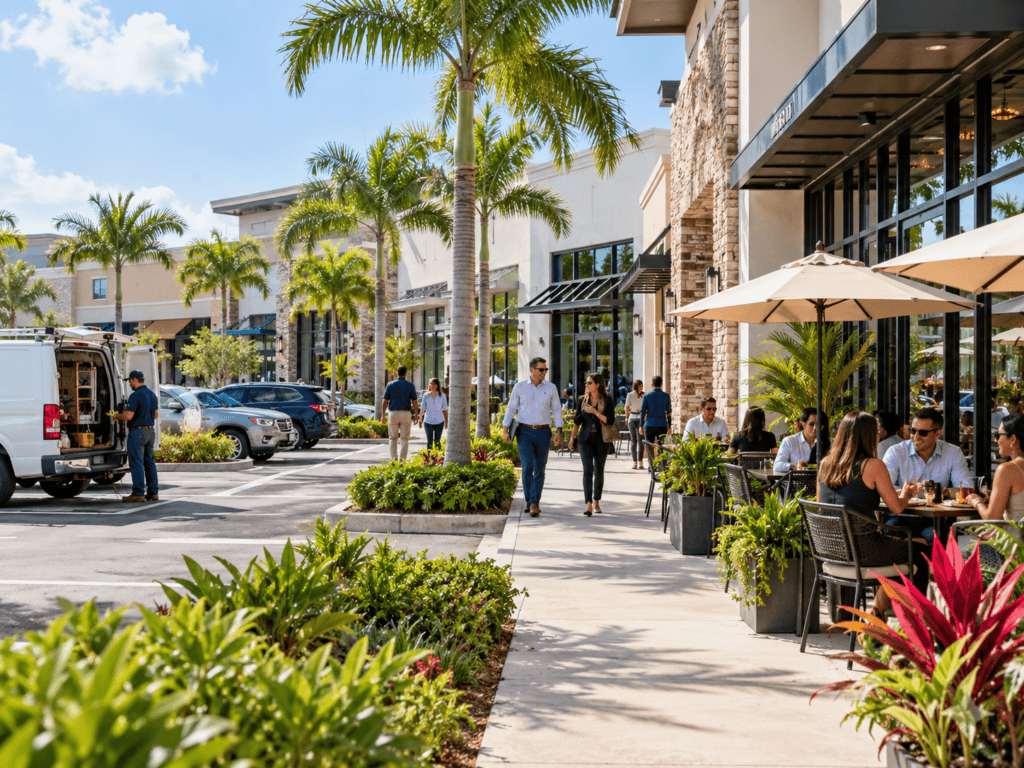 Commercial property exposures can vary widely among retailers, restaurants, professional offices, contractors, manufacturers, property owners, and other Florida businesses.
The type of property that needs to be insured can vary significantly by business. A retailer may need protection for inventory, shelving, and point-of-sale equipment, while a contractor may need coverage for office equipment, stored materials, and property kept at a permanent location.
A business that owns its building may need both building and business personal property coverage. A business that leases space may still need coverage for furniture, equipment, inventory, improvements, and other property it owns or is responsible for under the lease.
Commercial property insurance may also be required by a lender, landlord, lease agreement, or other contract.
The appropriate coverage should reflect the business’s actual property values, ownership or lease obligations, location, operations, and exposure to events such as fire, theft, wind, water damage, and other covered causes of loss.
What Property Can Commercial Property Insurance Cover?
Commercial property insurance can help protect many of the physical assets a business owns, uses, or is responsible for, depending on the policy and how the property is insured.
Covered property may include:
-
Buildings and structures: Commercial buildings owned by the business, along with certain permanently installed fixtures and improvements.
-
Business personal property: Furniture, office equipment, computers, machinery, shelving, supplies, and other property used in business operations.
-
Inventory and stock: Merchandise, raw materials, finished goods, and other inventory held for sale or use in the business.
-
Machinery and equipment: Equipment used to manufacture products, perform services, operate a facility, or support daily business activities.
-
Furniture and fixtures: Desks, chairs, display cases, cabinetry, counters, shelving, and other business furnishings.
-
Signs and certain outdoor property: Some policies may provide limited coverage for exterior signs, fences, antennas, or other outdoor property, subject to specific limits and exclusions.
-
Tenant-installed property: Businesses that lease space may need coverage for improvements, betterments, fixtures, or other property they installed or paid for.
-
Property of others: Certain property belonging to customers, vendors, landlords, or other third parties may be covered when it is in the business’s care, custody, or control, depending on the policy.
Not every type of property is covered automatically. Vehicles, money and securities, property in transit, mobile equipment, valuable papers, electronic data, property located away from the insured premises, and certain specialized equipment may be limited, excluded, or better insured under another policy or endorsement.
Businesses should also review where their property is located. Standard commercial property insurance is generally designed around scheduled premises, so property that regularly moves between locations, travels to jobsites, or is stored off premises may require different protection.
The policy should reflect the actual property a business owns or is responsible for, where that property is located, how it is used, and what it would cost to repair or replace after a covered loss.
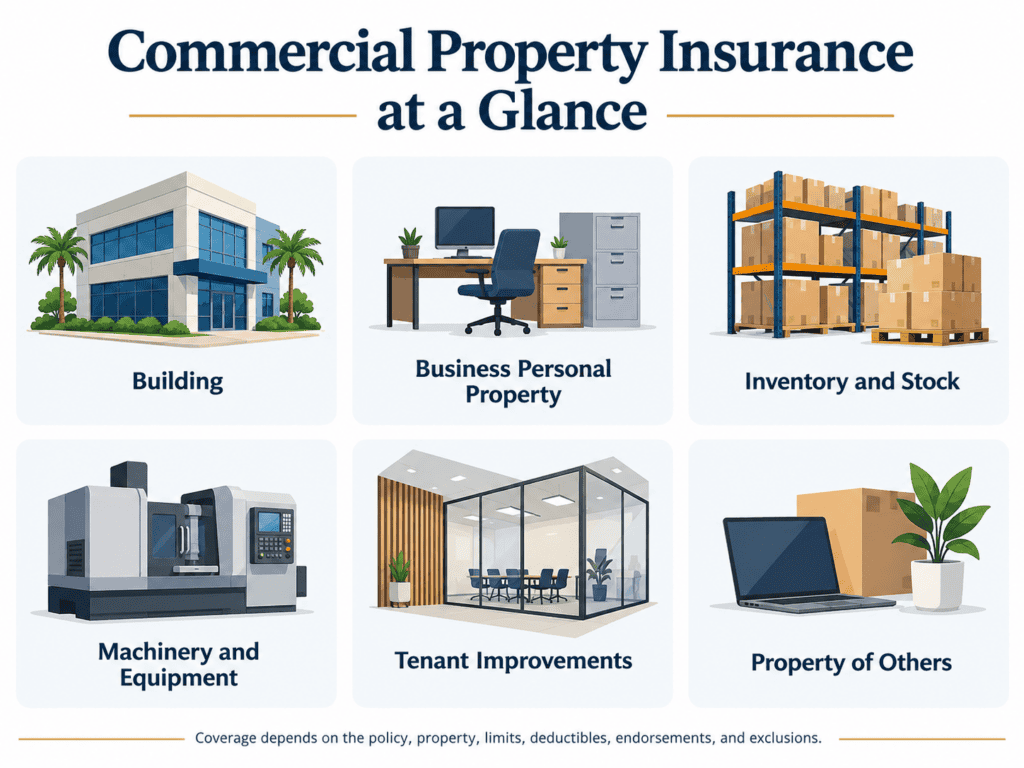 Commercial Property Insurance may help protect buildings, equipment, inventory, furniture, fixtures, tenant improvements, and other eligible business property, subject to the policy terms.
Do You Need Commercial Property Insurance If You Own or Lease Your Business Location?
Commercial property insurance can be important whether a business owns its building or leases commercial space, but the property that needs to be insured can differ substantially.
If the Business Owns the Building
A business that owns its commercial building may need coverage for the structure itself, including permanently installed fixtures and certain attached property.
The policy should reflect the building’s construction, occupancy, square footage, replacement cost, roof and building systems, location, and exposure to hazards such as fire, wind, water damage, and other covered causes of loss.
Building owners should also review whether additional coverage is needed for exposures such as business income, Ordinance or Law, equipment breakdown, flood, and certain outdoor property.
If the Business Leases Its Space
A tenant generally does not insure a building it does not own unless the lease or another agreement makes it responsible for certain property or improvements.
However, a tenant may still need commercial property insurance for:
-
Furniture
-
Computers and office equipment
-
Machinery
-
Inventory and stock
-
Supplies
-
Fixtures owned by the tenant
-
Tenant improvements and betterments
-
Other business personal property
The landlord’s insurance should not be assumed to cover the tenant’s business property.
Review the Lease Carefully
Commercial leases can assign insurance responsibilities differently. A lease may require the tenant to insure certain improvements, glass, equipment, fixtures, or other property and may also specify required limits or types of insurance.
Businesses should review their lease together with their insurance policy so they understand which property the landlord is responsible for and which property the tenant must insure.
Whether the business owns or leases its location, the goal is to avoid gaps between the property the business depends on and the property actually insured.
Building Coverage for Commercial Property
Building coverage can help protect a commercial structure owned by the business against certain covered causes of loss.
Depending on the policy, insured building property may include:
-
The main commercial building or structure
-
Permanently installed fixtures
-
Built-in machinery and equipment
-
Completed additions
-
Certain outdoor fixtures attached to the building
-
Certain landlord-owned improvements
-
Certain building service equipment
-
Materials and supplies intended for use in construction, alteration, or repair of the building, when covered by the policy
Coverage should be based on the property the business actually owns and is responsible for insuring.
How Should a Commercial Building Be Valued?
The building limit should reflect the applicable valuation method in the policy, such as replacement cost or actual cash value.
For replacement-cost coverage, the limit should generally reflect the estimated cost to repair or rebuild the insured structure with materials of like kind and quality, subject to the policy terms. That amount can be very different from the property’s market value, assessed value, mortgage balance, or purchase price.
Construction costs, labor, materials, debris removal, building code requirements, and other rebuilding expenses can all affect the amount needed.
What Building Features Can Affect Coverage?
Insurers may consider factors such as:
-
Construction type
-
Building age
-
Square footage
-
Roof age and condition
-
Electrical, plumbing, HVAC, and other building systems
-
Fire protection systems
-
Occupancy and tenant use
-
Distance to fire protection
-
Prior losses
-
Location
-
Wind and hurricane exposure
-
Flood exposure
-
Vacancy or partial vacancy
-
Renovation or construction activity
These characteristics can affect eligibility, pricing, deductibles, available limits, and policy terms.
Commercial property owners should review building values periodically rather than assuming a limit selected years ago still reflects current rebuilding costs.
Business Personal Property Coverage
Business Personal Property coverage can help protect property a business owns and uses in its operations, subject to the policy terms, limits, deductibles, valuation provisions, and exclusions.
Depending on the policy, business personal property may include:
-
Furniture and office furnishings
-
Computers and electronic equipment
-
Machinery and production equipment
-
Inventory and stock
-
Supplies and materials
-
Shelving, display cases, counters, and similar fixtures
-
Tools and equipment kept at the insured premises
-
Certain tenant-owned improvements or fixtures
-
Other property used in the business
The amount of coverage should reflect what it would cost to repair or replace the insured property after a covered loss, based on the valuation method provided by the policy.
Inventory and Stock
Businesses that sell, manufacture, distribute, or store products should pay particular attention to inventory values.
Inventory can fluctuate throughout the year because of seasonal demand, purchasing cycles, or business growth. If stock values increase significantly during certain periods, the business should review whether its policy limits remain adequate.
Some policies may offer options such as peak-season endorsements or reporting forms for businesses with changing inventory levels.
Machinery and Equipment
Machinery and equipment can represent a substantial portion of a business’s property value.
Businesses should consider the cost to repair or replace specialized equipment, whether replacement parts are readily available, and how long it could take to restore operations after a covered loss.
Standard commercial property insurance may cover certain direct physical damage to machinery or equipment, but mechanical breakdown, electrical arcing, pressure-system failures, and similar internal equipment failures may require separate Equipment Breakdown Insurance or an endorsement. We will address that exposure in detail later on this page.
Keep Property Values Current
Business property values can change as a company purchases new equipment, adds inventory, expands operations, or replaces older furnishings and systems.
A business should periodically review its property schedule and limits so the policy reflects the assets currently used in the operation rather than values that may no longer be accurate.
Tenant Improvements, Betterments, and Property of Others
Businesses that lease commercial space may invest substantially in improvements, fixtures, and other property that are not owned by the landlord. Commercial property insurance can help protect certain tenant-installed improvements and property belonging to others, depending on the policy and the business’s responsibilities.
Tenant Improvements and Betterments
Tenant improvements and betterments generally include alterations, additions, or improvements a tenant makes to leased space that become part of the building.
Examples may include:
-
Built-in cabinetry
-
Interior walls or partitions
-
Flooring
-
Lighting
-
Plumbing or electrical improvements
-
Permanently installed fixtures
-
Custom counters or displays
-
Other improvements paid for by the tenant
Coverage can depend on who paid for the improvements, who owns them under the lease, and what happens to them when the tenant leaves the premises.
Businesses should not assume the landlord’s property insurance will automatically cover improvements paid for by the tenant.
Property of Others
A business may also have property belonging to customers, vendors, landlords, or other third parties in its possession.
Depending on the policy, Commercial Property Insurance may provide limited coverage for certain property of others while it is at the insured premises and in the business’s care, custody, or control.
Examples may include:
-
Customer property temporarily held by the business
-
Equipment leased or borrowed from another company
-
Property owned by a landlord but used by the tenant
-
Goods belonging to others that are stored at the business location
Coverage for property of others may be subject to separate limits, valuation provisions, exclusions, or other restrictions.
Businesses that regularly hold valuable customer property or specialized equipment belonging to others may need broader coverage than a standard Commercial Property policy provides.
Review the Lease and Contracts
Lease agreements and other contracts can determine which party is responsible for insuring improvements, fixtures, equipment, and other property.
Businesses should review these agreements carefully and make sure the insurance policy reflects the property they are actually responsible for protecting.
How Do Basic, Broad, and Special Causes of Loss Work?
Commercial property policies can differ significantly in the causes of loss they cover. The three common approaches are Basic, Broad, and Special Causes of Loss.
Understanding the difference is important because a lower-cost policy may also provide narrower protection.
Basic Causes of Loss
A Basic Causes of Loss form generally covers only the causes of loss specifically listed in the policy.
Depending on the form and endorsements, covered causes may include events such as:
-
Fire
-
Lightning
-
Explosion
-
Windstorm or hail
-
Smoke
-
Certain types of vandalism
-
Certain types of vehicle or aircraft damage
-
Other specifically listed causes of loss
If a cause of loss is not listed, it generally is not covered under a named-peril form.
Broad Causes of Loss
A Broad Causes of Loss form generally includes the causes covered under the Basic form plus certain additional causes of loss.
Depending on the policy, these may include certain types of:
-
Falling objects
-
Weight of snow, ice, or sleet
-
Accidental discharge or leakage of water or steam
-
Collapse
-
Certain damage involving building systems
The exact coverage depends on the policy language and endorsements.
Special Causes of Loss
A Special Causes of Loss form generally provides broader protection by covering direct physical loss unless the cause is specifically excluded or limited by the policy.
This is sometimes described as “all-risk” coverage, but that term can be misleading because a Special form does not cover every possible loss.
Exclusions may still apply to causes such as:
-
Flood
-
Earth movement
-
Wear and tear
-
Deterioration
-
Rust or corrosion
-
Certain water-related losses
-
Mechanical breakdown
-
Ordinance or law
-
Intentional acts
-
Certain vacancy-related losses
-
Other excluded or limited causes
Some of these exposures may be addressed through endorsements or separate policies.
The Policy Form Matters
Two Commercial Property policies with similar limits and premiums can provide very different protection depending on the causes-of-loss form, exclusions, and endorsements.
Businesses should review whether the policy is written on a Basic, Broad, or Special Causes of Loss form and should also examine the exclusions that apply to the specific property and operations being insured.
The broader form is not automatically the right choice for every business, but the difference in coverage should be clearly understood before comparing policies based on price alone.
What Does Commercial Property Insurance Typically Not Cover?
Commercial property insurance can provide broad protection for buildings and business personal property, but it does not cover every type of loss. Exclusions and limitations vary by insurer, policy form, property type, location, and endorsements.
Common exclusions or coverage gaps may include:
-
Flood: Standard commercial property insurance generally does not cover flooding caused by rising surface water, storm surge, or similar flood events. Separate Commercial Flood Insurance may be needed.
-
Earth movement: Earthquake, earth sinking, landslide, and certain other forms of earth movement are commonly excluded unless coverage is added or purchased separately.
-
Wear and tear or deterioration: Insurance is generally intended for sudden or accidental covered losses rather than damage caused by normal aging, corrosion, rust, decay, or lack of maintenance.
-
Mechanical or electrical breakdown: Internal equipment failures, electrical arcing, pressure-system failures, and certain mechanical breakdowns may require Equipment Breakdown Insurance or an endorsement.
-
Ordinance or law costs: The additional cost of complying with current building codes after a covered loss may be limited or excluded unless appropriate Ordinance or Law Coverage is included.
-
Certain water-related losses: Sewer or drain backup, groundwater, repeated leakage, seepage, and other water losses may be excluded or limited depending on the policy.
-
Utility service interruption: Damage or business interruption caused by an off-premises power, water, communications, or other utility failure may not be covered unless appropriate coverage is added.
-
Cyber events and electronic data: Data loss, ransomware, network intrusions, and many technology-related losses generally require Cyber Insurance or other specialized coverage.
-
Money and securities: Cash, securities, and certain negotiable instruments may have very limited coverage under a standard Commercial Property policy.
-
Vehicles: Licensed automobiles used by the business generally require Commercial Auto Insurance rather than Commercial Property Insurance.
-
Employee theft or dishonest acts: Theft committed by employees may require Commercial Crime Insurance or another appropriate form of coverage.
-
Pollution or contamination: Pollution, contamination, and environmental cleanup costs may be excluded or significantly limited.
-
Intentional acts: Damage intentionally caused by an insured is generally excluded.
-
Certain vacancy-related losses: A building that remains vacant for a specified period may lose coverage for certain causes of loss or have coverage reduced under the policy’s vacancy provisions.
-
Property away from the insured premises: Tools, mobile equipment, materials, or other property that regularly travels between locations may have limited protection and may require Inland Marine Insurance.
Businesses should also be careful not to assume that a Special Causes of Loss form eliminates these exclusions. Special-form coverage can be broader than Basic or Broad Causes of Loss, but exclusions, limitations, deductibles, and policy conditions still apply.
A Commercial Property policy should therefore be reviewed not only for what it covers, but also for exclusions that could affect the business’s most important property and operations.
Replacement Cost vs. Actual Cash Value
Commercial property insurance can value damaged property in different ways. Two of the most common valuation methods are Replacement Cost and Actual Cash Value (ACV).
The valuation method matters because it can significantly affect how much the policy may pay after a covered loss.
Replacement Cost
Replacement Cost coverage generally values covered property based on the cost to repair or replace it with property of like kind and quality, without deducting for depreciation, subject to the policy terms and limits.
For example, if covered equipment is destroyed, Replacement Cost coverage may help pay the cost to replace it with comparable new equipment rather than reducing the settlement because of the age of the damaged property.
For buildings, Replacement Cost should not be confused with:
-
Market value
-
Purchase price
-
Tax-assessed value
-
Mortgage balance
-
Land value
A commercial building can have a market value that is substantially different from what it would cost to rebuild after a major loss.
Actual Cash Value
Actual Cash Value generally reflects the value of damaged property after depreciation is considered.
Depreciation may take into account factors such as:
-
Age
-
Condition
-
Expected useful life
-
Obsolescence
-
Wear and tear
Because depreciation can reduce the amount paid, an Actual Cash Value settlement may be considerably lower than the cost to purchase new replacement property.
How Replacement Cost Claims May Be Paid
Even when a policy provides Replacement Cost coverage, the insurer may initially pay based on Actual Cash Value and then make an additional payment after the property is repaired or replaced.
The timing and requirements for recovering depreciation depend on the policy. Businesses should review any deadlines, documentation requirements, and conditions that apply to Replacement Cost settlement.
Which Valuation Method Is Appropriate?
The appropriate valuation method depends on the type of property, business needs, policy availability, and cost.
A business that depends heavily on specialized equipment, inventory, furnishings, or a commercial building may want to consider whether an Actual Cash Value settlement would provide enough money to restore operations after a serious loss.
Businesses should also review whether different categories of property are valued differently under the policy. A building may have one valuation method while certain equipment, stock, improvements, or other property may be subject to separate provisions.
The goal is to understand how the policy will value damaged property before a claim occurs, rather than discovering after a loss that the settlement method does not match the business’s expectations.
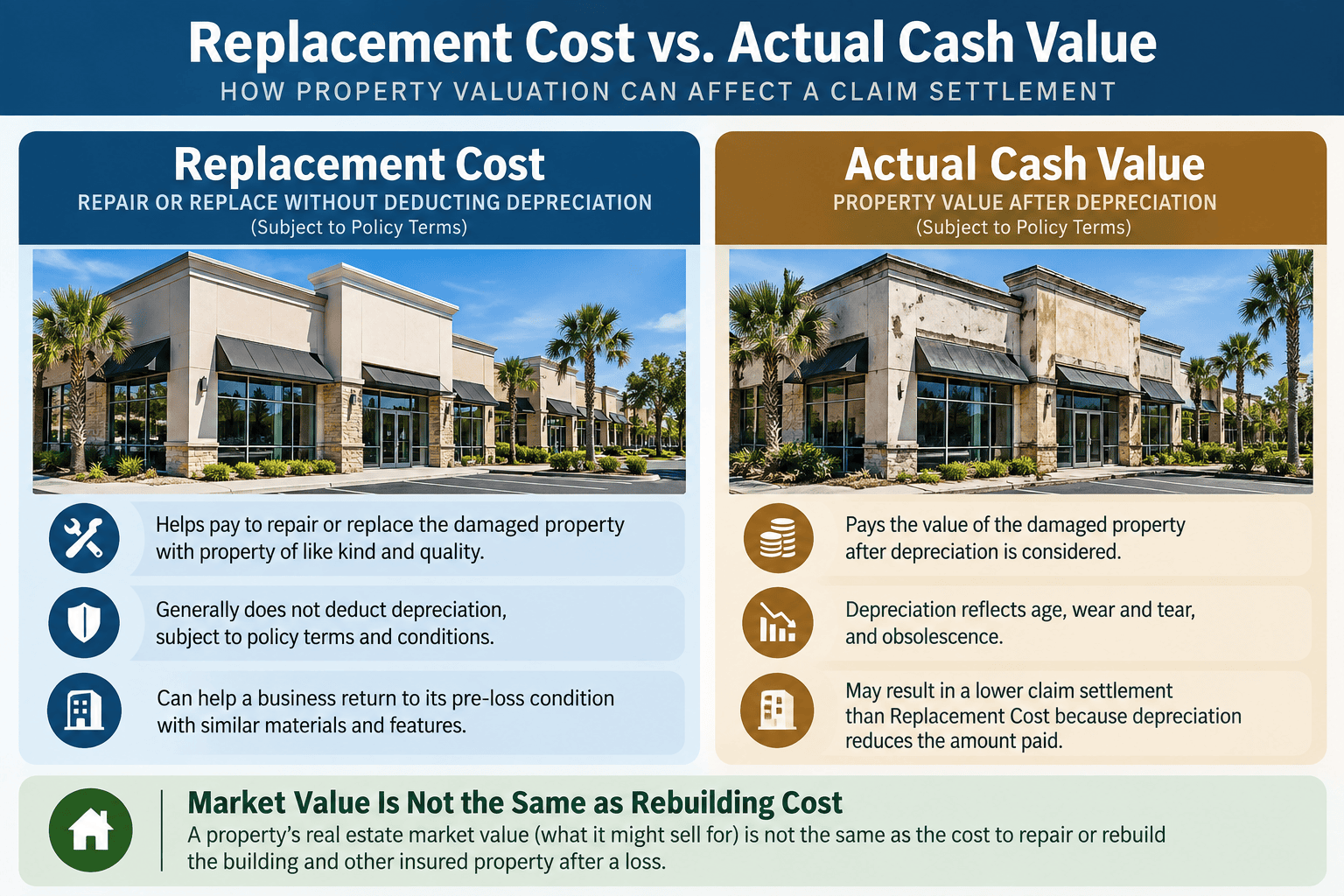 Replacement Cost and Actual Cash Value can produce very different claim settlements because Actual Cash Value generally considers depreciation.
How Much Commercial Property Insurance Does a Business Need?
The amount of Commercial Property Insurance a business needs should be based on the value of the property it is responsible for insuring and the amount it would take to repair or replace that property after a covered loss.
There is no single limit that is appropriate for every business. A small office may have relatively modest property values, while a manufacturer, restaurant, retailer, warehouse, or commercial building owner may have significantly greater exposure.
Businesses should consider the value of property such as:
-
Commercial buildings
-
Tenant improvements and betterments
-
Furniture and fixtures
-
Computers and office equipment
-
Machinery and specialized equipment
-
Inventory and stock
-
Supplies and materials
-
Property of others when the business is responsible for insuring it
-
Outdoor property or signs when applicable
Building Limits
For an owned commercial building, the insurance limit should reflect the applicable valuation method in the policy.
When Replacement Cost coverage applies, the limit should generally be based on the estimated cost to repair or rebuild the structure with materials of like kind and quality, subject to the policy terms.
Market value, purchase price, tax-assessed value, mortgage balance, and land value should not be assumed to equal the cost to rebuild.
Business Personal Property Limits
Business Personal Property limits should reflect the value of the furniture, equipment, inventory, fixtures, supplies, and other covered property the business would need to repair or replace after a major loss.
Businesses should account for recently purchased equipment, increases in inventory, renovations, expansion, and other changes that may have increased property values since the policy was originally written.
Allow for Changing Property Values
Property values do not remain static.
Construction costs can increase, businesses can add equipment, inventory can fluctuate, and improvements can be made without the insurance limits being updated automatically.
Businesses with seasonal or rapidly changing inventory should review whether additional options, such as peak-season limits or reporting forms, may be appropriate.
Avoid Underinsuring Important Property
Selecting a lower limit solely to reduce premium can create significant financial exposure after a major loss.
Insufficient limits may leave the business responsible for part of the repair or replacement cost and may also affect how certain policy provisions, including coinsurance requirements, apply.
The appropriate limits should reflect the business’s actual property values, valuation method, contractual obligations, and the potential cost of restoring operations after a serious covered loss.
How Do Coinsurance and Insurance-to-Value Requirements Work?
Commercial property policies may include coinsurance or insurance-to-value requirements designed to encourage businesses to insure property for an appropriate percentage of its value.
Coinsurance in Commercial Property Insurance is different from the way the term is commonly used in health insurance. It generally refers to a policy condition that can affect the amount paid after a covered loss if the property is insured for less than the required amount.
What Is a Coinsurance Requirement?
A Commercial Property policy may require the insured to maintain coverage equal to a specified percentage of the property’s value.
Common coinsurance percentages may include:
-
80 percent
-
90 percent
-
100 percent
The applicable percentage appears in the policy or declarations and can vary by insurer, property, and coverage form.
For example, if a policy requires property to be insured to 90 percent of its value but the business carries substantially less coverage, a covered partial loss may be subject to a coinsurance penalty.
How Can Underinsurance Affect a Claim?
If the amount of insurance carried is below the amount required by the coinsurance provision, the insurer may reduce the claim payment based on the relationship between:
-
The amount of insurance carried
-
The amount of insurance that should have been carried
-
The amount of the covered loss
This means a business can experience a reduced settlement even when the amount of the loss is below the policy limit.
A business should therefore not assume that having a limit greater than a particular claim automatically means the entire covered loss will be paid.
What Is Insurance to Value?
Insurance to value refers to maintaining coverage that appropriately reflects the value of the insured property under the valuation method used by the policy.
For a building insured on a Replacement Cost basis, this generally means reviewing the estimated cost to rebuild rather than relying on:
-
Market value
-
Purchase price
-
Tax-assessed value
-
Mortgage balance
-
The value of the land
For Business Personal Property, values should reflect the equipment, furniture, inventory, fixtures, and other property the business is responsible for insuring.
Can a Coinsurance Requirement Be Waived?
Some Commercial Property policies may offer an Agreed Value provision or another option that can suspend or modify the standard coinsurance requirement when specified conditions are met.
These provisions may require the insured to provide a current statement of property values or other documentation and may apply only for a stated period.
Businesses should not assume coinsurance has been waived unless the policy specifically provides for it.
Review Values Regularly
Building and business property values can change because of:
-
Rising construction costs
-
Renovations or additions
-
New machinery or equipment
-
Increased inventory
-
Business expansion
-
Inflation
-
Changes in replacement costs
Commercial property limits should therefore be reviewed periodically so the policy remains aligned with current values and any applicable insurance-to-value requirements.
Understanding the coinsurance percentage, valuation method, and property limit before a loss can help a business avoid unexpected reductions in a covered claim payment.
How Do Commercial Property Deductibles Work?
A deductible is the amount a business is responsible for before the insurer pays its share of a covered Commercial Property Insurance claim.
Deductibles can affect both the cost of the policy and the amount a business may need to pay after a loss.
Flat-Dollar Deductibles
Many Commercial Property policies use a fixed dollar deductible.
For example, if a covered loss exceeds the deductible, the insurer may pay the eligible amount above that deductible, subject to the policy limits and other terms.
A higher deductible can reduce premium, but it also increases the amount the business must absorb after a covered loss.
Percentage Deductibles
Some Commercial Property policies may use percentage deductibles for certain causes of loss, particularly windstorm, hurricane, or named-storm exposure.
A percentage deductible is generally calculated using a stated percentage of the applicable insured value rather than a fixed dollar amount.
This can result in a substantially higher out-of-pocket amount than a standard property deductible, so businesses should review how the percentage is applied before selecting coverage.
Different Deductibles May Apply to Different Causes of Loss
A Commercial Property policy can include more than one deductible.
For example, a business may have:
-
A standard property deductible
-
A separate windstorm deductible
-
A hurricane or named-storm deductible
-
A separate deductible for certain water losses
-
Different deductibles for specific buildings, locations, or coverages
The deductible that applies depends on the cause of loss and the policy wording.
Per-Occurrence vs. Per-Location Deductibles
Policies can also differ in how deductibles apply when a loss affects more than one location or building.
Depending on the policy, a deductible may apply:
-
Once per occurrence
-
Separately to each building
-
Separately to each location
-
According to another method stated in the policy
This distinction can materially affect the business’s financial responsibility after a widespread loss.
Choosing an Appropriate Deductible
Businesses should consider both premium savings and the amount they could realistically afford to pay after a loss.
A deductible that appears attractive because it lowers premium may create a financial strain if the business does not have enough cash available to absorb it.
The right deductible should reflect the business’s financial resources, property values, claims exposure, and tolerance for retaining risk.
Businesses should review all applicable deductibles, especially those for wind and hurricane exposure, before comparing Commercial Property Insurance options.
Wind, Hurricane, and Named-Storm Coverage for Florida Businesses
Wind and hurricane exposure is an important consideration for Commercial Property Insurance in Florida. Coverage for windstorm, hurricane, or named-storm damage can vary substantially by insurer, location, building characteristics, and policy form.
Businesses should not assume that every Commercial Property policy handles wind coverage the same way.
Is Wind Coverage Included in Commercial Property Insurance?
Depending on the insurer and property, wind coverage may be:
-
Included within the Commercial Property policy
-
Included subject to a separate windstorm, hurricane, or named-storm deductible
-
Limited by endorsement
-
Excluded from the policy and placed through a separate wind policy or another insurance market
The policy should be reviewed carefully to determine whether wind is covered and which deductible or restrictions apply.
Hurricane and Named-Storm Deductibles
Commercial Property policies may apply a separate deductible when damage results from a hurricane, named storm, or other specified wind event.
These deductibles may be structured differently from the standard property deductible and may be expressed as a percentage of an insured value rather than as a fixed dollar amount.
Businesses should understand:
-
Which events trigger the deductible
-
Whether the deductible applies per building, per location, or per occurrence
-
Which insured value is used to calculate a percentage deductible
-
Whether different locations have different wind deductibles
-
Whether a minimum deductible applies
A percentage deductible can result in a significant out-of-pocket expense after a major storm, so the deductible should be reviewed before coverage is purchased.
What Property Characteristics Can Affect Wind Coverage?
Insurers may evaluate characteristics such as:
-
Building location
-
Distance from the coast
-
Construction type
-
Building age
-
Roof age and condition
-
Roof shape and construction
-
Opening protection
-
Building height
-
Occupancy
-
Prior wind losses
-
Overall condition of the property
-
Wind-resistance or mitigation features
These factors may affect eligibility, premium, available limits, deductibles, and whether wind coverage is offered by a particular insurer.
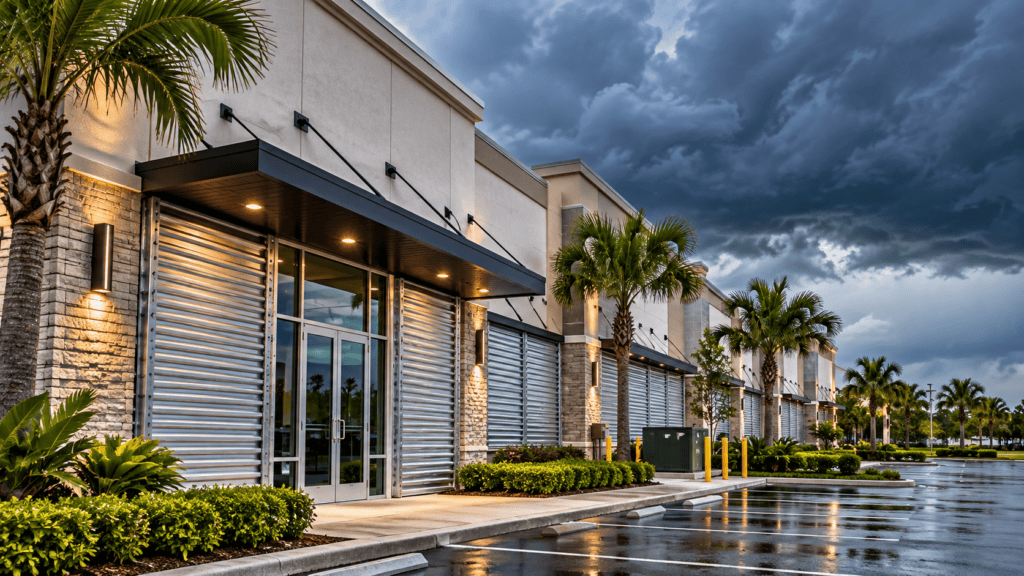 Florida commercial properties may face different wind, hurricane, and named-storm coverage terms depending on location, construction, building characteristics, and insurer requirements.
Wind Damage vs. Flood Damage
Wind and flood are different causes of loss.
Commercial Property Insurance may cover certain wind-related damage when wind is an insured cause of loss, but standard Commercial Property policies generally do not cover flood or storm surge.
A hurricane can create both wind and flood damage during the same event, which makes it important for Florida businesses to review both coverages before hurricane season.
Review More Than the Premium
When comparing Commercial Property Insurance in Florida, businesses should review more than the annual premium.
Important wind-related differences may include:
-
Whether wind coverage is included or excluded
-
Hurricane, named-storm, or windstorm deductibles
-
Coverage limits
-
Roof-related restrictions
-
Valuation provisions
-
Coinsurance requirements
-
Ordinance or Law Coverage
-
Business Income coverage
-
Exclusions and endorsements
Two policies with similar premiums can respond very differently after a major storm.
The goal is to understand how the policy treats wind and hurricane exposure before a loss occurs, including the applicable deductible, limits, exclusions, and any separate wind coverage that may be required.
Does Commercial Property Insurance Cover Flood Damage?
Standard Commercial Property Insurance generally does not cover damage caused by flooding. Florida businesses may need separate Commercial Flood Insurance to protect eligible buildings, equipment, inventory, furniture, and other business property against covered flood losses.
Flooding can result from heavy rainfall, tropical storms, hurricanes, storm surge, overflowing waterways, drainage problems, and other conditions. A business does not have to be located directly on the coast or in a designated high-risk flood area to experience flood damage.
What Can Commercial Flood Insurance Cover?
Depending on the policy, Commercial Flood Insurance may provide separate protection for:
-
Commercial buildings
-
Electrical and plumbing systems
-
HVAC equipment
-
Permanently installed fixtures
-
Machinery and equipment
-
Furniture
-
Inventory and stock
-
Other eligible business contents
Building and contents coverage may have separate limits, deductibles, valuation provisions, and exclusions.
NFIP vs. Private Commercial Flood Insurance
Florida businesses may have access to flood insurance through the National Flood Insurance Program (NFIP), private flood insurers, or both.
Available options can differ in areas such as:
-
Building and contents limits
-
Deductibles
-
Valuation methods
-
Eligibility requirements
-
Waiting periods
-
Additional coverage options
The appropriate choice depends on the property, flood exposure, property values, lender requirements, and available policy terms.
Does Flood Insurance Cover Lost Business Income?
Flood insurance should not automatically be assumed to cover lost revenue or the financial effects of a shutdown.
For example, NFIP commercial flood insurance does not provide coverage for business interruption or loss of use. Some private flood policies may offer additional options, but coverage varies by insurer.
Businesses should also review their Business Income coverage carefully because a standard Business Income policy generally requires the underlying cause of loss to be covered. If flood is excluded from the underlying property coverage, the resulting business-income loss may also be excluded.
Wind Damage and Flood Damage Are Different
A hurricane can cause both wind damage and flooding during the same event, but the two exposures are insured differently.
A Commercial Property policy may provide coverage for certain wind damage when wind is covered, while flood and storm surge generally require separate flood protection.
Florida businesses should therefore review both wind and flood coverage rather than assuming that hurricane-related damage will be handled by a single policy.
Evaluate the Property’s Actual Flood Exposure
Flood risk should be evaluated based on more than whether insurance is required by a lender.
Factors such as elevation, nearby waterways, drainage, storm-surge exposure, surrounding development, building characteristics, and location can all affect a property’s flood exposure.
Businesses should understand what their Commercial Property policy excludes and determine whether separate flood insurance is appropriate before a flood threat develops.
How Can Business Income and Extra Expense Coverage Help?
Commercial Property Insurance can help repair or replace covered physical property after a loss, but repairing the building or equipment does not address the income a business may lose while operations are interrupted.
Business Income Insurance, also called Business Interruption Insurance, may help replace certain lost income and continuing operating expenses when a covered property loss causes a business to suspend or reduce operations. Coverage depends on the policy’s covered causes of loss, limits, waiting periods, restoration period, exclusions, and other terms.
What Can Business Income Coverage Help Pay?
Depending on the policy, Business Income coverage may help with financial losses such as:
-
Lost net income the business would have earned
-
Rent or mortgage payments that continue during the interruption
-
Payroll and certain employee expenses
-
Taxes
-
Loan payments
-
Utilities and other continuing operating expenses
-
Other qualifying expenses that continue while operations are suspended
For example, if a covered fire substantially damages a retail store and the business cannot reopen while repairs are being completed, Business Income coverage may help replace certain income the business would have earned and eligible expenses that continue during the shutdown.
Coverage is generally based on financial records and the terms of the policy rather than simply reimbursing all revenue the business would have collected.
What Is Extra Expense Coverage?
Extra Expense coverage can help pay certain additional costs a business reasonably incurs to avoid or minimize a covered interruption or continue operating while damaged property is being repaired or replaced.
Depending on the policy, qualifying Extra Expenses may include:
-
Renting temporary commercial space
-
Temporarily relocating equipment or operations
-
Leasing replacement equipment
-
Paying additional transportation or shipping costs
-
Expediting repairs or replacement equipment
-
Installing temporary communications or technology
-
Other reasonable expenses incurred to continue or restore operations
For example, if a professional office is temporarily unusable after a covered water loss, Extra Expense coverage may help with eligible costs of operating from a temporary location while repairs are completed.
What Is the Period of Restoration?
Business Income coverage generally applies during a defined period of restoration following a covered loss.
The period of restoration typically relates to the reasonable amount of time required to repair, rebuild, or replace damaged property and resume operations, subject to the policy’s definitions and time limitations.
Coverage does not necessarily continue until the business has completely returned to its pre-loss level of income.
Some policies may provide Extended Business Income coverage for a limited period after operations resume, helping address the time it can take for revenue to recover after reopening.
Does a Waiting Period Apply?
Some Business Income coverage forms may include a waiting period before coverage begins.
A waiting period can function similarly to a time-based deductible, meaning the business is responsible for losses occurring during the initial period specified by the policy.
Businesses should review whether a waiting period applies and understand when the period of restoration and available coverage begin.
Does Business Income Coverage Require Property Damage?
Traditional Business Income coverage generally requires a suspension or reduction in operations caused by direct physical loss of or damage to covered property from a covered cause of loss.
However, additional coverages or endorsements may address other situations, such as certain:
-
Civil Authority losses
-
Dependent property or contingent business interruption exposures
-
Utility service interruptions
These coverages have their own requirements, limitations, and exclusions and should not be assumed to apply automatically.
What If a Hurricane Interrupts the Business?
Business Income coverage may respond when a covered hurricane or wind loss causes qualifying property damage that interrupts operations, provided the underlying cause of loss is covered and the requirements of the Business Income coverage are satisfied.
Flood is different.
If flood is excluded from the applicable property policy, standard Business Income coverage generally will not respond to an interruption caused by flooding. NFIP commercial flood insurance also does not cover business interruption or lost income, although some private flood policies may offer additional options.
Florida businesses should therefore review how their Commercial Property, wind, flood, and Business Income coverage work together rather than assuming a shutdown caused by a hurricane will automatically be covered.
How Much Business Income Coverage Does a Business Need?
The appropriate amount depends on the business’s finances and how long a serious covered loss could realistically interrupt operations.
Businesses should consider factors such as:
-
Expected net income
-
Continuing operating expenses
-
Payroll
-
Rent or mortgage obligations
-
Equipment replacement time
-
Building reconstruction time
-
Permitting and code requirements
-
Availability of replacement property
-
Supply-chain delays
-
Seasonal revenue
-
The time customers may take to return after reopening
Financial statements and a Business Income worksheet can help estimate the potential loss and determine an appropriate coverage amount.
A business should review Business Income and Extra Expense coverage as part of its overall Commercial Property Insurance program rather than focusing only on the cost to repair the building and replace physical property.
Ordinance or Law Coverage for Commercial Property
After a major property loss, repairing or rebuilding a commercial building may require compliance with current building codes, zoning requirements, or other construction standards that did not apply when the property was originally built.
Standard Commercial Property Insurance may limit or exclude some of these additional costs. Ordinance or Law Coverage can help address certain expenses created when enforcement of a building ordinance or law increases the cost of repairing, demolishing, or rebuilding property after a covered loss.
Why Can Building Codes Increase the Cost of a Loss?
A commercial building may have been constructed under older requirements for:
-
Electrical systems
-
Plumbing
-
Roofing
-
Fire protection
-
Accessibility
-
Structural components
-
Wind resistance
-
Energy efficiency
-
Other building systems or construction standards
After a covered loss, local authorities may require damaged portions of the building to be repaired to current standards.
In some situations, code requirements can also affect portions of the building that were not directly damaged.
What Can Ordinance or Law Coverage Include?
Depending on the policy, Ordinance or Law Coverage may address several different exposures.
Coverage for the Undamaged Portion of the Building
If a covered loss damages part of a building but enforcement of an ordinance or law requires the remaining undamaged portion to be demolished, coverage may help address the value of that undamaged portion when provided by the policy.
Demolition Costs
Coverage may help pay certain costs associated with demolishing and removing the undamaged portion of a building when demolition is required because of an applicable ordinance or law following a covered loss.
Increased Cost of Construction
Coverage may help pay certain additional costs required to repair or rebuild the property in compliance with current building codes.
Examples may include upgrading electrical systems, improving structural components, modifying accessibility features, or making other required construction changes.
Ordinance or Law Coverage Is Not the Same as Routine Maintenance
Ordinance or Law Coverage is generally intended to address qualifying code-related costs that arise in connection with a covered property loss.
It should not be assumed to pay for routine maintenance, correcting existing code violations, upgrading an undamaged building voluntarily, or bringing older property up to current standards when no covered loss has occurred.
Coverage depends on the policy wording and the circumstances of the loss.
Limits Matter
Ordinance or Law Coverage may have separate limits or sublimits that are different from the building limit.
Commercial property owners should review:
-
Whether Ordinance or Law Coverage is included
-
Which portions of the exposure are covered
-
The applicable limits
-
Any deductibles
-
How the coverage interacts with the building limit
-
Whether the available amount appears sufficient for the property
Older buildings, extensively renovated properties, and buildings in areas with evolving construction requirements may warrant particular attention.
Why This Coverage Matters for Florida Commercial Property
A serious fire, hurricane, or other covered property loss can involve more than simply replacing what was physically damaged.
The cost of complying with current construction requirements can materially increase the total rebuilding expense. Businesses should therefore review Ordinance or Law Coverage together with building limits, Replacement Cost valuation, coinsurance requirements, and wind or hurricane protection when evaluating Commercial Property Insurance.
Equipment Breakdown Coverage for Building Systems and Equipment
Commercial Property Insurance may cover certain external causes of loss, such as fire or wind, but it may not cover many losses caused by the sudden internal failure of mechanical, electrical, or pressure systems.
Equipment Breakdown Insurance can help address certain losses caused by the accidental breakdown of covered equipment, subject to the policy terms, limits, deductibles, exclusions, and endorsements.
What Types of Equipment May Be Covered?
Depending on the policy, covered equipment may include:
-
Heating and air-conditioning systems
-
Boilers and pressure vessels
-
Electrical panels and distribution systems
-
Refrigeration equipment
-
Generators
-
Elevators and escalators
-
Production machinery
-
Motors and pumps
-
Compressors
-
Computer-controlled equipment
-
Certain communications and security systems
-
Other mechanical, electrical, or pressure equipment used in the business
The equipment does not necessarily have to be specialized manufacturing machinery. Ordinary building systems can also create significant equipment-breakdown exposure.
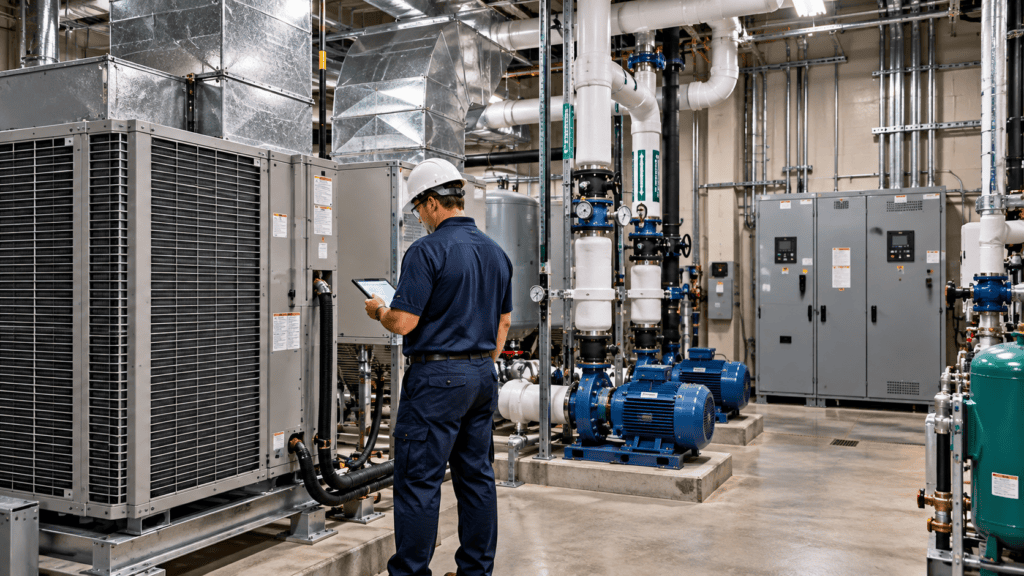 Equipment Breakdown coverage can help address certain mechanical, electrical, and pressure-system failures that may not be covered by standard Commercial Property Insurance.
What Is Considered an Equipment Breakdown?
A covered equipment breakdown may involve a sudden mechanical, electrical, or pressure-system failure rather than damage caused by an external event.
Examples may include:
-
Electrical arcing damages a commercial electrical system
-
A motor or compressor suffers an internal mechanical failure
-
A pressure vessel ruptures
-
Refrigeration equipment breaks down and causes additional covered damage
-
An HVAC system suffers a qualifying mechanical or electrical breakdown
-
Production machinery experiences a covered internal failure
The precise definition of a covered breakdown depends on the policy.
Why Commercial Property Insurance May Not Be Enough
A standard Commercial Property policy may cover equipment when it is damaged by a covered external cause of loss, such as fire.
However, internal mechanical failure, electrical breakdown, pressure-system failure, and similar equipment losses may be excluded or limited.
For example, if a fire damages an air-conditioning system, the Commercial Property policy may respond if fire is a covered cause of loss. If the system instead suffers an internal electrical or mechanical breakdown, Equipment Breakdown coverage may be needed.
What Costs Can Equipment Breakdown Coverage Address?
Depending on the policy and circumstances, Equipment Breakdown coverage may help pay for certain:
-
Repair or replacement costs for damaged covered equipment
-
Damage to other covered property resulting from the breakdown
-
Expediting expenses
-
Spoilage or contamination losses
-
Business Income losses
-
Extra Expenses incurred because of a covered breakdown
-
Other qualifying expenses provided by the policy
Not every Equipment Breakdown policy includes each of these coverages automatically, and separate limits or sublimits may apply.
Equipment Breakdown and Business Income
An equipment failure can interrupt operations even when there is relatively little visible property damage.
For example, a restaurant may be unable to operate if critical refrigeration equipment fails, or a manufacturer may have to stop production if essential machinery breaks down.
When included, Equipment Breakdown Business Income and Extra Expense coverage may help address certain financial losses resulting from a covered breakdown.
Businesses should review both the equipment-damage coverage and the potential effect an extended outage could have on operations.
Which Businesses Should Pay Particular Attention to Equipment Breakdown?
Equipment Breakdown coverage can be important for businesses that depend heavily on:
-
HVAC or refrigeration systems
-
Electrical equipment
-
Manufacturing machinery
-
Medical or diagnostic equipment
-
Commercial kitchens
-
Computer-controlled systems
-
Elevators
-
Pumps or compressors
-
Specialized production equipment
-
Building mechanical systems
Property owners should also consider building equipment that serves tenants, including HVAC, electrical, elevator, and other mechanical systems.
Review Equipment Values and Dependencies
Businesses should identify which systems or equipment are critical to continued operations and consider what would happen if they unexpectedly failed.
Important questions may include:
-
How much would the equipment cost to repair or replace?
-
How long would replacement take?
-
Is replacement equipment readily available?
-
Could a breakdown damage other property?
-
Would operations have to stop?
-
Could refrigerated or temperature-sensitive stock be lost?
-
Are Business Income and Extra Expense exposures adequately addressed?
Equipment Breakdown coverage should be reviewed as part of the overall Commercial Property Insurance program rather than assuming that every type of equipment failure is covered by the standard property policy.
What About Tools, Equipment, or Property Away From the Business Premises?
Standard Commercial Property Insurance is generally designed primarily around property located at the insured premises. Businesses that regularly move tools, equipment, materials, or other property between locations may need broader protection.
Inland Marine Insurance can help protect certain movable or specialized business property while it is away from the primary insured location, in transit, temporarily stored, or used at jobsites, subject to the policy terms, limits, deductibles, and exclusions.
What Types of Property May Need Inland Marine Coverage?
Depending on the business and policy, Inland Marine coverage may be appropriate for property such as:
-
Contractors’ tools and equipment
-
Portable machinery
-
Mobile diagnostic or medical equipment
-
Computers and electronic equipment used away from the office
-
Photography or production equipment
-
Materials transported to jobsites
-
Installation materials awaiting installation
-
Property temporarily stored at another location
-
Certain property of customers or clients
-
Specialized equipment that regularly moves between locations
The appropriate coverage depends on what the property is, where it travels, how it is used, and who is responsible for it.
Why Might Commercial Property Insurance Be Insufficient?
A Commercial Property policy may provide some limited coverage for property away from the insured premises, but those limits or coverage terms may not be adequate for businesses whose property regularly travels.
For example, a contractor may keep tools at a shop but use them daily at customer locations. A standard Commercial Property policy should not automatically be assumed to provide the same protection at every jobsite that it provides at the scheduled business premises.
The same concern can apply when equipment is transported between locations or temporarily stored somewhere other than the primary insured address.
Property in Transit
Businesses should also review how property is insured while being transported.
Commercial Auto Insurance generally protects the vehicle itself and certain auto-liability exposures, but it should not be assumed to cover tools, inventory, equipment, or materials being transported inside the vehicle.
Depending on the type of property and business, Inland Marine coverage may be used to insure eligible property while it is in transit.
Contractors and Installation Exposures
Contractors, installers, and other businesses may need specialized forms of Inland Marine coverage.
For example, an installation floater may help protect certain materials, supplies, or equipment while they are being transported, temporarily stored, or awaiting installation at a project site, subject to the policy terms.
Contractors may also need coverage specifically designed for tools and mobile equipment that move between their shop, vehicles, and jobsites.
Schedule Valuable Equipment When Appropriate
Some Inland Marine policies insure property on a scheduled basis, meaning specific equipment is listed with an assigned value. Other policies may provide blanket limits for eligible property.
Businesses with high-value or specialized equipment should maintain accurate records that may include:
-
Equipment descriptions
-
Serial numbers
-
Purchase dates
-
Purchase prices
-
Current replacement costs
-
Photos
-
Receipts or invoices
Accurate documentation can help with both underwriting and claims.
Review Where the Property Actually Goes
Businesses should consider not only what property they own, but also where that property is located throughout the course of normal operations.
If tools, equipment, materials, or other valuable property regularly leave the insured premises, Commercial Property Insurance alone may not provide the protection the business expects.
How Can Vacancy Affect Commercial Property Insurance?
Vacancy can materially affect Commercial Property Insurance. A building that becomes vacant or substantially unoccupied may face additional underwriting requirements, reduced coverage, exclusions for certain causes of loss, or the need for specialized insurance.
Businesses and property owners should notify their insurance professional when occupancy changes rather than assuming the existing Commercial Property policy will continue to respond the same way.
What Does “Vacant” Mean in Commercial Property Insurance?
A building can be considered vacant under the policy even when it is not completely empty.
The definition can depend on factors such as:
-
Whether the insured is a building owner or tenant
-
How much of the building is occupied
-
Whether the space is being used for its customary operations
-
Whether sufficient business personal property remains at the premises
-
How long the condition has existed
The policy’s actual vacancy definition should be reviewed because insurers and coverage forms may treat vacancy differently.
Vacant and Unoccupied Are Not Always the Same
A property that is unoccupied may still contain furniture, equipment, inventory, or other property but temporarily have no people present.
A vacant property may have little or no business activity or contents and may meet the policy’s specific definition of vacancy.
The distinction matters because policy restrictions may depend on whether the building meets the contractual definition of vacancy rather than simply whether someone is physically present.
Why Does Vacancy Increase Property Risk?
Vacant commercial buildings may be more vulnerable to losses because problems can remain undiscovered for longer periods.
Potential exposures include:
-
Vandalism
-
Theft
-
Fire
-
Water damage
-
Sprinkler leakage
-
Broken windows or doors
-
Unauthorized entry
-
Weather-related damage
-
Delayed discovery of mechanical or electrical problems
A small loss can become significantly more severe when nobody is regularly monitoring the property.
What Happens to Coverage When a Building Is Vacant?
Some Commercial Property policies contain vacancy provisions that can affect coverage after a building has met the policy’s definition of vacancy for a specified period.
Depending on the policy, vacancy can result in:
-
Certain causes of loss no longer being covered
-
Reduced claim payments
-
Additional deductibles or restrictions
-
Changes in underwriting eligibility
-
A requirement for a vacancy permit or endorsement
-
The need to move coverage to a specialized vacant-property policy
The affected causes of loss and applicable time periods depend on the policy form and endorsements.
Businesses should not assume that fire, theft, vandalism, water damage, or other losses will continue to be treated the same way after an extended vacancy.
What If Only Part of a Building Is Vacant?
Partial vacancy can also matter.
This can be especially important for:
-
Shopping centers
-
Office buildings
-
Mixed-use properties
-
Warehouses
-
Multi-tenant commercial buildings
-
Properties between tenants
A commercial building can have some occupied space and still meet a policy’s vacancy definition depending on how much of the property is being used and the wording of the policy.
Property owners should report substantial changes in tenant occupancy or building use to their insurance professional.
When Might Vacant Building Insurance Be Needed?
If a commercial property will remain vacant for an extended period, standard Commercial Property Insurance may no longer be the best fit.
Vacant Building Insurance may provide coverage designed specifically for an empty or substantially vacant commercial property, subject to its own causes of loss, limits, deductibles, conditions, and exclusions. First Florida Agency already has a dedicated Vacant Building Insurance page for this exposure.
Vacant-building coverage may be relevant when a property is:
-
Between tenants
-
Awaiting sale
-
Temporarily closed
-
Being held for redevelopment
-
Going through a prolonged transition in occupancy
-
Empty after a business relocation or closure
Report Occupancy Changes Promptly
Occupancy is an important underwriting characteristic.
A business or property owner should report material changes such as:
-
A tenant moving out
-
A substantial portion of the building becoming empty
-
Operations temporarily shutting down
-
A building being placed for sale
-
A prolonged renovation beginning
-
The property changing from occupied to vacant
The goal is to make sure the insurance policy continues to match how the property is actually being used.
Commercial Property Under Renovation or Construction
A standard Commercial Property policy may not be the right fit when a building is undergoing major construction, renovation, or structural work. Significant changes to the property can alter the risk enough that specialized coverage may be needed.
For projects involving new construction, major renovations, additions, or extensive remodeling, Builders Risk Insurance may be appropriate to help protect the building, construction materials, and other eligible project property while the work is in progress.
When Might Builders Risk Insurance Be Needed?
Builders Risk coverage may be appropriate for projects involving:
-
New commercial construction
-
Major building renovations
-
Structural additions
-
Extensive remodeling
-
Significant interior build-outs
-
Property undergoing substantial repair after a loss
-
Projects where the building is not yet ready for normal occupancy
The need for Builders Risk coverage can depend on the scope of work, contract requirements, lender requirements, property value, and how the existing Commercial Property policy treats construction activity.
What Can Builders Risk Insurance Cover?
Depending on the policy, Builders Risk Insurance may help protect:
-
The building or structure under construction
-
Construction materials and supplies at the jobsite
-
Materials temporarily stored off site
-
Certain property in transit
-
Equipment awaiting installation
-
Temporary structures
-
Debris-removal expenses
-
Certain soft costs or delay-related expenses when specifically included
Coverage varies substantially by insurer, project type, location, and policy form.
Why Should Renovation Work Be Reported?
A business should not assume that a major renovation is automatically covered under its existing Commercial Property policy.
Renovation can change:
-
The value of the property
-
The building’s occupancy
-
Fire and theft exposure
-
Wind and weather exposure
-
Construction materials stored on site
-
The use of temporary electrical or mechanical systems
-
Access by contractors and subcontractors
-
The length of time the property is partially or fully unoccupied
These changes may affect underwriting, limits, deductibles, exclusions, or eligibility.
Existing Building vs. New Construction
A Builders Risk policy for a renovation project may need to address both the existing structure and the new work being performed.
Businesses should confirm whether the policy covers:
-
The existing building
-
New construction or improvements
-
Materials awaiting installation
-
Temporary structures
-
Property in transit or stored off site
-
Contractor or owner interests
-
Soft costs
-
Wind or hurricane exposure
-
Flood exposure
The treatment of the existing structure can vary significantly, so it should not be assumed to be covered automatically.
When Does Builders Risk Coverage End?
Builders Risk Insurance is typically temporary coverage tied to the construction project.
Depending on the policy, coverage may end when:
-
Construction is completed
-
The building becomes occupied
-
The property is put to its intended use
-
The insured’s financial interest ends
-
The policy expires or is canceled
-
Another termination condition in the policy is triggered
The transition from Builders Risk to permanent Commercial Property Insurance should be coordinated carefully so the property does not experience an unintended coverage gap.
Review Wind and Flood Exposure During Construction
Florida construction projects can have significant hurricane, wind, and flood exposure.
Builders Risk policies can vary considerably in how they treat:
-
Windstorm
-
Named storms
-
Hurricane deductibles
-
Coastal exposures
-
Flood
-
Temporary protection
-
Open structures
-
Materials stored outdoors
Businesses should review these provisions carefully before construction begins rather than assuming the permanent Commercial Property policy will provide the same protection during the project.
Commercial Property Insurance vs. a Business Owners Policy
Commercial Property Insurance and a Business Owners Policy (BOP) can both protect business property, but they are not the same type of insurance program.
Commercial Property Insurance primarily focuses on protecting eligible buildings, business personal property, equipment, inventory, furniture, fixtures, and other physical assets against covered causes of loss.
A Business Owners Policy typically combines several coverages into one policy for eligible businesses, commonly including:
-
Commercial Property Insurance
-
General Liability Insurance
-
Business Income and Extra Expense coverage
A BOP can be a convenient option for businesses that qualify and need both property and liability protection.
When Might Standalone Commercial Property Insurance Be Appropriate?
A standalone Commercial Property policy may be more appropriate when a business:
-
Owns a larger or more complex commercial building
-
Has substantial building or business personal property values
-
Operates in an industry that does not qualify for a BOP
-
Needs specialized property coverage or endorsements
-
Has multiple locations
-
Has significant wind, hurricane, or catastrophe exposure
-
Needs property coverage structured separately from liability insurance
-
Requires limits or coverage terms not available through a standard BOP
Standalone Commercial Property Insurance may also provide greater flexibility for businesses with complex property schedules or specialized underwriting needs.
When Might a Business Owners Policy Be Appropriate?
A BOP may be suitable for certain small or midsize businesses that meet the insurer’s eligibility requirements.
Examples may include:
-
Professional offices
-
Retail stores
-
Certain restaurants
-
Service businesses
-
Small commercial property owners
-
Other businesses with relatively straightforward property and liability exposures
Eligibility varies by insurer and can depend on factors such as:
-
Type of business
-
Revenue
-
Building size
-
Property values
-
Number of locations
-
Occupancy
-
Claims history
-
Business operations
Not every business qualifies for a BOP.
Is the Property Coverage in a BOP the Same as a Standalone Commercial Property Policy?
Not necessarily.
A BOP may include Commercial Property coverage, but the available limits, deductibles, valuation provisions, causes of loss, endorsements, and additional coverage options can differ from those offered under a standalone Commercial Property policy.
Businesses should compare:
-
Building limits
-
Business Personal Property limits
-
Replacement Cost or Actual Cash Value provisions
-
Coinsurance requirements
-
Wind or hurricane deductibles
-
Business Income coverage
-
Equipment Breakdown options
-
Ordinance or Law Coverage
-
Flood exclusions
-
Property away from the premises
-
Vacancy provisions
-
Other exclusions and endorsements
The fact that two policies both include “Commercial Property” coverage does not mean they provide identical protection.
A BOP Is More Than Property Insurance
One important distinction is that a BOP generally combines property insurance with liability coverage.
For example, the Commercial Property portion can help address covered damage to the business’s physical property, while the General Liability portion may help protect against certain third-party bodily injury, property damage, personal and advertising injury, and products-completed operations claims.
A standalone Commercial Property policy does not automatically provide those General Liability protections.
Which Option Is Better?
Neither a Business Owners Policy nor standalone Commercial Property Insurance is automatically better for every business.
The appropriate structure depends on the business’s:
-
Property values
-
Operations
-
Building ownership or lease arrangements
-
Liability exposures
-
Number of locations
-
Wind and hurricane exposure
-
Business Income needs
-
Contractual requirements
-
Eligibility for packaged coverage
The goal is to choose the structure that provides appropriate protection for the business’s actual property and liability exposures rather than selecting a policy simply because it is packaged or priced lower.
How Much Does Commercial Property Insurance Cost in Florida?
The cost of Commercial Property Insurance in Florida can vary significantly because businesses differ in their property values, building characteristics, location, operations, catastrophe exposure, claims history, and coverage needs.
A small professional office leasing space may pay a very different premium than a restaurant, manufacturer, warehouse, retailer, or business that owns a large commercial building.
Factors that can affect Commercial Property Insurance cost include:
-
Building value
-
Business Personal Property value
-
Construction type
-
Building age
-
Roof age and condition
-
Occupancy and business use
-
Location
-
Distance from the coast
-
Wind and hurricane exposure
-
Flood exposure
-
Fire protection systems
-
Electrical, plumbing, and HVAC systems
-
Prior claims history
-
Requested property limits
-
Replacement Cost or Actual Cash Value
-
Deductibles
-
Wind, hurricane, or named-storm deductibles
-
Coinsurance requirements
-
Business Income limits
-
Ordinance or Law Coverage
-
Equipment Breakdown coverage
-
Vacancy
-
Number of locations
-
Specialized equipment or unusual property exposures
Why Florida Commercial Property Premiums Can Vary So Much
Florida properties can face significant hurricane, wind, and other catastrophe exposures.
Two businesses with similar building values may still receive very different insurance terms depending on construction, roof condition, location, occupancy, mitigation features, prior losses, and the insurer’s underwriting requirements.
A coastal commercial building may also have different wind coverage, deductibles, or carrier options than a similar property farther inland.
Property Values Can Affect Premium
Higher building, equipment, inventory, and Business Personal Property values generally create greater potential loss exposure.
The valuation method also matters.
A policy written on a Replacement Cost basis may be priced differently from one using Actual Cash Value because the insurer may be responsible for a greater amount after a covered loss.
Deductibles Can Affect Cost
Choosing a higher deductible may reduce premium, but it also increases the amount the business must absorb after a covered loss.
Businesses should pay particular attention to percentage-based wind, hurricane, or named-storm deductibles because they can create substantial out-of-pocket exposure.
Coverage Options Affect Premium
Adding broader protection can also affect cost.
Examples may include:
-
Business Income and Extra Expense
-
Ordinance or Law Coverage
-
Equipment Breakdown
-
Higher property limits
-
Broader causes-of-loss coverage
-
Increased limits for certain property
-
Additional coverage for specialized exposures
The lowest-priced policy is not always the best option if it provides lower limits, narrower causes of loss, higher deductibles, or exclusions that materially affect the business.
The Best Way to Estimate Cost
The most reliable way to estimate Commercial Property Insurance cost is to quote the specific business using accurate information about:
-
Property values
-
Building construction
-
Occupancy
-
Location
-
Roof and building systems
-
Business operations
-
Claims history
-
Requested limits
-
Deductibles
-
Wind coverage
-
Additional coverage needs
Commercial Property Insurance should be compared based on both price and coverage, including limits, valuation, deductibles, exclusions, endorsements, causes of loss, and catastrophe protection.
What Factors Affect Commercial Property Insurance Premiums?
Commercial Property Insurance premiums are based on the type, value, condition, location, and use of the property, along with the likelihood and potential severity of a covered loss.
Two businesses with similar property values can still receive very different premiums because insurers evaluate many underwriting characteristics beyond the building limit alone.
Factors insurers may consider include:
-
Building construction: Masonry, frame, fire-resistive, and other construction types can affect how a building may respond to fire, wind, and other hazards.
-
Building age and condition: Older properties may present different underwriting concerns, particularly when roofing, electrical, plumbing, HVAC, or structural systems have not been updated.
-
Roof age and condition: Roof type, age, condition, attachment, and prior repairs can be especially important for Florida commercial properties because of wind and hurricane exposure.
-
Occupancy and business operations: A professional office generally presents different property hazards than a restaurant, manufacturer, auto repair shop, warehouse, or other higher-hazard operation.
-
Property values: Higher building, equipment, inventory, and Business Personal Property values can increase the insurer’s potential loss exposure.
-
Location: Geographic area can affect exposure to hurricane, windstorm, flood, crime, wildfire, and other hazards.
-
Distance from the coast: Coastal and near-coastal properties may have greater wind and hurricane exposure and may face different carrier availability, deductibles, or policy terms.
-
Fire protection: Sprinkler systems, fire alarms, extinguishing systems, hydrant access, and proximity to fire protection can affect underwriting.
-
Security and loss-prevention measures: Burglar alarms, monitored security systems, cameras, access controls, and other safeguards may influence how an insurer evaluates theft or vandalism exposure.
-
Wind-mitigation features: Roof improvements, opening protection, structural upgrades, and other wind-resistant features may affect eligibility or pricing depending on the insurer.
-
Prior claims history: Previous property losses can affect premium, deductibles, eligibility, and available coverage terms.
-
Replacement Cost vs. Actual Cash Value: The valuation method can affect both the amount of protection and the premium.
-
Deductibles: Higher deductibles may reduce premium, while lower deductibles generally shift more of the loss exposure to the insurer.
-
Wind, hurricane, or named-storm deductibles: Florida properties may have separate catastrophe deductibles that affect the overall policy structure and price.
-
Coinsurance or insurance-to-value requirements: Property values and the percentage of value the business is required to insure can affect premium and claim settlement.
-
Business Income coverage: Higher Business Income and Extra Expense limits can increase premium because the insurer may be responsible for both property damage and certain financial losses following a covered interruption.
-
Equipment Breakdown coverage: Adding protection for certain mechanical, electrical, or pressure-system failures can affect premium.
-
Ordinance or Law Coverage: Additional limits for demolition, undamaged portions of the building, or increased construction costs can affect price.
-
Vacancy or partial vacancy: Vacant or substantially unoccupied buildings may present greater fire, theft, vandalism, and water-damage exposure.
-
Renovation or construction activity: Major renovations can change the property risk and may require different underwriting or Builders Risk coverage.
-
Number of buildings or locations: Businesses with multiple properties may have more complex exposures and greater total insured values.
-
Catastrophe exposure: Insurers may consider the potential for widespread hurricane, windstorm, or other catastrophe losses affecting the property and surrounding area.
Improvements Do Not Always Produce a Separate Discount
Property improvements such as a newer roof, updated electrical system, sprinkler protection, or wind-resistant features may improve underwriting eligibility or affect the overall rate even when the policy does not show a separate line-item discount.
The effect depends on the insurer, property, location, inspection results, and underwriting guidelines.
Accurate Information Matters
Incomplete or outdated property information can make it difficult to compare insurance options accurately.
Businesses should report material changes such as:
-
A new roof
-
Building renovations
-
Electrical or plumbing upgrades
-
Installation of sprinklers or alarms
-
Changes in occupancy
-
New equipment
-
Increased inventory
-
Building additions
-
Changes in tenant use
-
Extended vacancy
Keeping this information current can help insurers evaluate the property based on its actual condition and exposure.
Commercial Property Insurance premiums should therefore be reviewed in the context of the coverage provided, not just the price. A lower premium may reflect higher deductibles, narrower causes of loss, lower limits, restrictive endorsements, or reduced catastrophe protection.
What Information Helps When Getting a Commercial Property Insurance Quote?
Providing complete and accurate information can help insurers evaluate a commercial property more efficiently and reduce delays during the quoting process.
Businesses may be asked for information such as:
-
Business name and legal entity
-
Property address
-
Whether the business owns or leases the location
-
Building square footage
-
Year the building was constructed
-
Construction type
-
Roof age, type, and condition
-
Electrical, plumbing, HVAC, and other major building-system information
-
Occupancy and business operations
-
Number and type of tenants, when applicable
-
Building value
-
Business Personal Property value
-
Equipment and machinery values
-
Inventory or stock values
-
Tenant improvements and betterments
-
Business Income needs
-
Current insurance information
-
Prior claims or loss history
-
Requested property limits
-
Deductible preferences
-
Wind, hurricane, or named-storm coverage requirements
-
Flood exposure
-
Fire protection systems
-
Security systems
-
Vacancy or partial-vacancy information
-
Renovation or construction activity
-
Mortgagee, lender, landlord, or other contractual insurance requirements
-
Number of buildings or locations
-
Any specialized or unusual property exposures
Building Information Can Be Especially Important
For businesses that own commercial property, insurers may need detailed information about the building itself.
This may include:
-
Construction materials
-
Roof details
-
Number of stories
-
Total square footage
-
Fire protection
-
Electrical updates
-
Plumbing updates
-
HVAC systems
-
Sprinkler protection
-
Building occupancy
-
Prior renovations
-
Overall condition
Older buildings or properties with unusual construction may require additional underwriting information before an insurer can provide terms.
Property Values Should Be Current
Businesses should provide realistic values for buildings, equipment, inventory, furnishings, tenant improvements, and other insured property.
Outdated or understated values can make it difficult to structure appropriate coverage and may create problems with coinsurance, insurance-to-value requirements, or claim settlement.
If values have changed significantly because of renovations, new equipment, inventory growth, or business expansion, those changes should be reflected in the quote information.
Loss History Can Affect Underwriting
Insurers may ask for prior property loss information, including:
-
Date of loss
-
Type of loss
-
Amount paid
-
Cause of loss
-
Whether repairs or corrective action were completed
Providing accurate loss information can help an insurer understand whether prior issues have been addressed.
Florida Wind and Hurricane Information
For Florida commercial properties, insurers may also request information related to wind and hurricane exposure.
Depending on the property, this may include:
-
Roof age and condition
-
Roof covering
-
Opening protection
-
Building construction
-
Distance from the coast
-
Wind-mitigation features
-
Prior storm damage
-
Current wind coverage and deductibles
Properties in coastal or higher-hazard areas may require more detailed information before coverage can be offered.
Additional Documents May Help
Depending on the property and insurer, useful documents may include:
-
Prior insurance declarations
-
Loss runs
-
Property appraisals
-
Replacement-cost estimates
-
Building inspection reports
-
Roof reports
-
Lease agreements
-
Mortgage or lender requirements
-
Property schedules
-
Equipment lists
-
Inventory reports
-
Photos of the building and major systems
Not every quote requires every document, but having accurate property information available can make the process faster and more reliable.
The more accurately the property and business operations are described at the start of the process, the easier it is to compare Commercial Property Insurance options based on the actual exposures involved.
Florida Commercial Property Insurance for Northeast Florida Businesses
Commercial property exposures can vary significantly across Northeast Florida depending on the type of business, building construction, location, occupancy, property values, wind exposure, and proximity to the coast.
First Florida Agency serves businesses in Jacksonville, Ponte Vedra, Ponte Vedra Beach, Nocatee, St. Augustine, St. Johns County, and surrounding Northeast Florida communities, while also serving businesses throughout Florida.
 First Florida Agency helps businesses throughout Northeast Florida and across the state compare Commercial Property Insurance options based on their property, operations, and location.
Commercial Property Insurance needs may differ for:
-
Retail stores and restaurants with customer-facing locations
-
Professional offices and medical practices
-
Contractors and service businesses with shops, offices, or storage locations
-
Manufacturers and wholesalers
-
Warehouses and distribution businesses
-
Commercial landlords and multi-tenant property owners
-
Businesses with specialized machinery or equipment
-
Companies with significant inventory or stock
-
Businesses operating from coastal or near-coastal locations
-
Businesses with multiple Florida locations
A commercial building in Jacksonville may have different construction, occupancy, fire-protection, and catastrophe exposures than a retail location in St. Augustine or an office property in Ponte Vedra.
Coastal and near-coastal properties may also require closer review of wind coverage, hurricane or named-storm deductibles, roof condition, opening protection, and carrier eligibility.
Businesses farther inland can still face significant wind, water, fire, theft, equipment, and business-interruption exposures. Flood risk should also be evaluated separately because standard Commercial Property Insurance generally does not cover flood damage.
Commercial property owners and tenants should review whether their policy appropriately addresses:
-
Building and Business Personal Property values
-
Replacement Cost or Actual Cash Value
-
Coinsurance or insurance-to-value requirements
-
Wind and hurricane coverage
-
Deductibles
-
Business Income and Extra Expense
-
Ordinance or Law Coverage
-
Equipment Breakdown
-
Flood exposure
-
Vacancy
-
Property away from the insured premises
First Florida Agency can help Northeast Florida businesses compare Commercial Property Insurance options based on the property they own or lease, the assets they depend on, and the risks associated with their location and operations.
What First Florida Agency Reviews When Comparing Commercial Property Insurance
Commercial Property Insurance should be compared on more than premium alone. Building values, Business Personal Property limits, valuation methods, deductibles, causes of loss, exclusions, and catastrophe protection can all materially affect how a policy responds after a loss.
When comparing Commercial Property Insurance options, First Florida Agency may review:
-
Building values: Whether the insured amount appears consistent with the estimated cost to repair or rebuild the property.
-
Business Personal Property limits: Whether equipment, inventory, furniture, fixtures, and other business property are adequately reflected.
-
Replacement Cost vs. Actual Cash Value: How damaged property will be valued at the time of a covered loss.
-
Coinsurance and insurance-to-value requirements: Whether the property limits satisfy applicable policy requirements and help reduce the risk of a coinsurance penalty.
-
Deductibles: The standard property deductible and any separate wind, hurricane, named-storm, water, or other deductibles.
-
Causes of loss: Whether the policy uses Basic, Broad, Special, or another causes-of-loss form and what that means for the property being insured.
-
Wind and hurricane coverage: Whether wind is included, excluded, or placed separately, and how catastrophe deductibles apply.
-
Business Income and Extra Expense: Whether the limits and restoration provisions appear appropriate for the time it could take to resume operations.
-
Ordinance or Law Coverage: Whether the policy addresses potential demolition, undamaged-building, and increased construction costs after a covered loss.
-
Equipment Breakdown: Whether mechanical, electrical, and pressure-system exposures are adequately addressed.
-
Property away from the premises: Whether tools, equipment, materials, or other movable property may need Inland Marine coverage.
-
Flood exposure: Whether separate Commercial Flood Insurance should be considered.
-
Vacancy and occupancy: Whether current occupancy, tenant use, or vacancy conditions could affect coverage.
-
Renovation or construction activity: Whether Builders Risk Insurance or different underwriting may be needed while significant work is underway.
-
Exclusions and endorsements: Whether policy provisions could materially limit coverage for the business’s actual property and operations.
-
Lender, landlord, or contractual requirements: Whether the policy satisfies applicable insurance obligations.
-
Multiple buildings or locations: Whether limits, deductibles, and coverage are structured appropriately across the property schedule.
-
Related insurance needs: Whether General Liability, Business Income, Commercial Auto, Workers’ Compensation, Cyber, Crime, or other coverage should also be considered.
We also compare material differences between insurance proposals.
Two Commercial Property policies with similar premiums may provide different building limits, valuation provisions, wind deductibles, causes of loss, Business Income protection, exclusions, and endorsements.
The goal is to help businesses understand those differences so they can compare coverage based on their actual property, operations, contractual obligations, and risk exposures rather than price alone.
Why Work With First Florida Agency for Commercial Property Insurance?
Commercial Property Insurance should reflect the property a business actually owns, leases, uses, or is responsible for—not just a generic building value or industry classification.
First Florida Agency works with Florida businesses to help identify important property exposures, valuation issues, catastrophe risks, coverage gaps, and policy differences before comparing available insurance options.
As an independent insurance agency, we can help review coverage from multiple insurance carriers rather than being limited to a single company.
Depending on the business and property, we may help compare:
-
Building and Business Personal Property limits
-
Replacement Cost and Actual Cash Value provisions
-
Coinsurance and insurance-to-value requirements
-
Standard and catastrophe deductibles
-
Wind, hurricane, and named-storm coverage
-
Business Income and Extra Expense
-
Ordinance or Law Coverage
-
Equipment Breakdown
-
Flood exposure
-
Vacancy and occupancy issues
-
Property away from the insured premises
-
Renovation or construction exposures
-
Policy exclusions and endorsements
-
Lender, landlord, or contractual insurance requirements
-
Coverage for multiple buildings or locations
-
Related insurance needs such as General Liability, Commercial Auto, Workers’ Compensation, Cyber, Crime, or Commercial Umbrella
We also help businesses understand how policy structure can affect coverage after a loss.
Two insurance proposals may have similar premiums but differ substantially in valuation, deductibles, causes of loss, wind protection, Business Income coverage, exclusions, and endorsements.
Our goal is to help business owners understand those differences so they can choose Commercial Property Insurance that fits their property, operations, location, and risk exposures.
First Florida Agency serves businesses throughout Northeast Florida and across the state of Florida.
Get a Florida Commercial Property Insurance Quote
Commercial Property Insurance should be structured around the property a business actually owns, leases, uses, or is responsible for, along with the financial impact a serious loss could create.
First Florida Agency can help Florida businesses compare Commercial Property Insurance options from multiple carriers and review important differences in:
-
Building and Business Personal Property limits
-
Replacement Cost and Actual Cash Value provisions
-
Coinsurance and insurance-to-value requirements
-
Deductibles
-
Wind, hurricane, and named-storm coverage
-
Business Income and Extra Expense
-
Ordinance or Law Coverage
-
Equipment Breakdown
-
Flood exposure
-
Vacancy and occupancy
-
Policy exclusions and endorsements
-
Other related property risks
The goal is to help businesses compare coverage based on their actual property values, operations, location, and risk exposures rather than premium alone.
To discuss Commercial Property Insurance options for your business, call First Florida Agency at 904-822-8800 or complete the Commercial Property Insurance Quote Request form below.
Florida Commercial Property Insurance FAQs
What does Commercial Property Insurance cover in Florida?
Commercial Property Insurance can help protect eligible buildings, business personal property, equipment, inventory, furniture, fixtures, and other physical assets against covered causes of loss. Coverage depends on the policy, limits, deductibles, valuation provisions, exclusions, and endorsements.
Is Commercial Property Insurance required in Florida?
Commercial Property Insurance is not universally required for every Florida business. However, a lender, landlord, lease agreement, mortgage, or other contract may require property insurance. Even when it is not required, businesses should consider the financial impact of having to repair or replace important property after a major loss.
Do I need Commercial Property Insurance if I lease my business location?
A business that leases commercial space may still need Commercial Property Insurance for furniture, equipment, inventory, computers, machinery, fixtures, tenant improvements, and other property it owns or is responsible for. The landlord’s insurance should not be assumed to cover the tenant’s business property.
Does Commercial Property Insurance cover hurricane and wind damage?
It may. Depending on the insurer, location, and policy, wind coverage may be included, subject to a separate wind, hurricane, or named-storm deductible, limited by endorsement, or excluded and insured separately. Florida businesses should review both the wind coverage and the deductible before purchasing a policy.
Does Commercial Property Insurance cover flood damage?
Standard Commercial Property Insurance generally does not cover flooding or storm surge. Businesses may need separate Commercial Flood Insurance for eligible buildings and business property. Wind damage and flood damage can occur during the same hurricane but are typically insured differently.
What is the difference between Replacement Cost and Actual Cash Value?
Replacement Cost generally values covered property based on the cost to repair or replace it with property of like kind and quality without deducting depreciation, subject to the policy terms. Actual Cash Value generally considers depreciation, which can result in a lower claim settlement. Neither should be confused with the property’s real estate market value.
Does Commercial Property Insurance cover lost business income?
Commercial Property Insurance by itself does not necessarily replace income lost while a business is closed. Business Income and Extra Expense coverage may help replace certain lost income and continuing expenses when operations are interrupted because of qualifying property damage from a covered cause of loss.
Does Commercial Property Insurance cover equipment breakdown?
Standard Commercial Property Insurance may not cover certain internal mechanical, electrical, or pressure-system failures. Equipment Breakdown Insurance can help address qualifying breakdowns involving equipment such as HVAC systems, electrical equipment, refrigeration, machinery, pumps, or other covered systems.
How much does Commercial Property Insurance cost in Florida?
The cost varies based on factors such as building value, business personal property values, construction type, occupancy, location, roof age, wind and hurricane exposure, claims history, deductibles, valuation method, and selected coverage. The most reliable way to determine cost is to quote the specific property and business.
How much Commercial Property Insurance does my business need?
The appropriate amount depends on the value of the buildings and business property the company is responsible for insuring. Businesses should consider rebuilding costs, equipment, inventory, furnishings, tenant improvements, and other property, while also reviewing valuation methods, coinsurance requirements, deductibles, and Business Income needs.
Let’s Get Started
Florida Commercial Property Insurance Quote Request
"*" indicates required fields
Don’t like forms? Contact us at or email us.
