
Insurance Protection Built for Florida Trucking Businesses
Florida trucking companies face a combination of commercial auto, cargo, equipment, driver, regulatory, and business interruption risks that can be significantly different from those of other transportation businesses.
The right trucking insurance program should reflect how the operation actually works, including whether the business is an owner-operator or motor carrier, the trucks and trailers used, commodities hauled, operating radius, driver experience, DOT and safety history, cargo values, leasing arrangements, and whether the company operates under its own authority.
First Florida Agency helps Florida trucking businesses evaluate coverage for exposures involving trucking liability, physical damage, motor truck cargo, trailer interchange, non-trucking use, workers’ compensation, and other risks associated with moving freight by commercial truck.
Interactive Graphic

Commercial Trucking Insurance
Risk Factor
The type of trucking insurance you need can vary based on a number of factors. Private carriers who are hauling goods in their own truck or for an employer will need insurance designed for private trucking. Owner-operators will have different needs depending on whether they are operating under their own authority or under permanent lease to a motor carrier.
Solution
Having the right insurance for the situation is essential. For example, an owner-operator under permanent lease to a motor carrier may have their primary liability insurance provided by the motor carrier. However, there are other coverages they’ll want to consider. Additionally, the type of truck, driver experience, and goods hauled can all affect coverage needs as well.
Garagekeepers and On-Hook
Risk Factor
Tow trucks carry a unique risk involving the property of someone else. The tow truck could be involved in an accident and the vehicle it is towing could become damaged. Also, it’s not unusual for a towed vehicle to be stored overnight at the garage of the towing company. In either scenario, special insurance is needed to cover the towed vehicle.
Solution
On-hook insurance provides protection in the case of damages to a vehicle while it is being towed. Garagekeepers insurance would cover losses sustained when a vehicle is being temporarily stored at the towing company’s location.
Bobtail Insurance
Risk Factor
Sometimes a truck is driven without a trailer attached. This could include when the driver is on their way to pick up a load, has just dropped off a load, or is in between loads. When a truck is driven this way under someone else’s trucking authority, a coverage gap can exist if the truck is involved in an accident and found liable for bodily injury or damage to property.
Solution
Bobtail insurance is a liability policy that provides coverage for legal fees, damages awarded, and medical expenses for times when a truck is driven under someone else’s trucking authority and there is no trailer attached.
Non-trucking liability
Risk Factor
Trucks that are under permanent lease to a motor carrier are typically covered under their liability coverage, which offers protection when the truck is used for business purposes. But what happens if the truck is involved in an accident and is liable for damages caused while being driven for non-business purposes?
Solution
Non-trucking liability insurance offers protection when a truck is driven for personal reasons, for example while running personal errands on a day off. It covers medical expenses, property damage, and legal fees related to the driver.
Trailer Interchange
Risk Factor
There are times a trailer needs to be handed off from one trucker to another to finish the shipment. The contract that arranges this transfer is known as a trailer interchange agreement. The parties to this agreement would need trailer interchange insurance.
Solution
If a trailer is damaged, the trucker currently in possession of it would be responsible for them. Trailer interchange insurance offers protection for these damages for the period of time the policyholder is in possession of the trailer.
Rental Reimbursement With Downtime
Risk Factor
A truck that’s been damaged in an accident will need to be taken off the road for repairs. When the truck can’t be used, the business will lose money.
Solution
Rental reimbursement with downtime may cover the cost of truck payments and other bills while the truck is inoperable due to a covered loss. It may also provide reimbursement for a temporary replacement truck.
Motor Truck General Liability
Risk Factor
Owner-operators under their own authority and motor carriers can find themselves responsible for their mistakes. A customer injury, a delivery mistake or damage to goods, or damage to property caused by their truck or the actions of a driver can all be very costly.
Solution
Motor truck general liability insurance may provide coverage for bodily injury and property damage, personal or advertising injury, and other damages caused by the company’s own negligence.
Motor Truck Cargo Insurance
Risk Factor
For-hire truckers are often hauling something for someone. For the time that the freight or goods are in the possession of the trucker, the trucker is responsible for any damage to the goods. Whether the goods are damaged in a collision, are spilled off the truck, or damaged during loading and unloading, the expenses associated with this damage can add up fast.
Solution
Motor truck cargo insurance, sometimes simply referred to as cargo insurance, may cover the cost of the damaged cargo, removal expenses if the cargo is spilled, lost cargo, legal fees, and freight charges if the cargo is not delivered.
Physical Damage
Risk Factor
If a truck is damaged in an accident and another driver is not held liable for these damages, the truck’s owner would be responsible for the repairs. The truck’s owner would also be responsible for damages caused in other ways, such as if something falls on it, it is vandalized, it catches fire, or it is stolen.
Solution
Physical damage insurance covers the cost of repairs to your own vehicle if it’s damaged by you or it is damaged by some other factor that you cannot be held responsible for. For vehicles that are owned outright, this coverage may be optional. However, if the truck is being leased or financed, this coverage may be required by the bank.
What Is Florida Trucking Insurance?
Florida Trucking Insurance is a combination of commercial insurance coverages designed for businesses that operate trucks to transport property or freight.
It is not one standardized policy. The appropriate insurance program depends on how the trucking business operates, including the vehicles used, commodities hauled, operating radius, driver experience, cargo values, trailer arrangements, ownership structure, and whether the company operates under its own motor carrier authority or is leased to another carrier.
Trucking Insurance Is More Specialized Than Standard Commercial Auto
A typical Commercial Auto policy may protect business-owned vehicles, but trucking operations can create additional exposures that require more specialized coverage.
A trucking insurance program may include Commercial Trucking Auto Liability, Physical Damage Insurance, Motor Truck Cargo Insurance, Trailer Interchange coverage, Non-Trucking Liability, Motor Truck General Liability, Workers’ Compensation, Umbrella or Excess Liability, and other protections depending on the operation.
The exact combination should be based on the trucking business rather than assuming every motor carrier or owner-operator needs the same policy structure.
Trucking Insurance Should Reflect What the Business Hauls
The type of freight being transported can materially affect both underwriting and coverage.
A carrier hauling general merchandise may present a different risk from one transporting refrigerated products, automobiles, building materials, heavy equipment, household goods, or hazardous materials.
Cargo values, theft exposure, loading and unloading methods, refrigeration requirements, and contractual obligations can all influence the insurance program.
The Trucks and Trailers Matter Too
Insurers may evaluate the type, age, value, and use of the equipment being operated.
A business using tractor-trailers can have different insurance needs from one operating box trucks, dump trucks, flatbeds, refrigerated units, hotshot equipment, or specialized hauling vehicles.
Trailer ownership also matters. A trucking company may own its trailers, lease them, interchange trailers with another carrier, or pull equipment owned by someone else.
Those arrangements can affect which coverages should be considered.
Operating Radius Can Affect the Risk
A local trucking operation that stays within a limited area may present a different insurance exposure from a carrier operating throughout Florida or across multiple states.
Underwriters may consider the territories traveled, average and maximum trip distance, frequency of interstate travel, overnight operations, and the types of roads and freight lanes used.
Longer operating distances can increase both vehicle exposure and driver fatigue concerns.
Owner-Operators and Motor Carriers Can Have Different Insurance Needs
An owner-operator leased to a motor carrier may have different insurance responsibilities from a trucking company operating under its own authority.
The leasing agreement, operating authority, vehicle ownership, dispatch arrangement, and responsibility for cargo and trailers can all affect which policies and endorsements are needed.
For that reason, trucking insurance should be structured around the actual business relationship rather than simply the fact that the insured owns a commercial truck.
Trucking Insurance Is Different From Broader Transportation Insurance
Trucking Insurance focuses primarily on businesses using commercial trucks to transport freight or property.
Broader Transportation Insurance can apply to other types of operations, such as passenger transportation, courier services, moving companies, towing businesses, and other transportation-related risks.
Keeping those exposures separate allows the insurance program to address the specific risks associated with commercial trucking rather than treating every transportation business the same way.
Coverage Should Follow the Actual Operation
A single-truck owner-operator, a new motor carrier, and a large trucking fleet can require very different insurance programs.
The objective is to understand how the business operates and build coverage around the trucks, drivers, cargo, trailers, contracts, authority, and financial exposures involved.
Who May Need Trucking Insurance in Florida?
Trucking Insurance may be appropriate for Florida businesses and owner-operators that use commercial trucks to transport freight, property, equipment, or other goods as part of their operations.
The appropriate insurance program depends on how the business operates, who owns the vehicles, whether the company operates under its own authority, what is being hauled, and whether the trucks travel locally, throughout Florida, or across state lines.
Businesses that may need specialized trucking insurance include:
-
Owner-operators
-
For-hire motor carriers
-
Private trucking fleets
-
Dry van carriers
-
Refrigerated or reefer trucking companies
-
Flatbed trucking operations
-
Dump truck operators
-
Box truck businesses
-
Hotshot trucking companies
-
Auto haulers
-
Heavy-equipment haulers
-
Household-goods carriers
-
Building-material haulers
-
Aggregate, sand, gravel, and construction-material haulers
-
Specialized freight carriers
-
Local and regional freight carriers
-
Interstate trucking companies
-
Trucking businesses operating under their own motor carrier authority
Owner-Operators
An owner-operator may own one truck and either operate independently under its own authority or lease the truck and driving services to another motor carrier.
Those arrangements can create very different insurance responsibilities.
An owner-operator leased to a motor carrier may have certain liability protection provided while operating under the carrier’s authority but may still need other coverage such as Physical Damage, Non-Trucking Liability, or protection for other exposures depending on the lease agreement.
An owner-operator operating under its own authority generally assumes broader insurance and regulatory responsibilities.
For-Hire Motor Carriers
For-hire motor carriers transport property belonging to others in exchange for compensation.
These businesses may operate one truck or a large fleet and can face substantial exposure involving vehicle liability, cargo, trailers, drivers, contractual requirements, and federal or state financial-responsibility rules.
The insurance program should reflect the carrier’s authority, equipment, commodities, operating radius, and customer requirements.
Private Trucking Fleets
Not every trucking operation hauls freight for other companies.
Manufacturers, wholesalers, distributors, contractors, retailers, and other businesses may operate their own trucks to transport their own property.
A private fleet can still create significant Commercial Auto, Physical Damage, employee, and liability exposure even though the company is not primarily in the trucking business.
The insurance structure for a private fleet may differ from that of a for-hire motor carrier.
Specialized Hauling Operations
Certain trucking businesses can require more specialized underwriting because of the equipment or commodities involved.
A refrigerated carrier may have temperature-control and spoilage exposure. A flatbed carrier may face cargo securement concerns. An auto hauler may transport multiple high-value vehicles at one time. A heavy-equipment hauler may operate oversized or specialized equipment.
These differences can affect eligibility, pricing, limits, deductibles, and the types of coverage available.
Local, Regional, and Interstate Carriers
Operating territory also matters.
A local carrier making short trips within Northeast Florida can present a different risk from a regional trucking company traveling throughout the Southeast or an interstate motor carrier operating nationwide.
Insurers may consider radius, states traveled, annual mileage, overnight driving, road conditions, delivery schedules, and the frequency of long-distance trips.
New Venture Trucking Companies
A newly established trucking business may also need specialized coverage before beginning operations.
New ventures can receive additional underwriting scrutiny because they may have limited company loss history or operating experience under the new business entity.
Driver experience, prior trucking history, vehicle information, authority status, commodities, radius, and business plan can become especially important during underwriting.
Coverage Should Match the Actual Trucking Operation
Two businesses can both call themselves trucking companies while presenting very different risks.
A one-truck hotshot operator should not automatically be insured the same way as a refrigerated fleet, dump truck company, auto hauler, or interstate dry-van carrier.
The insurance program should be based on what the business actually hauls, where it operates, who drives, what equipment is used, and which contractual or regulatory requirements apply.
What Types of Trucking Operations Can Be Insured?
Trucking insurance can be structured for a wide range of commercial freight-hauling operations, from single-truck owner-operators to larger motor carrier fleets.
The appropriate coverage depends on the vehicles used, commodities hauled, operating radius, cargo values, trailer arrangements, driver experience, and whether the business operates under its own authority or is leased to another motor carrier.
Dry Van Trucking
Dry van carriers transport general freight in enclosed trailers and represent one of the most common types of trucking operations.
Insurance considerations can include Commercial Auto Liability, Physical Damage, Motor Truck Cargo, Trailer Interchange, and protection for owned or non-owned trailers.
Underwriters may also consider the types and values of commodities hauled, operating radius, driver history, and whether the carrier transports higher-theft or higher-value cargo.
Refrigerated and Reefer Trucking
Refrigerated carriers transport temperature-sensitive products such as food, beverages, pharmaceuticals, and other perishable goods.
In addition to ordinary trucking exposures, these operations can face losses involving refrigeration failure, temperature change, spoilage, contamination, and delays.
Motor Truck Cargo coverage should be reviewed carefully to determine how temperature-controlled freight, reefer breakdown, and spoilage are addressed.
Flatbed Trucking
Flatbed carriers transport freight that may not fit inside a traditional enclosed trailer, including construction materials, machinery, steel, lumber, equipment, and oversized items.
Cargo securement can be a major exposure because freight may be more directly exposed to weather, shifting, theft, and road hazards.
The type, size, and value of the freight can materially affect both underwriting and cargo coverage.
Dump Truck Operations
Dump trucks may haul sand, gravel, asphalt, demolition materials, dirt, aggregates, construction debris, and other materials.
These operations can involve frequent loading and unloading, construction sites, uneven terrain, short-haul routes, and heavy vehicle weights.
The insurance program should reflect whether the trucks operate primarily on public roads, construction sites, or a combination of both.
Box Truck and Straight-Truck Operations
Box trucks and straight trucks are commonly used for local and regional deliveries, commercial freight, retail distribution, and other transportation operations.
Although they may be smaller than tractor-trailers, they can still create substantial liability, cargo, and physical-damage exposure.
Insurers may evaluate delivery frequency, operating radius, cargo type, vehicle weight, driver experience, and whether the business is for-hire or transporting its own goods.
Hotshot Trucking
Hotshot trucking typically involves hauling freight with pickup trucks or medium-duty trucks pulling flatbed, gooseneck, or other trailers.
These businesses may transport equipment, machinery, building materials, vehicles, or time-sensitive freight.
Hotshot operations should be insured according to their actual commercial use rather than assumed to fit within ordinary personal or light-commercial auto coverage.
The combined truck-and-trailer configuration, weight, operating radius, cargo, and motor carrier authority can all affect the insurance requirements.
Auto Hauling
Auto haulers transport passenger vehicles, trucks, specialty automobiles, and other motor vehicles.
Cargo values can become significant when several vehicles are being transported simultaneously.
Coverage should reflect the potential value of the vehicles in the carrier’s care, along with loading and unloading exposure, trailer configuration, operating radius, and contractual requirements.
Heavy Equipment and Machinery Hauling
Some trucking businesses specialize in transporting construction equipment, agricultural machinery, industrial equipment, or other heavy property.
These operations can involve high cargo values, oversized loads, specialized trailers, loading equipment, permits, and route-planning considerations.
The insurance review should account for both the equipment being transported and the specialized vehicles or trailers used to move it.
Building Material and Construction Hauling
Trucking companies may transport lumber, roofing materials, steel, concrete products, piping, equipment, aggregates, and other construction-related freight.
These operations can involve delivery to active job sites where access, unloading, terrain, and customer-property exposures differ from ordinary warehouse-to-warehouse transportation.
The type of material and how it is loaded, secured, and unloaded can affect underwriting.
Household Goods Carriers
Household-goods carriers transport customers’ personal property during residential or commercial moves.
These businesses can face additional regulatory and cargo responsibilities because they are taking possession of property belonging directly to customers.
Household-goods carriers may also be subject to federal or state requirements that differ from those applying to many ordinary freight carriers.
Specialized and High-Value Freight
Some motor carriers transport specialized commodities such as electronics, machinery, medical equipment, alcohol, high-value consumer products, or other goods that can present increased theft or severity exposure.
A cargo policy that is appropriate for ordinary general freight may not provide adequate protection for every specialized commodity.
Commodity restrictions, sublimits, theft requirements, unattended-vehicle conditions, and other policy provisions should be reviewed carefully.
Private Fleets
Businesses that operate trucks primarily to transport their own goods may also need commercial trucking-related coverage even if they are not for-hire motor carriers.
Manufacturers, wholesalers, distributors, contractors, and retailers may operate private fleets to move inventory, equipment, materials, or products between locations or to customers.
Their insurance program may be structured differently from that of a for-hire motor carrier, but the vehicle and driver exposures can still be substantial.
The Operation Determines the Insurance Program
The term “trucking company” can describe businesses with very different equipment, freight, routes, and responsibilities.
A refrigerated carrier hauling food across several states should not automatically be insured the same way as a local dump truck operator, hotshot carrier, auto hauler, or private delivery fleet.
The insurance program should be built around the specific trucking operation rather than simply the vehicle type.
What Types of Insurance Can a Florida Trucking Business Need?
A Florida trucking business may need several types of commercial insurance because one trucking operation can create vehicle, cargo, equipment, employee, contractual, and regulatory exposures at the same time.
The appropriate combination depends on whether the business is an owner-operator or motor carrier, whether it operates under its own authority, the trucks and trailers used, commodities hauled, operating radius, driver experience, cargo values, employees, and contractual requirements.
Common trucking coverages may include:
-
Commercial Trucking Auto Liability for certain bodily injury and property damage claims arising from the operation of covered commercial vehicles.
-
Physical Damage Insurance for covered damage to tractors, trucks, and other insured vehicles.
-
Motor Truck Cargo Insurance for certain losses involving freight being transported in the carrier’s care, custody, or control.
-
Trailer Interchange Insurance for certain physical damage to non-owned trailers being used under a qualifying trailer-interchange agreement.
-
Non-Trucking Liability Insurance for certain liability exposures when an owner-operator is using the truck for non-business purposes while not operating on behalf of the motor carrier, subject to the policy terms.
-
Motor Truck General Liability for certain business-related liability exposures that are not caused by operation of the truck itself.
-
Workers’ Compensation Insurance for qualifying work-related injuries and occupational illnesses involving employees.
-
Commercial Umbrella or Excess Liability for additional liability limits above certain scheduled underlying policies.
-
Cyber Insurance for certain cyber incidents involving dispatch systems, electronic logging devices, customer information, payment systems, or other technology.
-
Commercial Crime Insurance for certain theft, fraud, or financial-loss exposures.
Additional coverage may be needed depending on the operation.
Auto Liability Is the Foundation of the Trucking Insurance Program
For many trucking businesses, Commercial Trucking Auto Liability is one of the most important coverages because a serious truck accident can result in substantial bodily injury or property damage.
The appropriate limits can also be influenced by federal or state financial-responsibility requirements, operating authority, commodities hauled, vehicle weight, contracts, and shipper or broker requirements.
Trucking companies should not assume that every operation is subject to the same required liability limit.
Physical Damage Protects the Trucking Equipment
A tractor, straight truck, dump truck, box truck, or other commercial vehicle can represent a substantial business investment.
Physical Damage Insurance can help protect covered vehicles against certain collision and comprehensive-type losses, subject to the policy terms and deductibles.
For financed or leased trucks, the lender or lessor may also require Physical Damage coverage.
Cargo Coverage Protects Freight Being Hauled
Motor Truck Cargo Insurance can help protect against certain losses involving property being transported for customers.
Cargo coverage deserves careful review because policies may contain commodity restrictions, theft conditions, refrigeration limitations, deductibles, sublimits, unattended-vehicle requirements, or exclusions that significantly affect how coverage responds.
A carrier hauling general merchandise may need very different cargo protection from an auto hauler, refrigerated carrier, machinery hauler, or household-goods mover.
Trailer Exposure Should Be Addressed Separately
Trucking companies do not always pull trailers they own.
A carrier may use leased trailers, interchange equipment with another motor carrier, or pull customer-owned or other non-owned trailers.
Trailer Interchange or other physical damage coverage may be needed depending on the arrangement and contractual responsibility for the equipment.
The policy should reflect who owns the trailer and under what agreement the trucking business has possession of it.
Owner-Operators May Need Specialized Coverage
An owner-operator leased to a motor carrier may have a different insurance structure from a carrier operating under its own authority.
The motor carrier may provide certain liability coverage while the owner-operator is operating on its behalf, but other exposures may remain with the owner-operator.
Depending on the lease and operation, Physical Damage, Non-Trucking Liability, Occupational Accident, or other coverage may need to be considered.
The lease agreement and insurance provisions should be reviewed carefully rather than assuming the motor carrier provides every type of protection.
General Liability Addresses Different Risks Than Auto Liability
Motor Truck General Liability can address certain liability exposures associated with operating the trucking business that are not caused by use of the covered vehicle.
Examples can involve premises, certain loading or unloading situations, customer interactions, or other business operations depending on the policy.
It should not be confused with Commercial Auto Liability, and the two coverages should be reviewed separately.
Workers’ Compensation Can Be Important for Drivers and Other Employees
Trucking employees can face injuries involving loading and unloading, lifting, falls, vehicle maintenance, roadside incidents, and other work-related activities.
Workers’ Compensation Insurance may be required depending on the business structure and number of employees and can provide benefits for qualifying work-related injuries and illnesses.
Owner-operators and independent-contractor arrangements require separate review because simply describing a driver as an independent contractor does not by itself resolve every insurance or employment issue.
Higher Liability Limits May Require Umbrella or Excess Coverage
A severe trucking accident can create damages that exceed the primary Auto Liability limit.
Commercial Umbrella or Excess Liability can provide additional limits over certain underlying coverage when properly structured.
The business should confirm which policies are scheduled beneath the Umbrella or Excess policy and whether trucking-specific exposures are included.
Technology and Financial Risks Should Not Be Overlooked
Modern trucking businesses depend heavily on dispatch platforms, electronic logging devices, GPS systems, online load boards, customer information, electronic payments, and other technology.
A cyberattack, fraudulent payment instruction, stolen credentials, or system outage can create significant financial and operational losses even when no truck is physically damaged.
Cyber and Commercial Crime coverage can therefore become increasingly important as trucking operations become more connected.
The Insurance Program Should Work as a Whole
The strongest trucking insurance program is not necessarily the one with the longest list of policies.
The coverages should work together around the actual trucking operation, including the trucks, trailers, drivers, cargo, operating authority, contracts, employees, and geographic territory.
A policy package that works for a one-truck owner-operator may be inappropriate for a growing motor carrier with multiple drivers, higher-value cargo, leased trailers, interstate operations, and its own operating authority.
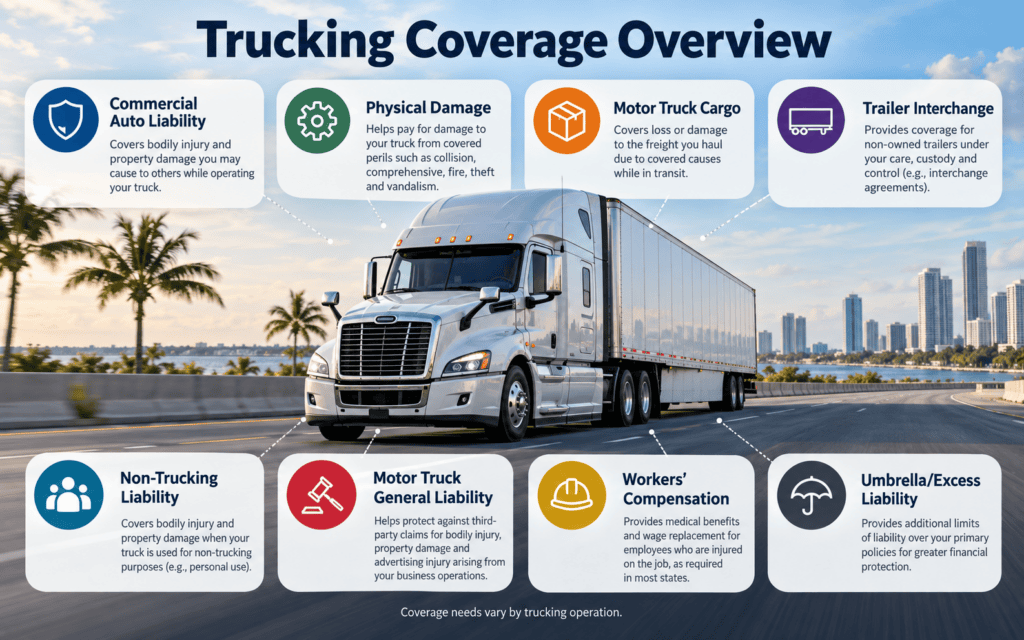 Common trucking insurance coverages can protect different parts of a motor carrier’s operation, from liability and equipment to cargo, trailers, employees, and higher liability limits.
Commercial Trucking Auto Liability Insurance
Commercial Trucking Auto Liability Insurance is one of the core coverages for motor carriers and owner-operators because a serious truck accident can result in substantial bodily injury or property damage claims.
Depending on the policy, Auto Liability coverage can help protect the insured trucking business when a covered vehicle is involved in an accident and the business or driver is legally responsible for injuries or damage to others.
Coverage is subject to the policy terms, limits, exclusions, endorsements, and the circumstances of the loss.
What Does Trucking Auto Liability Cover?
Commercial Trucking Auto Liability generally addresses third-party liability arising from the ownership, maintenance, or use of covered commercial vehicles.
A covered claim may involve:
-
Bodily injury to another driver, passenger, pedestrian, or other person
-
Damage to another vehicle
-
Damage to buildings, guardrails, signs, utility equipment, or other property
-
Certain legal defense costs associated with a covered liability claim
The policy does not insure the trucking company’s own truck against physical damage. Protection for the insured vehicle itself is generally addressed through Physical Damage Insurance.
Trucking Liability Is Different From Ordinary Commercial Auto
A trucking operation can present substantially different exposures from a business that simply owns a few service vehicles.
Trucks may travel longer distances, operate across state lines, carry heavy or high-value freight, pull trailers, operate overnight, and spend significantly more time on the road.
The potential severity of an accident can also be much greater because of vehicle size, weight, cargo, and the number of other vehicles or people involved.
For those reasons, trucking businesses are often underwritten differently from ordinary Commercial Auto risks.
Who Is Driving Matters
Driver quality is one of the most important factors in trucking insurance.
Insurers may review each driver’s:
-
Commercial driver’s license status
-
Driving experience
-
Motor vehicle record
-
Accident and violation history
-
Age and licensing history
-
Experience with the specific vehicle and type of freight
-
Prior employment or trucking experience
A trucking company’s ability to hire and retain qualified drivers can materially affect both insurance availability and premium.
The Vehicles Must Be Accurately Scheduled
The insurance company should have accurate information about the trucks and tractors being operated.
Relevant information can include vehicle identification numbers, year, make, model, gross vehicle weight, ownership or lease status, garaging location, and how the vehicle is used.
Adding, replacing, selling, or leasing trucks can change the exposure, so the policy should be updated as the fleet changes.
Operating Radius Can Affect Liability Exposure
A truck operating locally within a limited radius may present a different exposure from one regularly traveling throughout Florida, across the Southeast, or nationwide.
Longer trips can involve more miles, more time on the road, different traffic conditions, overnight travel, and increased driver-fatigue exposure.
Insurers may therefore consider both the typical and maximum operating radius when underwriting the account.
Commodities Hauled Can Affect Liability Underwriting
The freight being transported can also influence the liability risk.
Some commodities may increase vehicle weight, require specialized handling, create environmental exposure, or increase the severity of an accident.
Hazardous materials, oversized loads, automobiles, heavy equipment, refrigerated goods, and other specialized freight can require additional underwriting and may be subject to different regulatory or insurance requirements.
Liability Limits Should Match the Operation
The appropriate Auto Liability limit depends on more than what a trucking company would prefer to purchase.
Federal or state financial-responsibility requirements may apply depending on the carrier’s operation, vehicle weight, commodities hauled, and authority.
Shippers, freight brokers, lenders, or contracts may also require limits that exceed the minimum required by law.
We will address federal and Florida liability requirements separately in the next several sections.
Legal Defense Can Be a Significant Part of a Claim
A serious truck accident can lead to extensive investigation and litigation.
Depending on the policy, Commercial Trucking Auto Liability may provide legal defense for covered claims in addition to amounts paid for covered settlements or judgments.
Businesses should understand how defense expenses are handled and whether they reduce the liability limit.
One Accident Can Involve Several Types of Coverage
A trucking accident can create more than one insurance claim.
For example, the same loss might involve:
-
Auto Liability for injuries or damage to others
-
Physical Damage for the insured truck
-
Motor Truck Cargo for damaged freight
-
Trailer coverage for damage to the trailer
-
Workers’ Compensation for an injured employee driver
-
Umbrella or Excess Liability if the primary liability limit is exhausted
This is why trucking insurance should be reviewed as a coordinated program rather than as one isolated Auto Liability policy.
Coverage Should Reflect the Actual Trucking Business
A one-truck local carrier can have very different liability needs from an interstate motor carrier operating multiple tractors and trailers.
The insurance program should reflect the actual vehicles, drivers, routes, commodities, operating authority, contracts, and regulatory requirements of the business.
How Much Liability Insurance Does a Trucking Company Need?
The amount of liability insurance a trucking company needs depends on the operation. There is no single liability limit that applies to every motor carrier.
Relevant factors can include whether the carrier operates interstate or only within Florida, vehicle weight, commodities hauled, operating authority, hazardous-material exposure, contractual requirements, and the amount of protection the business wants beyond any legal minimum.
Legal Minimums Are Only the Starting Point
Federal and state financial-responsibility rules can establish minimum liability requirements for certain trucking operations.
For example, FMCSA currently requires many for-hire interstate property carriers operating vehicles with a gross vehicle weight rating of at least 10,001 pounds and transporting non-hazardous property to maintain at least $750,000 in public liability financial responsibility. Certain hazardous-material operations can be subject to minimums of $1,000,000 or $5,000,000, depending on the commodity and circumstances.
These are regulatory minimums. They should not automatically be interpreted as the appropriate insurance limit for every trucking business.
Vehicle Weight Can Affect the Requirement
Vehicle size and weight can affect which financial-responsibility rules apply.
FMCSA’s current filing chart distinguishes between non-hazardous for-hire property carriers operating vehicles below 10,001 pounds and those operating vehicles at or above that threshold. Federal requirements also change for certain hazardous-material operations.
Florida has separate commercial-motor-vehicle financial-responsibility requirements for certain intrastate operations, with minimums that can vary according to gross vehicle weight and whether the vehicle is subject to federal U.S. Department of Transportation insurance regulations.
We will examine the federal and Florida requirements separately in the next two sections.
The Commodity Being Hauled Can Change the Requirement
What the truck carries can be just as important as the truck itself.
A carrier transporting ordinary non-hazardous freight may be subject to a different liability requirement from a business transporting oil, hazardous waste, certain hazardous materials, explosives, poison gas, or specified radioactive materials.
For that reason, a trucking company should not select its liability limit based solely on what another motor carrier purchases.
Contracts May Require More Than the Legal Minimum
A shipper, freight broker, logistics company, customer, lender, lease agreement, or other contract may require liability limits that are higher than the minimum required by law.
A carrier therefore needs to satisfy both applicable financial-responsibility requirements and the insurance obligations created by its contracts.
Before accepting a new hauling agreement, the business should review the insurance requirements to determine whether its current policy satisfies them.
A Minimum Limit May Not Be Enough for a Serious Truck Accident
Regulatory compliance and adequate business protection are two different questions.
A serious trucking accident can involve severe bodily injury, fatalities, multiple vehicles, extensive property damage, environmental cleanup, or several claimants.
The financial consequences can exceed a required minimum liability limit.
For that reason, trucking businesses should consider potential claim severity when determining whether limits above the regulatory minimum are appropriate.
Umbrella or Excess Liability Can Provide Additional Limits
A trucking company seeking greater liability protection may be able to purchase Commercial Umbrella or Excess Liability above qualifying underlying insurance.
The structure should be reviewed carefully because the Umbrella or Excess policy must properly coordinate with the underlying Commercial Auto Liability coverage.
Higher limits do not correct an exclusion or other gap in the primary trucking policy.
Operating Authority Matters
A motor carrier operating under its own authority may have federal filing and financial-responsibility obligations that differ from those of an owner-operator leased to another motor carrier.
FMCSA states that applicable insurance requirements depend on factors including the entity type, operating authority, cargo, and vehicle type, and that required financial-responsibility filings must be in place before applicable operating authority is granted.
An owner-operator leased to a motor carrier should review the lease carefully to determine which liability coverage the motor carrier provides and which insurance responsibilities remain with the owner-operator.
The Appropriate Limit Should Be Evaluated as Part of the Entire Operation
Determining how much trucking liability insurance to carry should involve more than choosing the lowest amount permitted by law.
The review should consider applicable federal and Florida requirements, vehicle size, commodities, operating radius, driver exposure, contractual requirements, assets at risk, potential claim severity, and whether additional Umbrella or Excess limits are appropriate.
The goal is to satisfy applicable requirements while selecting a liability structure appropriate for the trucking business itself.
Federal FMCSA Insurance Requirements for Interstate Motor Carriers
Trucking companies that operate in interstate commerce may be subject to federal financial-responsibility requirements administered by the Federal Motor Carrier Safety Administration (FMCSA).
The applicable requirement depends on several factors, including whether the business is a for-hire motor carrier, the type and weight of the vehicles operated, the commodities transported, and the authority under which the carrier operates.
A trucking business should not assume that every interstate carrier is subject to the same federal liability limit.
Many For-Hire Property Carriers Have Federal Liability Requirements
Under FMCSA’s current requirements, a for-hire property carrier transporting non-hazardous freight in interstate commerce is generally subject to the following minimum public-liability financial responsibility:
-
Vehicles with a GVWR of less than 10,001 pounds: $300,000
-
Vehicles with a GVWR of 10,001 pounds or more: $750,000
These requirements apply to qualifying for-hire property carriers and should not be interpreted as universal limits for every trucking operation.
Certain Hazardous Materials Require Higher Limits
Federal financial-responsibility requirements can increase substantially when a carrier transports certain hazardous materials.
FMCSA currently lists a $1,000,000 minimum for certain hazardous-material operations and a $5,000,000 minimum for specified higher-hazard commodities, including certain explosives, poison gases, and radioactive materials.
Whether a particular commodity triggers a higher requirement depends on its classification, quantity, vehicle, and the applicable federal regulations.
A carrier transporting hazardous materials should therefore determine the requirement based on the actual commodity rather than assuming the standard property-carrier limit applies.
Private Carriers and For-Hire Carriers Are Not Always Treated the Same
Federal financial-responsibility rules distinguish among different types of motor carriers.
For ordinary non-hazardous property transportation, the FMCSA filing requirements commonly associated with operating authority apply primarily to qualifying for-hire carriers.
Private carriers transporting certain hazardous materials can also become subject to federal financial-responsibility requirements.
This distinction is important because a private fleet transporting its own products may have different federal obligations from a for-hire motor carrier transporting property belonging to customers.
Household Goods Carriers Have Additional Requirements
For-hire household-goods motor carriers are subject to federal liability requirements and additional cargo-related financial-responsibility requirements.
FMCSA’s current filing chart lists a seven-hundred-fifty-thousand-dollar bodily injury and property damage requirement for qualifying household-goods carriers operating vehicles with a GVWR of at least 10,001 pounds, along with a separate federal cargo filing requirement.
Household-goods transportation therefore should not be treated exactly the same as ordinary general-freight trucking.
We will address federal cargo requirements separately in the Motor Truck Cargo sections of this page.
Operating Authority and Insurance Filings Are Connected
For motor carriers that require FMCSA operating authority, financial-responsibility filings are an important part of the authority process.
FMCSA states that it will not grant applicable operating authority until the required minimum level of financial responsibility is on file. After authority is granted, required filings must remain current to avoid potential revocation proceedings.
The motor carrier does not ordinarily submit the insurance filing itself. FMCSA requires the insurance company or other authorized financial-responsibility provider to make the applicable filing electronically.
BMC-91 and BMC-91X Provide Evidence of Liability Coverage
When liability insurance is used to satisfy the federal filing requirement, the insurer may make a filing with FMCSA using Form BMC-91 or BMC-91X, depending on the insurance arrangement.
These forms provide evidence to FMCSA that the required bodily injury and property damage financial responsibility is in place.
The BMC filing should not be confused with the MCS-90 endorsement attached to the motor carrier’s policy.
We will explain both in dedicated sections because they serve different purposes.
Federal Minimums Do Not Determine the Best Liability Limit
Meeting FMCSA’s minimum requirement does not necessarily mean the trucking company has selected enough liability protection for its business.
A serious commercial-truck accident can involve multiple vehicles, catastrophic injuries, fatalities, extensive property damage, or several claimants.
Freight brokers, shippers, customers, or contracts may also require liability limits greater than the federal minimum.
The trucking company should therefore distinguish between:
the amount required for regulatory compliance and the amount of liability protection appropriate for the operation.
Interstate Operations Should Be Identified Accurately
A trucking business should accurately disclose whether it operates interstate, intrastate, or both.
The answer can affect operating authority, federal filings, underwriting, and insurance requirements.
The business should also disclose vehicle weights, commodities, hazardous-material exposure, operating radius, and authority status so the applicable requirements can be evaluated correctly.
Federal Requirements Can Change With the Operation
A carrier’s obligations can change if the business adds heavier vehicles, begins transporting different commodities, obtains new operating authority, enters interstate commerce, or begins hauling hazardous materials.
Federal compliance and insurance should therefore be reviewed when the trucking operation changes rather than only when the policy renews.
Florida Insurance Requirements for Intrastate Commercial Trucks
Trucking companies that operate only within Florida can still be subject to state financial-responsibility requirements even when they are not operating under federal interstate motor carrier authority.
For qualifying commercial motor vehicles operating on Florida roads, Florida Statute §627.7415 establishes minimum combined bodily injury and property damage liability insurance requirements based primarily on vehicle weight. If the vehicle or operation is subject to federal financial-responsibility rules under 49 C.F.R. Part 387, the applicable federal minimum applies instead.
Florida Minimum Liability Requirements by Vehicle Weight
For commercial motor vehicles that are not subject to the federal financial-responsibility requirements referenced in the statute, Florida currently establishes the following minimum combined bodily injury and property damage liability limits:
-
26,000 pounds or more, but less than 35,000 pounds: $50,000 per occurrence
-
35,000 pounds or more, but less than 44,000 pounds: $100,000 per occurrence
-
44,000 pounds or more: $300,000 per occurrence
These requirements are stated in Florida Statute §627.7415 and apply in addition to other insurance requirements that may apply to the vehicle or business.
Federal Requirements Can Override the Florida Weight-Based Minimum
A carrier should not automatically use the Florida weight-based limits simply because most of its driving occurs within Florida.
Florida Statute §627.7415 specifically provides that commercial motor vehicles subject to the U.S. Department of Transportation financial-responsibility rules under 49 C.F.R. Part 387 must maintain insurance equivalent to the applicable federal minimum.
This can be particularly important for for-hire motor carriers and carriers transporting certain hazardous materials.
The carrier’s operating status, commodities, vehicle configuration, and applicable federal regulations should therefore be identified before determining which minimum applies.
Intrastate Does Not Automatically Mean a Lower Insurance Requirement
A trucking company should not assume that staying within Florida automatically means it qualifies for one of the lower state limits.
Whether federal financial-responsibility requirements apply can depend on more than where the truck happens to travel on a particular day.
The business should determine whether its operation is subject to federal motor carrier regulations and whether any commodity-specific requirements apply.
State Minimums Should Not Be Confused With Recommended Limits
The limits in Florida Statute §627.7415 establish minimum financial-responsibility requirements for qualifying vehicles.
They do not necessarily represent an appropriate amount of liability insurance for a trucking company.
A serious truck accident can involve catastrophic bodily injury, multiple vehicles, fatalities, or substantial property damage that exceeds a statutory minimum.
Shippers, brokers, customers, lenders, leases, or other contracts may also require higher liability limits.
Contract Requirements Can Be Higher Than Florida Law
A motor carrier may satisfy Florida’s statutory minimum and still fail to meet the insurance requirements of a customer or business partner.
Freight brokers and shippers may require specified Auto Liability limits before allowing a carrier to haul loads under their contracts.
A trucking company should therefore review both:
the legal minimum required for the operation and the contractual limits required to conduct business.
Vehicle Weight Should Be Reported Accurately
The applicable Florida requirement depends in part on vehicle weight.
Trucking businesses should provide accurate information about the truck or tractor, including gross vehicle weight and vehicle configuration, when applying for insurance.
Changes in equipment can affect the applicable requirement.
A company that replaces a lighter vehicle with a heavier truck, adds tractor-trailers, or changes its operating model should review its insurance rather than assuming the existing policy remains sufficient.
Hazardous Materials Require Additional Review
A carrier transporting hazardous materials should not rely on Florida’s ordinary weight-based limits without determining whether federal hazardous-material financial-responsibility rules apply.
As discussed in the previous section, certain hazardous-material operations can be subject to significantly higher federal minimums.
The specific commodity, quantity, vehicle, and regulatory classification can all matter.
Private and For-Hire Operations Can Be Different
Florida’s commercial vehicle insurance requirements can apply to both private and for-hire commercial vehicles within the statutory framework, while federal financial-responsibility requirements can depend heavily on carrier type and commodities transported.
A company using heavy trucks to transport its own property may therefore have a different regulatory profile from a for-hire motor carrier transporting freight for customers.
The insurance program should reflect the actual operation rather than relying solely on whether the company describes itself as a trucking business.
Proof of Insurance Is Important for Commercial Vehicle Registration
Florida Highway Safety and Motor Vehicles maintains procedures for commercial motor vehicle insurance and requires qualifying commercial vehicle owners to provide evidence that applicable coverage is in force.
FLHSMV’s Commercial Motor Vehicle Insurance procedure reflects the same weight-based liability requirements contained in Florida law and identifies the higher federal requirements for vehicles subject to U.S. Department of Transportation financial-responsibility rules.
Maintaining accurate insurance information can therefore be important not only for claim protection but also for vehicle registration and regulatory compliance.
The Requirement Should Be Verified for the Individual Operation
Florida trucking insurance requirements can depend on the vehicle, weight, commodity, operating status, and whether federal regulations apply.
Before selecting liability limits, a trucking business should identify:
-
Whether the operation is intrastate, interstate, or both
-
Whether the carrier is private or for-hire
-
Gross vehicle weight
-
Commodities hauled
-
Hazardous-material exposure
-
Federal DOT regulatory status
-
Contractual liability requirements
The applicable legal minimum can then be considered alongside the amount of liability protection appropriate for the business.
What Is an MCS-90 Endorsement?
An MCS-90 endorsement is a federally required endorsement attached to certain motor carrier liability insurance policies to demonstrate compliance with the financial-responsibility requirements of the Motor Carrier Act of 1980 and 49 C.F.R. §387.15.
It is not a separate insurance policy and it should not be viewed as a substitute for properly structured Commercial Trucking Auto Liability coverage.
FMCSA states that the MCS-90 is attached to the motor carrier’s liability insurance policy rather than issued separately for individual vehicles.
What Does the MCS-90 Do?
The MCS-90 is designed to help satisfy federal public-liability financial-responsibility requirements.
Under the endorsement, the insurer agrees—within the stated limits—to pay certain final judgments entered against the insured motor carrier for public liability resulting from negligence in the operation, maintenance, or use of motor vehicles subject to the federal requirements. The endorsement states that this obligation can apply even when the particular vehicle involved is not specifically described in the policy.
In this context, the MCS-90 defines public liability to include:
-
Bodily injury
-
Property damage
-
Certain environmental restoration obligations
The applicable financial-responsibility limit depends on the type of carrier, vehicle, and commodity being transported.
The MCS-90 Is Not Broad Additional Insurance Coverage
One of the most important things for trucking businesses to understand is that an MCS-90 should not be treated as though it simply adds broad insurance coverage to an otherwise inadequate policy.
The underlying insurance policy continues to control the contractual relationship between the motor carrier and its insurance company.
The MCS-90 contains a reimbursement provision stating that the insured agrees to reimburse the insurer for certain payments the insurer would not otherwise have been obligated to make under the policy but for the MCS-90 endorsement.
That distinction can be extremely important after a serious loss.
Why the Reimbursement Provision Matters
Suppose the insurer is required under the MCS-90 to satisfy a qualifying final judgment even though the underlying policy would not otherwise provide coverage because of a policy condition, exclusion, or other issue.
The MCS-90 may protect the public by requiring the insurer to make the qualifying payment, but the endorsement can allow the insurer to seek reimbursement from the motor carrier for a payment it would not otherwise have owed under the policy.
For that reason, trucking companies should focus on having the underlying liability policy structured correctly rather than relying on the MCS-90 as a safety net for coverage gaps.
The MCS-90 Does Not Cover the Motor Carrier’s Cargo
The MCS-90 specifically states that the public-liability insurance provided through the endorsement does not apply to property being transported by the insured as cargo.
Cargo exposure should therefore be addressed separately through appropriate Motor Truck Cargo Insurance when needed.
The MCS-90 also does not replace Physical Damage coverage for the insured truck or tractor.
Employee Injuries Are Also Treated Separately
The endorsement also excludes injury to or death of the insured motor carrier’s employees while they are acting in the course of their employment.
Employee injury exposure may instead involve Workers’ Compensation, Employers Liability, Occupational Accident coverage, or another appropriate insurance arrangement depending on the business and employment relationship.
The MCS-90 Is Attached to the Motor Carrier’s Policy
FMCSA’s current MCS-90 identifies the motor carrier, the insurance company, the policy being amended, and whether the applicable insurance layer is primary or excess.
The endorsement is therefore tied directly to the motor carrier’s liability insurance arrangement and federal financial-responsibility obligations.
It should not be confused with a certificate showing that a particular truck has ordinary commercial auto insurance.
MCS-90 and BMC-91/BMC-91X Are Different
The MCS-90 and the federal insurance filing are related, but they do not serve the same function.
The MCS-90 is the endorsement attached to the motor carrier’s liability policy.
BMC-91 or BMC-91X is the electronic filing made with FMCSA by the insurer to provide evidence that the required public-liability financial responsibility is in place. FMCSA lists these forms separately in its registration and insurance-filing materials.
We will explain the BMC filings in more detail in the next section.
The Underlying Liability Policy Still Matters Most
A trucking company should not view the presence of an MCS-90 as evidence that every trucking liability exposure is properly insured.
The underlying policy should still be reviewed for the vehicles, drivers, operating radius, commodities, exclusions, covered operations, liability limits, and other terms that determine how the insurer responds to a claim.
The MCS-90 serves an important federal financial-responsibility function, but it does not eliminate the need for a properly designed trucking insurance program.
BMC-91, BMC-91X, and Federal Insurance Filings
Motor carriers that are required to maintain federal financial responsibility may also need proof of that coverage filed directly with the Federal Motor Carrier Safety Administration (FMCSA).
For bodily injury and property damage liability, BMC-91 and BMC-91X are federal insurance filings used to show that the motor carrier has the required public-liability financial responsibility in place. These filings are different from the MCS-90 endorsement discussed in the previous section.
What Is a BMC-91 Filing?
A BMC-91 is a certificate of insurance filed with FMCSA to demonstrate that a motor carrier has the full required amount of bodily injury and property damage liability financial responsibility.
Federal regulations provide that a BMC-91 can be used when the filing represents the full applicable security limit required for the carrier.
The filing does not replace the underlying Commercial Trucking Auto Liability policy. It serves as evidence to FMCSA that the required financial responsibility is in place.
What Is a BMC-91X Filing?
A BMC-91X can also be used as proof of bodily injury and property damage liability insurance.
Unlike the BMC-91, federal regulations allow the BMC-91X to represent either the full required amount or a portion of an aggregated insurance structure. When multiple insurers participate in providing the required limit, each participating insurer may make the appropriate BMC-91X filing for its portion of the coverage.
This can become relevant when a motor carrier’s required financial-responsibility limit is provided through more than one layer of insurance.
The Insurance Company Makes the Filing
The motor carrier generally does not file the BMC-91 or BMC-91X itself.
FMCSA requires these financial-responsibility filings to be submitted electronically by an authorized insurance company or other registered financial-responsibility filer. FMCSA specifically identifies BMC-91 and BMC-91X as forms used to make liability filings for bodily injury and property damage insurance.
After coverage is bound, the trucking business should confirm that the insurer has the information needed to make any required federal filing.
Operating Authority Can Depend on the Filing
For motor carriers that require FMCSA operating authority, obtaining the insurance policy alone may not be enough.
FMCSA states that it will not grant applicable operating authority until the required financial responsibility is on file with the agency. Once authority is granted, the required insurance filings must remain current to avoid possible revocation proceedings.
This makes filing accuracy and continuity especially important for motor carriers operating under their own authority.
BMC-91 and BMC-91X Are Not Certificates of Insurance for Customers
A federal BMC filing serves a regulatory purpose.
It should not be confused with an ordinary Certificate of Insurance, or COI, that a trucking company may provide to a shipper, freight broker, customer, landlord, or other business partner.
A COI generally summarizes certain policy information for commercial purposes. A BMC-91 or BMC-91X is filed with FMCSA to satisfy applicable federal financial-responsibility requirements.
The two documents serve different functions.
BMC Filings and the MCS-90 Work Differently
The MCS-90 and BMC-91/BMC-91X are closely related to federal financial responsibility, but they are not the same document.
The MCS-90 is an endorsement attached to the motor carrier’s liability insurance policy.
The BMC-91 or BMC-91X is the filing made with FMCSA to provide evidence that the required liability financial responsibility is in place. FMCSA’s own compliance materials distinguish the insurance filing from the MCS-90 endorsement.
A trucking business operating under federal authority may therefore encounter both as part of the same overall insurance and regulatory arrangement.
Other Federal Filings May Apply
BMC-91 and BMC-91X are not the only FMCSA financial-responsibility forms.
Depending on the type of operation, other filings can apply.
For example, qualifying household-goods carriers may be subject to a separate federal cargo filing requirement, while brokers and freight forwarders have different financial-responsibility forms.
FMCSA’s current filing chart identifies the required forms according to entity type, operating authority, vehicle type, and cargo.
A Filing Must Match the Motor Carrier Correctly
Federal insurance filings are associated with the motor carrier’s FMCSA registration and authority.
The business name, identifying information, coverage, and filing status should be accurate so the filing is properly associated with the motor carrier.
A discrepancy between the insurance policy and the carrier’s federal registration information can delay authority or create compliance problems.
Cancellation or Lapse Can Affect Operating Authority
A motor carrier that is required to maintain a federal insurance filing must keep the required financial responsibility in force.
If a required filing is canceled and replacement coverage is not properly filed, the carrier can face loss or revocation of operating authority.
Trucking businesses changing insurers should therefore coordinate policy effective dates and required filings carefully to avoid an unintended gap in federal financial-responsibility records.
Federal Filings Should Be Reviewed With the Liability Policy
Seeing an active BMC filing does not tell a trucking business everything it needs to know about its underlying insurance.
The actual liability policy should still be reviewed for limits, covered vehicles, drivers, operations, exclusions, endorsements, commodities, operating radius, and other terms.
The filing demonstrates federal financial responsibility. The policy determines the contractual insurance protection the carrier has purchased.
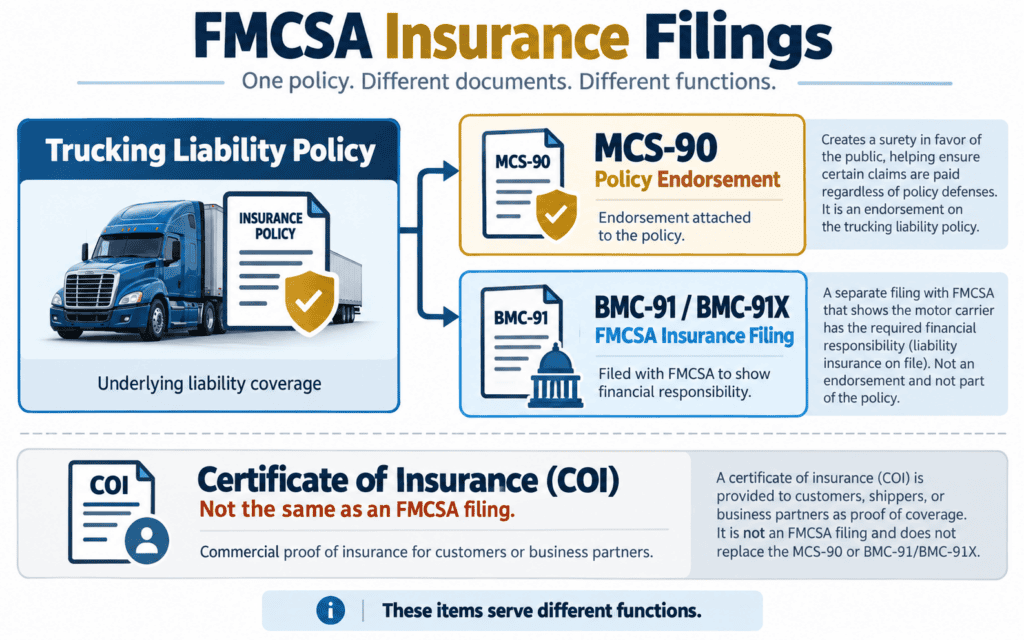 The liability policy, MCS-90 endorsement, and BMC-91 or BMC-91X filing serve different functions within federal motor carrier financial responsibility.
Physical Damage Insurance for Trucks and Tractors
Trucks and tractors can represent some of the most valuable assets in a trucking business.
Physical Damage Insurance can help pay for covered damage to an insured truck, tractor, or other scheduled vehicle, subject to the policy terms, deductibles, valuation method, exclusions, and circumstances of the loss.
This coverage is separate from Commercial Trucking Auto Liability, which is designed primarily to address certain claims involving injury or damage to others.
What Does Physical Damage Insurance Cover?
Physical Damage coverage is commonly divided into two main parts:
-
Collision coverage for certain damage caused by the insured vehicle colliding with another vehicle or object, or overturning.
-
Comprehensive or specified causes of loss coverage for certain non-collision losses such as theft, fire, vandalism, falling objects, or weather-related damage, depending on the policy.
The exact causes of loss covered can vary, so the policy wording should be reviewed carefully.
Liability Coverage Does Not Protect the Truck Itself
A trucking company can carry substantial Auto Liability limits and still have no insurance for damage to its own truck.
If a tractor is damaged in a collision, stolen, vandalized, or affected by another covered loss, liability insurance does not ordinarily pay to repair or replace the insured vehicle.
Physical Damage Insurance addresses that separate exposure.
Financed and Leased Trucks May Require Physical Damage Coverage
A lender or leasing company may require Physical Damage Insurance when a truck is financed or leased.
The financing agreement may also require the lender or lessor to be shown on the policy in the appropriate capacity.
The trucking business should review both the insurance policy and financing agreement so the coverage and valuation requirements are consistent.
Truck Values Should Be Reported Accurately
The value assigned to a truck can affect both the premium and the amount available after a covered total loss.
A trucking business should provide accurate information about the vehicle, including year, make, model, equipment, modifications, and other factors that materially affect its value.
Understating the value may create problems after a major loss, while overstating it does not necessarily mean the insurer will pay the scheduled amount if the policy uses another valuation method.
Agreed Value, Stated Amount, and Actual Cash Value Are Not the Same
Trucking policies can use different methods for valuing a damaged or totaled vehicle.
Depending on the policy, settlement may be based on actual cash value, a stated amount, an agreed value, or another valuation provision.
These terms should not be assumed to mean the same thing.
For example, a stated amount can sometimes function as a maximum limit rather than a guaranteed settlement amount. The actual policy language determines how a total loss is calculated.
Permanently Attached Equipment Should Be Considered
A truck may include expensive equipment beyond the base vehicle itself.
Depending on the operation, this can include:
-
Refrigeration units
-
Hydraulic systems
-
Liftgates
-
Specialized bodies
-
Mounted tool or storage systems
-
PTO equipment
-
Tarp systems
-
Custom racks
-
Other permanently installed equipment
The business should confirm whether this equipment is included in the insured value or requires separate scheduling or endorsement.
Deductibles Affect Both Premium and Out-of-Pocket Cost
Physical Damage coverage usually includes deductibles.
A higher deductible may reduce premium, but it also increases the amount the trucking business may need to absorb after a covered loss.
The deductible should be selected with the business’s cash flow and ability to handle an unexpected repair expense in mind.
Theft Exposure Can Be Significant
Commercial trucks and tractors can be attractive theft targets because of their value and mobility.
Theft exposure may be influenced by where the truck is garaged, whether it is left unattended overnight, security measures, geographic territory, and the type of equipment installed.
Insurers may consider these factors when determining eligibility, pricing, deductibles, or theft-related conditions.
Downtime Can Create a Second Financial Loss
Damage to the truck can create more than a repair bill.
If the vehicle is out of service, the trucking business may lose revenue while still facing loan payments, insurance costs, payroll, and other continuing expenses.
Physical Damage Insurance does not automatically replace lost income.
Rental Reimbursement, Downtime, or other specialized coverage may be available depending on the insurer and policy structure.
We will address those exposures separately later in this page.
Physical Damage Coverage Should Follow Fleet Changes
Trucking fleets change frequently.
Businesses may buy new tractors, sell older units, add specialized equipment, refinance vehicles, or change lease arrangements.
The policy should be updated as those changes occur so the scheduled vehicles, insured values, and lienholder or lessor information remain accurate.
Coverage Should Reflect the Actual Equipment
A one-truck owner-operator with a financed tractor may have very different Physical Damage needs from a fleet operating multiple tractors, refrigerated units, dump trucks, or specialized hauling equipment.
The coverage should reflect the value of the equipment, financing arrangements, deductibles, attached equipment, and the financial impact of losing a truck after a covered loss.
Motor Truck Cargo Insurance
Motor Truck Cargo Insurance can help protect a trucking business against certain losses involving property or freight being transported in the carrier’s care, custody, or control.
For a for-hire motor carrier, cargo can represent a substantial financial exposure because the freight may belong to a shipper, manufacturer, distributor, broker customer, or another third party rather than to the trucking company itself.
Coverage is subject to the policy terms, cargo limits, deductibles, exclusions, commodity restrictions, and circumstances of the loss.
What Can Motor Truck Cargo Insurance Cover?
Depending on the policy, Motor Truck Cargo Insurance may help pay for certain direct physical loss or damage to covered freight while it is being transported.
Covered losses may involve events such as:
-
Collision or overturn
-
Fire
-
Theft
-
Certain weather-related losses
-
Damage during loading or unloading when included
-
Other covered causes of loss specified by the policy
The exact scope of protection varies significantly between insurers and policy forms.
Cargo Coverage Is Different From Auto Liability
Commercial Trucking Auto Liability primarily addresses certain bodily injury and property damage claims involving other people or property.
It does not ordinarily insure the freight being transported by the motor carrier.
For example, if a tractor-trailer overturns and damages both another vehicle and the customer’s cargo, the accident could involve separate coverage considerations:
-
Auto Liability for qualifying damage or injuries to others
-
Physical Damage for the insured tractor
-
Trailer coverage for the trailer
-
Motor Truck Cargo Insurance for the customer’s freight
Each coverage addresses a different exposure.
Cargo Limits Should Reflect the Maximum Value at Risk
Cargo limits should be based on the amount of property the trucking business could realistically be responsible for on a single load.
A carrier that normally hauls twenty-five-thousand-dollar loads may occasionally accept freight worth substantially more.
If the cargo limit is lower than the value of the shipment, the trucking company could face a significant uninsured exposure after a major loss.
Motor carriers should understand both their typical and maximum cargo values before selecting a limit.
The Commodity Being Hauled Matters
Cargo policies do not necessarily cover every type of freight automatically.
Insurers may ask what commodities the carrier transports and may restrict, exclude, or apply special terms to certain types of property.
Examples that can require additional review include:
-
Automobiles
-
Electronics
-
Alcohol
-
Pharmaceuticals
-
Refrigerated or temperature-sensitive products
-
Heavy machinery
-
Household goods
-
High-value consumer products
-
Tobacco
-
Certain building materials
-
Hazardous or specialized commodities
The trucking company should disclose the actual commodities it expects to haul rather than relying on a broad description such as “general freight.”
High-Value Cargo May Require Special Treatment
A standard cargo limit may not be sufficient for high-value shipments.
Some policies can impose per-item limits, theft sublimits, special deductibles, or additional security requirements for certain commodities.
A carrier accepting a new contract involving substantially higher-value freight should review its Cargo Insurance before hauling the load.
Theft Is an Important Cargo Exposure
Cargo theft can be a significant risk for motor carriers, particularly when freight is left unattended overnight or parked in unsecured locations.
Policies may contain conditions involving unattended vehicles, approved parking locations, locked trailers, security devices, or theft-prevention procedures.
A trucking company should understand those requirements because failure to comply with a policy condition can affect how a loss is handled.
Loading and Unloading Should Be Reviewed
Cargo can be damaged before the truck begins moving or after it arrives at the destination.
The policy should be reviewed to determine when coverage begins and ends and how loading, unloading, temporary storage, or terminal exposure is treated.
These provisions can be particularly important for businesses that load freight themselves or regularly hold cargo before final delivery.
Refrigerated Cargo Requires Additional Review
Temperature-controlled freight creates specialized cargo exposure.
A refrigeration-unit failure, temperature change, mechanical breakdown, or delay could result in spoilage even when there is no collision or traditional physical damage to the trailer.
Coverage for reefer breakdown, temperature change, and spoilage should be specifically verified rather than assumed to be included in ordinary Cargo Insurance.
We will address refrigerated trucking in more detail in Section 16.
Cargo Policies Can Contain Important Exclusions
Cargo insurance may contain exclusions or limitations involving certain commodities, unattended vehicles, dishonest acts, improper packaging, inherent vice, delay, temperature change, unexplained disappearance, or other circumstances.
The details vary by insurer and policy.
A trucking business should therefore compare more than the cargo limit and premium when evaluating coverage.
Deductibles May Vary by Type of Loss
Cargo policies commonly apply deductibles, and certain losses can be subject to different deductibles.
For example, theft or high-value commodities may be subject to a different deductible than an ordinary collision-related cargo loss.
The business should understand how much it may need to absorb before the insurer responds.
Shippers and Brokers May Require Cargo Insurance
Even when a particular cargo filing is not required by law, shippers, freight brokers, logistics companies, or other contracting parties may require the motor carrier to maintain Motor Truck Cargo Insurance.
The contract may specify a minimum cargo limit or require coverage for particular commodities.
A carrier should review those requirements before accepting the load.
A Certificate of Insurance Does Not Describe Every Cargo Restriction
A freight broker or shipper may request a Certificate of Insurance showing the carrier’s Cargo Insurance and limits.
The certificate can provide evidence that coverage exists, but it does not describe every exclusion, commodity restriction, deductible, or condition contained in the policy.
The trucking business should understand the actual policy terms rather than relying only on what appears on the certificate.
Cargo Coverage Should Match the Freight the Business Actually Hauls
A dry-van carrier transporting ordinary general merchandise can have very different cargo exposure from an auto hauler, refrigerated carrier, machinery hauler, or household-goods mover.
Motor Truck Cargo Insurance should be structured around the actual commodities, values, routes, theft exposure, loading arrangements, and contractual requirements of the trucking business.
Is Motor Truck Cargo Insurance Required?
Motor Truck Cargo Insurance is not federally required for most ordinary property motor carriers, but that does not mean a trucking company can safely operate without it.
Whether cargo coverage is legally required depends on the type of operation. Even when no federal cargo-insurance requirement applies, a shipper, freight broker, customer, lease, or transportation contract may require the motor carrier to maintain cargo insurance before it is allowed to haul the load.
Most General Freight Carriers Do Not Have a Federal Cargo Insurance Requirement
FMCSA’s current insurance filing requirements show no federal cargo-insurance requirement for most for-hire property carriers transporting ordinary non-hazardous freight. The same filing chart shows no general federal cargo requirement for the hazardous-material property-carrier categories listed there.
FMCSA also specifically states that Motor Carriers of Property, except Household Goods, must file proof of public liability insurance to obtain interstate operating authority but cargo insurance is not required by FMCSA for that category.
This distinction is important because liability insurance and cargo insurance protect different exposures.
Household Goods Carriers Are an Important Exception
FMCSA requires qualifying household goods motor carriers to maintain cargo financial responsibility and file proof with the agency. FMCSA identifies household goods carriers and household goods freight forwarders as the categories required to carry cargo insurance under its current rules.
Federal cargo financial responsibility for qualifying household-goods operations includes at least $5,000 for loss or damage to property carried on any one motor vehicle and $10,000 for losses or damage occurring at any one time and place.
Those regulatory amounts should not be confused with an appropriate cargo limit for a real shipment. The value of a household-goods load can be substantially higher.
Florida Has Separate Requirements for Intrastate Household Movers
Florida also imposes specialized requirements on businesses conducting intrastate household moves.
The Florida Department of Agriculture and Consumer Services states that Florida movers must maintain cargo legal liability coverage for loss or damage to household goods of not less than $10,000 per shipment, subject to limited alternatives available to certain small movers under Florida law.
This requirement applies to the specialized household-moving industry and should not be interpreted as a general cargo-insurance requirement for every Florida trucking company.
Brokers and Shippers May Still Require Cargo Insurance
For many trucking companies, the practical cargo-insurance requirement comes from the businesses providing the freight rather than from FMCSA.
A freight broker, shipper, manufacturer, distributor, logistics company, or other customer may require the carrier to maintain Motor Truck Cargo Insurance as a condition of the transportation agreement.
The contract may specify a minimum cargo limit and may also impose requirements involving particular commodities, deductibles, exclusions, theft protection, refrigeration, or other coverage terms.
A carrier that cannot satisfy those requirements may be unable to accept certain loads even though federal law does not otherwise require cargo coverage.
Contractual Limits Can Be Much Higher Than Regulatory Minimums
Cargo values vary dramatically.
A truckload of ordinary building materials may present a very different exposure from a load of automobiles, electronics, machinery, pharmaceuticals, refrigerated products, or other high-value goods.
A carrier should therefore select its cargo limit based on the maximum realistic value of freight at risk, not simply on whether a minimum filing requirement applies.
Cargo Insurance Can Protect the Carrier’s Financial Position
Even when cargo coverage is not legally required, the trucking company may still be responsible for loss or damage to freight under applicable law or contract.
A major cargo loss could involve damaged merchandise, theft, overturn, fire, refrigeration failure, loading damage, or another covered event.
Without appropriate cargo insurance, the motor carrier may have to absorb some or all of that financial loss itself.
The Policy Must Cover the Freight Actually Being Hauled
Having a Cargo Insurance policy does not necessarily mean every load is covered.
Commodity exclusions, high-value limitations, unattended-vehicle provisions, theft restrictions, refrigeration exclusions, geographic limitations, and other policy terms can materially affect coverage.
A trucking company should confirm that the commodities it actually hauls are acceptable under the policy and that the cargo limit reflects the potential value of the load.
Federal Cargo Filings Are Different From Ordinary Proof of Cargo Insurance
When a federal cargo filing is required for a qualifying household-goods carrier, Form BMC-34 may be filed electronically by the insurance company as proof of cargo liability insurance with FMCSA. FMCSA separately identifies BMC-34 as the form used for household-goods cargo filings.
That federal filing should not be confused with a Certificate of Insurance that a carrier provides to a freight broker, shipper, or other customer.
A COI may show that Cargo Insurance is in force, but the actual policy determines the commodities, limits, deductibles, exclusions, and conditions that apply.
Required and Recommended Are Two Different Questions
For most ordinary freight carriers, asking “Is Cargo Insurance required by FMCSA?” and asking “Should my trucking business carry Cargo Insurance?” can produce different answers.
Federal law may not require cargo coverage for the operation, while contracts and the financial exposure of hauling property belonging to others can make it an important part of the trucking insurance program.
The better approach is to evaluate the commodities, maximum load value, contracts, shipper and broker requirements, theft exposure, refrigeration exposure, and policy restrictions before deciding on the appropriate Cargo Insurance limit.
Refrigerated Trucks, Reefer Breakdown, and Spoilage Exposure
Refrigerated trucking creates additional insurance exposure because the value of a shipment can depend on maintaining the correct temperature throughout transportation.
A refrigerated trailer may be hauling food, beverages, pharmaceuticals, produce, frozen goods, or other temperature-sensitive products that can become unusable even when the truck and trailer suffer no visible physical damage.
For that reason, a standard Motor Truck Cargo policy should not automatically be assumed to provide adequate protection for every refrigerated load.
Reefer Breakdown Can Create a Major Cargo Loss
A mechanical or electrical failure involving a refrigeration unit can cause the temperature inside the trailer to rise or fall outside the acceptable range.
If the cargo spoils or is rejected as a result, the financial loss can be substantial.
Coverage for refrigeration breakdown, temperature change, or spoilage may need to be specifically included or endorsed onto the Cargo policy.
The exact protection varies by insurer, so the trucking business should confirm what causes of loss are actually covered.
Temperature Change Is Not Always Automatically Covered
A refrigerated trailer can lose temperature for several reasons.
The refrigeration unit might fail mechanically, electrical components may malfunction, fuel could be interrupted, a door may not seal properly, or another event could affect the trailer’s ability to maintain the required temperature.
A cargo policy may distinguish among these causes.
For example, a policy that covers mechanical reefer breakdown may not automatically cover every loss involving improper temperature.
The wording should be reviewed carefully rather than assuming all spoilage is insured.
Reefer Breakdown Endorsements Can Have Special Conditions
Coverage for refrigerated cargo may contain conditions that do not apply to ordinary dry freight.
Depending on the insurer, the policy may require the refrigeration unit to meet certain age or maintenance requirements, be inspected regularly, or have maintenance records available after a loss.
Coverage may also depend on how long the unit has been operating, whether temperature settings were appropriate, or whether the refrigeration equipment experienced an identifiable covered breakdown.
These conditions can materially affect a claim.
Maintenance Records Can Become Important
Preventive maintenance is particularly important for refrigerated trucking.
A carrier should maintain records showing inspections, repairs, servicing, and maintenance of refrigeration units.
Those records can help demonstrate that the equipment was properly maintained and may become important when an insurer investigates a spoilage or refrigeration-breakdown claim.
A history of poor maintenance can also create underwriting concerns.
Temperature Monitoring Can Help Document a Loss
Many refrigerated trucking operations use electronic temperature-monitoring systems, telematics, or data loggers to document conditions inside the trailer.
These systems can help identify temperature deviations and provide records showing what occurred before and during a loss.
Temperature records can also be important when a shipper or receiver rejects a load based on concerns that the product was exposed to unacceptable conditions.
A Rejected Load Does Not Automatically Mean the Cargo Policy Pays
A consignee may reject a refrigerated shipment because of temperature concerns, delivery delays, product condition, or another issue.
That rejection alone does not necessarily establish a covered Cargo Insurance loss.
The policy may require actual covered physical loss or damage, a qualifying refrigeration breakdown, or another insured cause of loss before coverage applies.
The business should understand how its policy treats rejected loads, suspected contamination, and temperature excursions.
Delay Can Be a Separate Coverage Issue
Refrigerated freight can be especially sensitive to delays.
Traffic accidents, mechanical problems, road closures, weather, loading delays, or other disruptions can extend transit time and increase the risk of spoilage.
However, ordinary delay is commonly treated differently from direct physical damage under Cargo Insurance.
A carrier should not assume that loss caused solely by late delivery will automatically be covered.
Pharmaceuticals and Other Sensitive Cargo May Require Specialized Coverage
Not all refrigerated cargo creates the same exposure.
Frozen food, fresh produce, dairy products, meat, beverages, and pharmaceuticals may have very different acceptable temperature ranges, values, handling requirements, and consequences if those requirements are not maintained.
High-value pharmaceuticals or other specialized commodities can require higher cargo limits, additional underwriting, or special policy terms.
The carrier should disclose the actual commodities it intends to transport.
Cargo Limits Should Reflect the Value of Refrigerated Loads
A refrigerated load can be worth substantially more than ordinary general freight.
The trucking company should evaluate both the typical and maximum value of refrigerated cargo it may carry.
A Cargo policy with an inadequate limit can leave the business exposed even when the cause of loss is otherwise covered.
The Trailer and Refrigeration Unit Need Separate Physical Protection
Motor Truck Cargo Insurance protects qualifying freight losses, but it does not replace Physical Damage coverage for the equipment itself.
A loss involving a refrigerated trailer could involve several separate coverages:
-
Physical Damage for the tractor
-
Trailer coverage for the refrigerated trailer
-
Equipment-related coverage for the refrigeration unit, depending on the policy
-
Motor Truck Cargo for covered damage to the freight
-
Reefer breakdown or spoilage coverage when included
Those protections should be coordinated so the business understands which policy addresses each part of the loss.
Refrigerated Trucking Should Be Underwritten as a Specialized Operation
A carrier that regularly transports temperature-sensitive freight should make that exposure clear during underwriting.
The insurer may want information about refrigeration-unit age, maintenance practices, temperature-monitoring systems, commodities, cargo values, operating radius, and prior spoilage losses.
The insurance program should reflect the actual refrigerated operation rather than treating the business as an ordinary dry-van carrier.
Trailer Interchange Insurance
Trucking companies do not always pull trailers they own.
A motor carrier may temporarily take possession of a trailer owned by another trucking company, shipper, lessor, or business partner and become responsible for damage to that trailer while it is in the carrier’s care, custody, or control.
Trailer Interchange Insurance can help cover certain physical damage to non-owned trailers when the trucking company is using them under a qualifying trailer interchange agreement, subject to the policy terms, limits, deductibles, exclusions, and contractual responsibility.
What Is a Trailer Interchange Agreement?
A trailer interchange agreement is an arrangement under which one motor carrier or trucking business takes possession of a trailer owned by another party and agrees to assume certain responsibility for that equipment while it is being used.
These arrangements are common in trucking because a carrier may need to pull trailers that belong to another motor carrier, shipper, or equipment provider.
The insurance policy should reflect whether the trucking company is actually operating under a trailer interchange agreement and what responsibility the agreement places on the carrier.
What Can Trailer Interchange Insurance Cover?
Depending on the policy, Trailer Interchange coverage may help pay for certain physical damage to a non-owned trailer caused by events such as:
-
Collision
-
Overturn
-
Fire
-
Theft
-
Vandalism
-
Certain weather-related losses
-
Other covered causes of loss
The exact causes of loss covered depend on the policy form.
Trailer Interchange Coverage Is Different From Cargo Insurance
Trailer Interchange Insurance protects the trailer itself, not the freight inside it.
If a borrowed or interchanged trailer is damaged in an accident and the cargo is also damaged, the loss may involve separate coverage:
-
Trailer Interchange coverage for qualifying damage to the non-owned trailer
-
Motor Truck Cargo Insurance for qualifying damage to the freight
-
Auto Liability for covered injury or damage to others
-
Physical Damage for the insured tractor
These coverages should not be assumed to be interchangeable.
The Trailer Interchange Limit Should Reflect the Value of the Equipment
The selected limit should reflect the value of the trailers the trucking business may be responsible for.
A standard dry van can present a different replacement-cost exposure from a refrigerated trailer, specialized flatbed, tank trailer, car-hauling trailer, or other high-value equipment.
The carrier should consider the maximum value of a non-owned trailer it may use, not only the value of the trailer it typically pulls.
Refrigerated Trailers Can Create Higher Equipment Values
Reefer trailers may be substantially more valuable because of their refrigeration units, controls, insulation, and specialized systems.
A Trailer Interchange limit that appears adequate for an ordinary dry van may not be sufficient for a refrigerated trailer.
The business should confirm whether permanently attached refrigeration equipment is included within the trailer value and how the policy treats damage to that equipment.
Deductibles Should Be Reviewed Carefully
Trailer Interchange coverage generally includes a deductible.
The deductible should be evaluated together with the potential value of the trailer and the trucking company’s ability to absorb an unexpected loss.
Certain causes of loss may also be subject to different deductibles or policy conditions.
The Written Agreement Matters
The trucking company should review the trailer interchange or equipment-use agreement carefully.
The contract may specify when responsibility for the trailer begins and ends, what types of damage the carrier is responsible for, and what insurance limits must be maintained.
The insurance policy should be coordinated with those contractual obligations rather than assuming the standard policy automatically satisfies every agreement.
Trailer Interchange Is Not the Same as Every Non-Owned Trailer Exposure
A trucking company may use non-owned trailers under several different arrangements.
Some trailers may be leased for an extended period. Others may be borrowed, rented, or used under a written interchange agreement.
Those arrangements can be treated differently by insurers.
A business should not assume that Trailer Interchange coverage is automatically the correct solution for every trailer it does not own.
Owned Trailers Need Different Protection
Trailer Interchange coverage is designed for certain non-owned trailer exposures.
Trailers owned by the trucking company generally need to be insured under the appropriate Physical Damage coverage or other scheduled equipment protection.
The policy should clearly identify which trailers are owned, leased, interchanged, rented, or otherwise non-owned.
Damage While Detached Should Be Reviewed
A trailer may be damaged while attached to a tractor or while temporarily detached and parked at a terminal, customer location, warehouse, or other site.
The policy should be reviewed to determine when Trailer Interchange coverage applies and whether any restrictions exist while the trailer is unattended, detached, stored, or located away from the insured’s premises.
The Coverage Should Match the Carrier’s Actual Trailer Use
A trucking company that rarely uses another carrier’s trailer can have very different needs from a business that routinely participates in trailer interchange arrangements.
The insurance program should reflect how often non-owned trailers are used, their maximum value, the type of trailers involved, contractual responsibility, operating territory, and applicable deductibles.
Owned, Leased, and Non-Owned Trailers
Trucking companies can use trailers under several different ownership and contractual arrangements, and the insurance should reflect who owns the equipment and who is financially responsible for damage.
A trailer may be owned by the trucking company, leased for a period of time, rented temporarily, borrowed, or used under a trailer interchange agreement. Those arrangements are not necessarily insured the same way.
Owned Trailers
Trailers owned by the trucking company generally need to be insured under the appropriate Physical Damage coverage.
Depending on the policy, the trailer may be specifically scheduled with an insured value and deductible.
The business should keep the policy updated as trailers are purchased, sold, replaced, or modified so the insurance accurately reflects the equipment in the fleet.
Leased Trailers
A trucking company may lease a trailer from an equipment provider, leasing company, or other business.
The lease agreement can determine who is responsible for physical damage, theft, maintenance, and other losses.
The insurance policy should be reviewed together with the lease so the trucking company understands whether the trailer needs to be scheduled, covered under a leased-equipment provision, or insured in another way.
Rented Trailers
Temporary trailer rentals can create a different exposure from long-term leases.
A carrier may rent a trailer for a short period because of seasonal demand, equipment breakdown, or an unusually large workload.
The business should not assume that a policy written primarily for owned equipment automatically covers every rented trailer.
The rental agreement and insurance policy should be reviewed before the equipment is used.
Non-Owned Trailers
A trucking company may pull trailers it does not own under arrangements other than a traditional lease.
Depending on the circumstances, the carrier may have legal or contractual responsibility for physical damage to that trailer.
The correct coverage can depend on how the trailer is obtained, how long it is used, and what agreement governs the arrangement.
Trailer Interchange Applies to Specific Arrangements
Trailer Interchange Insurance is designed for certain non-owned trailers used under a trailer interchange agreement.
It should not automatically be assumed to cover every leased, rented, borrowed, or otherwise non-owned trailer.
The exact arrangement should be disclosed so the insurer can determine how the equipment should be covered.
The Contract Determines Responsibility
A trailer agreement may specify who is responsible for damage caused by collision, theft, fire, vandalism, or other losses.
It may also require a specific insurance limit, deductible, or type of coverage.
The trucking company should understand those responsibilities before accepting possession of the trailer.
Trailer Values Can Vary Substantially
Not all trailers have similar values.
A dry van may have a significantly different replacement value from a refrigerated trailer, specialized flatbed, tank trailer, car carrier, or other specialty equipment.
The insurance limit should reflect the highest-value trailer the business may be responsible for rather than assuming every trailer creates the same exposure.
Permanently Attached Equipment Should Be Included in the Review
Trailers can include expensive permanently attached equipment such as refrigeration units, liftgates, hydraulic systems, tarping systems, specialized racks, or other components.
The business should confirm whether that equipment is included in the insured trailer value and how the policy responds if the attached equipment is damaged.
Trailer Damage and Cargo Damage Are Separate Exposures
Damage to the trailer and damage to the freight inside it can involve different insurance coverage.
For example:
-
Physical Damage may protect an owned trailer
-
Trailer Interchange may protect certain non-owned trailers
-
Motor Truck Cargo may protect qualifying freight losses
A single accident can therefore involve several separate coverage sections.
Detached and Unattended Trailers Should Be Reviewed
Trailers may be left at terminals, customer locations, warehouses, truck stops, or other locations while detached from the tractor.
The policy should be reviewed for any conditions or restrictions involving unattended or detached trailers.
Theft, vandalism, and weather exposure can become especially important when trailers are left away from the trucking company’s primary location.
Fleet Changes Should Be Reported Promptly
Trucking companies frequently add, replace, sell, lease, or rent trailers as business needs change.
Those changes can affect coverage and should be reported so the policy continues to reflect the equipment being used.
Waiting until renewal to update trailer information can create problems if a loss occurs involving equipment that was never properly added or disclosed.
Trailer Coverage Should Match the Actual Arrangement
The best way to determine the correct trailer coverage is to identify:
-
Who owns the trailer
-
How the trucking company obtained it
-
How long it will be used
-
Who is responsible for physical damage
-
The trailer’s value
-
Any contractual insurance requirements
-
Whether specialized equipment is permanently attached
The insurance can then be structured around the actual trailer exposure rather than applying one coverage approach to every type of equipment.
 The tractor, non-owned trailer, and freight can each require different coverage depending on ownership, contractual responsibility, and policy terms.
What Is Non-Trucking Liability Insurance?
Non-Trucking Liability Insurance is a specialized liability coverage commonly used by owner-operators who are leased to a motor carrier.
It can help provide liability protection when the owner-operator is using the truck for certain personal or non-business purposes and is not operating on behalf of the motor carrier, subject to the policy terms, exclusions, and circumstances of the loss.
It is not a replacement for the motor carrier’s primary trucking liability coverage.
Why Owner-Operators May Need Non-Trucking Liability
An owner-operator leased to a motor carrier may receive primary Auto Liability protection while operating on behalf of that carrier.
However, the owner-operator may still use the truck at times when it is not being operated for the motor carrier’s business.
For example, an owner-operator might use the tractor for a qualifying personal trip after returning home or for another non-business purpose.
Non-Trucking Liability can help address certain liability exposure during those periods when the motor carrier’s business-use liability coverage may not apply.
Non-Trucking Liability Is Based on How the Truck Is Being Used
One of the most important things to understand is that Non-Trucking Liability is generally based on the purpose of the trip, not simply whether a trailer is attached.
A tractor can be operating without a trailer and still be engaged in trucking business.
Likewise, a tractor may be physically connected to a trailer while being used in a situation that must be evaluated under the specific policy wording.
The actual activity taking place at the time of the accident can therefore be critical to determining which policy may respond.
Business Use Is Generally Outside the Purpose of Non-Trucking Liability
Non-Trucking Liability is not intended to provide primary liability protection while the owner-operator is hauling freight or otherwise operating on behalf of the motor carrier.
Activities such as transporting a load, traveling to pick up freight, repositioning equipment for a dispatch, or performing another business-related trip may fall outside the intended scope of Non-Trucking Liability coverage.
The exact distinction depends on the policy language and facts of the trip.
Deadheading Should Not Automatically Be Assumed to Be Non-Trucking Use
A driver traveling with an empty trailer—or traveling without a trailer—may still be engaged in motor carrier business.
For example, an owner-operator traveling to pick up a load or returning from a delivery under the motor carrier’s direction may still be performing a business function even though no freight is being hauled at that moment.
For that reason, empty does not necessarily mean non-business.
The coverage determination depends on why the truck was being operated.
Non-Trucking Liability Does Not Cover Physical Damage to the Tractor
Non-Trucking Liability addresses certain liability claims involving injury or damage to others.
It does not ordinarily pay to repair the owner-operator’s truck after a collision, theft, fire, or other physical loss.
Physical protection for the tractor is generally handled through Physical Damage Insurance.
An owner-operator may therefore need both coverages because they protect different exposures.
It Does Not Replace Motor Truck Cargo Insurance
Non-Trucking Liability also does not protect freight being hauled.
Cargo exposure is addressed separately through Motor Truck Cargo Insurance when applicable.
A trucking insurance program should keep these coverages distinct:
-
Auto Liability addresses certain liability while operating for the motor carrier.
-
Non-Trucking Liability addresses certain qualifying non-business use.
-
Physical Damage protects the insured truck against covered physical loss.
-
Motor Truck Cargo addresses qualifying damage to freight.
Lease Agreements Should Be Reviewed Carefully
Owner-operators should review their lease agreement with the motor carrier to understand what liability coverage the carrier provides and when that coverage applies.
The lease may address insurance responsibilities, deductibles, physical damage, occupational accident coverage, cargo, and other exposures.
A lease requirement for Non-Trucking Liability does not by itself explain every situation the policy will cover.
The actual insurance policy and the lease should be reviewed together.
Non-Trucking Liability Is Different From Bobtail Insurance
The terms Non-Trucking Liability and Bobtail Insurance are sometimes used as though they mean the same thing, but they can describe different exposures.
Non-Trucking Liability generally focuses on whether the truck is being used for a non-business purpose.
Bobtail terminology generally refers to operating a tractor without a trailer attached.
Those are not necessarily the same situation.
We will compare the two more closely in the next section.
Coverage Should Reflect the Owner-Operator’s Actual Arrangement
Non-Trucking Liability is most relevant when an owner-operator is leased to a motor carrier and needs liability protection for certain periods outside the carrier’s business operations.
The policy should be reviewed for definitions of business use, exclusions, covered vehicles, drivers, geographic territory, limits, deductibles or retentions, and any conditions imposed by the motor carrier’s lease.
The goal is to understand exactly when the motor carrier’s liability policy applies and when the owner-operator’s own coverage may need to respond.
Bobtail Insurance vs. Non-Trucking Liability
Bobtail Insurance and Non-Trucking Liability Insurance are not technically the same coverage, even though the terms are sometimes used interchangeably in the trucking industry.
The key difference is generally this:
Bobtail coverage focuses on whether the tractor is operating without a trailer attached. Non-Trucking Liability focuses on whether the truck is being used for a personal, non-business purpose.
Because insurers may use these terms differently, an owner-operator should always review the actual policy wording rather than relying only on the name of the coverage.
What Is Bobtail Insurance?
Bobtail coverage generally refers to liability protection while a tractor is being operated without a trailer attached.
The important distinction is that the tractor may still be engaged in trucking business.
For example, an owner-operator could be driving the tractor without a trailer after dropping one at a customer location or traveling to pick up another trailer.
Progressive Commercial distinguishes Bobtail coverage from Non-Trucking Liability by explaining that Bobtail can apply when a tractor is operated without a trailer, whether or not the driver is under dispatch.
What Is Non-Trucking Liability?
Non-Trucking Liability generally provides liability protection for certain personal, non-business use of a truck by an owner-operator who is leased to a motor carrier.
The determining issue is usually why the truck is being driven—not whether a trailer is attached.
Examples of potentially qualifying personal use could include using the tractor while off duty for a personal errand or other activity unrelated to the motor carrier’s business, subject to the actual policy terms.
Progressive describes Non-Trucking Liability as protection for permanently leased owner-operators while using the truck for personal, non-business purposes.
Bobtailing Can Still Be Business Use
This is where the two coverages are frequently confused.
Suppose an owner-operator delivers a trailer and then drives the tractor without a trailer back to the terminal.
The truck is physically bobtailing because no trailer is attached.
However, the driver may still be operating for a business purpose.
That means the trip should not automatically be assumed to qualify for Non-Trucking Liability simply because the tractor has no trailer.
A Tractor Without a Trailer Is Not Automatically Off Duty
Whether a trailer is attached does not, by itself, determine whether the owner-operator is conducting motor carrier business.
Trips involving dispatch, returning to a terminal, repositioning equipment, traveling for a load, fueling, maintenance, or other business-related activity may fall outside Non-Trucking Liability coverage depending on the policy.
Progressive specifically notes that activities such as traveling to or from a terminal, fueling, maintenance, servicing, layovers, deadheading, and washing the truck may be considered business use under its Non-Trucking Liability form.
This is why the purpose of the trip should be evaluated carefully.
Deadheading Is Different From Bobtailing
The trucking terms deadhead and bobtail are also sometimes confused.
Bobtail generally refers to a tractor operating without a trailer attached.
Deadheading generally refers to operating without freight or a revenue-producing load. A truck may be deadheading while pulling an empty trailer.
An empty trailer does not turn the trip into personal use.
If the truck is being repositioned for the motor carrier or traveling to obtain another load, the operation can still be business-related.
Unladen Liability Is Another Coverage to Understand
Some trucking insurance programs also use the term Unladen Liability.
OOIDA distinguishes Unladen Liability from Bobtail Liability by describing Unladen coverage as applying while the truck is operating with an empty trailer attached or without a trailer, subject to the particular coverage terms.
This provides another reason not to rely solely on informal trucking terminology.
Depending on the insurer, the available options may be labeled Non-Trucking Liability, Bobtail Liability, Unladen Liability, or another variation, and the coverage triggers may differ.
A Simple Way to Understand the Difference
For general comparison purposes:
-
Bobtail: Is the tractor being driven without a trailer?
-
Non-Trucking Liability: Is the truck being used for a qualifying personal, non-business purpose?
-
Unladen: Is the tractor operating without cargo, potentially with or without an empty trailer, depending on the policy?
Those descriptions are useful starting points, but the insurance policy ultimately determines coverage.
Neither Coverage Replaces Primary Trucking Liability
Bobtail or Non-Trucking Liability should not be treated as substitutes for the Primary Auto Liability coverage required when a truck is being operated on behalf of a motor carrier.
An owner-operator leased to a motor carrier should determine when the carrier’s Primary Liability coverage applies and what secondary liability coverage the lease requires.
OOIDA likewise advises leased owner-operators to review their motor carrier lease for requirements involving Bobtail, Non-Trucking, Unladen, or other secondary liability coverage.
Neither Coverage Protects the Truck Against Physical Damage
Bobtail and Non-Trucking Liability are liability coverages.
They do not ordinarily pay to repair or replace the owner-operator’s tractor after a collision, theft, fire, vandalism, or other covered physical loss.
That exposure is addressed separately through Physical Damage Insurance.
Likewise, these liability coverages do not replace Motor Truck Cargo Insurance for freight or Trailer Interchange coverage for qualifying non-owned trailers.
The Motor Carrier Lease Should Be Reviewed
A leased owner-operator should review the motor carrier agreement carefully to determine:
-
What Primary Liability coverage the motor carrier provides
-
When that coverage applies
-
Whether Non-Trucking, Bobtail, or Unladen Liability is required
-
What limits must be maintained
-
Who is responsible for purchasing the coverage
The insurance policy should then be compared with those requirements.
Do Not Rely on the Coverage Name Alone
The terminology used in trucking insurance is not always consistent between insurers, motor carriers, agents, and drivers.
A policy marketed as “Bobtail Insurance” may not necessarily provide exactly the same protection as another insurer’s product using the same name.
For that reason, the most important questions are what activities trigger coverage, what constitutes business use, which vehicles and drivers are insured, and what exclusions apply.
Understanding those details is more important than relying on the label printed on a quote.
 Bobtail generally describes a tractor operating without a trailer, while Non-Trucking Liability generally focuses on qualifying personal, non-business use. The policy wording ultimately controls coverage.
Motor Truck General Liability
Motor Truck General Liability Insurance can help protect a trucking business against certain third-party liability claims arising from business operations that are not primarily caused by the ownership, maintenance, or use of a covered commercial vehicle.
It is different from Commercial Trucking Auto Liability and should not be treated as a substitute for it.
What Can Motor Truck General Liability Cover?
Depending on the policy, Motor Truck General Liability may help address certain claims involving:
-
Bodily injury to third parties
-
Property damage to third parties
-
Premises-related liability
-
Certain loading or unloading activities
-
Operations performed away from the truck
-
Personal and advertising injury
-
Legal defense costs for covered claims
The exact scope of coverage depends on the policy form, exclusions, endorsements, and circumstances of the loss.
General Liability and Auto Liability Cover Different Exposures
One of the most important distinctions is that Motor Truck General Liability is not intended to replace Commercial Auto Liability.
Auto Liability generally addresses claims arising from the ownership, maintenance, or use of covered vehicles.
General Liability can address other business-related liability exposures that fall outside the auto policy.
For example, a trucking company could face a premises-liability claim involving a visitor at its office or terminal even though no truck accident occurred.
Premises Liability Can Matter for Trucking Businesses
Trucking operations may maintain offices, yards, terminals, warehouses, parking areas, or other business premises.
A customer, vendor, delivery person, contractor, or other visitor could be injured on the property and allege that the trucking business was responsible.
Depending on the policy, Motor Truck General Liability may help respond to certain covered premises-related claims.
Loading and Unloading Can Create Coverage Questions
Loading and unloading freight can create complicated liability situations because both General Liability and Commercial Auto policies may contain provisions affecting how those activities are treated.
A claim could involve:
-
Damage to a customer’s property
-
Injury to a third party
-
Freight handling
-
Use of forklifts or other equipment
-
Loading docks
-
Employees or contractors assisting with the load
The applicable policy can depend on how the accident occurred and the specific wording of the Auto and General Liability forms.
A trucking business should not assume every loading or unloading incident automatically falls under one policy.
Work Performed at Customer Locations Can Create Exposure
Drivers and employees may enter warehouses, distribution centers, construction sites, manufacturing facilities, or other customer locations.
An incident involving property damage or injury could occur while the employee is performing a task unrelated to driving the truck.
Motor Truck General Liability may help address certain covered claims arising from those business activities.
Personal and Advertising Injury May Also Be Included
Depending on the policy, General Liability coverage may include protection for certain personal and advertising injury claims.
These can involve allegations such as certain forms of defamation, advertising injury, or other covered offenses defined by the policy.
This is a different exposure from bodily injury or vehicle-related liability.
Motor Truck General Liability Does Not Cover Everything
General Liability policies can contain important exclusions involving auto liability, workers’ compensation, professional services, pollution, cargo, property in the insured’s care, custody, or control, and other exposures.
For trucking businesses, the auto exclusion is especially important because vehicle-related liability is generally intended to be handled under the Commercial Auto policy.
Cargo being transported also should not automatically be assumed to be protected by General Liability.
Cargo and Property in the Carrier’s Care Need Separate Coverage
A trucking business may be responsible for property belonging to customers while it is being transported.
General Liability often contains limitations or exclusions affecting property in the insured’s care, custody, or control.
Motor Truck Cargo Insurance is generally the more relevant coverage for qualifying loss or damage to freight being hauled.
This is another reason trucking businesses need coordinated policies rather than relying on one liability form for every exposure.
Independent Contractors Can Create Additional Liability Exposure
Trucking businesses may use owner-operators, contract drivers, maintenance providers, loading services, or other outside contractors.
A claim involving one of those parties could create questions about responsibility, contractual obligations, additional insured status, and which policy applies.
Contracts and Certificates of Insurance should be reviewed when outside parties perform work on behalf of the trucking business.
General Liability Limits Should Coordinate With Umbrella Coverage
If the trucking business carries Commercial Umbrella or Excess Liability, Motor Truck General Liability may be one of the underlying policies scheduled beneath it.
The business should confirm that the required underlying limits are maintained and that the Umbrella actually applies over the General Liability exposure.
A higher Umbrella limit does not automatically correct exclusions in the underlying policy.
Coverage Should Reflect the Trucking Company’s Actual Operations
A trucking company with only one owner-operator and no separate business premises may have different General Liability needs from a larger motor carrier with terminals, employees, loading operations, contractors, and customer-facing facilities.
The policy should reflect where the business operates, what employees and drivers do away from the vehicle, whether loading or unloading occurs, and what third-party premises exposures exist.
Pollution, Hazardous Materials, and Environmental Liability
Trucking businesses can face environmental liability when an accident, spill, leak, or other event releases fuel, chemicals, hazardous materials, or other substances into the environment.
These losses can involve more than damage to another vehicle or building. A serious release may require emergency response, containment, cleanup, soil or water remediation, disposal, regulatory reporting, and other costly measures.
For carriers that transport hazardous materials, the exposure can be especially significant and may require specialized insurance beyond ordinary Commercial Trucking Auto Liability.
Pollution Exposure Is Not Limited to Hazmat Carriers
A trucking company does not have to specialize in hazardous materials to face a pollution-related loss.
A truck accident could release diesel fuel, engine fluids, cargo, or other substances onto a roadway, adjoining property, drainage system, waterway, or surrounding land.
Depending on the circumstances, the carrier may face costs involving cleanup, environmental restoration, third-party property damage, or government response.
The U.S. Environmental Protection Agency notes that parties responsible for the transportation of hazardous substances or oil can be liable for containment, cleanup, and certain damages resulting from a release associated with their activities.
Hazardous Materials Can Trigger Higher Federal Insurance Requirements
Motor carriers transporting certain hazardous materials can be subject to substantially higher federal financial-responsibility requirements than carriers hauling ordinary non-hazardous freight.
Under current FMCSA requirements, qualifying hazardous-material operations may require $1,000,000 or $5,000,000 in public-liability financial responsibility depending on factors such as the commodity, vehicle, quantity, and type of transportation.
The carrier should determine the applicable requirement based on the actual material being transported rather than assuming the standard non-hazardous freight limit applies.
Hazardous-Material Exceptions Do Not Always Remove Financial-Responsibility Requirements
A hazardous material may qualify for an exception from certain packaging, placarding, or other hazardous-material regulations and still remain subject to federal financial-responsibility requirements.
FMCSA explains that if a commodity still meets the federal definition of a hazardous material, applicable Part 387 financial-responsibility requirements may continue to apply even when another hazardous-material regulatory exception is available.
This is another reason carriers should evaluate the specific commodity rather than relying only on whether placards are required.
The MCS-90 Includes Environmental Restoration Within Public Liability
The federal MCS-90 endorsement defines public liability to include bodily injury, property damage, and environmental restoration.
Its definition of environmental restoration includes certain costs arising from the accidental discharge, dispersal, release, or escape of a commodity transported by the motor carrier, including removal and measures necessary to minimize or mitigate certain environmental and human-health damage.
However, the MCS-90 should not be interpreted as broad standalone Pollution Liability Insurance.
As discussed earlier on this page, it is a federal financial-responsibility endorsement attached to the motor carrier’s liability policy and contains provisions that can require the insured to reimburse the insurer for certain payments that would not otherwise have been covered under the policy.
Auto Liability May Not Address Every Pollution Exposure
Commercial Trucking Auto policies can contain pollution exclusions, exceptions, endorsements, and definitions that determine how a spill or environmental claim is handled.
Coverage may depend on what substance was released, whether it was cargo, where the release occurred, how the release happened, and whether the claim arose from the ownership, maintenance, or use of a covered vehicle.
A trucking business should not assume that carrying the required Auto Liability limit means every cleanup or environmental claim is insured.
Transportation Pollution Liability May Be Needed
For trucking businesses with meaningful environmental exposure, specialized Transportation Pollution Liability or other pollution coverage may be appropriate.
Depending on the policy, this type of coverage may help address certain claims involving accidental releases during transportation, loading, unloading, or related activities.
Coverage can vary considerably, so important issues may include:
-
Materials or commodities covered
-
Cleanup and remediation expenses
-
Third-party bodily injury or property damage
-
Loading and unloading
-
Non-owned disposal locations
-
Emergency response costs
-
Policy territory
-
Limits and deductibles
-
Exclusions involving known pollution conditions or intentional releases
The coverage should be structured around the carrier’s actual environmental exposure.
Loading and Unloading Can Create Environmental Risk
Pollution incidents do not occur only during highway accidents.
A release can happen while a tanker, truck, or trailer is being loaded or unloaded at a terminal, customer facility, distribution center, construction site, fuel location, or other premises.
Responsibility can become complicated when several businesses participate in the loading or unloading process.
The trucking company’s contracts and insurance should address those operations when they are part of the carrier’s business.
Cleanup Costs Can Be Substantial
Environmental losses can escalate quickly.
A relatively small release may require emergency contractors, containment materials, excavation, disposal, environmental testing, or regulatory involvement.
A larger incident affecting soil, groundwater, surface water, or a waterway can create much more significant financial exposure.
Insurance limits should therefore be evaluated in relation to potential cleanup severity, not just the physical value of the truck or cargo.
Spill Reporting and Emergency Response Can Be Required
Certain hazardous-substance releases can trigger federal, state, or local reporting obligations.
EPA states that transportation owners or operators may have emergency-notification responsibilities following qualifying releases, and certain CERCLA hazardous-substance releases may require notification to the National Response Center.
Trucking companies transporting regulated materials should maintain appropriate emergency-response and reporting procedures rather than trying to determine those requirements for the first time after an accident.
Contracts May Require Specialized Pollution Coverage
Shippers, manufacturers, chemical companies, government entities, construction companies, and other customers may require a trucking company to maintain Pollution Liability or specific environmental limits as a condition of hauling certain commodities.
Those requirements can exceed the carrier’s basic regulatory obligations.
The insurance provisions should be reviewed before accepting the contract or load so the trucking company understands whether its existing policy satisfies the requirement.
The Commodity Should Be Disclosed Accurately
Accurate commodity information is particularly important when hazardous materials or pollution-sensitive freight is involved.
The insurer may need information about:
-
The material being transported
-
Hazardous-material classification
-
Quantity
-
Packaging or tank configuration
-
Vehicle type
-
Operating radius
-
Loading and unloading responsibilities
-
Prior spill or environmental losses
-
Emergency-response procedures
A material change in commodities should be discussed with the insurer before the trucking company begins hauling the new freight.
Environmental Coverage Should Match the Actual Operation
A dry-van carrier transporting ordinary consumer goods may have very different pollution exposure from a fuel hauler, chemical carrier, waste transporter, tanker operation, or motor carrier hauling other regulated materials.
The insurance program should reflect the specific commodity, vehicle, regulatory requirements, contracts, potential cleanup exposure, and environmental liability associated with the operation.
Workers’ Compensation for Florida Trucking Businesses
Trucking employees can face significant workplace injury exposure both on the road and away from the vehicle.
Drivers may be injured while entering or exiting a truck, loading or unloading freight, securing cargo, coupling trailers, performing inspections, handling equipment, or responding to roadside problems. Mechanics, dispatch employees, warehouse workers, and other staff can create additional workplace exposures.
Workers’ Compensation Insurance can help provide benefits for qualifying work-related injuries and occupational illnesses, including certain medical expenses and wage-replacement benefits, subject to Florida law and the circumstances of the claim.
When Is Workers’ Compensation Required for a Florida Trucking Business?
Trucking businesses are generally treated as non-construction employers for Florida Workers’ Compensation purposes.
Florida generally requires a non-construction employer with four or more employees, whether full-time or part-time, to maintain Workers’ Compensation coverage, subject to rules concerning business ownership, exemptions, and entity structure.
A trucking company should not assume it is exempt simply because some drivers work part-time or because the business operates only a small fleet.
Drivers Face Risks Beyond Highway Accidents
A driver’s workplace exposure extends well beyond a collision involving the truck.
Work-related injuries can occur while:
-
Climbing into or out of the cab
-
Connecting or disconnecting trailers
-
Opening trailer doors
-
Securing or tarping freight
-
Loading or unloading cargo
-
Using liftgates or other equipment
-
Inspecting the truck or trailer
-
Handling chains, straps, or other cargo-securement equipment
-
Performing roadside tasks
-
Slipping or falling at terminals, customer locations, or loading docks
Whether a particular injury qualifies for Workers’ Compensation benefits depends on the facts and applicable law.
Workers’ Compensation and Auto Liability Protect Different Exposures
Commercial Trucking Auto Liability and Workers’ Compensation serve different purposes.
Auto Liability generally addresses certain bodily injury or property damage claims involving third parties.
Workers’ Compensation addresses qualifying work-related injuries and occupational illnesses involving employees.
For example, a truck accident could simultaneously involve Auto Liability claims from another driver and a Workers’ Compensation claim from an employee driver injured in the same accident.
Employers Liability Is Also Important
Workers’ Compensation policies generally include Employers Liability coverage in addition to statutory Workers’ Compensation benefits.
Employers Liability can address certain employee injury claims that fall outside the exclusive benefits provided under Workers’ Compensation law, subject to the policy terms and limits.
Trucking businesses carrying Commercial Umbrella or Excess Liability should also review whether Employers Liability is scheduled beneath the higher-limit policy when appropriate.
Owner-Operators and Independent Contractors Require Careful Review
Trucking businesses frequently work with owner-operators and drivers who are described as independent contractors.
That description alone does not necessarily determine a worker’s status for Florida Workers’ Compensation purposes.
Florida’s Division of Workers’ Compensation states that non-construction industries have specific statutory criteria for determining independent-contractor status. Simply calling a worker an independent contractor does not automatically eliminate Workers’ Compensation obligations.
The actual working relationship should therefore be evaluated rather than relying solely on a contract label or tax form.
A Form 1099 Does Not Automatically Settle the Question
A trucking company should not assume that issuing a worker a Form 1099 automatically establishes that the individual is an independent contractor for Workers’ Compensation purposes.
Relevant facts can include how the work relationship is structured and whether the individual satisfies Florida’s applicable independent-contractor criteria.
Misclassification can create insurance, premium, and compliance problems.
Business Owners and Exemptions Should Be Evaluated Separately
Florida provides certain Workers’ Compensation exemption options for qualifying corporate officers and LLC members.
An exemption applies to the individual who qualifies and receives it; it is not a blanket exemption for the entire business. Florida’s Division of Workers’ Compensation explains that exempt officers or members are no longer treated as employees for purposes of the Workers’ Compensation law and generally cannot recover Workers’ Compensation benefits through that exemption.
Sole proprietors and partners in non-construction businesses are treated differently and may elect coverage under Florida’s rules.
The trucking business should review its entity structure and exemption status rather than assuming that an owner’s status automatically determines the requirements for everyone else.
Occupational Accident Is Not the Same as Workers’ Compensation
Some owner-operator or independent-contractor arrangements use Occupational Accident Insurance.
Occupational Accident coverage can provide specified benefits for certain work-related injuries, depending on the policy, but it is not the same as statutory Workers’ Compensation Insurance.
A trucking business should not assume that purchasing Occupational Accident coverage satisfies a Workers’ Compensation requirement when Florida law requires Workers’ Compensation.
The employment relationship, contract, and applicable state requirements should be evaluated separately.
Employee Duties and Payroll Affect Premium
Florida’s Division of Workers’ Compensation identifies payroll, the type of work employees perform, and the employer’s claims history as major factors affecting Workers’ Compensation premium.
For a trucking business, accurate job classifications can be particularly important because drivers, mechanics, warehouse employees, clerical staff, and other workers may present different exposures.
Payroll and job duties should be reported accurately and updated when staffing or operations change.
Driver Duties Should Be Described Accurately
Two truck drivers may have very different workplace exposures.
One driver may primarily transport sealed loads from terminal to terminal, while another may regularly load freight, operate a liftgate, secure flatbed cargo, enter construction sites, or perform other physical work.
Those differences should be described accurately during underwriting.
Misrepresenting or concealing payroll or employee duties can also create compliance problems. Florida’s Division of Workers’ Compensation states that employers operating without required coverage—or misrepresenting payroll or duties to avoid proper premium—can face enforcement action, including Stop-Work Orders and penalties.
Multistate Trucking Operations Need Additional Review
A Florida trucking company may have drivers who regularly travel through several states.
Workers’ Compensation requirements can vary by state, and a policy written only around Florida operations may need additional consideration when employees work outside Florida.
The business should disclose the states in which employees regularly work so the policy can be reviewed for appropriate state coverage and other-states provisions.
Workers’ Compensation Does Not Replace Workplace Safety
Workers’ Compensation Insurance does not replace the need for strong safety procedures.
Trucking businesses can reduce workplace risk through driver training, safe loading and unloading procedures, cargo-securement practices, equipment maintenance, proper lifting techniques, fall prevention, vehicle inspections, and clear procedures for roadside emergencies.
A strong safety program can help protect employees and reduce the frequency and severity of claims.
Coverage Should Keep Pace With the Business
A one-truck operation can eventually grow into a fleet with multiple drivers, dispatch staff, mechanics, or warehouse employees.
Employee counts, payroll, job duties, operating states, and ownership structure should be reviewed as the trucking company grows.
The Workers’ Compensation program should reflect the workforce the business actually has—not the workforce it had when the policy was first written.
Commercial Umbrella and Excess Liability
A serious trucking accident can create liability well beyond the limits of a primary insurance policy.
Commercial Umbrella or Excess Liability Insurance can provide additional liability limits above certain scheduled underlying policies, subject to the policy terms, exclusions, attachment points, and coverage structure.
For trucking businesses, this can be especially important because severe accidents may involve catastrophic injuries, multiple vehicles, fatalities, extensive property damage, or several claimants.
Why Higher Liability Limits May Matter
Commercial trucks can create high-severity losses because of their size, weight, operating mileage, and the amount of time they spend on public roads.
A major accident could exhaust the primary Commercial Trucking Auto Liability limit.
Umbrella or Excess Liability can provide an additional layer of protection when a qualifying underlying limit has been exhausted by a covered claim.
Umbrella and Excess Liability Are Not Always the Same
The terms Umbrella Liability and Excess Liability are sometimes used interchangeably, but the policies may not provide identical protection.
An Excess Liability policy may primarily provide additional limits above specifically scheduled underlying insurance.
An Umbrella policy may, depending on its wording, provide broader protection in certain circumstances.
The actual policy language should be reviewed rather than assuming the title alone determines how coverage works.
Commercial Auto Liability Is Often the Primary Underlying Coverage
For many trucking businesses, Commercial Trucking Auto Liability is the primary exposure beneath the Umbrella or Excess policy.
The higher-layer policy may require the carrier to maintain a specified minimum Auto Liability limit before the Umbrella or Excess coverage will apply.
If the required underlying limit is not maintained, the trucking business could be responsible for part of the difference.
Other Liability Policies May Also Be Scheduled Underneath
Depending on the trucking operation and insurance structure, the Umbrella or Excess policy may also sit above other underlying coverage such as:
-
Motor Truck General Liability
-
Employers Liability
-
Certain Pollution Liability coverage
-
Other specifically scheduled liability policies
The business should confirm which policies are actually listed as underlying insurance rather than assuming every liability policy automatically receives additional limits.
Cargo Insurance Is Separate From Liability Coverage
Motor Truck Cargo Insurance should not automatically be assumed to receive additional limits from a Commercial Umbrella policy.
Cargo coverage protects property being transported in the carrier’s care, custody, or control and is generally structured separately from third-party liability coverage.
A trucking company needing higher Cargo limits should address that exposure directly under the Cargo policy rather than assuming the Umbrella will increase the available Cargo limit.
Physical Damage Is Also Separate
Commercial Umbrella and Excess Liability do not ordinarily increase Physical Damage limits for the insured truck, tractor, or trailer.
Physical Damage coverage should be evaluated separately based on the value of the equipment.
The same principle generally applies to Trailer Interchange and other property-type coverages.
Pollution Exposure Requires Careful Review
Trucking businesses with hazardous-material or environmental exposure should verify how the Umbrella or Excess policy treats pollution-related claims.
A primary policy may provide a specific pollution endorsement or Transportation Pollution Liability coverage, but the Umbrella may contain its own pollution exclusion or may not automatically follow that protection.
A higher overall liability limit does not necessarily mean the business has higher pollution limits.
Contract Requirements May Drive Higher Limits
Freight brokers, shippers, logistics companies, customers, lenders, government entities, or other contracting parties may require liability limits above the trucking company’s primary policy.
An Umbrella or Excess policy can sometimes help satisfy those requirements.
The contract should be reviewed together with the insurance program to confirm that the required underlying coverage is actually included beneath the higher limit.
Federal Minimums and Umbrella Limits Serve Different Purposes
Federal or Florida financial-responsibility requirements establish minimum limits for certain motor carrier operations.
An Umbrella or Excess policy addresses a different question: whether the trucking business wants or is contractually required to carry liability limits above those minimums.
Meeting the legal minimum does not prevent a trucking company from purchasing greater protection.
Likewise, carrying an Umbrella does not replace the need to maintain the required primary liability coverage and applicable federal filings.
Defense Costs Should Be Understood
A serious trucking claim can generate substantial legal expenses.
The business should understand how defense costs are treated under both the underlying policy and the Umbrella or Excess policy.
Depending on the policy structure, defense expenses may be paid outside the liability limit or may reduce the amount available for settlements or judgments.
That distinction can become particularly important in complex commercial trucking litigation.
Higher Limits Do Not Fix Underlying Coverage Gaps
One of the most important principles is that additional limits do not automatically correct exclusions or weaknesses in the underlying policy.
If the primary policy excludes a particular exposure, the Umbrella or Excess policy may also exclude it.
For example, purchasing a larger Umbrella limit does not automatically create broader pollution, Cargo, Non-Trucking Liability, or other specialized trucking coverage.
The quality of the underlying insurance matters just as much as the total amount of limits purchased.
Limits Should Reflect the Actual Trucking Operation
The appropriate Umbrella or Excess limit can depend on factors such as:
-
Fleet size
-
Vehicle weight
-
Operating radius
-
Interstate operations
-
Driver exposure
-
Commodities hauled
-
Hazardous-material exposure
-
Contractual requirements
-
Prior claims
-
Assets the business wants to protect
-
Potential severity of a major accident
A single-truck local operator may have very different needs from a large interstate fleet hauling high-value or specialized freight.
The Umbrella Should Be Reviewed With the Entire Liability Program
A trucking company’s higher-limit protection should be evaluated alongside Commercial Trucking Auto Liability, Motor Truck General Liability, Employers Liability, Pollution Liability when applicable, and contractual insurance requirements.
The goal is not simply to purchase a large headline limit.
The goal is to make sure the additional limits actually sit above the exposures the trucking business expects them to protect.
Rental Reimbursement, Downtime, and Towing Coverage
When a commercial truck is damaged or disabled, the financial impact can extend beyond the cost of repairing the vehicle.
A trucking business may lose revenue while the truck is out of service, incur towing expenses, or need to rent replacement equipment to continue operating.
Rental Reimbursement, Downtime, and Towing coverage can help address certain expenses associated with a covered loss or vehicle disablement, but these protections are not necessarily included automatically in Physical Damage Insurance and can vary significantly by insurer.
Physical Damage Does Not Automatically Replace Lost Revenue
Physical Damage Insurance can help pay to repair or replace a covered truck after certain collision, theft, fire, vandalism, or other insured losses.
However, repairing the truck does not compensate the business for every financial consequence of having the vehicle unavailable.
An owner-operator may still face:
-
Truck payments
-
Insurance premiums
-
Business overhead
-
Lost hauling revenue
-
Driver payroll
-
Contractual commitments
-
Replacement transportation expenses
Additional coverage may be needed for some of these costs.
What Is Rental Reimbursement Coverage?
Rental Reimbursement coverage can help pay certain costs of renting a replacement commercial vehicle while an insured truck is being repaired after a covered loss.
Coverage is generally subject to a daily limit, maximum benefit, covered-loss requirement, and other policy conditions.
The trucking business should review:
-
The maximum amount available per day
-
The total maximum benefit
-
How soon coverage begins
-
How long reimbursement can continue
-
Which types of rental vehicles qualify
-
Whether a covered Physical Damage loss is required
A rental reimbursement limit that appears adequate for an ordinary passenger vehicle may be insufficient for a commercial tractor or specialized truck.
Replacement Equipment May Not Always Be Easy to Find
A trucking company should also consider the practical availability of replacement equipment.
A standard box truck may be easier to rent than a specialized tractor, refrigerated unit, dump truck, auto hauler, or other purpose-built vehicle.
Even when Rental Reimbursement coverage is available, an appropriate replacement truck may not be immediately available.
The business should therefore consider both the insurance limit and the actual replacement-equipment market.
What Is Downtime Coverage?
Downtime coverage can help address certain financial losses when an insured commercial vehicle cannot be used because of a covered loss.
Depending on the policy, the coverage may provide a specified daily or weekly benefit during an eligible period of repair.
Downtime coverage should not automatically be assumed to reimburse the trucking company’s full lost revenue or profit.
The policy may provide a predetermined benefit subject to a maximum amount and waiting period.
Rental Reimbursement and Downtime Are Different
Rental Reimbursement and Downtime coverage serve related but different purposes.
Rental Reimbursement generally helps with the cost of renting substitute equipment.
Downtime coverage generally provides a specified benefit associated with the period the covered vehicle is out of service.
A trucking business may value one coverage more than the other depending on whether substitute equipment is realistically available and how dependent the company is on each truck for revenue.
A Disabled Truck Can Have a Significant Financial Impact on an Owner-Operator
Downtime can be particularly significant for a single-truck owner-operator.
If the only tractor is unavailable after a covered accident, the business may have little or no ability to generate hauling revenue until the truck is repaired or replaced.
A larger fleet may have more flexibility to shift drivers or loads among other vehicles.
The financial consequences of downtime should therefore be evaluated in relation to the size and structure of the trucking operation.
Towing Coverage Can Help After a Breakdown or Accident
Commercial truck towing can be expensive, particularly when a tractor-trailer must be recovered from a highway, accident scene, remote location, or difficult terrain.
Depending on the policy, towing or roadside assistance coverage may help with certain expenses associated with a disabled insured vehicle.
Available protection may include qualifying towing, jump-starts, tire-related assistance, fuel delivery, lockout assistance, or other emergency services depending on the insurer and policy.
Accident Recovery Is Different From Routine Roadside Towing
Not every towing expense is handled the same way.
A simple mechanical breakdown requiring a tow to a repair facility can present a different insurance issue from a major accident requiring heavy-duty wreckers, vehicle recovery, debris removal, cargo handling, or specialized equipment.
Some towing and recovery expenses may be addressed under Physical Damage or another portion of the insurance program when associated with a covered loss, while ordinary roadside breakdown may require separate towing or roadside coverage.
The policy should be reviewed to understand which situations qualify.
Heavy-Duty Towing Costs Can Be Significant
Recovering a tractor-trailer can involve substantially more expense than towing a passenger vehicle.
Costs can increase when:
-
The truck overturns
-
The trailer is loaded
-
Specialized recovery equipment is required
-
The vehicle leaves the roadway
-
Cargo must be transferred
-
Multiple wreckers are needed
-
The accident occurs far from the carrier’s usual operating area
Trucking businesses should review towing limits carefully rather than assuming a small roadside-assistance limit will cover a serious recovery.
Mechanical Breakdown Is Not the Same as Physical Damage
A truck can become disabled because of an accident or because of ordinary mechanical failure.
Physical Damage Insurance generally addresses covered physical losses, not routine wear, maintenance problems, or mechanical breakdown merely because the truck stops operating.
Separate roadside, towing, equipment-related, warranty, or mechanical protection may apply depending on the circumstances and available coverage.
Regular maintenance remains essential.
Trailer and Cargo Problems Can Increase Downtime
A tractor may be operational while a damaged trailer, refrigeration unit, or cargo problem prevents the truck from completing its trip.
Rental Reimbursement or Downtime coverage written for the tractor should not automatically be assumed to respond to every interruption involving a trailer or cargo.
The trucking company should understand which insured equipment triggers the coverage.
Waiting Periods and Maximum Benefits Matter
Rental Reimbursement and Downtime policies may contain waiting periods before benefits begin.
They can also limit how long benefits are payable or establish a maximum amount per covered loss.
For example, a coverage that provides a daily benefit may still stop after a specified number of days even if the truck remains in the repair facility longer.
Those limitations should be reviewed before a loss occurs.
Coverage Should Reflect How Dependent the Business Is on Each Truck
The importance of Rental Reimbursement and Downtime coverage depends heavily on the trucking operation.
A one-truck owner-operator may have substantial exposure when a single vehicle is unavailable.
A larger fleet may be able to move loads to other equipment, although losing a specialized truck can still create significant disruption.
The business should consider repair times, availability of replacement equipment, continuing expenses, revenue dependence, and the financial impact of having a truck out of service.
Cyber, ELD, Dispatch, and Transportation Technology Risks
Modern trucking businesses increasingly depend on technology to dispatch drivers, track vehicles, manage loads, communicate with customers, process payments, maintain electronic records, and comply with operational requirements.
A cyber incident can therefore create losses even when no truck, trailer, or cargo is physically damaged.
Cyber Insurance can help address certain financial, operational, and liability losses arising from covered cyber events, subject to the policy terms, limits, deductibles or retentions, exclusions, and circumstances of the incident.
Trucking Operations Depend on Connected Technology
A motor carrier may rely on several interconnected systems throughout a normal load.
These can include:
-
Electronic logging devices
-
Dispatch and transportation-management systems
-
GPS and telematics
-
Load boards
-
Fleet-management platforms
-
Fuel-card systems
-
Electronic payment systems
-
Customer and broker portals
-
Email and cloud-based applications
-
Driver mobile devices
A disruption affecting one critical system can interfere with dispatching, communication, billing, load visibility, or other parts of the operation.
Electronic Logging Devices Can Contain Valuable Operational Data
Electronic logging devices, or ELDs, are used by many motor carriers and drivers to record hours-of-service information and other required data.
Because ELD systems can interact with mobile devices, fleet-management platforms, GPS, and cloud services, access credentials and connected systems should be protected appropriately.
A compromised account could expose operational data, interfere with access to records, or become part of a broader cyber incident involving the trucking company.
Cyber Insurance should not be viewed as a substitute for maintaining secure ELD and technology practices.
Dispatch Systems Can Be Critical to Revenue
Dispatch software can become one of the most important operational systems in a trucking company.
Dispatchers may use it to assign loads, communicate with drivers, monitor equipment, track deliveries, maintain customer information, and manage scheduling.
If ransomware, malware, unauthorized access, or another cyber event makes the system unavailable, the carrier may have difficulty moving freight or coordinating drivers.
For a business operating a large fleet—or even a small company dependent on one dispatch platform—a technology outage can quickly become a revenue problem.
Cyber Business Interruption Should Be Reviewed
Traditional Business Income coverage is commonly associated with covered physical damage to property.
A cyber event can interrupt trucking operations without causing physical damage to a truck, terminal, or office.
Depending on the Cyber policy, Cyber Business Interruption coverage may help address certain lost income and extra expenses resulting from a covered technology outage.
Important issues can include:
-
What events trigger coverage
-
Whether a waiting period applies
-
How lost income is calculated
-
How long coverage continues
-
Whether outages involving outside technology providers are included
These provisions can vary substantially between policies.
Ransomware Can Disrupt an Entire Fleet
A ransomware attack can affect more than office computers.
A trucking company’s dispatch, accounting, customer records, email, billing, document storage, load-management systems, or other technology could become inaccessible.
Depending on the Cyber policy, coverage may help with certain incident-response costs, forensic investigation, system restoration, business interruption, extortion-related expenses, and other covered losses.
The actual protection depends on the policy and applicable legal requirements.
Fraudulent Load and Payment Schemes Create Additional Risk
Trucking and logistics businesses can also face fraud involving stolen identities, fake carriers, fraudulent load instructions, compromised email accounts, or deceptive payment requests.
A cybercriminal may impersonate a customer, broker, employee, or vendor in an attempt to redirect funds or obtain sensitive information.
Coverage for social engineering, fraudulent instruction, computer fraud, or funds-transfer fraud should be reviewed specifically because those losses may not be handled the same way under every Cyber or Commercial Crime policy.
Load Boards and Broker Portals Can Be Targeted
Motor carriers may use online load boards, broker portals, and transportation marketplaces to locate freight and exchange documentation.
Compromised credentials can create opportunities for unauthorized account access, fraudulent load activity, altered payment information, or theft of business information.
Trucking companies should use unique credentials, strong password practices, and multi-factor authentication where available.
Fuel Cards and Electronic Payments Create Financial Exposure
Fuel cards, electronic payments, ACH transactions, and other digital financial tools can make trucking operations more efficient, but they can also create fraud exposure.
Unauthorized fuel purchases, compromised account credentials, fraudulent payment instructions, or altered banking information can result in substantial losses.
Cyber Insurance and Commercial Crime Insurance may respond differently depending on how the loss occurred.
The two coverages should therefore be reviewed together.
Customer, Driver, and Employee Information Can Be Exposed
Trucking companies may maintain personal or confidential information involving drivers, employees, customers, brokers, vendors, or business partners.
Depending on the operation, records may include driver’s-license information, payroll information, tax documents, banking details, motor vehicle records, contact information, employment records, and customer data.
A breach involving that information can create notification, legal, forensic, regulatory, or reputational expenses depending on the circumstances.
Third-Party Technology Providers Can Create Contingent Risk
Many trucking companies rely on outside vendors for dispatch, ELDs, telematics, payroll, accounting, cloud storage, payment processing, or transportation-management software.
A cyber event affecting one of those vendors can disrupt the trucking company even when the carrier’s own systems were not directly attacked.
Depending on the policy, dependent business interruption or similar coverage may help address certain qualifying outages involving important technology providers.
That protection should be confirmed rather than assumed.
Cybersecurity Controls Can Affect Insurance Underwriting
Cyber insurers increasingly evaluate how businesses protect their systems before determining eligibility, pricing, and coverage terms.
For a trucking company, underwriting may consider controls such as:
-
Multi-factor authentication
-
Secure backups
-
Employee access controls
-
Software and security updates
-
Email security
-
Password practices
-
Incident-response planning
-
Driver-device security
-
Vendor access
-
Network protections
The business should answer Cyber Insurance applications accurately because the insurer may rely on those representations when underwriting the policy.
Drivers and Mobile Devices Can Create Additional Exposure
Drivers often communicate with dispatchers, customers, brokers, and vendors through smartphones, tablets, or other mobile devices.
Those devices may contain business email, load information, customer contacts, login credentials, or access to fleet-management systems.
Lost, stolen, or compromised devices can therefore create cyber exposure away from the trucking company’s office or terminal.
Businesses should consider mobile-device security as part of the overall cyber program.
Cyber and Commercial Crime Coverage Should Work Together
Technology-related losses can fall into a complicated area between Cyber Insurance and Commercial Crime Insurance.
For example, ransomware, stolen customer information, fraudulent wire transfers, social-engineering scams, fuel-card fraud, and employee theft may involve different policy triggers.
A trucking company should review these coverages together to understand which types of losses are covered, excluded, or subject to separate sublimits.
Technology Risk Should Be Treated as an Operational Exposure
Cybersecurity is no longer only an office or IT concern for trucking businesses.
ELDs, dispatch systems, mobile devices, telematics, electronic payments, cloud platforms, and transportation-management software have become part of normal fleet operations.
The insurance program should therefore consider both the physical risks of trucking and the technology risks that can interrupt or financially harm the business.
Cargo Theft, Crime, and Fraud Exposure
Trucking companies can face financial losses from more than collisions and damaged freight.
Cargo theft, fraudulent pickups, stolen identities, payment fraud, employee dishonesty, fictitious carriers, and other criminal schemes can create significant losses even when the truck itself is never damaged.
Because these events can involve several different policies, a trucking business should not assume that Motor Truck Cargo, Cyber Insurance, or Commercial Crime Insurance automatically covers every theft or fraud scenario.
Cargo Theft Can Occur in Several Ways
Cargo theft is not limited to a trailer being stolen from a parking lot.
A loss may involve:
-
Theft of an entire tractor-trailer
-
Theft of a trailer
-
Cargo removed from a parked trailer
-
Pilferage of individual items
-
Fictitious pickup
-
Fraudulent carrier substitution
-
Identity theft involving a legitimate motor carrier
-
Theft during temporary storage
-
Dishonest acts involving employees or contractors
The way the loss occurs can determine which policy, if any, may respond.
Motor Truck Cargo Insurance May Cover Certain Theft Losses
Motor Truck Cargo Insurance can help protect qualifying freight against certain covered theft losses.
However, coverage may be subject to important conditions involving:
-
Unattended vehicles
-
Locked trailers
-
Approved parking locations
-
Security devices
-
Theft-prone commodities
-
High-value cargo
-
Geographic restrictions
-
Time limits
-
Special deductibles
A policy can appear to include theft coverage while still placing significant restrictions on when that coverage applies.
Unattended Vehicle Conditions Deserve Careful Review
Trucking businesses frequently leave equipment at terminals, truck stops, customer facilities, distribution centers, warehouses, and other locations.
Some Cargo policies may restrict theft coverage when a vehicle or trailer is left unattended or parked outside specified locations.
Those provisions can be especially important for high-value freight or commodities that are frequent theft targets.
A trucking company should understand what the policy considers an unattended vehicle and whether special security procedures are required.
Fictitious Pickup Is a Different Type of Theft
A fictitious pickup can occur when a criminal impersonates a legitimate motor carrier, driver, broker, or other transportation party and obtains possession of a load through fraud.
The shipment may be released voluntarily because the shipper or broker believes the person collecting it is legitimate.
That can create a different coverage issue from a traditional theft involving forced entry or stolen equipment.
Cargo policies vary significantly in how they treat fictitious pickup, fraudulent bills of lading, identity theft, or voluntary parting with property.
These exposures should be reviewed specifically if the trucking business handles high-value freight or works through load boards and broker networks.
Double Brokering Can Create Additional Fraud Exposure
Double brokering can occur when a load is transferred to another carrier without proper authorization or disclosure.
In some cases, this can be part of a legitimate but unauthorized subcontracting arrangement. In other cases, it can be connected to fraud, stolen carrier identities, nonpayment, or cargo theft.
The insurance implications can become complicated if the carrier actually transporting the freight is different from the carrier shown in the original contract.
Motor carriers should verify who is authorized to transport the load and understand whether subcontracting or re-brokering is permitted.
Carrier Identity Theft Can Affect Legitimate Trucking Companies
Criminals may steal or misuse a legitimate motor carrier’s name, DOT number, MC number, insurance information, or other identifying details.
A fraudulent operator may then pose as that carrier to obtain loads, redirect payments, or commit cargo theft.
This can create reputational, operational, and financial problems for the legitimate carrier even when it was not directly involved in the shipment.
Strong account security, verification procedures, and prompt response to suspicious activity can help reduce the risk.
Load Boards Can Create Additional Fraud Exposure
Online load boards and broker platforms are central to many trucking operations, but they can also be targeted by criminals.
Compromised login credentials may allow someone to impersonate a carrier, alter contact information, accept fraudulent loads, or redirect payments.
Motor carriers should use strong passwords, multi-factor authentication where available, and verification procedures for unusual load instructions or account changes.
Cyber Insurance and Commercial Crime Insurance may address different parts of these exposures depending on how the fraud occurs.
Commercial Crime Insurance Can Address Different Losses
Commercial Crime Insurance can help protect a trucking business against certain theft, fraud, or dishonest acts that may not be handled under Motor Truck Cargo Insurance.
Depending on the policy, available coverage may include:
-
Employee theft
-
Forgery or alteration
-
Computer fraud
-
Funds-transfer fraud
-
Social engineering
-
Theft of money or securities
-
Other covered crime losses
These coverages are not automatically included in every policy and may be subject to separate limits, sublimits, and deductibles.
Employee Theft Should Not Be Overlooked
Trucking businesses may have employees or contractors with access to fuel cards, customer payments, cargo, bank information, company accounts, or other valuable property.
Employee dishonesty can involve fuel theft, fraudulent purchases, theft of freight, false reimbursements, unauthorized transfers, or other schemes.
A Commercial Crime policy can help address certain employee theft losses, but the policy definitions and proof requirements should be reviewed carefully.
Fuel Card Fraud Can Create Significant Losses
Fuel cards are convenient but can become a target for fraud.
Losses may involve stolen cards, cloned credentials, compromised PINs, unauthorized purchases, or internal misuse.
Coverage for fuel-card fraud may fall under a Crime policy, Cyber policy, card-provider program, or another arrangement depending on how the loss occurred.
A trucking company should not assume that every unauthorized fuel purchase is automatically insured.
Fraudulent Payment Instructions Can Affect Trucking Businesses
A criminal may impersonate a broker, customer, vendor, employee, or executive and attempt to redirect payment to a fraudulent account.
These schemes may involve hacked email accounts, altered invoices, spoofed messages, or social-engineering tactics.
Coverage can vary depending on whether the loss is classified as social engineering, computer fraud, funds-transfer fraud, or another type of crime.
The business should review these protections specifically rather than relying only on broad Cyber Insurance.
High-Value Commodities Create Additional Theft Exposure
Certain commodities are more attractive to thieves because they are portable, valuable, or easy to resell.
Examples can include electronics, pharmaceuticals, alcohol, tobacco, consumer products, automotive parts, and other high-value freight.
Cargo insurers may impose higher deductibles, special theft conditions, security requirements, or commodity restrictions for these loads.
A carrier should confirm coverage before accepting freight that is substantially more valuable or theft-sensitive than its normal business.
Security Procedures Can Reduce Cargo Theft Risk
Insurance should complement practical theft-prevention procedures.
Trucking businesses should consider:
-
Secure parking
-
Trailer locks
-
GPS tracking
-
Geofencing
-
Driver check-in procedures
-
Load-verification protocols
-
Credential verification
-
Multi-factor authentication
-
Restricted account access
-
Prompt reporting of suspicious activity
These controls can also be relevant to insurance underwriting.
Cargo, Cyber, and Crime Coverage Should Be Reviewed Together
A cargo theft or fraud loss can involve several overlapping exposures.
For example, a criminal might compromise a load-board account, impersonate a legitimate carrier, obtain possession of freight, and redirect payment information.
That incident could potentially involve Motor Truck Cargo, Cyber Insurance, Commercial Crime, or contractual claims depending on the facts and policy language.
The trucking business should review these coverages together so it understands where gaps may exist.
Coverage Should Reflect the Trucking Company’s Actual Fraud Exposure
A one-truck carrier hauling ordinary local freight can have a very different theft and fraud exposure from a larger motor carrier using multiple dispatchers, online load boards, high-value cargo, outside contractors, and electronic payment systems.
The insurance program should reflect how freight is booked, who has system access, what commodities are hauled, where equipment is parked, how payments are processed, and what security controls are in place.
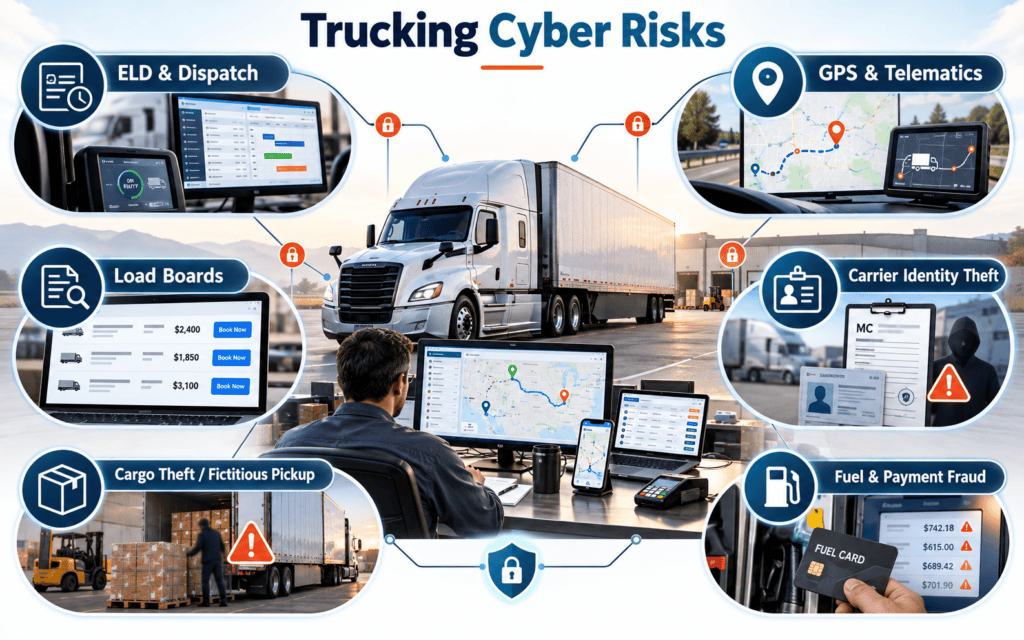 Technology and fraud risks can affect dispatch, ELDs, load boards, payments, and cargo even when no truck or trailer is physically damaged.
Owner-Operators Leased to a Motor Carrier
An owner-operator who leases a truck and driving services to an authorized motor carrier can have a very different insurance structure from a trucking company operating under its own authority.
Under a typical lease arrangement, the owner-operator provides the equipment—and often the driver—while the motor carrier operates the equipment under its authority. The motor carrier may provide certain liability protection while the owner-operator is operating on its behalf, but that does not mean every exposure involving the owner-operator, truck, trailer, cargo, or driver is automatically insured.
The lease and the actual insurance policies should be reviewed together.
Federal Rules Govern Many Owner-Operator Lease Arrangements
Federal leasing regulations generally require an authorized motor carrier using equipment it does not own to operate under a written lease that complies with 49 C.F.R. Part 376.
Among other requirements, the lease must provide that the authorized carrier has exclusive possession, control, and use of the equipment for the duration of the lease and assumes responsibility for its operation during that period. Federal regulations also make clear that these leasing provisions do not, by themselves, determine whether the owner-operator or driver is an employee or independent contractor.
The Motor Carrier Has a Public-Liability Insurance Obligation
Federal leasing regulations specifically require the lease to state the authorized motor carrier’s legal obligation to maintain insurance protecting the public in accordance with applicable federal financial-responsibility requirements.
FMCSA has also stated that a motor carrier cannot satisfy its own financial-responsibility obligation merely by relying on an owner-operator’s policy and MCS-90 with the motor carrier named as an additional insured. The authorized motor carrier remains responsible for meeting the applicable federal financial-responsibility requirement.
That does not mean the motor carrier’s policy provides every type of insurance the owner-operator may need.
The Lease Should Identify Who Provides Other Insurance
Federal regulations require the lease to specify who is responsible for other insurance involving the leased equipment, including coverage such as bobtail insurance.
If the motor carrier charges the owner-operator for insurance provided through the carrier, the lease must identify the charge. When an owner-operator purchases insurance through the authorized carrier, the federal leasing rules also contain requirements concerning policy information and Certificates of Insurance.
For that reason, the insurance section of the lease deserves careful review before the owner-operator begins hauling.
Primary Liability Does Not Protect the Owner-Operator’s Truck
The motor carrier’s public-liability coverage is intended to address liability to the public. It should not be assumed to pay for damage to the owner-operator’s tractor.
An owner-operator may need Physical Damage Insurance for collision, theft, fire, vandalism, and other covered damage to the truck.
If the tractor is financed or leased, the lender or lessor may also require Physical Damage coverage.
Non-Trucking Liability May Still Be Needed
When the owner-operator is no longer operating on behalf of the motor carrier and uses the truck for a qualifying personal or non-business purpose, the motor carrier’s business Auto Liability protection may not apply.
Depending on the lease and policy structure, the owner-operator may need Non-Trucking Liability Insurance for that exposure.
As discussed earlier, the determination should be based on the actual policy language and purpose of the trip—not simply whether the truck is empty or whether a trailer is attached.
Bobtail and Unladen Requirements Should Be Verified
Some motor carriers require leased owner-operators to maintain Bobtail, Non-Trucking Liability, Unladen Liability, or another form of secondary liability coverage.
Those terms should not automatically be treated as interchangeable.
The owner-operator should determine exactly which coverage the motor carrier requires, what activities trigger that coverage, and how it coordinates with the carrier’s primary liability policy.
Physical Damage Deductibles and Claims Procedures Matter
When Physical Damage Insurance is provided through the motor carrier’s insurance program, the owner-operator should understand the deductible, vehicle valuation method, claims procedure, and any amounts deducted from settlements.
The lease and insurance documents should make clear what the owner-operator is paying for and what protection is being provided.
A charge appearing on a weekly settlement statement should not be treated as a substitute for understanding the underlying policy.
Cargo Insurance Responsibilities Should Be Confirmed
The motor carrier may maintain Motor Truck Cargo Insurance for freight transported under its authority, but the owner-operator should not simply assume every commodity, load, or type of loss is covered.
Cargo limits, deductibles, commodity exclusions, theft restrictions, refrigeration provisions, and other policy terms can affect the protection available.
The lease may also establish circumstances under which the motor carrier can deduct amounts from an owner-operator’s settlement for cargo or property damage. Federal leasing rules require the lease to specify conditions governing certain deductions.
Trailer Coverage Depends on the Equipment Arrangement
A leased owner-operator may pull trailers belonging to the motor carrier, shipper, customer, or another party.
Responsibility for physical damage to those trailers should be identified in the lease and insurance program.
Depending on the arrangement, Trailer Interchange, non-owned trailer coverage, or another form of physical damage protection may be appropriate.
Occupational Accident and Workers’ Compensation Are Different
Some leased owner-operators purchase Occupational Accident Insurance rather than being insured as employees under a Workers’ Compensation policy.
Occupational Accident Insurance and statutory Workers’ Compensation are not the same.
Which arrangement is appropriate depends on the working relationship, applicable law, motor carrier requirements, and policy structure. Describing a driver as an independent contractor in a lease does not by itself resolve every employment or Workers’ Compensation question.
Insurance Charges Through the Motor Carrier Should Be Understood
An owner-operator may have insurance premiums deducted from settlement payments by the motor carrier.
Federal leasing rules require the lease to address insurance charge-backs when the carrier provides insurance for which the owner-operator is charged. If the owner-operator purchases insurance through the carrier, the regulations also provide rights to certain policy and certificate information.
Owner-operators should understand the type of coverage, limits, deductibles, effective dates, insurer, and actual cost rather than evaluating the deduction solely by its weekly amount.
Leasing Equipment Is Different From “Leasing” Operating Authority
A legitimate owner-operator arrangement can involve leasing equipment and driver services to an authorized motor carrier under the federal leasing rules.
That is different from attempting to buy, sell, or “lease” another party’s USDOT number or operating authority outside a legitimate transaction. FMCSA reiterated in March 2026 that compliant equipment-leasing arrangements under 49 C.F.R. Part 376 remain permissible, while warning against purported sales or leases of USDOT or MC numbers themselves.
The Lease and Insurance Program Should Be Reviewed Together
Before signing with a motor carrier, an owner-operator should understand when the carrier’s liability coverage applies and which exposures remain the owner’s responsibility.
Important considerations include Primary Auto Liability, Physical Damage, Non-Trucking or Bobtail Liability, cargo, trailer exposure, Occupational Accident or Workers’ Compensation, deductibles, insurance charge-backs, and what happens when the lease terminates.
The objective is to avoid discovering after an accident that the owner-operator and motor carrier had different assumptions about who was responsible for a particular loss.
Trucking Under Your Own Operating Authority
Operating under your own motor carrier authority changes the insurance and regulatory responsibilities of a trucking business.
Instead of hauling under another motor carrier’s authority as a leased owner-operator, the trucking company operates as the authorized carrier responsible for its own federal registration, required insurance filings, drivers, vehicles, safety compliance, contracts, and other obligations associated with the operation.
For a new trucking business, obtaining authority is therefore much more than getting an identification number and buying a truck.
What Does Operating Under Your Own Authority Mean?
FMCSA operating authority is the federal registration that allows certain businesses to conduct specific types of for-hire interstate transportation.
In general, FMCSA states that companies operating as for-hire interstate carriers may need operating authority in addition to a USDOT Number. The type of authority needed depends on the business and the transportation being provided.
A carrier operating under its own authority generally contracts and operates in its own name rather than relying on another authorized motor carrier’s authority to haul freight.
A USDOT Number and Operating Authority Are Not the Same
A USDOT Number identifies a motor carrier or other regulated entity within FMCSA’s registration and safety system.
Operating authority is a separate registration requirement that applies to certain transportation operations.
A trucking company may need a USDOT Number without needing for-hire interstate operating authority, while a qualifying for-hire interstate carrier may need both. FMCSA also notes that a company can require more than one type of operating authority depending on its business operations.
For that reason, the terms USDOT Number and operating authority should not be used interchangeably.
Your Authority Affects Your Insurance Requirements
The type of operating authority requested can affect the insurance and financial-responsibility requirements that apply.
FMCSA states that insurance requirements vary based on factors including:
-
Entity type
-
Type of operating authority
-
Cargo transported
-
Vehicle type
A trucking business should identify these details accurately because they can determine the minimum financial responsibility and filings required for the operation.
Required Insurance Must Be Filed With FMCSA
For motor carriers subject to federal operating-authority insurance requirements, purchasing a liability policy is not the end of the process.
FMCSA states that it will not grant applicable operating authority until the required minimum level of financial responsibility is on file with the agency. The authorized insurance company or other registered financial-responsibility filer submits the required filing on behalf of the carrier.
Depending on the insurance arrangement, this can include the BMC-91 or BMC-91X liability filing discussed earlier on this page.
Once authority is granted, required filings must remain current to avoid potential revocation proceedings.
The MCS-90 May Also Be Part of the Liability Program
A motor carrier subject to the federal financial-responsibility requirements may also have an MCS-90 endorsement attached to its liability policy.
As explained earlier, the MCS-90 serves a federal public-protection and financial-responsibility function. It should not be treated as a substitute for having the underlying trucking liability policy structured correctly.
A business operating under its own authority should understand both its federal filings and the actual protection provided by the underlying policy.
A BOC-3 Process Agent Filing May Be Required
For-hire carriers subject to the current process-agent requirements must designate process agents using Form BOC-3.
A process agent is a representative who can receive court papers on behalf of the motor carrier in legal proceedings. FMCSA explains that only a process agent can file a BOC-3 on behalf of a motor carrier and that the required designations must cover the applicable states.
BOC-3 is therefore a regulatory filing, not an insurance policy.
New Interstate Motor Carriers Enter the New Entrant Program
A newly registered interstate motor carrier generally enters FMCSA’s New Entrant Safety Assurance Program.
FMCSA states that a new entrant is monitored for 18 months and must undergo a Safety Audit within the first 12 months of operations. The audit evaluates whether the carrier has basic safety-management controls in place.
This makes safety procedures important from the beginning of the operation rather than something to address only after the trucking company has been in business for several years.
Operating Under Your Own Authority Means Assuming Broader Responsibility
An owner-operator leased to another motor carrier may rely on that carrier for certain regulatory, dispatch, insurance, and administrative functions.
A motor carrier operating under its own authority generally assumes much more direct responsibility for the business.
That can include responsibilities involving driver qualification, vehicle maintenance, hours-of-service compliance, safety records, insurance filings, contracts, cargo, claims, and other operational requirements.
From an insurance standpoint, the business must make sure the policy reflects the operation it is conducting under its own name and authority.
Primary Auto Liability Becomes a Core Responsibility
A carrier operating under its own authority generally needs to arrange the liability insurance required for its operation rather than relying on another motor carrier’s primary trucking policy.
That coverage should reflect the vehicles, drivers, operating radius, commodities, authority, and applicable federal or state financial-responsibility requirements.
The business may also choose limits higher than the legal minimum because of contract requirements or potential claim severity.
Cargo Insurance May Be Required by Customers Even When FMCSA Does Not Require It
As discussed earlier, most ordinary property carriers are not subject to a general FMCSA cargo-insurance filing requirement.
However, freight brokers, shippers, logistics companies, manufacturers, and other customers may require Motor Truck Cargo Insurance before allowing a carrier to haul their freight.
A trucking company operating under its own authority should therefore consider both regulatory requirements and the insurance requirements imposed by the businesses providing its loads.
Brokers and Shippers May Request Proof of Insurance
A new motor carrier may frequently need to provide Certificates of Insurance to freight brokers, shippers, or other contracting parties.
Those parties may evaluate the carrier’s Auto Liability, Cargo Insurance, General Liability, limits, policy effective dates, and other information before approving the carrier.
Some may also impose requirements beyond the legal minimum.
The carrier should understand the actual policy rather than purchasing coverage solely to satisfy what appears on a certificate.
Driver and Safety History Can Affect Insurance From the Beginning
A new authority may not have a long company loss history, but insurers can still evaluate the experience and driving history of the people operating the trucks.
Driver experience, motor vehicle records, violations, vehicle types, commodities, radius, prior trucking experience, and safety-management practices can all affect underwriting.
As the authority develops its own operating history, claims and safety performance can become increasingly important at future renewals.
Changes in the Operation Should Be Reported
A motor carrier may begin with one truck and general freight and later add drivers, vehicles, states, commodities, refrigerated loads, heavier equipment, or specialized hauling.
Those changes can affect both insurance and regulatory requirements.
The carrier should review coverage before materially changing its operation rather than assuming that insurance written for the original business automatically applies to every new activity.
Operating Authority Itself Should Not Be “Leased” Informally
Operating under another motor carrier through a legitimate equipment-and-driver lease is different from attempting to buy, sell, or informally “lease” another business’s USDOT Number or operating authority.
FMCSA has specifically warned against the purported sale, purchase, or lease of USDOT or MC numbers outside legitimate corporate transactions, while distinguishing those arrangements from lawful equipment leasing under federal regulations.
A business that wants to operate as its own authorized motor carrier should establish and maintain the appropriate registration for its own operation.
Insurance Should Be Structured Before the Carrier Begins Hauling
A trucking company preparing to operate under its own authority should coordinate the insurance process with the authority process.
The business should identify its vehicles, drivers, commodities, operating radius, cargo values, trailer arrangements, contractual requirements, and applicable federal filings before operations begin.
The objective is not merely to activate operating authority. It is to establish an insurance program that supports the actual trucking business the carrier intends to operate.
 A leased owner-operator and a motor carrier operating under its own authority can have very different insurance and regulatory responsibilities.
Insurance for New Venture Trucking Companies
A new trucking business can be more difficult to insure than an established motor carrier because the company may have little or no operating history, loss experience, safety record, or financial history for an insurer to evaluate.
That does not mean a new venture cannot obtain trucking insurance.
It does mean insurers may examine the experience of the owners and drivers, the type of freight being hauled, equipment, operating radius, authority status, safety procedures, and business plan more closely before offering coverage.
What Is a New Venture Trucking Company?
In trucking insurance, a new venture generally refers to a trucking business that has recently started operations or does not yet have an established insurance and loss history under its current business or authority.
The exact definition can vary by insurer.
A company may still be treated as a new venture even when the owner or driver has several years of prior trucking experience.
That distinction matters because the insurer is evaluating both the experience of the people involved and the history of the business itself.
Prior Trucking Experience Can Still Matter
An owner may be forming a new motor carrier while bringing significant prior experience as:
-
A company driver
-
An owner-operator leased to another motor carrier
-
A fleet manager
-
A dispatcher
-
A safety manager
-
An experienced commercial driver
Insurers may consider that prior experience even though the business entity itself is new.
Documenting relevant experience accurately can therefore be important during underwriting.
Driver Experience Is Especially Important for New Ventures
Without an established company loss history, the experience and driving records of the proposed drivers may become particularly important.
Insurers may review:
-
Commercial driving experience
-
CDL history
-
Motor vehicle records
-
Accidents
-
Moving violations
-
License suspensions
-
Experience with similar trucks
-
Experience hauling similar commodities
-
Prior employment history
A new company with experienced, qualified drivers can present a very different underwriting profile from a new company using drivers with limited commercial trucking experience.
The Type of Freight Matters From the Beginning
The commodities a new trucking business intends to haul can significantly affect insurance availability and pricing.
A carrier hauling ordinary dry freight may be viewed differently from one transporting:
-
Refrigerated products
-
Automobiles
-
Heavy equipment
-
Building materials
-
Household goods
-
High-value electronics
-
Pharmaceuticals
-
Alcohol or tobacco
-
Hazardous materials
-
Oversized or specialized freight
The business should be specific about intended commodities rather than simply describing the operation as “general freight” if specialized loads are expected.
Operating Radius Can Affect Underwriting
A local trucking operation with a limited radius may present a different risk from an interstate carrier operating across multiple regions.
Insurers may consider:
-
Local routes
-
Regional operations
-
Long-haul interstate trucking
-
States regularly entered
-
Overnight travel
-
Mileage
-
Urban congestion
-
Weather exposure
A new venture should describe the expected radius realistically.
Quoting the business as a local operation when the company intends to begin long-haul interstate work can create problems later.
The Trucks and Trailers Should Match the Business Plan
The insurer may evaluate the age, condition, type, value, ownership, and intended use of the equipment.
A new venture should be prepared to provide information about:
-
Tractors
-
Straight trucks
-
Box trucks
-
Dump trucks
-
Refrigerated units
-
Flatbed trailers
-
Dry van trailers
-
Auto haulers
-
Specialized trailers
-
Financed or leased equipment
-
Vehicle identification numbers
-
Stated or actual equipment values
Specialized equipment can create different Physical Damage, Cargo, and liability exposures.
New Ventures Operating Under Their Own Authority Face Additional Requirements
A new trucking company seeking its own interstate operating authority must address the federal registration and insurance-filing requirements that apply to its operation.
As discussed earlier, applicable insurance filings must generally be in place before FMCSA grants operating authority.
A newly registered interstate motor carrier also generally enters FMCSA’s New Entrant Safety Assurance Program.
Insurance and regulatory planning should therefore occur together rather than being handled as separate last-minute tasks.
A New Authority May Cost More to Insure
New venture trucking insurance can sometimes cost more than coverage for an established carrier with a favorable operating and loss history.
An insurer may have less information available to determine how the new business will perform.
Pricing can also be affected by:
-
Driver records
-
Vehicle values
-
Fleet size
-
Cargo
-
Radius
-
Limits
-
Deductibles
-
Safety practices
-
Prior insurance history
-
Owner experience
-
Type of authority
There is no single “new venture rate” that applies to every trucking company.
Prior Insurance History Should Be Disclosed Accurately
If the owners or drivers have prior commercial trucking insurance experience, that information may be useful during underwriting.
Insurers may request prior loss runs, policy history, or information about previous trucking operations.
A new business should distinguish clearly between:
-
The new company’s insurance history
-
The owner’s prior business experience
-
The driver’s prior employment or insurance history
Those are related but not necessarily the same thing.
Loss Runs May Be Limited or Unavailable
An established motor carrier can often provide several years of loss history.
A true new venture may have no prior company loss runs because the business did not previously operate.
That should be explained accurately rather than trying to substitute unrelated loss history.
If prior trucking experience exists under another business, the insurer may determine whether that information is relevant to the current submission.
Safety Procedures Can Strengthen the Submission
A new venture may not have years of operating history, but it can still demonstrate that safety is being addressed deliberately.
Useful practices can include:
-
Driver qualification procedures
-
MVR review
-
Pre-employment screening
-
Drug and alcohol compliance
-
Hours-of-service procedures
-
Vehicle inspection procedures
-
Preventive maintenance
-
Cargo securement
-
Accident-reporting procedures
-
Driver training
-
ELD monitoring
-
Written safety policies
A well-organized safety program can help demonstrate that the business is treating risk management seriously from the beginning.
New Ventures Should Avoid Buying Insurance Solely on Price
A new trucking company may be especially sensitive to startup expenses.
Choosing insurance based only on the lowest premium can create serious problems if the policy does not match the operation.
A lower-priced policy may differ in areas such as:
-
Liability limits
-
Cargo coverage
-
Commodity restrictions
-
Physical Damage valuation
-
Trailer coverage
-
Radius restrictions
-
Driver eligibility
-
Deductibles
-
Exclusions
-
Federal filings
-
Non-Trucking Liability
-
Pollution coverage
The quote should be evaluated based on coverage and underwriting terms—not premium alone.
Contract Requirements Should Be Reviewed Before Binding Coverage
A new motor carrier may plan to work with freight brokers, shippers, contractors, or other companies that require specific insurance limits or endorsements.
Those requirements should be reviewed before the policy is finalized.
Otherwise, the business may purchase insurance and later discover that it does not satisfy the requirements needed to obtain loads or sign a contract.
Certificates of Insurance Will Likely Be Important
New trucking companies frequently need Certificates of Insurance when establishing relationships with brokers, shippers, lenders, lessors, customers, or other business partners.
The certificate should accurately reflect the coverage in force.
It should not be treated as proof that every contract requirement or exposure is covered.
The underlying policies still control.
Cash Flow Should Be Considered When Choosing Deductibles
Higher deductibles may reduce premium, but a new trucking company should consider whether it could realistically pay the deductible after a loss.
This can be especially important for:
A deductible that looks attractive when purchasing the policy can create a significant financial problem if the business does not have enough cash available when a claim occurs.
Growth Plans Should Be Discussed Up Front
A business may start with one truck but plan to add vehicles, drivers, trailers, commodities, or new states quickly.
Those plans should be discussed during the insurance process.
Some insurers may be comfortable with planned growth, while others may have limitations involving fleet size, driver experience, radius, or specific commodities.
It is usually better to understand those limitations before the business expands.
New Drivers and Vehicles Should Be Reported Promptly
After coverage begins, the trucking company should notify the agency or insurer when adding drivers, trucks, trailers, or materially different operations.
A rapidly growing startup can change significantly in a short period of time.
The insurance program needs to keep pace with those changes.
New Venture Insurance Should Be Built Around the Actual Business
A strong new venture submission should tell a clear and accurate story about the operation.
That includes:
-
Who owns and manages the business
-
Who will drive
-
Prior trucking experience
-
Trucks and trailers
-
Commodities
-
Operating radius
-
Authority status
-
Expected revenue or mileage when requested
-
Cargo values
-
Contracts or broker requirements
-
Safety procedures
-
Growth plans
The more accurately the operation is described, the better the opportunity to compare insurance options that actually fit the business.
How Driver Experience, MVRs, DOT Records, and Safety History Affect Insurance
Drivers are one of the most important underwriting considerations in commercial trucking insurance.
The experience and driving history of the people operating the trucks can affect whether an insurer is willing to offer coverage, which drivers are acceptable, the available limits and deductibles, and the overall premium.
For an established motor carrier, insurers may also consider the company’s broader safety and loss history, including accidents, roadside inspections, violations, out-of-service activity, and other available DOT information.
 Driver experience, vehicle condition, and consistent safety procedures can influence trucking insurance underwriting and loss performance.
Commercial Driving Experience Can Matter
Insurers may consider how long a driver has operated commercial vehicles and whether that experience is relevant to the proposed trucking operation.
Experience can be particularly important when a driver will operate:
-
Tractor-trailers
-
Heavy commercial vehicles
-
Tankers
-
Flatbeds
-
Refrigerated trucks
-
Dump trucks
-
Auto haulers
-
Specialized equipment
-
Long-haul interstate routes
Several years of experience driving a smaller commercial vehicle does not necessarily demonstrate the same experience as operating a tractor-trailer or specialized hauling equipment.
Experience With Similar Equipment Can Be Important
An insurer may look beyond the number of years a driver has held a CDL.
The type of equipment previously operated can matter.
For example, a driver with extensive dry-van experience may still have limited experience with flatbed cargo securement, tanker operations, heavy-equipment hauling, or other specialized work.
The trucking company should describe driver experience accurately rather than reporting only the total number of years behind the wheel.
Motor Vehicle Records Help Show Driving History
A Motor Vehicle Record, or MVR, generally provides information maintained by a state driver-licensing authority about an individual’s driving record.
Depending on the jurisdiction and record, it can contain information involving:
-
Moving violations
-
Accidents
-
License status
-
Suspensions or revocations
-
Certain convictions
-
Other driving-record information
Insurers may review MVRs when evaluating whether a driver meets their underwriting guidelines.
A poor driving record can affect the driver’s eligibility, premium, or the insurer’s willingness to write the trucking account.
Serious Violations Can Receive Greater Underwriting Attention
Not every violation carries the same significance.
Underwriters may be particularly concerned about patterns of unsafe driving or serious violations involving issues such as excessive speeding, reckless driving, impaired driving, license suspension, or other conduct indicating a potentially higher accident exposure.
The insurer will determine how individual violations affect eligibility according to its own underwriting guidelines.
A single violation does not automatically produce the same result with every insurer.
Frequency of Violations Can Matter Too
Several less-severe violations over a relatively short period can sometimes create concern even when no individual violation would independently make a driver unacceptable.
A pattern involving speeding, following too closely, improper lane changes, distracted driving, or other moving violations may suggest a different risk profile from an otherwise clean driving history.
This is one reason trucking businesses should evaluate driver records before adding a driver to the fleet.
Motor Carriers Have Driver-Qualification Responsibilities
Federal motor carrier rules include requirements involving driver qualification and driving-record review.
FMCSA guidance for 49 C.F.R. §391.25 states that, when performing the required annual review, a motor carrier must consider reasonably available information about the driver’s experience, including known violations, motor vehicle accidents, and other information that may indicate a lack of due regard for public safety.
Insurance underwriting and federal driver-qualification compliance are separate issues, but both make accurate driver information important.
An MVR and a PSP Record Are Not the Same Thing
A state MVR should not be confused with an FMCSA Pre-Employment Screening Program, or PSP, record.
FMCSA explains that a PSP record contains a commercial driver’s most recent five years of crash data and three years of roadside inspection data from the federal Motor Carrier Management Information System. It is different from an MVR generated from state driver-licensing records.
A PSP report also does not contain a driver score.
These records can provide different information about a driver’s history.
Roadside Inspection History Can Reveal Additional Information
A driver may have a relatively clean state driving record but still have a history of roadside inspection violations involving commercial vehicle operations.
Depending on the circumstances, inspection records can involve matters such as:
-
Hours-of-service compliance
-
Driver fitness
-
Vehicle condition
-
Cargo securement
-
Required documentation
-
Other commercial motor vehicle requirements
This information can provide a broader view of a driver’s commercial operating history than an MVR alone.
The Motor Carrier’s DOT Safety History Can Also Matter
For established motor carriers, underwriting may extend beyond individual drivers.
An insurer may consider available information involving the trucking company’s:
-
Crash history
-
Roadside inspections
-
Out-of-service activity
-
Safety violations
-
DOT operating history
-
Prior insurance losses
-
Driver-management practices
FMCSA’s Safety Measurement System uses inspection and crash information to evaluate motor carrier safety performance across several Behavior Analysis and Safety Improvement Categories, commonly called BASICs. Current SMS carrier profiles generally reflect a rolling twenty-four-month period of relevant inspection and crash activity.
A DOT-Reported Crash Does Not Automatically Establish Fault
A carrier’s FMCSA record may show reportable crashes involving its vehicles.
That does not necessarily mean the carrier or driver caused each accident.
FMCSA specifically notes in its Safety Measurement System that crashes shown in the system represent the motor carrier’s involvement in reportable crashes regardless of the carrier’s or driver’s role in causing the crash.
This distinction is important when reviewing a carrier’s safety record.
Out-of-Service Violations Can Receive Attention
Roadside inspections can result in drivers or vehicles being placed out of service when qualifying safety violations are identified.
A pattern of driver or vehicle out-of-service activity may raise questions about driver supervision, maintenance, compliance procedures, or overall safety management.
A trucking company should therefore view inspection results as more than a regulatory concern. They can also become part of the overall risk profile presented to insurers and business partners.
Vehicle Maintenance Can Affect the Company’s Safety Profile
Driver safety and vehicle safety are closely connected.
Inspection violations involving brakes, tires, lighting, suspension, or other equipment can reflect on the carrier even when the driver’s personal MVR is otherwise clean.
Regular preventive maintenance, documented inspections, and prompt repairs can help reduce mechanical problems and roadside violations.
Driver Turnover Can Affect Underwriting
A trucking company that regularly changes drivers can present different underwriting considerations from a business with an experienced and stable driver group.
Each new driver may require review and approval under the insurer’s underwriting rules.
Rapid driver turnover can also make it more difficult to maintain consistent training and safety procedures.
The trucking company should understand the insurer’s requirements before allowing a new driver to operate an insured vehicle.
New Drivers Should Be Reported Before They Begin Driving
A trucking business should not assume that every licensed driver is automatically covered merely because the vehicle is insured.
Commercial Auto policies may contain driver eligibility requirements, scheduled-driver provisions, exclusions, or other underwriting conditions.
New drivers should be submitted for review as required by the policy or insurer before they begin operating company vehicles.
Driver Qualification Should Be an Ongoing Process
Evaluating a driver only when the person is hired may not be enough.
Motor carriers should maintain appropriate procedures for reviewing driving records, monitoring safety performance, addressing violations, maintaining required qualification information, and responding to changes in a driver’s eligibility.
FMCSA maintains driver-qualification resources and forms associated with requirements such as annual driving-record review and Driver Qualification Files.
Safety Programs Can Become Part of the Insurance Conversation
A trucking company can help present its risk more clearly by maintaining organized safety procedures.
Depending on the operation, these may include:
-
Driver hiring standards
-
MVR review
-
Driver qualification files
-
Safety training
-
Accident review
-
Hours-of-service monitoring
-
ELD procedures
-
Preventive maintenance
-
Roadside inspection review
-
Cargo-securement procedures
-
Written disciplinary practices
Insurers may evaluate these controls differently, but a well-managed safety program can demonstrate how the business identifies and responds to trucking risk.
Accurate Driver Information Is Critical When Requesting Quotes
When comparing trucking insurance, the agency and insurer may need information about every driver expected to operate the insured vehicles.
This can include the driver’s:
-
Name
-
Date of birth
-
License information
-
CDL class
-
Commercial driving experience
-
Accident history
-
Violation history
-
Type of equipment operated
-
Employment or trucking history
Incomplete or inaccurate driver information can make a quote unreliable and may create problems after coverage is issued.
Driver and Safety History Should Be Reviewed Before Renewal
The driver roster and motor carrier safety history can change during the policy term.
Before renewal, a trucking business should review current drivers, recent violations, accidents, claims, DOT inspection activity, equipment changes, and safety practices.
Addressing unfavorable trends early can help the business identify operational problems before they become larger insurance or regulatory issues.
How Much Does Trucking Insurance Cost in Florida?
The cost of trucking insurance in Florida can vary substantially from one operation to another. There is no single statewide rate that accurately represents what an owner-operator, new motor carrier, or established fleet will pay.
A trucking company’s premium can depend on whether it operates under its own authority or is leased to another motor carrier, the trucks and trailers insured, driver records, operating radius, commodities hauled, Cargo limits, equipment values, loss history, required liability limits, and the combination of coverages purchased.
For that reason, the most useful way to determine the cost of Florida trucking insurance is to quote the actual trucking operation rather than relying on a broad industry average.
Why Trucking Insurance Prices Can Vary So Much
Two trucking companies with similar-looking tractors can receive very different insurance premiums.
For example, one might be an experienced owner-operator hauling ordinary dry freight within Florida, while another is a new authority operating nationwide with multiple drivers and high-value refrigerated cargo.
Although both businesses operate tractor-trailers, the insurer is evaluating significantly different exposures.
Operating Under Your Own Authority Can Change the Cost
An owner-operator operating under its own motor carrier authority generally has a different insurance responsibility from an owner-operator leased to another motor carrier.
A carrier operating under its own authority may need to arrange coverage such as:
-
Primary Commercial Trucking Auto Liability
-
Physical Damage
-
Motor Truck Cargo
-
Motor Truck General Liability
-
Trailer coverage
-
Commercial Umbrella or Excess Liability
-
Workers’ Compensation when applicable
-
Pollution or other specialized coverage when needed
A leased owner-operator may receive Primary Liability protection from the motor carrier while operating on its behalf and instead purchase coverages such as Physical Damage and Non-Trucking Liability, depending on the lease.
Comparing the premiums of those two operations without accounting for the difference in coverage would therefore be misleading.
New Venture Trucking Insurance Can Be More Expensive
A newly established motor carrier may pay more than an otherwise similar trucking company with a favorable established history.
A new venture may have little or no company loss experience, DOT operating history, or prior insurance history for an insurer to evaluate.
The insurer may therefore place greater emphasis on the owners’ experience, driver records, equipment, commodities, radius, safety procedures, and business plan.
As the trucking company develops its own operating and claims history, those results can become increasingly important at future renewals.
One Truck Does Not Have One Standard Price
Even for a single owner-operator, the cost can change significantly depending on how the truck is used.
A local box truck, regional dry-van tractor, long-haul refrigerated unit, dump truck, hotshot operation, auto hauler, and heavy-equipment carrier should not be expected to produce the same insurance premium.
The truck is only one part of the rating exposure.
Liability Limits Affect Premium
The amount of liability protection purchased can influence the cost of the insurance program.
A carrier buying only the minimum limit required for its operation can have a different premium from a business purchasing higher Primary Auto Liability limits or adding a Commercial Umbrella or Excess Liability policy.
Contractual requirements from freight brokers, shippers, customers, or other parties may also require limits above the applicable regulatory minimum.
Higher limits generally mean the insurer is assuming greater potential claim exposure.
Physical Damage Cost Depends Partly on Equipment Value
Physical Damage premium is influenced by the value and characteristics of the insured equipment.
A newer, higher-value tractor may cost more to insure for Physical Damage than an older truck with a lower insurable value.
Trailers, refrigeration units, permanently attached equipment, specialized truck bodies, and other equipment can also affect the amount of property being insured.
Deductible selection can affect the premium as well.
Cargo Insurance Adds Another Variable
Motor Truck Cargo Insurance is another important component of many trucking insurance programs.
Its cost can vary depending on factors such as:
-
Cargo limit
-
Commodities transported
-
Maximum value per load
-
Operating radius
-
Theft exposure
-
Refrigerated or temperature-sensitive cargo
-
Claims history
-
Deductible
-
Special coverage requirements
A carrier hauling ordinary building materials may therefore have a very different Cargo premium from one hauling pharmaceuticals, electronics, automobiles, or other high-value freight.
Specialized Operations May Require Additional Coverage
The overall insurance cost can increase when the trucking operation requires specialized protection.
Examples can include:
-
Reefer breakdown coverage
-
Trailer Interchange
-
Transportation Pollution Liability
-
Higher Cargo limits
-
Commercial Umbrella or Excess Liability
-
Non-Trucking Liability
-
Cyber Insurance
-
Commercial Crime Insurance
-
Rental Reimbursement
-
Downtime coverage
-
Specialized towing or recovery coverage
These coverages can be valuable, but comparing premiums only by looking at the total price can be misleading when competing quotes contain different protection.
The Cheapest Trucking Quote May Not Be the Least Expensive Option
A lower premium does not necessarily mean two trucking insurance quotes provide equivalent coverage.
One quote may have:
-
Higher deductibles
-
Lower Cargo limits
-
More restrictive commodities
-
Narrower operating radius
-
Driver restrictions
-
Different trailer protection
-
Theft exclusions
-
Reefer limitations
-
Lower towing limits
-
Different liability coverage
-
Missing federal filings
Those differences can be financially significant after a loss.
The premium should therefore be compared alongside the coverage, limits, deductibles, exclusions, endorsements, and underwriting conditions.
Down Payments and Payment Plans Can Affect Cash Flow
Trucking insurance can represent a significant operating expense, particularly for a new venture or single-truck owner-operator.
Depending on the insurer and financing arrangement, the business may be able to pay the premium in full or use an installment or premium-financing plan.
The amount required up front, installment schedule, financing charges, fees, and cancellation provisions should be reviewed when comparing payment options.
A lower initial payment does not necessarily mean a lower total insurance cost.
Deductibles Can Affect Both Premium and Out-of-Pocket Risk
Selecting a larger deductible can sometimes reduce the premium for certain coverages, but it also increases the amount the trucking business may have to pay following a covered loss.
A deductible should therefore be selected based on the company’s ability to absorb the expense.
This is particularly important for Physical Damage, Cargo, theft, and other coverages where deductibles can materially affect the claim payment.
Cost Per Truck Can Change as a Fleet Grows
A trucking business adding trucks and drivers should not assume that each additional vehicle will cost exactly the same amount to insure.
Fleet size can affect underwriting, but each vehicle, driver, commodity, operating pattern, and loss history still matters.
An established fleet with experienced drivers and favorable claims performance may present a different risk from a rapidly growing fleet adding inexperienced drivers and unfamiliar operations.
Published Averages Should Be Used Carefully
Industry price averages can provide useful context, but they should not be treated as a Florida trucking insurance quote.
For example, Progressive Commercial reports that its 2025 national average monthly premium per power unit for new for-hire truck policies with no driver violations was approximately $734 for specialty trucking operations and $926 for transportation trucking operations, based on Liability and Physical Damage coverage.
Those figures are national averages—not Florida-specific prices—and they do not represent every coverage a trucking business may need. Actual premiums can vary considerably based on the operation, drivers, vehicles, coverage selections, limits, deductibles, and underwriting factors.
A Florida trucking business with different driver experience, operating authority, Cargo coverage, equipment values, operating radius, commodities, or loss history can therefore have a substantially different premium.
For an accurate cost comparison, trucking insurance should be quoted based on the actual operation and coverage needed, rather than relying on a published industry average.
The Best Cost Estimate Comes From a Complete Submission
A meaningful trucking insurance quote generally requires more information than the year, make, and model of the truck.
Providing complete information about drivers, vehicles, trailers, commodities, authority, radius, Cargo values, insurance history, claims, contracts, and requested coverages gives insurers a clearer picture of the operation.
That makes it easier to compare quotations on an equivalent basis and determine what the trucking insurance program will actually cost.
What Factors Affect Florida Trucking Insurance Premiums?
Florida trucking insurance premiums are influenced by the overall risk presented by the business—not simply the type or value of the truck.
Insurers may evaluate the drivers, vehicles, operating authority, commodities hauled, operating radius, Cargo values, safety history, prior claims, coverage limits, deductibles, and other characteristics of the trucking operation before determining eligibility and pricing.
The weight given to each factor can vary by insurer and type of trucking business.
Driver Experience and Driving Records
The people operating the trucks can have a major effect on insurance pricing.
Insurers may consider:
-
Commercial driving experience
-
CDL history
-
Motor vehicle records
-
Accidents
-
Moving violations
-
Serious driving offenses
-
Experience with similar equipment
-
Experience hauling similar commodities
-
Driver age and other permitted underwriting factors
-
Stability of the driver roster
A trucking company with experienced drivers and favorable driving records can present a different risk from an operation using drivers with limited commercial experience or unfavorable records.
New Venture vs. Established Motor Carrier
A new trucking company may be evaluated differently from an established carrier with several years of operating, insurance, and loss history.
For a new venture, the insurer may have less company-specific information available and may place greater emphasis on the owners’ experience, driver qualifications, equipment, planned routes, commodities, and safety procedures.
An established motor carrier may be evaluated more heavily on its actual claims and safety performance.
Operating Under Your Own Authority
Whether the trucking business operates under its own motor carrier authority or is leased to another motor carrier can materially change the insurance structure.
A carrier operating under its own authority may be responsible for arranging Primary Auto Liability and applicable federal filings, along with the other coverages required by the operation.
A leased owner-operator may have a different insurance responsibility depending on the motor carrier’s policy and lease agreement.
Those arrangements should not be expected to produce identical premiums.
Type of Truck and Equipment
The vehicles being insured can affect both liability and Physical Damage pricing.
Insurers may evaluate:
-
Tractor-trailers
-
Box or straight trucks
-
Dump trucks
-
Refrigerated trucks
-
Flatbeds
-
Hotshot equipment
-
Auto haulers
-
Specialized trucks
-
Trailers
-
Permanently attached equipment
Vehicle age, value, weight, configuration, repair cost, and intended use can all influence the exposure.
Vehicle Value
The value of a truck is particularly important when Physical Damage coverage is purchased.
A newer tractor worth substantially more than an older unit generally presents a greater potential property loss.
Specialized equipment such as refrigeration units, hydraulic systems, liftgates, custom bodies, or other permanently installed equipment can also increase the amount at risk.
Operating Radius
Where and how far the trucks travel can affect premium.
An insurer may distinguish among:
-
Local operations
-
Intermediate-radius trucking
-
Regional carriers
-
Long-haul interstate operations
Longer routes can mean greater annual mileage, more time on the road, additional states, unfamiliar roads, overnight travel, and increased exposure to accidents and other losses.
The radius reported to the insurer should reflect the actual operation.
Annual Mileage
Mileage is another measure of how much a truck is exposed to road risk.
A truck traveling a relatively short local route may have a different exposure from a tractor operating hundreds of miles per day throughout several states.
Estimated mileage should be realistic, particularly for new ventures that do not yet have established operating data.
Commodities Hauled
What the trucking company transports can significantly affect underwriting.
Different exposures may apply to:
-
General dry freight
-
Refrigerated goods
-
Building materials
-
Automobiles
-
Heavy machinery
-
Household goods
-
Electronics
-
Pharmaceuticals
-
Alcohol or tobacco
-
Hazardous materials
-
Other high-value or specialized freight
The commodity can affect Auto Liability, Motor Truck Cargo, Pollution Liability, theft exposure, and other parts of the insurance program.
Cargo Values and Limits
A trucking company regularly carrying high-value loads may require a different Cargo limit from a carrier transporting lower-value commodities.
Insurers may consider the maximum value carried in a single truck or trailer rather than only the average load value.
Higher Cargo limits can increase the insurer’s potential loss and may affect premium.
Specialized cargo can also require endorsements, higher deductibles, security requirements, or separate underwriting.
Refrigerated and Temperature-Sensitive Cargo
Refrigerated trucking introduces additional equipment and cargo exposures.
Insurance considerations can include:
-
Refrigeration-unit breakdown
-
Temperature change
-
Spoilage
-
Maintenance records
-
Age and condition of the reefer unit
-
Temperature-monitoring procedures
-
Type and value of refrigerated cargo
A refrigerated carrier can therefore have a different insurance profile from a dry-van operation using otherwise similar trucks.
Fleet Size
The number of trucks and drivers can affect the overall premium.
A larger fleet creates more total exposure, but insurers may also evaluate fleet management, driver supervision, maintenance programs, loss trends, and the consistency of safety procedures.
Adding vehicles does not necessarily mean each truck will be priced identically.
Claims and Loss History
Prior insurance claims are an important underwriting consideration.
Insurers may review:
-
Auto Liability claims
-
Physical Damage losses
-
Cargo claims
-
Theft losses
-
Workers’ Compensation claims
-
Frequency of claims
-
Severity of claims
-
Causes of prior losses
One severe loss can affect an account differently from a pattern of frequent smaller claims.
Insurers may also look at what the trucking company has done to prevent similar losses from occurring again.
DOT and Safety History
A motor carrier’s safety performance can also affect underwriting.
Insurers may consider available information involving:
-
Roadside inspections
-
Out-of-service activity
-
Crash history
-
Safety violations
-
Vehicle maintenance
-
Hours-of-service compliance
-
Driver-management practices
An unfavorable safety trend can create concerns even when the business has relatively little insured loss history.
Vehicle Maintenance
Well-maintained trucks can reduce the likelihood of certain mechanical failures, roadside violations, and accidents.
Insurers may consider the age and condition of equipment as well as the trucking company’s maintenance practices.
Larger or more sophisticated operations may be asked about preventive-maintenance programs, inspection schedules, and repair procedures.
Where the Trucks Are Garaged
The location where trucks and trailers are normally kept can influence the exposure.
Insurers may consider theft, vandalism, traffic density, weather, catastrophe exposure, and other characteristics of the garaging area.
In Florida, severe-weather exposure may also be relevant when evaluating Physical Damage protection for vehicles and trailers.
Secure overnight parking can be particularly important when high-value equipment or freight is involved.
Cargo Theft and Security Controls
Carriers hauling theft-sensitive commodities may receive additional underwriting scrutiny.
Security practices can include:
Cargo policies may also contain special deductibles or conditions for certain commodities.
Liability Limits
The amount of liability coverage purchased affects how much potential loss the insurer is assuming.
A trucking company purchasing higher limits may pay more than an otherwise similar carrier purchasing only the minimum required for its operation.
Higher limits may be selected because of the carrier’s risk exposure or required by brokers, shippers, customers, or contracts.
Deductible Selection
Deductibles can affect the premium for coverages such as Physical Damage and Motor Truck Cargo.
Selecting a higher deductible may reduce premium in some situations, but it also increases the amount the trucking business must absorb after a covered loss.
The deductible should therefore be based on both premium savings and the company’s ability to pay the amount when a claim occurs.
Trailer Ownership and Use
Trailer arrangements can also influence coverage and cost.
The insurer may need to know whether trailers are:
-
Owned
-
Financed
-
Leased
-
Rented
-
Borrowed
-
Used under trailer-interchange agreements
The values and number of trailers, as well as responsibility for non-owned equipment, can affect the insurance program.
Business Contracts and Insurance Requirements
Freight brokers, shippers, customers, lenders, and other contracting parties may require specific limits or coverages.
A contract could require higher Auto Liability, Cargo, General Liability, Umbrella, Pollution, or other insurance limits than the trucking business would otherwise purchase.
Those requirements can increase the total cost of the insurance program.
Prior Insurance and Continuity of Coverage
Insurers may consider the trucking company’s prior insurance history, including how long coverage has been maintained and whether there have been lapses or cancellations.
An established history of continuous insurance can present differently from a business that is newly insured or has experienced repeated coverage interruptions.
Prior insurance information should be reported accurately.
The Combination of Factors Matters Most
Trucking insurance pricing is rarely determined by one characteristic alone.
An experienced driver operating one dry-van tractor locally with a favorable record can present a very different risk from a new authority operating multiple trucks across the country with inexperienced drivers and high-value refrigerated cargo.
The most accurate insurance comparison therefore comes from evaluating the trucking operation as a whole.
Providing complete and accurate information allows First Florida Agency to compare available options based on the actual vehicles, drivers, freight, routes, limits, and exposures of the business.
What Information Helps When Getting a Trucking Insurance Quote?
A trucking insurance quote is only as useful as the information provided to the agency and insurer.
Because trucking policies can depend on the drivers, vehicles, trailers, commodities, operating authority, radius, Cargo values, prior losses, and required coverages, incomplete information can result in inaccurate pricing or a quote that does not properly reflect the business.
Providing complete information at the beginning can make the quoting process more efficient and help First Florida Agency compare options on a more consistent basis.
Basic Business Information
The agency may need information about the trucking company itself, including:
-
Legal business name
-
DBA or trade name, if applicable
-
Business address
-
Garaging location
-
Entity type
-
Years in business
-
Ownership information
-
Contact information
-
Nature of the trucking operation
For a new venture, prior trucking experience of the owners or managers can also be important.
USDOT Number and Operating Authority
If the business has a USDOT Number, MC Number, or other operating authority, providing that information can help identify the motor carrier and better understand its operating status.
For a new business that has not yet received authority, the agency should know whether the company is:
-
Applying for its own authority
-
Waiting for authority to become active
-
Operating only intrastate
-
Leasing to another motor carrier
-
Changing from leased owner-operator status to its own authority
The insurance structure can differ significantly among these arrangements.
Driver Information
Insurers typically need information about each person expected to operate an insured truck.
Depending on the insurer, this may include:
-
Driver name
-
Date of birth
-
Driver’s-license number and state
-
CDL class
-
Commercial driving experience
-
Tractor-trailer experience
-
Experience with similar equipment
-
Accident history
-
Violation history
-
Employment or prior trucking history
Driver information should be accurate and complete from the beginning.
Adding a driver after a quote is prepared can materially change the premium or eligibility.
Vehicle Information
The agency will generally need detailed information about every truck to be insured.
Useful information can include:
-
Year
-
Make
-
Model
-
Vehicle identification number
-
Vehicle type
-
Gross vehicle weight
-
Ownership status
-
Garaging location
-
Current value
-
Loan or lease information
-
Permanently attached equipment
-
Intended use
For Physical Damage coverage, the value reported for the truck should reflect the equipment being insured as accurately as possible.
Trailer Information
Trailers should also be identified accurately.
Information may include:
-
Trailer type
-
Year
-
Make
-
Vehicle identification number
-
Value
-
Ownership
-
Lease or rental arrangement
-
Refrigeration equipment
-
Permanently attached equipment
-
Whether non-owned trailers are used
The agency should also know whether the operation requires Trailer Interchange or another form of non-owned trailer protection.
Type of Trucking Operation
The insurer needs a clear description of what the business actually does.
Examples include:
-
Dry van
-
Refrigerated trucking
-
Flatbed
-
Dump trucking
-
Box truck
-
Hotshot
-
Auto hauling
-
Heavy-equipment hauling
-
Building-material hauling
-
Household goods
-
Specialized freight
-
Private fleet operations
A broad description such as “general trucking” may not provide enough information if the company has specialized exposures.
Commodities Hauled
The types of freight transported are important for both liability and Motor Truck Cargo underwriting.
The agency should know what commodities are normally hauled and whether the business expects to transport higher-risk or specialized property such as:
-
Automobiles
-
Electronics
-
Pharmaceuticals
-
Alcohol
-
Tobacco
-
Refrigerated products
-
Machinery
-
Household goods
-
Building materials
-
Hazardous materials
-
High-value freight
The business should also disclose occasional commodities that fall outside its normal hauling pattern if they are expected to be part of the operation.
Maximum Cargo Value
The average value of a load is useful, but the maximum value carried at one time can be even more important when selecting a Cargo limit.
A trucking company that normally carries loads worth far less than its maximum exposure should still consider what could be on the truck during its highest-value shipment.
The Cargo limit should be evaluated against the actual freight exposure and contractual requirements.
Operating Radius and States Traveled
The agency should know how far the trucks travel and where they operate.
Information may include:
-
Local radius
-
Regional radius
-
Long-haul operations
-
Intrastate vs. interstate travel
-
States regularly entered
-
Estimated annual mileage
-
Overnight or multi-day routes
The radius provided should reflect the operation the business actually expects to conduct.
Prior Insurance Information
Established trucking companies may be asked to provide information about their current or prior insurance.
Useful documents can include:
-
Current policy declarations
-
Coverage limits
-
Deductibles
-
Policy effective dates
-
Insurance company
-
Prior policy information
-
Reason for changing carriers
-
Information about any lapse or cancellation
Existing policy documents can also make it easier to identify coverage that should be compared at renewal.
Loss Runs
Insurers frequently request loss runs showing prior claims activity.
Depending on the carrier and account, several years of loss history may be requested.
Loss runs can help show:
-
Number of claims
-
Types of claims
-
Amounts paid
-
Amounts reserved
-
Open claims
-
Closed claims
-
Overall loss patterns
A new venture may not have company loss runs, but prior business or driving experience should still be explained accurately when relevant.
DOT and Safety Information
For established motor carriers, insurers may review available DOT and safety information.
It can therefore help to understand the company’s recent history involving:
-
Roadside inspections
-
Out-of-service violations
-
Accidents
-
Vehicle maintenance
-
Driver compliance
-
Safety-management practices
If a prior issue has been corrected, providing context about the corrective action may also help explain the current operation.
Current Contracts and Insurance Requirements
Freight brokers, shippers, customers, contractors, lenders, or other business partners may require specific insurance limits or coverages.
Providing those requirements before the quote is finalized can help avoid having to restructure the insurance program later.
Contract requirements may involve:
-
Auto Liability
-
Motor Truck Cargo
-
General Liability
-
Umbrella or Excess Liability
-
Pollution Liability
-
Additional insured status
-
Waiver of subrogation
-
Other endorsements or limits
The underlying policy must actually support the requested requirement. A Certificate of Insurance by itself does not create coverage that is not contained in the policy.
Current Certificates or Broker Requirements Can Be Helpful
If a trucking company regularly provides Certificates of Insurance to freight brokers, shippers, or other businesses, existing certificate requirements can help identify what customers expect.
However, the quoting process should still evaluate whether those requirements make sense for the entire trucking operation rather than simply duplicating the current certificate.
Financing and Lienholder Information
When trucks or trailers are financed or leased, the agency may need information about the lender or lessor.
The financing agreement may require Physical Damage coverage and specify how the lender or lessor must be shown on the policy.
Providing this information early can help prevent delays when evidence of coverage is needed.
Coverage Limits and Deductibles
The trucking company should identify the limits and deductibles it wants to compare.
This can include:
-
Auto Liability limits
-
Physical Damage deductibles
-
Cargo limits
-
Cargo deductibles
-
Trailer Interchange limits
-
General Liability limits
-
Umbrella or Excess limits
-
Non-Trucking Liability
-
Pollution Liability
-
Workers’ Compensation
-
Other specialized coverages
When the business is unsure which limits are appropriate, the discussion should start with its operations, regulatory obligations, contracts, equipment values, and potential loss exposure.
Payment and Financing Preferences
The agency may also need to know whether the trucking business prefers to pay the annual premium in full or use available installment or premium-financing arrangements.
For a startup, the amount due at inception and ongoing payment obligations can be important to cash-flow planning.
Payment structure should be considered alongside the total premium and coverage—not instead of them.
Growth Plans Should Be Disclosed
A company quoting one truck today may intend to operate three or five trucks within the next several months.
Expected changes involving vehicles, drivers, commodities, states, or contracts should be discussed when reasonably known.
That can help identify whether an insurer is likely to remain a good fit as the operation grows.
Complete Information Makes Quotes Easier to Compare
The goal is not simply to obtain the fastest or lowest-priced quote.
A strong trucking insurance submission gives insurers enough information to evaluate the same operation and provide terms that can be meaningfully compared.
For First Florida Agency, that means understanding the business, drivers, trucks, trailers, freight, routes, authority, loss history, and coverage requirements before evaluating available insurance options.
Trucking Insurance for Northeast Florida Businesses
Northeast Florida is an important transportation and logistics market, with trucking operations serving the Jacksonville metropolitan area, JAXPORT, distribution centers, manufacturers, construction businesses, retailers, and customers throughout Florida and the Southeast.
First Florida Agency helps trucking businesses in Jacksonville, St. Johns County, Ponte Vedra, St. Augustine, and throughout Northeast Florida evaluate insurance based on the way they actually operate—from single-truck owner-operators to motor carriers and growing fleets.
 Commercial trucking operations connect Jacksonville and Northeast Florida with ports, distribution centers, construction activity, and markets throughout Florida and beyond.
Jacksonville Is a Major Freight and Logistics Market
Jacksonville’s transportation network connects trucking operations with port facilities, rail, warehousing, distribution centers, and major highway corridors.
JAXPORT operates three marine cargo terminals in Jacksonville and describes Northeast Florida as a major warehousing and distribution market. The port reports that more than 150 trucking and drayage firms operate in and around Jacksonville and that its terminals provide access to major interstate routes serving markets throughout Florida and the United States.
That transportation activity creates opportunities for trucking businesses involved in local delivery, regional distribution, interstate hauling, port-related freight, and specialized transportation.
JAXPORT Creates Specialized Trucking Exposures
Trucking companies serving the Port of Jacksonville may transport a wide range of freight.
JAXPORT facilities handle cargo including containers, automobiles, breakbulk freight, heavy-lift cargo, refrigerated and chilled goods, steel, lumber, paper, and other commodities.
Insurance needs can therefore differ substantially among carriers operating in the same Jacksonville market.
A drayage carrier hauling containers from a marine terminal may have different exposures from an auto hauler, refrigerated carrier, flatbed operation, or trucking company moving construction materials throughout Northeast Florida.
Port and Drayage Operations Require Accurate Underwriting
Trucking businesses serving ports or intermodal facilities should accurately describe those operations when requesting insurance.
Relevant considerations can include:
-
Port and terminal access
-
Container hauling
-
Intermodal operations
-
Operating radius
-
Trailer and chassis arrangements
-
Cargo values
-
Commodities
-
Driver experience
-
Daily mileage
-
Equipment used
-
Contractual insurance requirements
Port-related trucking should not simply be described as ordinary local delivery when the actual operation involves drayage, container movement, or other specialized exposures.
Major Highway Corridors Increase Regional Reach
Jacksonville provides access to major transportation corridors that allow Northeast Florida carriers to operate locally, throughout Florida, and across state lines.
JAXPORT identifies I-10 and I-95, along with connections to I-75, as important interstate routes supporting freight movement from Jacksonville to markets throughout the United States.
A trucking business operating primarily within Jacksonville can therefore have a very different insurance profile from a carrier regularly traveling throughout Florida, Georgia, the Southeast, or nationwide.
Operating radius and the states regularly traveled should be reported accurately.
Northeast Florida Includes More Than Long-Haul Trucking
Not every Northeast Florida trucking operation is a long-haul tractor-trailer carrier.
Businesses in the region may operate:
-
Dry vans
-
Refrigerated trucks
-
Flatbeds
-
Dump trucks
-
Box trucks
-
Hotshot operations
-
Auto haulers
-
Heavy-equipment haulers
-
Building-material trucks
-
Local delivery fleets
-
Private trucking fleets
-
Port and drayage operations
Each operation can require a different combination of liability, Physical Damage, Cargo, trailer, Workers’ Compensation, and specialized coverage.
Construction and Development Can Create Specialized Hauling Exposure
Northeast Florida trucking businesses may also serve contractors, developers, building-material suppliers, equipment dealers, and construction projects.
These operations can involve dump trucks, flatbeds, heavy-equipment trailers, hotshot units, or other specialized equipment.
The insurer may need to understand the materials being transported, where the vehicles operate, whether trucks enter construction sites, equipment values, trailer arrangements, and the driver’s experience with the particular type of hauling.
Coastal Weather Is an Important Physical Damage Consideration
Florida trucking businesses can face severe weather involving tropical storms, hurricanes, heavy rain, wind, and flooding.
Trucks and trailers parked at terminals, yards, distribution centers, or other locations can be exposed even when they are not being driven.
A Northeast Florida trucking company should consider where equipment is normally garaged, whether vehicles can be relocated before a major storm, and how Physical Damage coverage applies to weather-related losses.
Cargo Can Also Be Affected by Severe Weather
A storm does not have to destroy the truck to cause a Cargo loss.
Water intrusion, extended delays, power interruption, refrigeration problems, or damage to a trailer can affect freight.
Refrigerated carriers and businesses hauling temperature-sensitive goods should pay particular attention to their Cargo and reefer-related coverage.
Coverage depends on the cause of loss and policy wording, so storm-related Cargo protection should not be assumed solely because Cargo Insurance is in place.
Local Knowledge Matters, but Coverage Should Follow the Entire Route
A trucking company based in Jacksonville or St. Johns County may operate throughout Florida or across the country.
Its insurance should therefore reflect the entire operation, not just the location of its headquarters.
A carrier based in Northeast Florida but regularly hauling freight to Atlanta, Savannah, Orlando, Tampa, Miami, or other markets should disclose its actual radius and states of operation.
The business’s home address does not define the full trucking exposure.
Local Trucking Businesses Still Face Federal Requirements
Being based in Northeast Florida does not remove federal requirements when a trucking business conducts interstate operations subject to FMCSA regulation.
Depending on the operation, the carrier may need appropriate operating authority, financial-responsibility filings, driver qualification procedures, hours-of-service compliance, and other federal requirements discussed earlier on this page.
Intrastate Florida carriers can have different requirements, which is why the actual operation should be reviewed individually.
Insurance Should Match the Northeast Florida Operation
A Jacksonville drayage carrier, St. Augustine dump-truck business, St. Johns County contractor with commercial trucks, and Northeast Florida interstate motor carrier may all need trucking insurance—but they should not necessarily have identical policies.
First Florida Agency reviews factors such as the vehicles, drivers, authority, freight, radius, Cargo values, trailer arrangements, contracts, and safety history when evaluating insurance options for a trucking business.
The goal is to build coverage around how and where the company actually operates, whether its trucks remain in Northeast Florida or travel throughout the state and across the country.
What First Florida Agency Reviews When Comparing Trucking Insurance
Trucking insurance should be compared on more than premium alone.
Two quotes can appear similar at first glance while differing significantly in liability limits, Cargo protection, Physical Damage terms, driver eligibility, deductibles, exclusions, federal filings, trailer coverage, and other provisions that can affect the business after a loss.
First Florida Agency reviews the trucking operation and the details of each available insurance option to help identify meaningful differences before coverage is selected.
The Actual Trucking Operation
The review begins with understanding how the business operates.
That can include:
-
Owner-operator or motor carrier
-
Leased operation or own authority
-
Local, regional, or interstate routes
-
Trucks and trailers used
-
Commodities hauled
-
Maximum Cargo values
-
Number and experience of drivers
-
Fleet size
-
Garaging locations
-
Contractual insurance requirements
The objective is to make sure the insurance is being compared against the actual business rather than a generic trucking classification.
Commercial Trucking Auto Liability
Primary Auto Liability is one of the most important coverages for a trucking business.
When comparing options, First Florida Agency can review issues such as:
-
Liability limits
-
Covered vehicles
-
Eligible drivers
-
Operating radius
-
Commodities
-
Federal financial-responsibility requirements
-
Applicable filings
-
Policy exclusions
-
Defense provisions
-
Deductibles or retentions when applicable
The lowest-priced liability option is not necessarily the strongest option if the policy does not fit the carrier’s operation.
Federal and State Filing Requirements
For trucking companies operating under their own authority, required insurance filings are an important part of the review.
Depending on the operation, this can include confirming whether the insurer can provide applicable federal filings such as BMC-91 or BMC-91X and whether the liability policy includes the required MCS-90 endorsement.
The agency can also consider whether the proposed insurance structure is consistent with applicable Florida or federal financial-responsibility requirements.
A policy that cannot support the required filing structure may not be appropriate even if the premium appears attractive.
Physical Damage Coverage
When Physical Damage is included, First Florida Agency can review how the trucks and equipment are insured.
Important considerations can include:
-
Collision coverage
-
Comprehensive or specified causes of loss
-
Vehicle values
-
Deductibles
-
Permanently attached equipment
-
Refrigeration units
-
Specialized truck bodies
-
Lender or lessor requirements
-
Towing or recovery provisions
-
Rental reimbursement or downtime options
Particular attention should be paid to valuation because actual cash value, stated amount, and agreed value are not automatically the same thing.
Motor Truck Cargo
Cargo coverage can contain some of the most significant differences between trucking insurance policies.
A review may include:
-
Cargo limit
-
Deductible
-
Covered commodities
-
High-value freight restrictions
-
Theft provisions
-
Unattended vehicle conditions
-
Loading and unloading
-
Refrigerated cargo
-
Temperature-change coverage
-
Fictitious pickup
-
Fraud-related exclusions
-
Territorial restrictions
-
Maximum value per load
A Cargo quote should therefore be evaluated based on what the carrier actually transports, not merely whether the declarations page shows a Cargo limit.
Refrigerated and Specialized Freight
Refrigerated, temperature-sensitive, hazardous, or specialized freight may require additional scrutiny.
For a reefer operation, for example, the review may include whether the policy addresses refrigeration-unit breakdown, temperature change, spoilage, maintenance requirements, and monitoring conditions.
A specialized trucking operation should not assume that coverage designed for ordinary dry freight will provide the same protection.
Trailer Exposure
First Florida Agency can also review how trailers are being used and insured.
That may include:
-
Owned trailers
-
Financed trailers
-
Leased trailers
-
Rented trailers
-
Non-owned trailers
-
Trailer Interchange
-
Trailer values
-
Refrigeration or other attached equipment
The correct coverage depends on the actual ownership and contractual arrangement.
Non-Trucking, Bobtail, and Unladen Liability
For owner-operators leased to motor carriers, the terminology used for secondary liability coverage deserves close attention.
A policy labeled Non-Trucking Liability, Bobtail Liability, or Unladen Liability may not necessarily provide identical protection to another policy using a similar name.
The review should focus on when coverage applies, what constitutes business use, and how the policy coordinates with the motor carrier’s Primary Liability coverage.
General Liability and Other Liability Exposures
A trucking company may also need protection for liability exposures outside the direct use of the truck.
Depending on the business, this can include:
-
Motor Truck General Liability
-
Premises liability
-
Loading and unloading
-
Work performed at customer locations
-
Commercial Umbrella or Excess Liability
-
Transportation Pollution Liability
-
Employers Liability
These coverages should be evaluated alongside the Auto policy rather than treated as isolated products.
Workers’ Compensation
When Workers’ Compensation applies, the review should consider the actual workforce and job duties.
This can include drivers, mechanics, warehouse employees, dispatch staff, and other workers.
Owner-operator arrangements and independent-contractor relationships may also require closer review because the description used in a contract does not necessarily determine how every Workers’ Compensation obligation applies.
Driver Eligibility
A competitive quote is not useful if the insurer will not accept the trucking company’s drivers.
First Florida Agency can review driver requirements involving:
-
Commercial driving experience
-
CDL history
-
MVRs
-
Accidents
-
Violations
-
Experience with similar equipment
-
Driver age requirements when applicable
-
New-driver approval procedures
This can be especially important for new ventures or growing fleets.
Policy Exclusions and Restrictions
The declarations page does not tell the entire story.
Important limitations may appear in endorsements, exclusions, warranties, or underwriting conditions.
Depending on the policy, these can affect:
-
Commodities
-
Radius
-
Drivers
-
Cargo theft
-
Reefer losses
-
Hazmat
-
Trailer use
-
Non-owned equipment
-
Pollution
-
Personal use
-
Contractual obligations
A lower premium should be evaluated in the context of these restrictions.
Limits and Deductibles
First Florida Agency can compare whether the proposed limits and deductibles make sense for the operation.
That can include:
-
Auto Liability
-
Cargo
-
Physical Damage
-
Trailer Interchange
-
General Liability
-
Umbrella or Excess Liability
-
Pollution Liability
-
Workers’ Compensation
-
Other specialized coverage
Higher deductibles may reduce premium in some situations, but the trucking company should be able to absorb the deductible if a loss occurs.
Contractual Insurance Requirements
Freight brokers, shippers, logistics companies, customers, lenders, and other parties may impose insurance requirements as a condition of doing business.
The agency can review whether the proposed insurance program appears consistent with requirements involving:
-
Liability limits
-
Cargo limits
-
Additional insured status
-
Waivers of subrogation
-
Umbrella limits
-
Pollution coverage
-
Certificates of Insurance
-
Other endorsements
A certificate cannot create coverage that the policy itself does not provide.
Prior Claims and Loss History
Loss history can affect both pricing and insurer eligibility.
First Florida Agency can review available loss runs and help identify issues involving:
-
Claim frequency
-
Claim severity
-
Open claims
-
Cargo losses
-
Auto accidents
-
Theft
-
Physical Damage
-
Workers’ Compensation
-
Corrective actions taken after prior losses
A carrier’s response to previous losses can be important when presenting the account to insurers.
Payment Terms and Total Cost
Premium is important, but the total financial arrangement should also be reviewed.
That can include:
-
Total annual premium
-
Amount due at inception
-
Installment structure
-
Premium-financing charges
-
Fees
-
Deductibles
-
Potential policy surcharges
-
Cancellation provisions
A lower down payment does not necessarily mean a lower overall insurance cost.
Service After the Policy Is Issued
Trucking businesses often need ongoing insurance service after coverage begins.
Drivers, trucks, trailers, Cargo values, contracts, and operating areas can change throughout the year.
First Florida Agency can assist with service needs involving policy changes, evidence of insurance, Certificates of Insurance, and coverage reviews as the business changes.
The Goal Is an Appropriate Fit, Not Just the Lowest Premium
A trucking insurance comparison should answer more than one question.
It should consider whether the insurer and policy fit the drivers, vehicles, freight, authority, contracts, equipment values, operating radius, and overall risk of the business.
First Florida Agency’s role is to help identify those differences so a trucking business can make a more informed insurance decision rather than selecting coverage based solely on price.
Why Work With First Florida Agency for Trucking Insurance?
Trucking insurance can involve much more than insuring a truck.
Liability requirements, federal filings, Cargo coverage, trailer arrangements, driver eligibility, operating authority, Physical Damage, contracts, Workers’ Compensation, and specialized exposures can all affect how the insurance program should be structured.
First Florida Agency helps Florida trucking businesses evaluate these issues together so coverage can be compared based on the actual operation—not simply on premium.
An Independent Florida Insurance Agency
First Florida Agency is an independent insurance agency serving businesses throughout Florida.
As an independent agency, we can evaluate available insurance options from insurers and programs that fit the type of trucking operation being submitted, rather than representing only one insurance company.
Availability depends on the individual account, underwriting requirements, insurer appetite, and the coverages requested.
Experience With Commercial Insurance
Commercial insurance is a major focus of First Florida Agency.
Trucking businesses can present overlapping exposures involving Commercial Auto, General Liability, Cargo, Physical Damage, Workers’ Compensation, Umbrella, Cyber, Crime, Pollution, and other specialized coverage.
Understanding how those policies interact can be just as important as comparing the premium for any one coverage.
We Look at the Entire Trucking Operation
A trucking business should not be reduced to the year, make, and model of its trucks.
First Florida Agency can review factors such as:
-
Whether the business operates under its own authority
-
Owner-operator or fleet structure
-
Drivers and commercial driving experience
-
Trucks and trailers
-
Commodities hauled
-
Maximum Cargo values
-
Operating radius
-
Interstate or intrastate operations
-
Prior claims
-
DOT and safety history
-
Contract requirements
-
Growth plans
This helps create a more complete submission for insurers and a more meaningful comparison of available options.
We Understand That Trucking Operations Are Not All the Same
A Jacksonville drayage carrier, long-haul dry-van operation, refrigerated carrier, dump-truck business, hotshot operator, auto hauler, and owner-operator leased to a motor carrier can have very different insurance needs.
The objective is not to force each trucking business into the same insurance structure.
Coverage should reflect what the company actually hauls, where it operates, what equipment it uses, who drives, and what contractual or regulatory obligations apply.
Regulatory Requirements Are Considered Alongside Coverage
Some trucking operations must satisfy federal or state financial-responsibility requirements in addition to purchasing insurance.
For carriers operating under their own authority, issues may include:
-
Applicable liability limits
-
BMC-91 or BMC-91X filings
-
MCS-90 requirements
-
Operating authority
-
Intrastate vs. interstate operations
-
Hazardous-material requirements
Meeting a regulatory requirement is important, but it is not the same as determining whether the coverage and limits are appropriate for the business.
First Florida Agency considers both.
We Compare More Than the Premium
The least expensive trucking quote is not necessarily the best value.
When comparing available options, we can look at differences involving:
-
Liability limits
-
Driver eligibility
-
Cargo limits
-
Commodity restrictions
-
Physical Damage valuation
-
Deductibles
-
Trailer coverage
-
Theft provisions
-
Reefer coverage
-
Pollution protection
-
Federal filings
-
Policy exclusions
-
Payment terms
This can help identify meaningful differences that may not be obvious from the premium alone.
We Can Help With New Venture Trucking Businesses
New trucking companies can face additional underwriting challenges because they may not yet have established company loss history, DOT history, or prior insurance experience under the new business.
First Florida Agency can help organize the information insurers may need, including prior driver experience, equipment, commodities, operating radius, authority status, safety procedures, and planned operations.
A new venture should still be presented as accurately and completely as an established motor carrier.
We Can Help Established Carriers Review Existing Coverage
An established trucking company may already have insurance but still benefit from reviewing the program before renewal.
Changes in drivers, equipment, commodities, Cargo values, routes, contracts, or fleet size can alter the risk significantly.
A renewal review can also identify differences between the current policy and alternative options available in the market.
Northeast Florida Knowledge With Statewide Service
First Florida Agency is based in the Ponte Vedra and Nocatee area of Northeast Florida and serves businesses throughout Florida.
That local presence can be especially useful for trucking operations connected with Jacksonville, JAXPORT, St. Johns County, St. Augustine, regional distribution, construction, and other Northeast Florida commercial activity.
At the same time, the agency can assist trucking businesses headquartered elsewhere in Florida or operating throughout the state and across state lines.
Direct Access to an Insurance Professional
Trucking insurance can generate questions that are difficult to answer from a generic online quote form.
A business may need help understanding why a driver is affecting eligibility, whether a particular commodity is acceptable, how a Cargo restriction works, what a federal filing means, or why two quotes are structured differently.
First Florida Agency provides the opportunity to discuss those issues with an insurance professional who can review the details of the account.
Service Continues After Coverage Is Bound
A trucking operation can change quickly.
Businesses may add:
-
Drivers
-
Trucks
-
Trailers
-
New commodities
-
Additional states
-
Higher Cargo values
-
New contracts
-
Different operating authority
-
Additional locations
Those changes can affect insurance.
First Florida Agency can assist with policy service, coverage reviews, Certificates of Insurance, and changes as the trucking operation develops.
Coverage Should Grow With the Business
A one-truck operation today may become a multi-truck fleet in the future.
Insurance should be reviewed as the company grows so that driver eligibility, vehicle schedules, Cargo limits, trailer exposure, Workers’ Compensation, liability limits, and other coverages continue to reflect the business.
The goal is to build an insurance relationship that can support the trucking company beyond the initial policy purchase.
A More Informed Trucking Insurance Decision
First Florida Agency helps Florida trucking businesses compare insurance based on the factors that matter most: drivers, equipment, freight, authority, routes, contracts, limits, exclusions, and overall risk.
The objective is not simply to find a policy.
It is to help the business understand the available options and make a more informed decision about protecting its trucking operation.
Get a Florida Trucking Insurance Quote
Trucking insurance should reflect the way your business actually operates—including your drivers, trucks, trailers, commodities, operating radius, authority, Cargo values, contracts, and coverage requirements.
First Florida Agency helps owner-operators, new ventures, motor carriers, and established trucking fleets throughout Florida compare insurance options for operations ranging from local and regional hauling to interstate transportation.
Whether you need Primary Auto Liability, Physical Damage, Motor Truck Cargo, Trailer Interchange, Non-Trucking Liability, General Liability, Workers’ Compensation, Umbrella or specialized trucking coverage, we can help review the exposures and available options for your business.
First Florida Agency is based in Northeast Florida and serves trucking businesses in Jacksonville, St. Johns County, Ponte Vedra, St. Augustine, and throughout Florida.
Ready to review your trucking insurance? Request a quote online or call First Florida Agency at 904-822-8800 to speak with an insurance professional about your operation.
Florida Trucking Insurance FAQs
What insurance does a trucking company need in Florida?
The insurance a Florida trucking business may need depends on the vehicles operated, cargo hauled, operating authority, contracts, driver history, and whether the operation is intrastate or interstate. Common coverages can include primary auto liability, physical damage, motor truck cargo, trailer interchange, general liability, non-trucking liability, and umbrella or excess liability. Some motor carriers may also need federal insurance filings.
Is trucking insurance required in Florida?
Commercial trucking operations are subject to financial-responsibility requirements that vary according to the vehicle and type of operation. Florida requirements may apply to intrastate commercial vehicles, while interstate motor carriers can also be subject to federal requirements administered by the Federal Motor Carrier Safety Administration. The required insurance should be reviewed based on the specific truck, weight, cargo, and operating authority.
What insurance is required for an interstate trucking company?
Interstate motor carriers may be subject to federal financial-responsibility requirements based on the type of operation, vehicle, and commodities transported. For-hire property carriers operating vehicles weighing at least 10,001 pounds are generally subject to a federal public-liability minimum, with higher requirements applying to certain hazardous-material operations. Required proof of financial responsibility is generally filed electronically with FMCSA by an authorized insurer or other registered filer.
Does a trucking company need motor truck cargo insurance?
Motor truck cargo insurance is not federally required for every property carrier, but it may be required for certain operations or by shippers, brokers, motor carriers, lenders, or contracts. Even when it is not legally required, cargo coverage can be important because the trucking company may be responsible for freight that is damaged, stolen, or lost while in its care. Federal cargo filing requirements apply differently to household-goods carriers than to general property carriers.
What is an MCS-90 endorsement?
An MCS-90 is a federally prescribed endorsement attached to certain motor carrier liability policies to satisfy federal financial-responsibility requirements. It is not a separate trucking insurance policy and should not be treated as a substitute for evaluating the actual liability coverage provided by the policy. FMCSA requires the endorsement for motor carriers subject to the applicable federal financial-responsibility rules.
Can a new trucking company get insurance in Florida?
Yes. New-venture trucking companies can obtain insurance, but underwriting may be more involved because the business has little or no operating history. Insurance companies may review driver experience, motor vehicle records, equipment, cargo, operating radius, ownership structure, safety procedures, and whether the company will operate under its own authority.
What insurance might an owner-operator leased to a motor carrier need?
An owner-operator leased to a motor carrier may have primary liability protection provided through the motor carrier while operating under its authority, but that does not mean every exposure is covered. Depending on the lease and operation, the owner-operator may still need physical damage, non-trucking liability, bobtail or unladen coverage, occupational accident or workers’ compensation coverage, and other insurance. The lease agreement and the motor carrier’s insurance requirements should be reviewed carefully.
What is the difference between bobtail insurance and non-trucking liability insurance?
The terms are sometimes used interchangeably, but they can describe different exposures. Bobtail generally refers to operating a tractor without a trailer, while non-trucking liability generally addresses certain personal or non-business use of a truck that is leased to a motor carrier. The actual coverage depends on the policy wording, so the circumstances in which the truck is being operated are important.
Does trucking insurance cover trailers?
It can, but trailer coverage depends on who owns the trailer and how it is being used. An owned trailer may be scheduled for physical damage coverage, while trailer interchange insurance may apply when a trucking company has possession of a non-owned trailer under a written trailer-interchange agreement. Other non-owned trailer exposures may require a different coverage approach.
What affects the cost of trucking insurance in Florida?
Trucking insurance premiums can be influenced by the number and type of trucks, vehicle values, driver experience and motor vehicle records, DOT and safety history, cargo, operating radius, annual mileage, loss history, coverage limits, deductibles, operating authority, and years in business. A new venture, long-haul carrier, hazardous-material operation, or business with unfavorable safety history may be evaluated differently from an established local trucking operation.
What information should I have ready for a trucking insurance quote?
It helps to have your business information, USDOT and MC numbers when applicable, vehicle identification numbers, truck and trailer values, driver information, motor vehicle records, cargo types, operating radius, annual mileage, current insurance information, loss history, and details about your operating authority. Contracts or lease agreements may also be useful when they contain specific insurance requirements.
Does First Florida Agency provide trucking insurance throughout Florida?
Yes. First Florida Agency can help trucking businesses throughout Florida evaluate commercial trucking insurance options. We are based in Northeast Florida and serve businesses in Jacksonville, Ponte Vedra, St. Augustine, St. Johns County, and communities throughout the state. Coverage availability, eligibility, and terms depend on the operation and the insurance companies available for the risk.
Let’s Get Started
Florida Trucking Insurance Quote Request
"*" indicates required fields
Don’t like forms? Contact us at or email us.
