

What Is Florida Homeowners Insurance?
Florida homeowners insurance is a package of property and liability coverages designed to help protect an eligible home, the belongings inside it, and the homeowner’s finances after certain covered losses. Depending on the policy, it may help pay to repair or rebuild the dwelling, repair detached structures, replace damaged or stolen personal property, cover additional living expenses when a covered loss makes the home uninhabitable, and respond to certain personal liability or medical-payment claims.
Coverage is not identical from one policy or insurance company to another. Covered causes of loss, exclusions, limits, deductibles, valuation methods, endorsements, and underwriting requirements can differ substantially. A lower premium does not necessarily mean that two policies provide comparable protection.
Florida homeowners also face considerations that may not be as prominent in other states, including hurricanes and windstorms, percentage-based hurricane deductibles, flood and storm-surge exposure, roof age and condition, water damage, rising rebuilding costs, and insurer-specific property requirements. Standard homeowners insurance generally does not cover flooding caused by rising water or storm surge, so separate flood insurance may be needed.
The appropriate policy depends on the home’s location, construction, estimated replacement cost, occupancy, age and condition; the household’s coverage needs; lender requirements; and the insurance markets available for the property. Reviewing these details before selecting coverage can help prevent costly surprises after a claim.
What Does Florida Homeowners Insurance Cover?
A Florida homeowners insurance policy generally combines several property and liability coverages within one policy. Each coverage serves a different purpose and may have its own limit, deductible, exclusions, conditions, and loss-settlement provisions.
Dwelling Coverage
Dwelling coverage may help pay to repair or rebuild the insured home after damage caused by a covered event. It generally applies to the main residence and structures attached to it, such as an attached garage.
The dwelling limit should be based primarily on the estimated cost to reconstruct the home—not its market value, purchase price, mortgage balance, or the value of the land. Construction type, square footage, finishes, labor and material costs, debris removal, and building-code requirements can all affect the estimated rebuilding cost.
Other Structures Coverage
Other structures coverage may apply to qualifying structures that are separated from the residence, such as a detached garage, fence, shed, gazebo, or similar property.
Certain structures may be subject to exclusions, special limits, or different underwriting requirements. Structures used for business purposes, rented to others, located over water, or in poor condition may require additional review.
Personal Property Coverage
Personal property coverage may help repair or replace belongings damaged or stolen because of a covered loss. This can include furniture, clothing, electronics, appliances, household items, and other personal possessions.
Some categories of property—including jewelry, watches, firearms, fine art, collectibles, money, business property, and certain electronic equipment—may have special limits or restrictions. Valuable possessions may need to be scheduled or insured through an endorsement.
Homeowners should also determine whether personal property losses will be settled at replacement cost or actual cash value. Actual cash value generally accounts for depreciation, while replacement-cost coverage may provide a greater amount to replace qualifying property, subject to the policy’s requirements and limits.
Loss of Use and Additional Living Expenses
Loss-of-use coverage may help with qualifying additional living expenses when a covered loss makes the insured home uninhabitable. Depending on the policy, this may include the increased cost of temporary housing, meals, laundry, transportation, pet boarding, and other necessary expenses above the household’s normal spending.
Coverage is generally subject to a limit, time period, and policy conditions. Homeowners should retain receipts and understand that additional living expense coverage normally applies only when the displacement results from a covered loss.
Personal Liability Coverage
Personal liability coverage may help protect the insured when a covered claim alleges that the insured caused bodily injury or property damage to someone else. It may help pay qualifying legal-defense costs, settlements, or judgments, subject to the policy’s terms and liability limit.
Liability coverage does not apply to every situation. Intentional acts, automobile accidents, many business activities, certain watercraft, and other excluded exposures may require separate insurance. Households with significant assets or higher liability exposures may also want to consider personal umbrella insurance.
Medical Payments to Others
Medical-payments coverage may help pay certain medical expenses when a guest is accidentally injured on the insured property, regardless of whether the homeowner is legally liable. It may also apply to some covered injuries caused by an insured away from the residence.
This coverage is generally intended for relatively minor injuries and has a lower limit than personal liability coverage. It normally does not cover the insured or regular members of the insured household.
The Cause of Loss Still Matters
The presence of a coverage on the declarations page does not mean every type of damage is insured. Coverage depends on what caused the loss, the applicable policy form, exclusions, endorsements, deductibles, limits, and whether the insured complied with the policy’s conditions.
Some policies cover only causes of loss specifically listed in the contract, while others may cover direct physical loss unless the cause is excluded. Reviewing the policy’s covered causes of loss and exclusions is therefore just as important as reviewing the coverage limits.
Interactive Graphic

Fire
Risk Factor
Most fires are devastating. Besides the emotional impact, the physical damage to your home can be significant. If you lost your home to fire, do you have adequate insurance to replace your home and its contents? Remember, inflation rates on building materials and construction costs rarely track with real estate values. As a result, rebuilding a home can often cost significantly more than expected.
Solution
Make sure your homeowners policy contains replacement cost coverage with no cap. This protects you if the cost to reconstruct your home is higher than your current limit of coverage. And, be sure that your insurance includes rebuilding your home to code. Very often, local ordinances and building codes change over time, which may require additional costs.
Personal Property / Contents - Property Damage
Risk Factor
When your home suffers damage due to an unexpected event, your personal property is also at risk. Furniture, appliances, clothing, electronics, and other personal items can also be damaged or destroyed.
Solution
Your homeowners insurance policy typically covers personal property, including the contents of your home and other personal items owned by you or family members who live with you. Make sure your homeowners policy includes replacement cost coverage for personal property so that you always receive the full cost to replace whatever item is damaged.
Additional Living Expense / Loss of Use
Risk Factor
When there is substantial damage to your home due to unexpected events such as lightning, fire, or a storm, you may not be able to live in your home until it can be repaired or rebuilt–potentially incurring additional living expenses for lodging, food, and other daily needs.
Solution
Ensure that your homeowners insurance policy provides additional living expense or loss of use coverage to compensate you for the additional costs you incur for reasonable housing and living expenses if a covered event makes your house temporarily uninhabitable while it's being repaired or rebuilt.
Valuable Possessions
Risk Factor
Typically, there is a sublimit on homeowner insurance policies for valuable possessions, such as jewelry, furs, fine arts, and other collectibles.
Solution
Obtain a personal floater or schedule your valuable possessions to ensure you’ll have the money to replace them.
Medical Expenses
Risk Factor
If a guest is injured while on your property, even when it’s due to a friendly game of baseball, you may be required to pay any medical expenses associated with their injury.
Solution
Your homeowners policy should include medical expenses coverage to take care of injuries and treatment - generally not of a serious nature. In the event a person is injured on your property and requires medical attention, you would be able to submit the injury-related medical expenses to your insurance carrier. Medical expenses are usually paid without a liability claim being filed against you.
Personal Liability
Risk Factor
In the unfortunate event that someone slips and falls while on your property, you and your family may be held liable for any injuries that result.
Solution
Your homeowners policy includes personal liability coverage to respond to incidents where injuries or damages occur to a third party where you may be deemed negligent. However, you should consider purchasing a personal umbrella or excess liability policy to provide additional coverage limits to protect your assets in case a lawsuit is brought against you.
Miscellaneous Coverage
Risk Factor
The fun that comes with having a trampoline in your backyard can also be accompanied by serious risks, which may not be covered under your standard homeowners insurance policy since coverage varies from state to state and between insurance companies.
Solution
You should make sure your homeowners insurance policy covers your trampoline, as many insurance providers refuse to take on trampoline liability and exclude the item from coverage.
Personal Injury / Defamation
Risk Factor
Young people are usually very active online. However, using social media and other sites can increase the possibility of them directly or indirectly damaging someone's reputation and exposing you, the parent, to a lawsuit.
Solution
Your homeowners insurance policy includes liability coverage for property damage caused by any member in the family, but likely does not cover rumors or statements that damage a reputation. You may need to seek additional coverage to include liability protection that covers personal injury or defamation.
Umbrella / Excess Liability Coverage
Risk Factor
You invite guests over for a pool party and one of your guests dives into the shallow end of the pool and is permanently injured. They hire a lawyer to represent them and after a long legal battle, you and your family are left financially responsible for their injuries. Do you have enough money in savings to cover your legal responsibilities as well as the legal defense costs?
Solution
An umbrella or excess liability policy increases your personal liability limits by adding protection over and above your current auto, boat, or homeowners policies-providing financial value and security. Excess liability insurance is available either by an endorsement to your homeowners policy or available as separate coverage.
Flood Coverage
Risk Factor
You do not have to live near a body of water to suffer loss due to flooding. With the changing weather patterns and more damaging storms occurring around the globe, flood losses are becoming more common in places that are not normally prone to flood damage. Your homeowners policy does not cover damage from flood. Could your home be at risk?
Solution
Purchase a flood insurance policy to protect your home and covered contents from certain types of flood losses as designated by the National Flood Insurance Program. A flood policy is purchased as a separate policy through the federal program (NFIP) or through a servicing carrier known as a write your own carrier.
Secondary Home
Risk Factor
Owning a secondary home has the potential of increasing your liability exposures.
Solution
Be certain that you extend the liability coverage under your homeowners policy to include your secondary home. You should also consider including the secondary home under an excess liability or umbrella policy to provide for additional liability limits.
Collector Cars
Risk Factor
Collector or classic vehicles often have significant value and require special documentation and unique insurance coverage to ensure they are adequately protected. Even if stored on your property, they are typically not covered under your homeowners insurance.
Solution
Insure your collector cars with a specialized insurance company that focuses on and understands the unique nature of collector or classic cars and other vehicles.
Wine Collection
Risk Factor
If you are a connoisseur of wine, you know that it is susceptible to outside environmental exposures that can ruin it. If the collection is damaged, coverage from your homeowners policy is a possible recourse. However, the damage is only insurable if it is a covered cause of loss as outlined in your homeowners policy. A deductible would also apply.
Solution
If you have a sizable wine collection, you may want to consider scheduling the collection on your homeowners policy. Doing so expands your coverage and eliminates the deductible in case of a loss. You can also consider unique coverages for wine, such as for spoilage.
Water Damage
Risk Factor
Whether entering from outside your home from a flood or from within your home’s plumbing system, water damage is the most common cause of loss to a home. Many policies exclude losses caused by backup of sewers and drains, and all unendorsed homeowner policies exclude damage caused by a flood.
Solution
Careful review is essential to protect your home and belongings from all sources of water damage. We recommend coverage solutions from insurance companies that include backup of sewers and drains. Also, identify cost efficient solutions to address the risk of flood damage in the first place.
Off-Premises Theft
Risk Factor
Surprisingly, standard auto insurance does not cover personal property or contents stolen from your car.
Solution
Most homeowners policies offer an option to include off-premises theft coverage as an endorsement, which covers you for theft of your personal property away from your residence.
What Does Florida Homeowners Insurance Not Cover?
Homeowners insurance does not cover every source of property damage or liability. A policy is designed to respond to covered losses—not routine maintenance, every natural hazard, or every activity conducted at the property.
Exclusions and limitations vary by insurance company and policy form, but common coverage gaps may include:
- Flooding, storm surge, and rising surface water: Standard homeowners insurance generally does not cover damage caused by flooding, storm surge, overflowing bodies of water, or water moving across normally dry ground. Protection generally requires a separate flood policy or an eligible flood endorsement.
- Wear, tear, and deterioration: Insurance typically does not pay for damage caused by aging, corrosion, rust, rot, deterioration, deferred maintenance, or the gradual failure of building materials and home systems.
- Long-term or repeated water leakage: Certain sudden and accidental water losses may be covered, but damage caused by continuous or repeated seepage, hidden leakage over an extended period, deterioration, or failure to make repairs may be excluded or limited. The policy may also treat the failed pipe, appliance, roof, or other source differently from the resulting damage.
- Sewer, drain, or sump backup: Water backing up through a sewer, drain, or sump is commonly excluded unless the policy includes applicable water-backup coverage. A water-backup endorsement is not the same as flood insurance and generally does not cover rising floodwater.
- Mold, fungi, wet rot, and bacteria: Mold-related testing, removal, remediation, and damaged property may be excluded, limited, or subject to a separate coverage amount. Available protection may depend on whether the mold resulted from a covered water loss and whether the homeowner acted promptly to stop and mitigate the damage.
- Pests, insects, and animals: Damage caused by termites, rodents, insects, birds, vermin, or other animals is commonly excluded when it results from infestation, nesting, chewing, or gradual deterioration.
- Earth movement: Earthquakes, landslides, settling, shrinking, expansion, and other types of earth movement are commonly excluded. Florida policies distinguish catastrophic ground-cover collapse from broader sinkhole losses, and homeowners should not assume that every form of ground movement or sinkhole damage is covered.
- Building-code upgrade expenses beyond the policy limit: Repairing or rebuilding after a covered loss may require compliance with newer building codes. Basic coverage for these additional costs may be limited, making the amount of ordinance or law coverage important.
- Home-based businesses and business property: Homeowners insurance may provide little or no protection for business equipment, inventory, customer property, professional liability, or injuries connected with a business operated from the residence. Separate business insurance or an endorsement may be needed.
- Rental, short-term rental, or vacant-property exposures: Renting the home, regularly renting a room, using the property for short-term rentals, leaving it vacant, or changing its occupancy can restrict or invalidate certain coverage if the exposure is not disclosed and properly insured.
- Motor vehicles, many watercraft, and certain recreational vehicles: Homeowners insurance is generally not a substitute for automobile, boat, personal watercraft, golf cart, or recreational-vehicle insurance. Any limited coverage provided by the homeowners policy remains subject to strict definitions and restrictions.
- Intentional or illegal acts: Losses intentionally caused by an insured, fraudulent claims, and damage connected with certain illegal activities are generally excluded.
Excluded Does Not Always Mean Uninsurable
Some coverage gaps may be addressed through an endorsement or a separate policy. Options may include flood insurance, water-backup coverage, increased ordinance or law coverage, equipment-breakdown coverage, service-line coverage, scheduled personal property, home-business coverage, animal-liability coverage, or other specialized protection.
Availability varies by insurance company, property, and underwriting requirements. Homeowners should identify important exclusions before a loss occurs and confirm whether an endorsement or separate policy is available rather than assuming the standard homeowners policy covers the exposure.
How Much Dwelling Coverage Does a Florida Home Need?
The dwelling coverage limit should generally reflect the estimated cost to reconstruct the insured home after a covered total loss. It should not be selected solely according to the home’s purchase price, current market value, mortgage balance, property-tax assessment, or the amount a lender requires.
An inaccurate dwelling limit can leave a homeowner underinsured or paying for a limit that does not reasonably reflect the home’s characteristics. The insurance company may also require the home to be insured to a specified percentage of its estimated replacement cost.
Replacement Cost Is Not the Same as Market Value
Market value represents what a buyer may pay for the property. It can be affected by the value of the land, school district, neighborhood, location, housing demand, nearby amenities, and other real-estate considerations.
Replacement cost estimates what it could cost to reconstruct the home using current labor, materials, and construction methods. The land normally does not need to be insured against property damage because it remains after the structure is damaged or destroyed.
A home’s replacement cost may be higher or lower than its market value. This is especially important in Florida communities where land values, waterfront access, or neighborhood demand can substantially influence sales prices.
 Dwelling coverage should be based on the estimated cost to rebuild the home—not its purchase price, appraised value, or market value.
What Affects a Home’s Estimated Replacement Cost?
Factors that may affect the estimated cost to rebuild a Florida home include:
- Total living area and number of stories
- Construction type and exterior materials
- Roof shape, material, size, and complexity
- Foundation and structural design
- Interior finishes, flooring, cabinetry, and countertops
- Windows, exterior doors, and opening protection
- Plumbing, electrical, heating, ventilation, and air-conditioning systems
- Attached garages, porches, and other permanently attached features
- Custom construction, architectural details, and specialty materials
- Local labor and material costs
- Contractor overhead and demand
- Debris removal and demolition expenses
- Accessibility of the property and construction site
- Applicable building codes and permitting requirements
- Increased construction demand following a widespread hurricane or disaster
Replacement-cost estimating tools rely on information supplied about the home. Incorrect square footage, construction details, renovations, finishes, or attached features can produce an inaccurate estimate.
Replacement-Cost Coverage Is Not Necessarily Unlimited Coverage
Replacement-cost coverage generally means depreciation is not deducted from the final settlement for qualifying repairs or replacement, subject to the policy’s terms. It does not automatically mean the insurance company will pay any amount necessary to rebuild regardless of the dwelling limit.
For a covered dwelling loss, an insurance company may initially pay the actual cash value of the damage, less the applicable deductible, and then pay eligible recoverable depreciation as repairs are completed and expenses are incurred. Claim-payment procedures depend on the policy and applicable Florida law.
Some insurers may offer extended or increased replacement-cost coverage. This can provide a specified amount of additional protection above the dwelling limit when rebuilding costs exceed the amount shown on the declarations page, provided the policy’s conditions are satisfied.
Guaranteed replacement-cost coverage may be available in limited circumstances, but it should never be assumed. Availability, qualifying properties, additional limits, exclusions, and policy conditions vary by insurance company.
Inflation Guard May Not Be Enough
Some homeowners policies automatically increase the dwelling limit at renewal through an inflation-guard provision. This adjustment can help address changing construction costs, but it does not guarantee that the updated limit will be sufficient to rebuild the home.
Inflation adjustments may not fully account for major renovations, additions, upgraded finishes, local construction-cost increases, changes in building codes, or the sharp demand for contractors and materials that can follow a major hurricane.
Why Being Underinsured Matters
A dwelling limit that is too low can create a serious financial shortfall after a major covered loss. Some policies also contain insurance-to-value requirements that may reduce payment for a partial loss when the home was not insured to the required percentage of its replacement cost.
A lender’s insurance requirement is primarily intended to protect the lender’s financial interest. The mortgage balance may be substantially different from the amount necessary to reconstruct the home.
When Should the Dwelling Limit Be Reviewed?
Homeowners should consider reviewing their dwelling coverage:
- At every policy renewal
- After purchasing the home
- After completing an addition or major renovation
- After upgrading kitchens, bathrooms, flooring, windows, or other finishes
- After adding attached structures or significant home features
- When local labor or material costs increase substantially
- When the policy’s replacement-cost estimate has not been updated recently
- When changing insurance companies or comparing policies
First Florida Agency can help review the property information used in the replacement-cost estimate and explain how different insurance options address dwelling coverage. The final limit, available coverage, and claim settlement remain subject to the insurance company’s underwriting requirements and policy terms.
How Do Hurricanes and Windstorms Affect Florida Homeowners Insurance?
Florida homeowners insurance may cover damage caused by hurricane winds and other windstorms, but every type of storm damage is not treated the same way. Coverage depends on the cause of the damage, the policy form, applicable exclusions and endorsements, and whether wind coverage is included in the homeowners policy or provided separately.
Hurricane Damage Is Evaluated by Cause
A single hurricane can produce several different causes of loss:
- Wind damage: Wind may tear shingles from a roof, damage siding, break windows, or cause a tree or other object to strike the home.
- Wind-driven rain: Interior water damage may be covered when the direct force of wind first damages the building and creates an opening through which rain enters, subject to the policy’s terms.
- Flood and storm surge: Rising water, storm surge, tidal water, and surface-water flooding are generally excluded from homeowners insurance and usually require separate flood insurance.
- Sewer or drain backup: Water entering through a sewer, drain, or sump may require a water-backup endorsement.
- Wear, deterioration, and pre-existing damage: Damage caused by an aging roof, failed maintenance, rot, or an existing leak may be excluded even when the problem becomes apparent during a storm.
This is why an adjuster may examine the source, sequence, and timing of the damage. A home can sustain covered wind damage and excluded flood damage during the same hurricane.
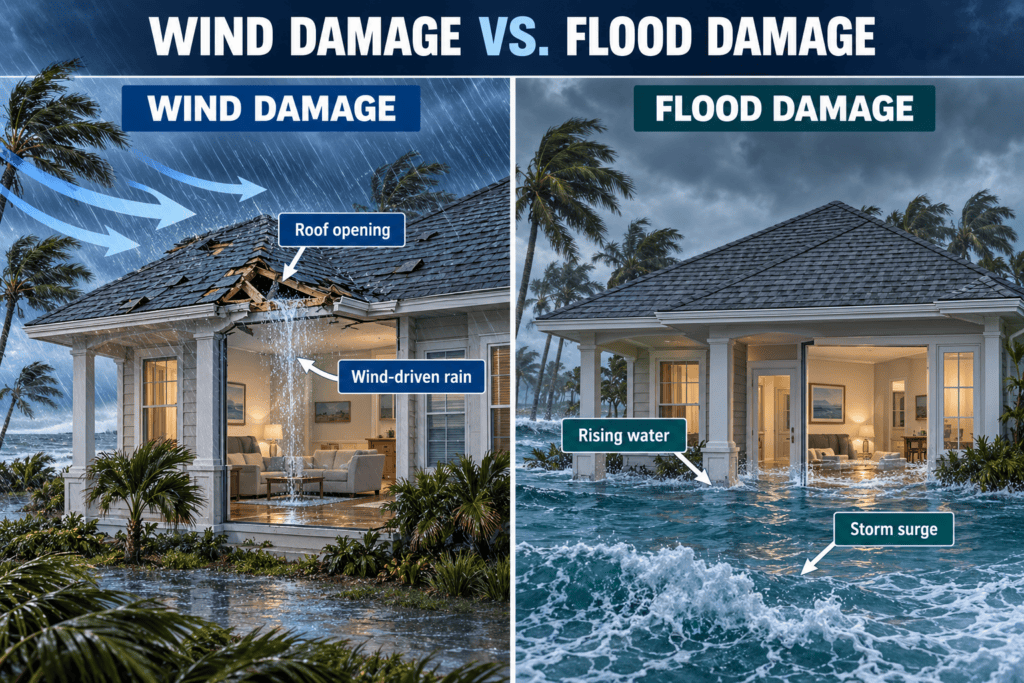 Wind and flood damage can occur during the same storm, but they may be insured differently. Coverage depends on the cause of loss and the applicable policy terms.
Is Windstorm Coverage Included in a Florida Homeowners Policy?
Windstorm coverage may be included in a Florida homeowners policy, but it should never be assumed.
Depending on the property’s location, construction, condition, and insurance company, wind coverage may be:
- Included in the homeowners policy
- Included with special limitations or deductibles
- Excluded from the homeowners policy
- Purchased through a separate wind-only policy
- Subject to roof-age, roof-condition, or roof-settlement provisions
Properties in coastal or higher-wind areas may have fewer coverage options or may require separate policies for homeowners, windstorm, and flood protection.
The declarations page and policy endorsements should identify whether wind coverage is included, which deductible applies, and whether any important limitations or exclusions have been added.
What Is a Florida Hurricane Deductible?
A hurricane deductible is the portion of a covered hurricane loss that the policyholder is responsible for before the insurance company pays the remaining covered amount.
It is usually separate from the policy’s all-other-perils deductible. Florida hurricane deductibles are commonly expressed as a percentage of the dwelling coverage limit rather than as a small flat amount.
For example, if a home is insured for five hundred thousand dollars and the hurricane deductible is two percent, the deductible would be ten thousand dollars. The percentage is applied to the insured dwelling limit—not to the amount of damage.
Florida insurers generally must offer specified hurricane-deductible options, subject to statutory exceptions and eligibility requirements. Available options can vary based on the home’s insured value, the insurance company, and whether the policy is written by an admitted or surplus-lines insurer.
The actual dollar amount of a percentage-based hurricane deductible should appear on the policy’s declarations page or renewal documents. Homeowners should review that amount at every renewal because an increase in dwelling coverage can also increase the hurricane deductible.
When Does the Florida Hurricane Deductible Apply?
For insurance purposes, Florida law defines a hurricane as a storm system declared to be a hurricane by the National Hurricane Center.
The statutory hurricane period begins when the National Hurricane Center issues a hurricane warning for any part of Florida. It ends 72 hours after the termination of the last hurricane watch or hurricane warning issued for any part of the state.
Covered windstorm damage occurring during that period may be subject to the hurricane deductible. Damage caused by a tropical storm, severe thunderstorm, tornado, or other wind event outside the statutory hurricane period may be subject to a different deductible, depending on the policy.
When the hurricane deductible applies, another deductible under the same policy generally is not applied to that hurricane loss.
Is the Hurricane Deductible Charged for Every Hurricane?
For Florida personal residential policies, the hurricane deductible generally applies on a calendar-year basis to covered hurricane losses insured by the same insurance company or another company within the same insurer group.
If more than one hurricane damages the home during the same calendar year:
- The first covered hurricane loss may be subject to the full hurricane deductible.
- A later covered hurricane loss may be subject to the remaining unpaid portion of that deductible.
- The applicable deductible for a later hurricane generally will be the greater of the remaining hurricane-deductible balance or the policy’s all-other-perils deductible.
- Once the full calendar-year hurricane deductible has been met, the all-other-perils deductible may apply to subsequent covered hurricane losses during that calendar year.
Changing insurance companies during the calendar year can affect whether prior hurricane damage receives credit toward the deductible. Homeowners should promptly report suspected storm damage and ask the insurer how damage below the deductible should be documented. Photographs, inspection reports, estimates, invoices, and repair receipts may become important if another hurricane causes damage later that year.
Hurricane, Named-Storm, and Windstorm Deductibles Are Not Always the Same
The terms hurricane deductible, named-storm deductible, and windstorm deductible should not automatically be treated as interchangeable.
A policy may contain:
- An all-other-perils deductible
- A Florida hurricane deductible
- A named-storm deductible
- A windstorm or wind-and-hail deductible
- A separate roof deductible or roof-settlement provision
The label, triggering event, calculation method, and covered causes of loss can differ. These differences are especially important when comparing admitted-market, surplus-lines, wind-only, and other specialized property policies.
Homeowners should determine which deductible would apply to a hurricane, tropical storm, tornado, ordinary windstorm, roof claim, or other weather-related loss before selecting coverage.
What Should Florida Homeowners Review Before Hurricane Season?
Before a storm threatens Florida, homeowners should confirm:
- Whether windstorm and hurricane coverage are included
- Whether a separate wind-only policy is required
- The hurricane deductible stated in actual dollars
- The all-other-perils and any additional deductibles
- How the roof will be valued after a covered loss
- Whether dwelling coverage reflects current rebuilding costs
- Whether ordinance or law coverage is adequate
- The limits and time period for additional living expenses
- Coverage for screened enclosures, detached structures, fences, pools, and outdoor property
- Whether separate flood insurance is in force
- How and where a claim should be reported
Insurance companies may restrict new policies or coverage changes when a hurricane or tropical storm threatens Florida. Coverage should therefore be reviewed well before a storm enters the region.
First Florida Agency can help homeowners compare wind coverage, hurricane deductibles, roof provisions, flood-insurance needs, and other storm-related policy terms before a loss occurs.
Does Florida Homeowners Insurance Cover Flood Damage?
Generally, no. Florida homeowners insurance typically excludes damage caused by flooding, including storm surge, rising surface water, and water overflowing from rivers, lakes, canals, or other bodies of water.
Flood protection usually must be purchased through a separate flood insurance policy or, when available, added to a homeowners policy by endorsement. Coverage may be available through the National Flood Insurance Program or a private flood insurance company.
What Is Considered Flood Damage?
Although exact definitions vary by policy, flood damage generally involves water that rises or accumulates outside the home before entering the structure.
Examples may include:
- Storm surge from a hurricane or tropical storm
- Rising tidal water
- Overflow from a river, lake, canal, creek, or other body of water
- Surface water accumulating after heavy rainfall
- Water flowing across normally dry land
- Flooding caused by overwhelmed neighborhood drainage
- Qualifying mudflow or flood-related erosion
The amount of rain alone does not determine whether a loss is considered a flood. The source of the water, how it traveled, and how it entered the home are important.
Flood Damage and Homeowners Water Damage Are Different
Not every water loss is a flood. Different sources of water may be handled under different insurance coverage.
For example:
- A suddenly ruptured plumbing supply line may be covered by homeowners insurance, subject to the policy.
- Rain entering through an opening created by covered wind damage may be covered.
- A slow or repeated plumbing leak may be excluded or restricted.
- Water backing up through a sewer, sump, or drain may require a water-backup endorsement.
- Rising exterior water entering through doors, walls, or the foundation is generally considered flood damage.
- Storm surge is generally handled as flood damage, even when a hurricane caused the surge.
A single storm can produce both covered homeowners damage and separately insured flood damage. Photographs, professional inspections, weather information, water lines, and the sequence of events may help establish the causes of loss.
Does Homeowners Insurance Cover Hurricane Storm Surge?
Homeowners insurance generally does not cover storm surge. Storm surge is rising water pushed onto normally dry land by a hurricane or tropical storm and is typically treated as flood damage.
A homeowners or windstorm policy may respond to covered wind damage while a separate flood policy responds to qualifying storm-surge damage. Different policies, limits, deductibles, exclusions, and claims adjusters may therefore be involved after the same hurricane.
Wind coverage should not be treated as a substitute for flood insurance.
Do Florida Homeowners Need Flood Insurance Outside a High-Risk Flood Zone?
A home does not need to be located in a high-risk flood zone to experience flooding. Heavy rainfall, drainage problems, new development, tidal conditions, nearby retention ponds, and overwhelmed stormwater systems can affect properties outside areas commonly considered high risk.
A flood-zone designation can influence lender requirements and insurance pricing, but it does not guarantee that a property will or will not flood.
Florida law generally does not require every homeowner to carry flood insurance. However, a mortgage lender may require it based on the property’s flood zone, loan type, or the lender’s underwriting requirements. Homeowners who are not required to purchase flood insurance may still choose coverage voluntarily.
 Flood risk can exist outside the highest-risk flood zones, and standard homeowners insurance generally does not cover flooding caused by rising surface water.
National Flood Insurance Program and Private Flood Insurance
Florida homeowners may have more than one source of flood insurance.
National Flood Insurance Program
The National Flood Insurance Program is administered by the federal government and offers standardized flood coverage through participating insurance companies and agents.
Building coverage and personal-property coverage are separate. Limits, deductibles, loss-settlement provisions, and restrictions apply. National Flood Insurance Program coverage generally does not include every expense that a homeowners policy might cover, such as additional living expenses.
Private Flood Insurance
Private flood insurance is offered by insurance companies rather than directly through the National Flood Insurance Program.
Depending on the insurer and property, a private policy may offer:
- Higher building or personal-property limits
- Additional living expense coverage
- Replacement-cost options for eligible property
- Coverage for certain additional structures
- Different deductibles or waiting periods
- Broader or more restrictive policy terms
- Excess flood coverage above an underlying policy
Private flood insurance is subject to underwriting, availability, and insurer-specific requirements. A private policy should not be assumed to match National Flood Insurance Program coverage in every respect.
What Should Homeowners Compare in a Flood Insurance Policy?
When evaluating flood insurance, review:
- Building coverage
- Personal-property or contents coverage
- Coverage limits
- Building and contents deductibles
- Replacement-cost or actual-cash-value settlement
- Additional living expense coverage
- Coverage for detached structures
- Limitations involving enclosed areas below an elevated building
- Coverage for mechanical equipment and building systems
- Debris removal and flood-loss avoidance expenses
- Waiting periods
- Exclusions and policy definitions
- Whether the policy satisfies lender requirements
- Whether excess flood coverage may be needed
The lowest-priced flood policy may not provide the most appropriate protection. Coverage differences can substantially affect the amount available after a serious loss.
Do Not Wait Until a Storm Is Approaching
National Flood Insurance Program policies generally have a 30-day waiting period before coverage becomes effective, although certain exceptions may apply. Private flood insurers may use different waiting periods and eligibility rules.
Flood insurance cannot cover damage that occurred before the policy became effective. Homeowners should evaluate flood coverage well before hurricane season or an approaching storm.
Flood Exposure in Northeast Florida
Homes throughout Jacksonville, Ponte Vedra, Ponte Vedra Beach, Nocatee, St. Augustine, St. Johns County, and surrounding Northeast Florida communities can face different combinations of coastal, tidal, river, rainfall, and drainage-related flood exposure.
Distance from the ocean is only one consideration. Nearby waterways, elevation, drainage, development patterns, retention ponds, and the home’s construction can also affect flood risk.
First Florida Agency can help Florida homeowners compare available National Flood Insurance Program and private flood insurance options alongside their homeowners and windstorm coverage.
How Do Roof Age and Condition Affect Florida Homeowners Insurance?
A home’s roof can significantly affect Florida homeowners insurance eligibility, premium, coverage options, deductibles, and claim settlement. Insurance companies consider roofs especially important because they are the home’s primary defense against wind, rain, and water intrusion.
A newer roof does not automatically guarantee coverage, and an older roof is not automatically uninsurable. The roof’s material, installation date, condition, maintenance history, remaining useful life, and resistance to wind damage may all influence underwriting.
What Roof Information Do Insurance Companies Review?
When evaluating a Florida home, an insurance company may consider:
- The roof’s age and installation date
- Roofing material, such as asphalt shingle, tile, metal, or flat roofing
- Whether the roof was fully replaced or only partially repaired
- Available building permits and contractor documentation
- Remaining useful life
- Missing, cracked, lifted, loose, or deteriorated roofing materials
- Soft spots, sagging, rot, or damaged roof decking
- Active leaks or evidence of prior water intrusion
- Previous roof repairs and insurance claims
- Roof shape, slope, attachment, and construction
- Underlayment and secondary water resistance
- Roof-to-wall connections
- Condition of flashing, valleys, vents, skylights, and penetrations
- Nearby trees or other conditions that could damage the roof
- Whether roof-mounted equipment, such as solar panels, has been installed
Insurance companies use different underwriting guidelines. A roof acceptable to one insurer may require an inspection, repair, exclusion, different settlement provision, or replacement with another insurer.
How Does Florida’s 15-Year Roof Rule Work?
For homeowners policies subject to the applicable Florida statute, an insurer generally may not refuse to issue or renew coverage solely because a roof is less than 15 years old.
When a roof is at least 15 years old, the insurer generally must allow the homeowner to obtain an inspection from an authorized inspector at the homeowner’s expense before requiring roof replacement as a condition of issuing or renewing the policy.
If that inspection determines that the roof has at least five years of useful life remaining, the insurer generally may not refuse to issue or renew the policy solely because of the roof’s age.
This protection does not guarantee that every older roof must be accepted. An insurance company may still consider other lawful underwriting concerns, including:
- Existing damage or active leaks
- Deteriorated roofing materials
- Poor installation or unpermitted work
- Inadequate maintenance
- Structural problems
- Prior losses
- Failure to meet other underwriting requirements
The law addresses decisions based solely on roof age. It does not require an insurer to disregard the roof’s actual condition.
How Is the Age of a Roof Determined?
For purposes of Florida’s roof-age provision, the roof’s age generally is based on the date when 100 percent of its surface area was built or replaced according to the building code in effect at that time.
Minor repairs or replacement of only one section may not reset the age of the entire roof. Homeowners should retain documentation establishing when a complete roof replacement occurred.
Useful records may include:
-
Building permits
-
Final inspection records
-
Roofing contracts
-
Paid invoices and receipts
-
Material warranties
-
Contractor completion certificates
-
Before-and-after photographs
-
Roof certifications or inspection reports
If public permit records are incomplete or incorrect, these documents may help establish the roof’s installation date and construction details.
Is a Manufacturer’s Roof Warranty the Same as Insurable Roof Life?
No. A manufacturer may advertise roofing materials with a projected lifespan or warranty period, but that does not mean an insurance company must treat the roof as acceptable for the same number of years.
A warranty generally addresses specified defects in materials or installation. Insurance underwriting considers the roof’s actual condition, exposure, maintenance, construction, and ability to withstand future losses.
Florida heat, ultraviolet exposure, humidity, heavy rainfall, salt air, wind, and hurricanes can also affect roofing materials differently depending on the home’s location and construction.
Will Homeowners Insurance Pay to Replace an Old Roof?
Homeowners insurance does not ordinarily replace a roof merely because it is old, worn, or nearing the end of its useful life.
Coverage generally requires direct physical damage caused by a covered event, such as:
- Windstorm
- Hurricane
- Hail
- Fire
- Lightning
- A fallen tree or other object
- Another covered cause of loss listed or not excluded by the policy
Wear and tear, deterioration, defective installation, rot, neglect, and maintenance problems are commonly excluded.
When an older roof is damaged during a storm, the insurer may evaluate which damage resulted from the covered event and which conditions existed beforehand. The presence of a leak after a storm does not by itself establish that the entire roof was damaged by a covered loss.
Replacement Cost, Actual Cash Value, and Roof Payment Schedules
The amount paid for a covered roof claim can depend on the policy’s loss-settlement provisions.
Replacement Cost Coverage
Replacement cost coverage generally values covered roof damage without subtracting depreciation, subject to the policy limit, deductible, and other terms.
Payment may occur in stages. The insurer may initially pay the actual cash value of the covered damage and release recoverable depreciation as repairs are completed and documented.
Homeowners should review applicable deadlines and documentation requirements for recovering withheld depreciation.
Actual Cash Value Coverage
Actual cash value generally considers depreciation based on factors such as the roof’s age, material, condition, and expected useful life.
An older roof with actual-cash-value settlement may produce a substantially lower payment than the amount required to install a new roof.
Roof Payment Schedule
Some policies or endorsements use a roof-payment schedule that determines the available settlement according to the roof’s age and material. The payable percentage may decrease as the roof becomes older.
A policy may otherwise provide replacement-cost coverage for the dwelling while applying a different settlement method to the roof. Homeowners should not assume that the words “replacement cost” on the declarations page mean every roof loss will be settled without depreciation.
Can a Florida Homeowners Policy Have a Separate Roof Deductible?
Florida law permits certain personal residential property policies to include a separate roof deductible when statutory requirements are satisfied.
The roof deductible may not exceed the lesser of:
- Two percent of the policy’s dwelling coverage limit
- Fifty percent of the cost to replace the roof
The policyholder must receive an actuarially sound premium credit or discount for accepting the deductible, and the actual dollar amount must be prominently disclosed in the policy or renewal documents. Eligible policyholders must also be given an opportunity to reject the separate roof deductible, although the resulting premium may differ.
Under the Florida statute, the separate roof deductible does not apply to certain losses, including:
- A covered total loss to the primary structure
- A roof loss resulting from a hurricane
- A tree fall or other hazard that damages the roof and punctures the roof deck
- A roof loss requiring repair of less than 50 percent of the roof
When a separate roof deductible applies, another deductible under the policy generally may not be applied to the same loss caused by that covered event.
Policy forms and insurer eligibility can differ, so homeowners should review the declarations page and applicable endorsements rather than assuming every policy uses the same roof deductible.
Roof Inspections, Four-Point Inspections, and Wind-Mitigation Inspections
These inspections serve different purposes:
- A roof-condition or roof-certification inspection evaluates the roof’s condition and remaining useful life.
- A four-point inspection evaluates the roof, electrical, plumbing, and heating and air-conditioning systems, commonly for underwriting.
- A wind-mitigation inspection documents qualifying construction features that may help reduce wind damage and may qualify the home for insurance credits.
One inspection does not automatically replace the others. The insurance company may specify the inspection form, qualifications, photographs, documentation, and completion date it will accept.
What Should Homeowners Do Before Renewal?
Florida homeowners should review roof-related insurance requirements before receiving a nonrenewal notice or discovering that repairs are needed during a transaction.
Helpful steps include:
- Confirm the roof’s documented installation date
- Locate permits, contracts, invoices, and warranties
- Inspect the roof for visible deterioration or damage
- Repair active leaks and maintenance problems promptly
- Keep records of completed repairs
- Ask how the policy settles covered roof losses
- Review any separate roof deductible
- Determine whether the insurer requires a roof certification or four-point inspection
- Verify that completed roof work has been properly permitted and inspected
- Notify the insurance agent after a complete roof replacement
- Request updated insurance quotes when major roof improvements are completed
Homeowners purchasing a property should evaluate the roof before closing. A roof that passes a general home inspection may still require additional documentation or may not satisfy every insurance company’s underwriting guidelines.
First Florida Agency can help Florida homeowners evaluate roof-age requirements, inspection reports, roof-settlement provisions, deductibles, and available insurance options before purchasing a home or renewing coverage.
What Inspections May Be Required for Florida Homeowners Insurance?
Florida homeowners insurance companies may request inspections to evaluate a home’s condition, verify construction features, determine eligibility, or calculate available wind-mitigation credits.
The inspection required depends on the home, its age, its condition, the insurance company, and the coverage requested. The most common insurance-related inspections are four-point inspections, wind-mitigation inspections, and roof-condition or roof-certification inspections.
These inspections serve different purposes and should not be treated as interchangeable.
What Is a Four-Point Inspection?
A four-point inspection is a limited evaluation of four major systems:
- Roofing
- Electrical
- Plumbing
- Heating, ventilation, and air conditioning
Insurance companies commonly request four-point inspections when evaluating older homes, although each insurer establishes its own property-age guidelines and underwriting requirements.
The inspection helps the insurer identify conditions that may increase the likelihood of fire, water, electrical, roof, or mechanical losses.
Roofing
The inspector may document:
- Roof covering material
- Approximate installation date
- Remaining useful life
- Visible deterioration or storm damage
- Missing, cracked, loose, or damaged materials
- Signs of active or prior leaks
- Condition of flashing, roof penetrations, and visible decking
- Permits or documentation supporting the roof’s age
Electrical System
The inspector may document:
- Electrical service size
- Panel manufacturer and condition
- Wiring type
- Exposed or damaged wiring
- Double-tapped breakers
- Improper modifications
- Evidence of overheating or fire hazards
- Ground-fault and other safety protection where applicable
The presence of an older electrical component does not automatically determine the underwriting result. Insurers evaluate the specific equipment, condition, installation, and their own eligibility guidelines.
Plumbing System
The inspector may review:
- Plumbing supply-line material
- Drain and waste piping
- Water-heater age and condition
- Evidence of active leaks
- Corrosion or deterioration
- Improper connections
- Prior repiping or plumbing updates
- Shutoff valves and visible fixtures
Certain plumbing materials or unresolved leaks may require repair, replacement, or additional documentation before coverage is approved.
Heating and Air-Conditioning System
The inspector may document:
- System type and approximate age
- Operating condition
- Visible damage or deterioration
- Signs of leaking or clogged condensate drainage
- Supplemental heating sources
- Professional installation of fireplaces or wood-burning equipment
- Manufacturer information and equipment photographs
Is a Four-Point Inspection the Same as a General Home Inspection?
No. A general home inspection is broader and is commonly used by buyers to evaluate the overall condition of a property before purchase.
A four-point inspection is narrower and is prepared primarily for insurance underwriting. It does not provide the same comprehensive evaluation as a buyer’s home inspection and should not be relied upon as a substitute.
Likewise, an insurance company may not accept a general home inspection in place of its required four-point form. Homeowners and buyers should confirm the required form, photographs, inspector qualifications, and acceptable report date before ordering an inspection.
Does a Four-Point Inspection Pass or Fail a Home?
A four-point inspection documents the visible age, type, and condition of the four systems. The inspector reports the findings, but the insurance company determines whether the property meets its underwriting guidelines.
Possible underwriting results may include:
- Approval without additional requirements
- A request for more photographs or documentation
- Required repairs before coverage begins
- Approval subject to proof that repairs are completed
- Different coverage terms, limits, or deductibles
- Exclusion of a particular exposure when legally and contractually permitted
- A decision not to offer coverage
One insurer’s decision does not necessarily determine whether another insurer will accept the property because underwriting requirements vary.
There is no single statewide validity period that every insurer must accept for a four-point inspection. Some insurers require a recently completed report, so homeowners should verify the acceptable timeframe before paying for an inspection.
 A Florida four-point inspection commonly documents the condition and age of the roof, electrical, plumbing, and air-conditioning systems.
What Is a Florida Wind-Mitigation Inspection?
A wind-mitigation inspection documents construction features that may help a home resist hurricane and windstorm damage.
Unlike a four-point inspection, its primary purpose is not to evaluate the electrical, plumbing, or air-conditioning systems. It identifies qualifying wind-resistant features that an insurance company can use when calculating available windstorm credits.
The inspector completes Florida’s Uniform Mitigation Verification Inspection Form and provides supporting photographs and documentation.
The inspection may address:
- Building-code compliance
- Roof-covering installation
- Roof-deck attachment
- Roof-to-wall connections
- Roof geometry
- Secondary water resistance
- Window, exterior-door, skylight, and garage-door protection
Examples of potentially qualifying features include hurricane clips or straps, reinforced roof attachments, a qualifying secondary water barrier, impact-resistant openings, and approved shutters. The exact credit depends on how the features are documented, the insurer’s approved rating plan, and the combination of protections present.
A wind-mitigation inspection does not guarantee a specific discount or premium. The insurance company reviews the completed form and determines the applicable credits.
How Long Is a Wind-Mitigation Inspection Valid?
Florida’s Uniform Mitigation Verification Inspection Form is generally valid for up to five years, provided no material changes have been made to the structure and no inaccuracies are found on the form.
A new inspection may be appropriate when:
-
The previous report has expired
-
The roof has been replaced
-
Hurricane clips, straps, or other roof connections have been upgraded
-
A secondary water barrier has been installed
-
Windows, doors, shutters, skylights, or the garage door have been upgraded
-
An addition or other material structural change has been completed
-
The prior report contains incomplete or incorrect information
Insurance companies may verify submitted information or order a reinspection as permitted by applicable law and policy procedures.
Who May Complete a Wind-Mitigation Inspection?
Florida law identifies authorized professionals who may complete and sign the Uniform Mitigation Verification Inspection Form. Depending on licensing, qualifications, and applicable requirements, these may include:
- Qualified Florida-licensed home inspectors
- Certified building-code inspectors
- Licensed general, building, or residential contractors
- Licensed professional engineers
- Licensed professional architects
- Other qualified individuals or entities recognized by the insurer
Before scheduling the inspection, homeowners should verify the professional’s active Florida license and confirm that the insurer will accept that inspector’s report.
What Is a Roof-Certification Inspection?
A roof-certification or roof-condition inspection focuses specifically on the roof. It may be requested when a roof is older, its installation date is unclear, or the insurer needs additional information about its condition and remaining useful life.
The report may address:
- Roof material
- Approximate age
- Overall condition
- Visible damage or deterioration
- Evidence of leaks
- Previous repairs
- Remaining useful life
- Whether repairs or replacement are recommended
A roof inspection may be completed separately or as part of a four-point inspection. The insurer may require a particular form, photographs, or an authorized inspector.
A roof certification does not guarantee coverage. The insurance company still applies its underwriting standards to the inspection findings.
Can an Insurance Company Inspect the Home After Coverage Begins?
Yes. An insurance company may order an exterior or interior property inspection as part of its underwriting process, including after a policy has initially been issued.
The insurer may use:
- An in-person inspection
- Exterior photographs
- A self-inspection completed by the homeowner
- Aerial or satellite imagery
- Public building-permit records
- Property-appraiser information
- Documentation from prior inspections
The inspection may identify conditions that were not visible or disclosed during the application process. Depending on the findings and applicable requirements, the insurer may request repairs, supporting documentation, updated photographs, or other underwriting action.
Homeowners should not assume that initial policy issuance means the property will not be inspected later.
How Should Homeowners Prepare for an Insurance Inspection?
Before scheduling an inspection:
- Ask which inspection and form the insurer requires
- Confirm who is authorized to complete it
- Verify how recent the report must be
- Gather roof permits, invoices, warranties, and repair records
- Provide safe access to the attic, electrical panels, water heater, plumbing, and air-conditioning equipment
- Replace missing electrical-panel covers and address exposed wiring
- Repair active plumbing or roof leaks
- Clear storage away from equipment that must be photographed
- Make sure utilities and major systems are operating when required
- Obtain a complete, signed report with all required photographs
- Keep a copy of the original report and repair documentation
Homeowners should not alter an inspection report or ask an inspector to omit an observed condition. Inaccurate reports can result in lost discounts, underwriting problems, claim complications, or allegations of fraud.
What Happens When an Inspection Finds a Problem?
An inspection finding does not always mean the home cannot be insured. Depending on the insurer and the severity of the condition, the homeowner may be able to:
- Complete the required repair
- Provide proof of a recent update
- Obtain a licensed contractor’s evaluation
- Correct inaccurate property records
- Submit paid invoices, permits, photographs, or warranties
- Arrange a follow-up inspection
- Compare options with another insurance company
Repairs should be completed by appropriately qualified professionals and documented carefully. Photographs, contracts, permits, receipts, and final inspection records may be needed to show that the problem was corrected.
First Florida Agency can help Florida homeowners determine which inspections are required, review available reports, identify missing documentation, and compare insurance options based on the home’s condition and construction features.
How Does Florida Homeowners Insurance Cover Water Damage and Mold?
Florida homeowners insurance may cover certain water losses, but coverage depends on where the water originated, how suddenly it escaped, how long the condition existed, and which policy limits, exclusions, deductibles, and endorsements apply.
Water damage is not treated as one single category. A burst pipe, leaking roof, backed-up sewer, storm surge, appliance overflow, and slow hidden leak can produce similar damage while receiving very different insurance treatment.
What Types of Water Damage May Be Covered?
A homeowners policy may cover resulting damage from a sudden and accidental water event, subject to the policy’s terms.
Examples may include:
- A suddenly ruptured plumbing supply line
- An accidental overflow from a washing machine or dishwasher
- A water heater that suddenly releases water
- A plumbing fixture that unexpectedly overflows
- Water used to extinguish a covered fire
- Rain entering through an opening first created by covered wind damage
- An accidental discharge from certain household systems or appliances
Coverage is not automatic. The cause, duration, property condition, applicable deductible, and policy form all affect the claim.
The Damaged Property and the Failed Item May Be Treated Differently
A policy may distinguish between the item that failed and the damage resulting from that failure.
For example, if an aging pipe suddenly ruptures, the policy may cover resulting damage to drywall, flooring, cabinets, or personal property while excluding the cost of replacing the worn or deteriorated pipe itself.
Likewise, a policy might cover resulting water damage from an appliance failure without paying to replace the appliance that malfunctioned.
Coverage for opening walls, floors, or ceilings to reach a damaged plumbing system—sometimes called tear-out or access coverage—also varies. Homeowners should not assume that every cost associated with locating and repairing a leak will be covered.
What Water Damage Is Commonly Excluded or Restricted?
Water-related losses that may be excluded, limited, or subject to additional requirements include:
- Continuous or repeated seepage or leakage
- Long-term hidden plumbing leaks
- Wear, corrosion, rust, or deterioration
- Defective installation or workmanship
- Unrepaired roof deterioration
- Water intrusion caused by failed maintenance
- Indoor humidity or condensation
- Groundwater or water below the surface
- Flooding, storm surge, or rising surface water
- Sewer, sump, or drain backup without applicable coverage
- Water entering through an opening that was not created by a covered event
- Damage that existed before the policy began
- Mold resulting from an excluded or uncovered water source
- Additional damage caused by an unreasonable failure to protect the property after a loss
Some Florida policies contain a water-damage limitation, separate water deductible, or endorsement that substantially changes the amount available for covered water damage. The declarations page and endorsements should be reviewed carefully.
Are Slow or Hidden Leaks Covered?
Slow or repeated leakage is commonly excluded or restricted, even when the homeowner did not immediately see the water.
Examples may include:
- A supply line slowly leaking behind a wall
- Water seeping under a kitchen cabinet over several months
- A shower pan or tile assembly allowing repeated water intrusion
- A roof leak that continues during multiple rainstorms
- An air-conditioning condensate line that repeatedly leaks
- Plumbing leakage below a slab or flooring that has existed for an extended period
Some policies contain limited exceptions or specialized coverage for hidden water damage. Others exclude damage occurring over a stated period or restrict coverage for repeated seepage regardless of when the homeowner discovered it.
The policy language, available evidence, moisture patterns, deterioration, and professional findings may all affect the coverage decision.
Does Homeowners Insurance Cover Roof-Leak Water Damage?
It depends on why the roof leaked.
If covered wind damages the roof and creates an opening through which rain enters, resulting interior damage may be covered, subject to the policy.
If water enters because the roof is worn, deteriorated, improperly maintained, or already leaking, the claim may be excluded or limited. The roof itself and the resulting interior water damage may also be evaluated differently.
Homeowners should document roof condition, repair active problems promptly, and retain roofing permits, contracts, invoices, warranties, and inspection reports.
Does Homeowners Insurance Cover Sewer or Drain Backup?
Homeowners policies do not typically provide broad coverage for water backing up through a sewer, sump, or drain. An optional water-backup endorsement may be needed.
Depending on its wording, the endorsement may apply to qualifying damage from:
- A sewer or drain backup
- Sump overflow
- Certain toilet or plumbing backups
- Water entering from connected drainage systems
Water-backup coverage is not the same as flood insurance. An endorsement may still exclude damage caused by rising surface water or flooding.
Homeowners should review the coverage limit, deductible, covered sources, and whether damage to finished areas, personal property, cleanup, or mechanical equipment is included.
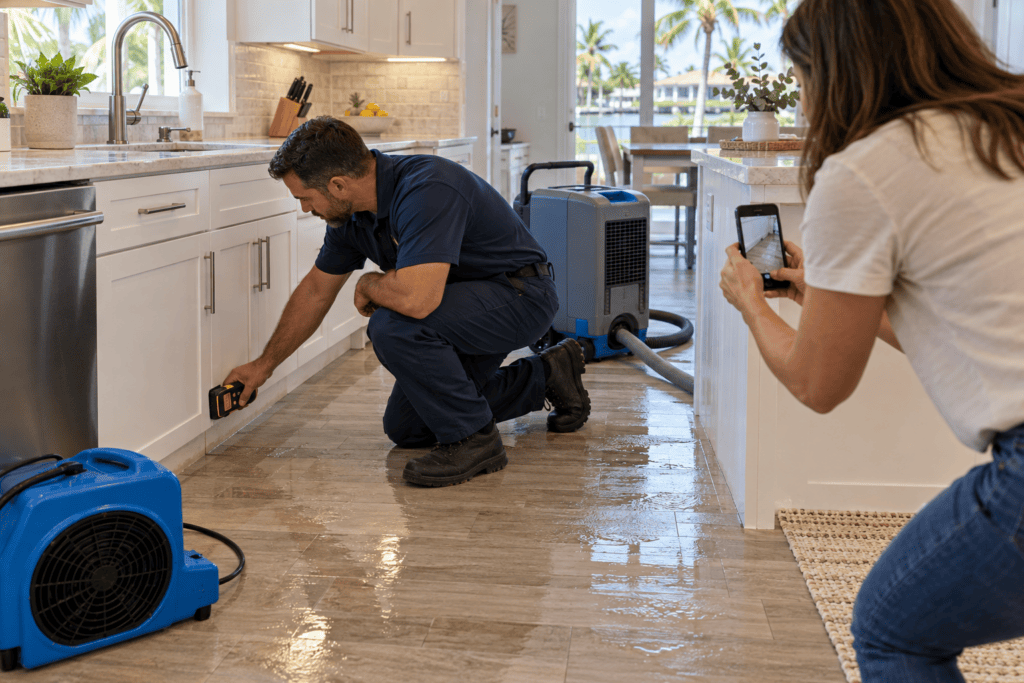 Promptly stopping the water source, documenting the damage, and beginning reasonable mitigation can help prevent additional damage. Coverage depends on the cause of loss and policy terms.
Does Homeowners Insurance Cover Mold?
Mold coverage commonly depends on what caused the moisture.
If mold develops as a direct result of a covered water loss and the homeowner takes reasonable steps to stop and mitigate the damage, the policy may provide limited coverage for:
- Mold testing or assessment
- Removal of contaminated materials
- Cleaning or remediation
- Tear-out and reconstruction
- Damage to covered property
- Additional living expenses when the home cannot be occupied because of a covered loss
Mold coverage is frequently subject to a separate limit or aggregate policy limit. That limit may apply collectively to testing, removal, cleanup, damaged property, and related expenses rather than providing a separate amount for each service.
Coverage may be excluded or restricted when mold results from:
- Long-term or repeated leakage
- Unrepaired water intrusion
- Excessive indoor humidity
- Condensation
- Flooding without applicable flood coverage
- Construction defects
- Deferred maintenance
- A condition that existed before the policy began
Optional endorsements may be available to increase property or liability limits for mold, depending on the insurer and property.
Mold Property Coverage and Mold Liability Coverage Are Different
Mold property coverage addresses qualifying damage to the insured home or belongings.
Mold liability coverage addresses claims alleging that another person experienced bodily injury or property damage because of mold associated with the insured property. This could be relevant to a homeowner who rents part of the property or faces a claim from a guest or another party.
A policy may limit or exclude one type of mold coverage even when it provides some protection for the other. Both should be reviewed separately.
Mold Assessors and Mold Remediators Have Different Roles
A mold assessor investigates the moisture source, evaluates the affected area, and documents the extent of the suspected mold condition.
A mold remediator performs containment, removal, cleaning, and remediation work.
Florida law generally separates these roles on the same structure for a specified period, subject to limited statutory exceptions. Homeowners should verify professional licensing and understand whether a company is acting as the assessor, remediator, or both under an applicable exception.
What Should a Homeowner Do After Discovering Water Damage?
When water damage is discovered:
- Protect people from electrical, structural, or contamination hazards
- Stop the water source when it can be done safely
- Contact the insurance company or agent promptly
- Photograph and record the damage before removing materials
- Document where the water originated
- Preserve damaged plumbing components or appliance parts when practical
- Take reasonable steps to prevent additional damage
- Begin appropriate water extraction and drying
- Keep contracts, estimates, invoices, receipts, and moisture records
- Ask before discarding damaged property unless removal is necessary for safety
- Avoid making unnecessary permanent repairs before the insurer can inspect
- Record the names and contact information of contractors and mitigation companies
Emergency mitigation does not guarantee that the insurance policy will cover every charge. Homeowners should review contracts, scopes of work, pricing, payment obligations, and any assignment or authorization documents before signing.
Water and Mold Coverage Questions to Review
Florida homeowners should determine:
- Whether the policy includes a water-damage limit
- Which deductible applies to a water loss
- Whether long-term or hidden leakage is covered
- Whether tear-out or access expenses are covered
- Whether sewer and drain backup coverage is included
- The mold property-damage limit
- Whether mold liability coverage is included
- Whether additional mold coverage can be purchased
- How damaged property will be valued
- Whether additional living expenses are available
- What documentation and notice the insurer requires
- Whether separate flood insurance is in force
Northeast Florida’s humidity, heavy rainfall, hurricanes, plumbing exposures, roof intrusion, and air-conditioning drainage systems make prompt moisture control especially important.
First Florida Agency can help Florida homeowners review water-damage limitations, mold coverage, water-backup endorsements, deductibles, and flood-insurance needs before a loss occurs.
How Much Does Homeowners Insurance Cost in Florida?
There is no single standard price for Florida homeowners insurance. Premiums can vary substantially based on the home, location, insurance company, coverage selected, deductibles, inspection results, and the applicant’s insurance history.
Published statewide averages can be misleading because they combine different counties, construction types, dwelling values, roof ages, policy forms, deductibles, and levels of coverage. A premium shown for a hypothetical home or model consumer may not represent the cost of insuring a specific property.
The most reliable way to determine the cost is to obtain quotes using accurate information about the home and compare equivalent coverage.
Factors That Affect Florida Homeowners Insurance Premiums
Insurance companies may consider:
- Property address, county, and ZIP code
- Proximity to the coast, tidal water, or other high-wind areas
- Dwelling replacement cost
- Home size, design, and number of stories
- Construction type and building materials
- Year built
- Roof age, material, condition, and shape
- Electrical, plumbing, and air-conditioning systems
- Fire-protection classification and distance from a fire station or hydrant
- Hurricane and windstorm exposure
- Documented wind-mitigation features
- Prior property claims
- Prior insurance and any lapse in coverage
- Occupancy and use of the home
- Whether the property is a primary, secondary, seasonal, vacant, or rental residence
- Swimming pools, trampolines, docks, detached structures, and other property features
- Animals and other liability exposures
- Coverage limits and optional endorsements
- Hurricane, all-other-perils, roof, water, and other deductibles
- Replacement-cost or actual-cash-value settlement provisions
- Insurance-based rating information permitted by law
- Individual insurance-company underwriting and rating guidelines
Two insurance companies can evaluate the same property differently. One may accept the home with standard terms, while another may require an inspection, additional documentation, repairs, different deductibles, restricted coverage, or a different premium.
Location and Wind Exposure
Florida homeowners premiums can differ significantly by location.
Insurance companies may consider:
- Distance from the Atlantic Ocean or Gulf of Mexico
- Distance from tidal waterways, bays, rivers, and the Intracoastal Waterway
- Local wind-speed and hurricane exposure
- County and ZIP-code loss history
- Concentration of insured property in the area
- Availability and quality of local fire protection
- Access for emergency services
- Construction standards in effect when the home was built
A home does not need to be directly on the beach to have substantial wind exposure. Properties farther inland may still face hurricane winds, tornadoes, falling trees, heavy rainfall, and water intrusion.
Flood risk is evaluated separately from homeowners coverage. The premium for a separate flood policy ordinarily is not included in the homeowners insurance premium.
Dwelling Replacement Cost
The amount required to rebuild the home is a major premium factor.
Replacement cost may consider:
- Heated and total square footage
- Number of stories
- Foundation type
- Exterior wall construction
- Roof design and material
- Flooring, cabinetry, and interior finishes
- Bathrooms and kitchens
- Attached garages, porches, and structural features
- Debris removal
- Contractor labor and material costs
- Local building-code requirements
- Architectural and engineering expenses
Replacement cost is not the same as the home’s purchase price, appraised value, or market value. Two homes with similar market values may have very different rebuilding costs and insurance premiums.
Reducing dwelling coverage below a reasonable rebuilding estimate solely to lower the premium can leave the home underinsured and may affect how a claim is settled.
Roof Age and Condition
The roof can affect:
- Eligibility
- Available insurance companies
- Premium
- Required inspections
- Wind-mitigation credits
- Deductibles
- Roof-loss settlement
- Renewal options
A newer roof may improve the available options, but installation date alone does not determine the premium. Material, condition, construction, permits, roof geometry, attachment, opening protection, and documented mitigation features may also matter.
Claims and Insurance History
Insurance companies may review prior losses associated with the applicant and property.
The effect of a prior claim can depend on:
- Type of loss
- Date of loss
- Amount paid
- Whether repairs were completed
- Whether the source of damage was corrected
- Number and frequency of claims
- Whether similar losses are likely to recur
- Individual insurer guidelines
A claim does not affect every insurance company in the same way. Homeowners should provide accurate information and retain proof of completed repairs, including invoices, photographs, permits, and contractor documentation.
A lapse in prior homeowners coverage may also affect eligibility or premium with some insurers.
Coverage and Deductible Choices
A lower premium can sometimes result from selecting less coverage or accepting more financial responsibility after a loss. That does not necessarily make the policy a better value.
Premiums may change based on:
- Dwelling coverage
- Other-structures coverage
- Personal-property coverage
- Additional living expense coverage
- Personal-liability limits
- Medical-payments coverage
- Hurricane deductible
- All-other-perils deductible
- Separate roof or water deductible
- Personal-property replacement cost
- Ordinance or law coverage
- Water-backup coverage
- Mold limits
- Screened-enclosure or pool-cage coverage
- Equipment-breakdown coverage
- Service-line coverage
- Scheduled valuable-property coverage
- Identity-theft or cyber-related endorsements
- Flood coverage when offered by endorsement
A higher deductible may reduce the premium, but the homeowner should be able to pay that deductible after a serious loss. Percentage-based hurricane deductibles should always be converted into actual dollar amounts before selecting a policy.
Why Can Neighboring Homes Have Different Premiums?
Homes on the same street can have different insurance premiums because of differences involving:
- Square footage and replacement cost
- Roof age and material
- Building permits and renovations
- Construction type
- Wind-mitigation features
- Opening protection
- Claims history
- Insurance-company selection
- Coverage limits
- Deductibles
- Optional endorsements
- Occupancy and household exposures
- Prior insurance history
A neighbor’s premium is therefore not a reliable estimate for another home, even when the properties appear similar.
Homeowners Premium and Mortgage Escrow Are Different
When homeowners insurance is paid through mortgage escrow, the total mortgage payment may include:
- Principal
- Interest
- Property taxes
- Homeowners insurance
- Flood insurance
- Mortgage insurance
- Other required assessments
An increase in the monthly mortgage payment does not necessarily mean the homeowners insurance premium increased by the same amount. Homeowners should review the insurer’s renewal documents and the lender’s escrow analysis separately.
The homeowner remains responsible for confirming that the insurance premium is paid on time, even when a mortgage company handles the payment through escrow.
Information Needed for an Accurate Homeowners Insurance Quote
Providing complete information can make quoting more efficient and reduce the likelihood of changes during underwriting.
Helpful information includes:
- Property address
- Purchase or closing date
- Current insurance and expiration date
- Intended occupancy
- Year built
- Square footage and number of stories
- Construction type
- Roof installation date and material
- Roof, electrical, plumbing, and air-conditioning updates
- Building permits and contractor documentation
- Four-point and wind-mitigation inspection reports
- Prior claims and completed repair documentation
- Swimming pools, trampolines, docks, fences, and detached structures
- Animals kept at the property
- Business or rental activity conducted from the home
- Mortgage-company information
- Desired coverage limits and deductibles
- Valuable property requiring additional coverage
- Requested policy effective date
Quotes remain subject to underwriting, inspections, documentation, and insurance-company approval. A preliminary quote may change if the property information is incomplete or an inspection identifies conditions that differ from the application.
Compare Coverage, Not Just Premium
When comparing Florida homeowners insurance quotes, review:
- Dwelling limit and replacement-cost estimate
- Windstorm and hurricane coverage
- Roof-loss settlement provisions
- Personal-property settlement method
- Hurricane deductible in actual dollars
- All-other-perils and additional deductibles
- Water-damage limitations
- Mold coverage
- Ordinance or law coverage
- Additional living expense limits
- Personal-liability limits
- Screened-enclosure and outdoor-property coverage
- Important exclusions and endorsements
- Whether separate wind or flood policies are needed
A lower premium may reflect a higher deductible, lower limit, restricted roof settlement, water-damage limitation, excluded wind coverage, or fewer endorsements. The meaningful comparison is what each policy would cover—and what the homeowner would remain responsible for—after the same loss.
First Florida Agency can compare available Florida homeowners insurance options and help homeowners evaluate premium, coverage, deductibles, exclusions, inspections, and policy differences before making a decision.
How to Potentially Lower Florida Homeowners Insurance Costs
Florida homeowners may be able to reduce their insurance costs by documenting qualifying wind-mitigation features, confirming available discounts, keeping property information accurate, comparing eligible insurance companies, and selecting deductibles carefully. Improvements that strengthen the home may also improve insurance eligibility, even when they do not produce a separate line-item discount.
No single strategy guarantees a lower premium. The outcome depends on the property, insurance company, inspection results, coverage selected, deductibles, and underwriting requirements. The goal is to identify potential savings while maintaining protection appropriate for the home and household.
Review or Update Your Wind-Mitigation Documentation
A wind-mitigation inspection documents construction features that may qualify for credits or other pricing benefits on the windstorm portion of the homeowners insurance premium.
These features may include:
- Roof-deck attachment
- Roof-to-wall connections
- Roof shape
- Secondary water resistance
- Roof-covering information
- Impact-resistant windows and exterior doors
- Hurricane shutters or storm panels
- Garage-door protection
- Protection for skylights and other glazed openings
Before paying for another inspection, ask whether your existing report remains current, accurate, and acceptable to the insurance company. If you have replaced the roof, installed opening protection, or completed other wind-resistance improvements since the previous inspection, updated documentation may be needed to receive credit for those changes.
For a new inspection, confirm that a properly qualified inspector uses Florida’s current Uniform Mitigation Verification Inspection Form and includes the required photographs and supporting documentation. Provide the completed report to your insurance agency or company for review.
An inspection does not automatically produce savings. The home may already be receiving the applicable credits, or the documented features may not qualify for an additional reduction. Wind-mitigation credits generally apply to the windstorm portion of the premium rather than the entire policy cost.
A four-point inspection is not a substitute for a wind-mitigation inspection. A four-point inspection is generally used to evaluate the roof, electrical, plumbing, and air-conditioning systems for underwriting purposes. A wind-mitigation inspection specifically documents construction features intended to reduce windstorm damage.
For more information about inspection requirements and qualifying features, read our Florida Wind Mitigation Inspection guide.
 A wind-mitigation inspection documents qualifying construction features that may affect windstorm credits, pricing, or insurance eligibility.
Submit Documentation for Home Improvements
Homeowners should not assume that an insurance company automatically knows when part of the property has been repaired, replaced, or upgraded.
Notify your insurance agent about improvements such as:
- Roof replacement
- Roof-deck reinforcement
- Improved roof-to-wall connections
- Secondary water resistance
- Impact-resistant windows
- Hurricane shutters or storm panels
- Qualifying exterior-door or garage-door protection
- Updated electrical wiring or panels
- Replaced plumbing or water-supply lines
- Updated air-conditioning systems
- Automatic water-shutoff or leak-detection devices
- Monitored fire or burglar alarms
Helpful records may include permits, paid invoices, contractor documentation, product-approval information, inspection reports, alarm certificates, and photographs. The documentation required depends on the improvement and insurance company.
Some improvements may qualify for a discount. Others may address underwriting concerns or make additional insurance companies available. Routine maintenance does not necessarily generate a separate credit, but maintaining the home can help prevent losses and address conditions that could affect eligibility.
Before completing expensive work primarily to reduce insurance costs, ask how the proposed improvement could affect pricing, eligibility, and documentation requirements. Consider its safety, maintenance, and property-protection benefits alongside any estimated premium savings.
Ask About Available Discounts and Credits
Ask your insurance agent to review the discounts and credits available for your property and household, including whether qualifying improvements are already reflected in the premium.
Depending on the insurer, potential savings may involve:
- Qualifying wind-mitigation features
- Newer construction
- A recently replaced roof
- Monitored fire or burglar alarms
- Approved water-leak detection or automatic shutoff devices
- A qualifying claims-free history
- An eligible gated community
- Multiple policies or home-and-auto arrangements
- Automatic payments
- Electronic policy delivery
- Paying the annual premium in full
Not every insurer offers every discount. Some property characteristics influence the overall rate or eligibility decision without appearing as separate credits.
Discount percentages should not be added together to estimate the expected savings. Different discounts may apply only to particular portions of the premium, and the way they interact can vary by insurance company. Ask for the actual quoted premium after all applicable credits have been applied.
For additional details, read our Florida Homeowners Insurance Discounts guide.
Compare Bundled and Separate Insurance Options
A home-and-auto bundle may provide savings, but it is not automatically the best overall option.
Compare the combined annual cost and coverage of both policies with suitable arrangements that place the home and vehicles with different insurance companies. The size of an advertised discount does not establish the value of the final package.
Review the actual:
- Homeowners premium
- Automobile premium
- Coverage limits
- Deductibles
- Endorsements
- Exclusions
- Eligibility requirements
- Total annual household insurance cost
An independent insurance agency can help evaluate bundled and separate-carrier arrangements based on the home, vehicles, household, and insurance companies willing to offer coverage.
Review Deductible Options Carefully
Selecting a higher deductible may reduce the premium, but it also increases the amount the homeowner must absorb after a covered loss.
Review:
- Hurricane deductible
- All-other-perils deductible
- Windstorm or hail deductible
- Roof deductible
- Water-damage deductible
- Any other separate deductible shown in the policy
Ask how much the premium changes with each available deductible option.
For many owner-occupied homeowners policies, a percentage-based hurricane deductible is calculated using the Coverage A dwelling limit—not the amount of the claim. Confirm the calculation shown in the policy and declarations pages.
For example, on a home insured for five hundred thousand dollars:
- A two-percent hurricane deductible equals ten thousand dollars
- A five-percent hurricane deductible equals twenty-five thousand dollars
In that example, the higher deductible creates fifteen thousand dollars in additional potential responsibility. Compare that increase with the actual annual premium savings and the funds your household could access after a serious loss.
A deductible should remain financially manageable when repairs are needed. Choosing an amount that could prevent you from restoring the home can undermine the purpose of the coverage.
Keep Property and Policy Information Accurate
Review the information used to insure the home, particularly:
- Roof installation date and material
- Square footage
- Construction type
- Number of stories and bathrooms
- Electrical, plumbing, and air-conditioning updates
- Wind-mitigation features
- Alarm and water-protection devices
Also disclose changes involving:
- Additions or renovations
- Upgraded interior finishes
- Detached structures
- Swimming pools and screened enclosures
- Solar panels or generators
- Occupancy
- Rental activity
- Home-based business operations
Accurate information does not always lower the premium. An addition or renovation may increase the estimated replacement cost and require more coverage. The objective is to base the policy on the property and its actual use while correcting errors that could affect pricing, eligibility, or claim protection.
Review Available Options Before Renewal
When renewal documents arrive, allow enough time to review policy changes, gather inspection reports, and compare available insurance companies.
A lower-priced quote may include:
- A higher deductible
- A lower dwelling limit
- Different roof-loss settlement terms
- Reduced water-damage coverage
- Lower mold limits
- Less additional living expense coverage
- Fewer endorsements
- Other restrictive policy provisions
Do not cancel the existing policy until the replacement coverage has been approved and confirmed as bound for the intended effective date. Review any outstanding inspection, documentation, or underwriting requirements and coordinate the effective dates carefully to prevent an unintended lapse in coverage.
Check Current Mitigation-Assistance Programs
Eligible homeowners may be able to obtain inspection or home-hardening assistance through the My Safe Florida Home Program or another public program. Eligibility, funding, application periods, approved improvements, and reimbursement procedures can change.
Check the current requirements and obtain any necessary approvals before signing a contract or beginning work. Do not assume that previously completed improvements will qualify for reimbursement.
Program assistance and homeowners insurance savings are separate considerations. Participation does not guarantee a particular premium reduction, and the insurance company may require additional inspection reports or documentation before recognizing the completed improvements.
Maintain Important Protection While Looking for Savings
Avoid reducing dwelling coverage below a reasonable rebuilding estimate solely to lower the premium.
Consider the financial consequences before:
- Removing windstorm coverage
- Selecting an unaffordable deductible
- Changing from replacement-cost to actual-cash-value settlement
- Accepting restricted or scheduled roof coverage
- Reducing water-damage or mold protection
- Reducing additional living expense coverage
- Removing ordinance or law coverage
- Lowering personal-liability limits
Ask what the homeowner would remain responsible for after the same loss under each proposed change. A lower annual premium may provide limited value if it creates an exposure the household cannot afford.
First Florida Agency can help Florida homeowners review available discounts, inspection and improvement documentation, deductible choices, and eligible insurance options. Savings opportunities should be evaluated alongside coverage, exclusions, and the household’s ability to manage out-of-pocket costs.
Discounts, eligibility, coverage, and pricing remain subject to each insurance company’s underwriting requirements and policy terms.
Citizens Property Insurance vs. Private Homeowners Insurance in Florida
Citizens Property Insurance Corporation and private homeowners insurance companies can both provide coverage for eligible Florida properties, but they operate differently.
Citizens is Florida’s government-created insurer of last resort. It is intended for eligible property owners who cannot obtain comparable coverage from a Florida-authorized private insurance company or whose qualifying private-market offers exceed the pricing threshold established by Florida law.
A private homeowners insurance policy is generally preferable when it offers suitable coverage, acceptable underwriting terms, and a competitive premium. However, Citizens can provide an important option when appropriate private-market coverage is unavailable or does not satisfy the statutory pricing test.
Neither option is automatically better for every homeowner. The appropriate choice depends on eligibility, coverage, deductibles, policy restrictions, flood insurance requirements, and total cost.
What Is Citizens Property Insurance?
Citizens Property Insurance Corporation was created by the Florida Legislature as a not-for-profit, tax-exempt government entity. Its public purpose is to provide property insurance to eligible Florida property owners who cannot find qualifying coverage in the private market.
Citizens is not intended to compete as an ordinary private insurance company or automatically provide the least expensive policy. Applicants must satisfy its eligibility and underwriting requirements.
Depending on the property and location, Citizens may offer:
- Homeowners insurance
- Dwelling insurance
- Condominium unit-owner insurance
- Renters insurance
- Mobile home insurance
- Wind-only coverage in eligible areas
- Other qualifying residential property policies
Available policy forms, coverage limits, deductibles, optional endorsements, and underwriting requirements depend on the property.
Who Is Eligible for Citizens Homeowners Insurance?
Under current Florida law, Citizens generally may issue a new policy when:
- Comparable coverage is not available from a Florida-authorized insurance company; or
- The premium offered by a Florida-authorized insurance company is more than twenty percent higher than the premium for comparable coverage from Citizens
The comparison must involve comparable coverage. Differences in dwelling limits, deductibles, roof settlement, water-damage coverage, endorsements, and other policy terms can affect whether a private offer satisfies the eligibility test.
A homeowner generally cannot select Citizens solely because its premium is lower when a qualifying private-market offer falls within the applicable threshold.
Eligibility also depends on Citizens’ underwriting rules. The home may need to satisfy requirements involving:
- Property location
- Replacement cost
- Occupancy
- Roof age and condition
- Electrical, plumbing, and air-conditioning systems
- Inspection reports
- Prior claims
- Property condition
- Windstorm exposure
- Other underwriting considerations
Qualification for Citizens is not permanent. A homeowner who is eligible today may later receive a qualifying offer from a private insurance company that affects continued Citizens eligibility.
What Is Private Homeowners Insurance?
Private homeowners insurance is issued by an insurance company rather than Citizens. Florida-authorized insurers establish their own rates, underwriting guidelines, inspection requirements, coverage options, and eligibility standards, subject to applicable Florida insurance laws and regulatory oversight.
Private insurance companies may differ considerably in how they evaluate:
- Roof age and material
- Home age and construction
- Distance from the coast
- Wind mitigation
- Prior claims
- Plumbing and electrical systems
- Water-damage exposure
- Replacement cost
- Swimming pools and screened enclosures
- Animals
- Occupancy
- Secondary or seasonal residences
- Available endorsements
One private company may decline a property that another company is willing to insure. Premiums and coverage can also differ substantially among companies that are willing to offer a policy.
How Can Coverage Differ?
Citizens and private insurance policies should be compared line by line. Do not assume that policies with similar dwelling limits provide equivalent protection.
Review:
- Policy form
- Dwelling coverage
- Other-structures coverage
- Personal-property coverage
- Replacement-cost or actual-cash-value settlement
- Roof-loss settlement provisions
- Hurricane deductible
- All-other-perils deductible
- Separate roof, water, or wind deductibles
- Water-damage limitations
- Mold coverage
- Additional living expense coverage
- Personal-liability limits
- Medical-payments coverage
- Ordinance or law coverage
- Screened-enclosure and pool-cage coverage
- Water-backup coverage
- Equipment-breakdown coverage
- Service-line coverage
- Available optional endorsements
- Important exclusions and policy conditions
A private policy may offer broader limits or endorsements than Citizens, but that is not guaranteed. A Citizens policy may provide an appropriate solution for an eligible homeowner, but its coverage should still be reviewed carefully.
The meaningful comparison is what each policy would pay—and what the homeowner would remain responsible for—after the same loss.
Citizens Flood Insurance Requirements
Citizens does not provide flood insurance. A separate flood policy must be purchased through the National Flood Insurance Program or an eligible private flood insurance company.
Florida law is phasing in a requirement for many Citizens personal residential policyholders whose policies include wind coverage to obtain and maintain flood insurance.
The requirement currently applies to:
- Properties located within a FEMA-designated Special Flood Hazard Area, regardless of replacement cost
- Additional properties that meet the replacement-cost thresholds established by the statutory phase-in
Effective in 2026, the phase-in includes structures with a dwelling replacement cost of four hundred thousand dollars or more, even when they are outside a FEMA Special Flood Hazard Area. The requirement is scheduled to expand to other personal residential properties subject to the law in 2027.
Under current law, condominium unit-owner policies and policies that do not provide wind coverage are exempt from this Citizens flood insurance requirement.
Policyholders subject to the requirement must provide acceptable proof of qualifying flood coverage. Failure to obtain or maintain the required flood policy can affect Citizens eligibility or renewal.
Flood insurance can still be important even when Citizens or a mortgage lender does not require it. Standard homeowners insurance generally excludes damage caused by storm surge, rising surface water, and other forms of flooding.
What Is the Citizens Depopulation Program?
Florida uses the Citizens Depopulation Program to move eligible policies from Citizens to insurance companies approved to participate in the private market.
A Citizens policyholder may receive a depopulation packet when one or more participating private insurers offer to assume the policy. The packet may include:
- Names of participating insurance companies
- Estimated renewal premiums
- Coverage comparison information
- Instructions for selecting or declining available offers
- A response deadline
Do not ignore a Citizens depopulation notice.
When a qualifying private-market offer is not more than twenty percent higher than the estimated Citizens renewal premium for comparable coverage, the property may no longer be eligible to remain with Citizens.
If every available private offer is more than twenty percent higher than the Citizens renewal premium, the homeowner may be eligible to remain with Citizens. However, the homeowner may need to respond by the stated deadline and affirm that choice.
Failure to respond can result in the policy being assigned to the private insurance company making the least expensive qualifying offer.
Before accepting or declining a depopulation offer, compare:
- Estimated premium
- Dwelling and personal-property limits
- Deductibles
- Roof settlement
- Water-damage coverage
- Mold limits
- Additional living expense coverage
- Liability limits
- Optional endorsements
- Inspections or repairs required by the private insurer
- Financial-strength information
- Renewal terms
- Flood insurance requirements
The initial assumption of a Citizens policy and the private insurer’s subsequent renewal are separate matters. Review the private company’s renewal offer when it becomes available because its premium, coverage, and underwriting requirements may differ from the Citizens policy.
Citizens Surcharges and Assessments
Citizens is funded primarily by policyholder premiums, but its financial structure differs from that of a private insurance company.
If Citizens experiences a qualifying deficit after a major hurricane or series of losses, Florida law permits assessments and surcharges to help cover that deficit. Citizens policyholders may be subject to a Citizens policyholder surcharge. If additional funding is required, emergency assessments may affect a broader group of Florida insurance consumers.
These charges are not ordinary policy deductibles. They are part of the financial mechanism established to fund Citizens after severe losses.
The possibility of a surcharge or assessment does not mean Citizens is an inappropriate choice. It is one of several differences homeowners should understand when comparing Citizens with private coverage.
Is Citizens or Private Homeowners Insurance Better?
A private homeowners policy may be preferable when it provides:
- Appropriate coverage
- Acceptable deductibles
- Favorable roof and water-damage provisions
- Needed endorsements
- Competitive pricing
- Suitable underwriting terms
Citizens may be the appropriate option when:
- No Florida-authorized private insurer will offer comparable coverage
- Available private offers exceed the applicable Citizens eligibility threshold
- The property otherwise satisfies Citizens’ underwriting requirements
The decision should not be based on premium alone. Compare what is covered, what is restricted or excluded, how losses will be settled, the amount of each deductible, and what additional policies may be required.
Before selecting either option, homeowners should understand:
- Why Citizens or a private company is being recommended
- Whether other eligible insurance companies were considered
- How the coverage differs
- Whether flood insurance is required
- Whether inspections or repairs are pending
- How a depopulation offer could affect future coverage
- What the homeowner would pay after a covered loss
First Florida Agency can help Florida homeowners compare available private-market options with Citizens when applicable. We can review eligibility, coverage, deductibles, inspection requirements, flood insurance obligations, and depopulation offers so homeowners can make an informed decision.
For a more detailed explanation, read our Citizens vs. Private Homeowners Insurance in Florida guide.
Citizens eligibility, private-market availability, flood requirements, premiums, coverage, and underwriting decisions remain subject to current Florida law, policy terms, and the requirements of the applicable insurance company.
How to Compare Florida Homeowners Insurance Quotes
The best way to compare Florida homeowners insurance quotes is to review more than the annual premium. Compare the property information used, policy form, coverage limits, loss-settlement provisions, deductibles, exclusions, endorsements, underwriting requirements, and the amount you would remain responsible for after the same loss.
Two quotes that appear similar can provide materially different protection. A lower-priced policy may include a higher deductible, lower dwelling limit, restricted roof coverage, limited water-damage protection, or fewer endorsements.
Make Sure Every Quote Uses Accurate Property Information
Begin by confirming that each insurance company received the same accurate information about the home and household.
Review:
- Property address
- Year built
- Square footage
- Construction type
- Number of stories
- Roof installation date and material
- Electrical, plumbing, and air-conditioning updates
- Wind-mitigation features
- Four-point and wind-mitigation inspection results
- Swimming pools and screened enclosures
- Detached structures
- Solar panels and generators
- Occupancy
- Rental or seasonal use
- Home-based business activity
- Prior claims
- Requested effective date
One quote may appear less expensive because it was calculated using an incorrect roof age, lower square footage, different occupancy, or incomplete property information. Those discrepancies can result in a revised premium, additional underwriting requirements, cancellation, nonrenewal, or claim complications.
Review the application before signing it, even when an insurance agent completed the form.
Compare the Policy Form and Covered Causes of Loss
The policy form determines how coverage is structured and which causes of loss may be covered or excluded.
Some homeowners policies provide broader protection for the dwelling than others. Personal property may be covered only for causes of loss specifically listed in the policy unless broader protection is added by endorsement.
Ask:
- Which policy form is being quoted?
- Is dwelling coverage written on an open-perils or named-perils basis?
- How is personal property covered?
- Are windstorm and hurricane losses included?
- Are any important causes of loss excluded or restricted?
- Does the insurer use endorsements that materially change the standard policy form?
A policy described as an HO-3, HO-5, or another familiar form should still be reviewed carefully. Insurance companies may use proprietary forms or endorsements that change coverage, definitions, exclusions, limits, and claim-settlement provisions.
Review the Dwelling Limit and Replacement-Cost Estimate
Dwelling coverage should be based on a reasonable estimate of what it would cost to rebuild the home after a covered loss—not its market value, purchase price, mortgage balance, or property-tax assessment.
When dwelling limits differ among quotes, review the information used in each replacement-cost estimate, including:
- Square footage
- Construction type
- Roof design
- Number of stories
- Kitchens and bathrooms
- Flooring and interior finishes
- Attached garages and porches
- Debris removal
- Local labor and material expenses
- Building-code requirements
The lowest dwelling limit is not automatically the most accurate. Likewise, the highest limit does not necessarily make a policy superior if the estimate is based on incorrect property information.
Ask whether the policy includes extended replacement cost, inflation protection, or another feature that may increase available dwelling coverage after a qualifying loss. Review the conditions that must be satisfied for that additional protection to apply.
Compare Loss-Settlement Provisions
Coverage limits alone do not explain how a claim will be paid.
Determine whether the policy settles covered property losses using:
- Replacement cost
- Actual cash value
- A roof-payment schedule
- A stated percentage of replacement cost
- Another settlement method
Review dwelling, roof, and personal-property settlement provisions separately. A policy may provide replacement-cost coverage for the home while applying actual cash value or a payment schedule to the roof or certain personal property.
Replacement-cost coverage may initially pay only the actual cash value, with recoverable depreciation paid after repairs or replacement are completed and documented. Review the time limits and conditions for recovering withheld depreciation.
These provisions can create a substantial difference between two policies after the same loss, even when their displayed coverage limits are identical.
Convert Every Deductible Into Actual Dollars
Do not compare deductibles only by percentage.
Review every deductible that may apply, including:
- Hurricane deductible
- All-other-perils deductible
- Windstorm or hail deductible
- Roof deductible
- Water-damage deductible
- Sinkhole deductible, when applicable
- Any other separate deductible shown in the quote
A percentage-based hurricane deductible is generally calculated using the dwelling coverage limit rather than the amount of the claim. Convert it into an actual dollar amount and consider whether that amount would be manageable following a major storm.
Ask which deductible would apply to common loss scenarios. A policy with a lower annual premium may shift substantially more financial responsibility to the homeowner.
For additional information, read Florida Hurricane Deductibles Explained.
Examine Florida-Specific Coverage Differences
Florida homeowners should pay particular attention to coverage provisions involving wind, roofs, water, mold, flooding, and building-code expenses.
Windstorm and Hurricane Coverage
Confirm whether windstorm and hurricane coverage are included in the homeowners policy or must be obtained through a separate wind-only policy.
If separate policies are required, compare the combined premiums, deductibles, coverage limits, exclusions, and claim-reporting responsibilities.
Roof Coverage
Review:
- Roof age and material
- Replacement-cost or actual-cash-value settlement
- Roof-payment schedules
- Cosmetic-damage exclusions
- Matching limitations
- Separate roof deductibles
- Inspection or maintenance requirements
Do not assume the entire roof will be replaced after every covered loss. The amount payable depends on the cause and extent of damage, policy language, settlement method, deductible, and other applicable conditions.
Water Damage
Compare protection for:
- Sudden plumbing failures
- Appliance overflows
- Accidental discharge of water
- Hidden water damage
- Repeated or long-term leakage
- Sewer or drain backup
- Water extraction
- Tear-out and access expenses
- Mold resulting from a covered water loss
Some Florida policies restrict water coverage, apply separate limits, or require an endorsement for sewer or drain backup.
For a detailed explanation, read Water Damage and Homeowners Insurance in Florida.
Mold Coverage
Review the limits for mold testing, removal, remediation, damaged property, and additional living expenses. Mold coverage may be limited even when the moisture originated from a covered loss.
Flood Insurance
Standard homeowners insurance generally excludes flooding caused by storm surge, rising water, and surface-water accumulation.
Confirm whether a separate National Flood Insurance Program or private flood policy is needed. Do not treat flood coverage as included merely because the homeowners policy covers hurricane wind damage.
Ordinance or Law Coverage
Older and newer homes may require building-code upgrades after substantial damage. Compare the amount of ordinance or law coverage available for demolition, reconstruction, and code-required improvements.
Compare Additional Living Expense Coverage
Additional living expense coverage can help pay qualifying increases in living costs when a covered loss makes the home uninhabitable.
Compare:
- Coverage limit
- Applicable time period
- Covered expenses
- Documentation requirements
- Conditions for extending benefits
- Whether a dollar limit, time limit, or both apply
A long reconstruction period can make this coverage particularly important after a widespread Florida catastrophe, when contractors, materials, and temporary housing may be difficult to obtain.
Compare Personal Liability Protection
Review personal-liability and medical-payments limits separately from property coverage.
Consider household exposures such as:
- Swimming pools
- Trampolines
- Dogs and other animals
- Golf carts
- Boats and personal watercraft
- Teenage household members
- Domestic employees
- Frequent guests
- Rental activity
- Home-based businesses
Ask about exclusions or restrictions involving animals, watercraft, motorized vehicles, business activity, attractive nuisances, and certain recreational equipment.
Homeowners with significant assets or liability exposures may also want to compare personal umbrella insurance options and the underlying liability limits required for umbrella eligibility.
Review Optional Endorsements and Special Property Limits
A homeowners policy may include limited coverage for certain property or exclude exposures that require an endorsement or separate policy.
Depending on the household, compare options involving:
- Personal-property replacement cost
- Water or sewer backup
- Equipment breakdown
- Service lines
- Scheduled jewelry, art, firearms, or collectibles
- Identity theft or cyber protection
- Home-based business property
- Increased ordinance or law coverage
- Refrigerated products
- Screened enclosures and pool cages
- Golf carts
- Sinkhole loss coverage
An endorsement should address a meaningful exposure. It should not be selected solely because it appears on one quote or omitted solely to reduce the premium.
Review Underwriting Conditions Before Selecting a Policy
A preliminary quote is not always a final offer of coverage.
Ask whether the quote remains subject to:
- Underwriter approval
- Exterior or interior inspection
- Four-point inspection
- Wind-mitigation inspection
- Roof certification
- Proof of repairs
- Permit documentation
- Updated photographs
- Alarm certificates
- Flood insurance
- Mortgage-company information
- Other property documentation
Confirm whether the quoted premium could change after inspection or underwriting review.
Before canceling an existing policy, verify that the replacement policy has been approved and confirmed as bound for the correct effective date. Understand any outstanding conditions and avoid an unintended lapse in coverage.
Consider the Insurance Company and Agency
Price and coverage are central to the decision, but homeowners should also consider the insurance company and the service available through the insurance agency.
Review:
- Whether the insurer is authorized to transact insurance in Florida
- Available financial-strength information
- Claims-reporting options
- Billing and payment procedures
- Inspection requirements
- Available online policy services
- Accessibility of the insurance agency
- Assistance with policy changes and annual reviews
Financial-strength ratings are opinions issued by independent rating organizations and are not guarantees. They can nevertheless provide additional information when evaluating an insurance company.
Compare How Each Policy Would Respond to the Same Loss
A practical way to evaluate competing quotes is to ask how each policy might respond to the same hypothetical events, subject to its terms.
Consider:
- Hurricane wind damages the roof and allows rain into the home
- A supply line suddenly ruptures and damages flooring and cabinets
- A fire causes a total loss and triggers updated building-code requirements
- A guest is seriously injured on the property
- Storm surge or rising water enters the home
- The home becomes uninhabitable for an extended period
For each scenario, ask:
- Is the cause of loss covered?
- Which coverage and limit apply?
- Which deductible applies?
- How will the damaged property be valued?
- Are there exclusions or sublimits?
- What expenses remain the homeowner’s responsibility?
- Is another policy required?
This comparison often reveals differences that are not obvious from the premium alone.
First Florida Agency can help homeowners compare Florida insurance quotes using consistent property information and explain differences involving policy forms, limits, deductibles, exclusions, endorsements, underwriting requirements, and loss-settlement provisions.
The objective is not simply to identify the least expensive quote. It is to help you understand what you are purchasing and select an available policy that provides an appropriate balance of coverage, cost, and financial responsibility.
What to Do After a Homeowners Insurance Loss in Florida
After damage to a Florida home, protect people first, take reasonable steps to prevent additional damage, document the original condition, and report the loss promptly to the insurance company.
You do not need to know the exact cause of damage or total repair cost before reporting a claim. Describe what you observed without guessing, obtain a claim number, and preserve photographs, receipts, damaged property, and communications throughout the process.
Immediate Steps After a Home Insurance Loss
When it is safe to do so:
- Check for injuries and contact emergency services when necessary.
- Leave the property if fire, structural damage, electrical hazards, gas, contaminated water, or another condition makes it unsafe.
- Stop the source of continuing damage when this can be done safely.
- Photograph and record the damage before major cleanup.
- Make reasonable emergency repairs to prevent additional damage.
- Notify the insurance company or agency promptly.
- Obtain the claim number and assigned adjuster’s contact information.
- Preserve damaged property unless retaining it creates a health or safety hazard.
- Keep receipts for emergency repairs and temporary living expenses.
- Review and respond to reasonable requests from the insurance company.
Safety comes before documentation. Do not enter an unsafe structure or attempt repairs that require a qualified professional.
Prevent Additional Damage When It Is Safe
Most homeowners policies require the insured to take reasonable steps to protect the property from additional damage after a loss.
Depending on the situation, emergency measures may include:
- Shutting off the water supply
- Turning off electricity or gas when directed by emergency personnel
- Tarping an exposed section of roof
- Boarding a broken window or door
- Extracting standing water
- Beginning reasonable drying or dehumidification
- Moving undamaged belongings away from active water
- Securing the property against theft or vandalism
- Removing a dangerous tree or debris when necessary for safety or access
Do not risk injury or make substantial permanent repairs merely to act quickly. Contact an appropriate emergency-service provider, licensed contractor, plumber, electrician, roofer, arborist, or water-mitigation professional when specialized work is required.
Photograph the original damage before completing temporary repairs whenever possible. Retain invoices, receipts, contracts, work authorizations, moisture readings, photographs, and reports related to emergency services.
Document the Original Damage
Create a clear record before damaged materials are removed, covered, dried, or repaired.
Take:
- Wide-angle photographs showing the affected room or exterior area
- Close-up photographs showing specific damage
- Video walking through the property
- Photographs of the apparent source of damage
- Photographs of damaged personal property
- Photographs before and after emergency repairs
- Photographs of materials that must be removed or discarded
Record:
- Date and approximate time the damage occurred or was discovered
- Weather conditions, when relevant
- Areas of the home affected
- Actions taken to stop continuing damage
- Names and contact information of witnesses
- Emergency-service, fire, police, plumbing, or contractor report numbers
Create a room-by-room inventory of damaged belongings. When possible, include each item’s description, manufacturer, model, serial number, age, purchase date, original cost, and estimated replacement cost.
Receipts, credit-card records, owner’s manuals, product photographs, online purchase histories, and photographs taken before the loss may help establish ownership and value.
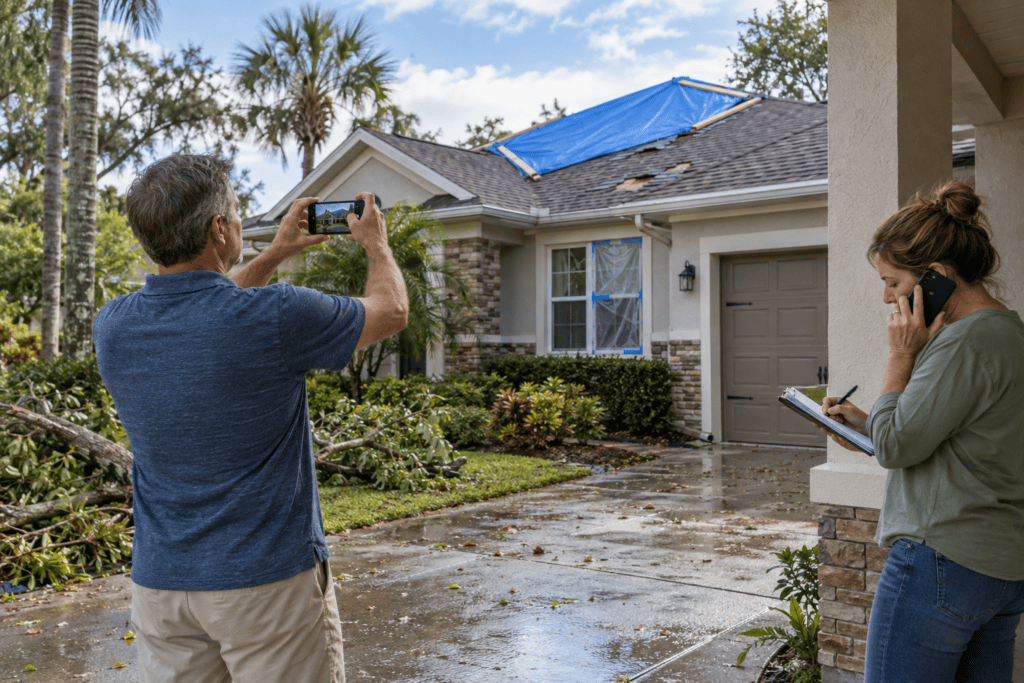 Document the damage when it is safe to do so, retain relevant records, and report the loss promptly to the insurance company.
Preserve Damaged Property
Keep damaged materials and personal property available for inspection when it is safe and practical.
Do not discard flooring, drywall, roofing materials, appliances, furniture, or other damaged property solely because cleanup has begun. The insurance company may need to inspect the items or confirm the nature and extent of the damage.
If an item presents a health or safety hazard and cannot reasonably be retained:
- Photograph or record it thoroughly
- Document why it had to be discarded
- Preserve representative samples when safe
- Record the manufacturer, model, serial number, and approximate age
- Keep disposal, cleanup, or replacement receipts
- Notify the adjuster
Give the insurance company a reasonable opportunity to inspect the damage before substantial permanent repairs begin, unless immediate work is necessary to protect people or prevent additional loss.
Report the Claim Promptly
Contact the insurance company directly using the claims telephone number or online reporting system shown on the policy documents. You may also notify your insurance agency for assistance locating the appropriate claim-reporting information.
Be prepared to provide:
- Named insured
- Policy number
- Property address
- Date and approximate time of loss
- Description of what happened
- Areas of the home affected
- Emergency repairs completed
- Current contact information
- Temporary address, if you left the home
- Police, fire, or emergency-service report information
- Available photographs or videos
Describe facts you know without speculating about the cause. For example, explain that water was discovered coming through a ceiling rather than assuming whether it originated from plumbing, rain, or another source.
Obtain:
- Claim number
- Adjuster’s name and contact information
- Adjuster’s Florida license number
- Instructions for submitting photographs and documents
- Expected inspection process
- Applicable deductible
- Information about emergency services or managed-repair provisions
If wind and flooding may both have contributed to the damage, notify the homeowners, windstorm, and flood insurance companies as applicable. Do not wait for one company to decide the entire cause before notifying another policy that may apply.
Maintain a Complete Claim File
Keep a dedicated electronic and physical file containing:
- Policy and declarations pages
- Claim number
- Adjuster information
- Photographs and videos
- Damaged-property inventory
- Inspection reports
- Contractor estimates
- Emergency-repair receipts
- Temporary living expense receipts
- Emails and letters
- Records of telephone calls
- Documents submitted to the insurer
- Proof that documents were delivered
- Insurer estimates
- Coverage and payment letters
- Repair invoices
- Proof of completed work
For telephone calls, record the date, time, name of the person contacted, telephone number, and a summary of what was discussed.
Respond promptly to reasonable requests for information and keep copies of everything provided.
Understand Florida Claim Deadlines
A policy may require prompt notice of loss, so homeowners should not wait for the maximum statutory deadline.
Under current Florida law:
- An initial or reopened property insurance claim generally must be reported within one year after the date of loss.
- A supplemental claim generally must be reported within 18 months after the date of loss.
For certain weather-related claims, Florida law defines the date of loss according to when the hurricane made landfall or when the tornado, windstorm, severe rain, or other weather event was verified.
These deadlines do not mean homeowners should wait months to report damage. Delayed notice can make it more difficult to determine the cause, scope, and timing of a loss. Policy terms, contractual duties, and other legal deadlines may also require earlier action.
Know the Insurance Company’s General Claim Timelines
Subject to statutory exceptions and circumstances beyond the insurer’s control, current Florida law generally requires a residential property insurer to:
- Review and acknowledge a claim-related communication within seven calendar days
- Begin a reasonably necessary investigation within seven days after receiving a proof-of-loss statement
- Conduct a necessary physical inspection within thirty days after receiving the proof-of-loss statement
- Provide a copy of an insurer adjuster’s detailed estimate within seven days after the estimate is generated
- Pay or deny an initial, reopened, or supplemental property claim, or a portion of the claim, within sixty days after receiving notice
The insurer generally must provide a reasonable written explanation for a payment, denial, or partial denial.
Florida insurers must also provide personal residential policyholders with a Homeowner Claims Bill of Rights within fourteen days after receiving the initial claim communication.
Keep in mind that statutory exceptions, tolling periods, emergency orders, missing information, policyholder actions, and other circumstances can affect these timelines.
Cooperate With the Claim Investigation
The policy’s Duties After Loss section may require the homeowner to:
- Protect the property from additional damage
- Provide access for inspection
- Show damaged property
- Submit photographs and records
- Create a personal-property inventory
- Provide requested estimates, receipts, and invoices
- Complete a sworn proof of loss when required
- Participate in a recorded statement
- Participate in an examination under oath
- Cooperate with the insurer’s investigation
Read requests carefully and respond by the stated deadline. Ask for clarification when a request is unclear or the requested material is unavailable.
Failure to cooperate or provide material claim information can delay the investigation and may affect coverage.
Understand Emergency Repairs and Permanent Repairs
Emergency work is intended to prevent additional damage or address an immediate hazard.
Examples include:
- Roof tarping
- Water extraction
- Temporary board-up
- Plumbing shutoff
- Drying and dehumidification
- Temporary electrical repairs
- Tree removal necessary for safety or access
Permanent work restores or replaces damaged property.
Examples include:
- Full roof replacement
- New drywall
- Flooring replacement
- Cabinet replacement
- Structural repairs
- Window replacement
- Permanent plumbing repairs
- Painting and finishing
Before authorizing substantial permanent work, allow the insurance company a reasonable opportunity to inspect the damage. Ask whether the policy includes managed-repair, preferred-vendor, right-to-repair, or advance-approval provisions.
Review Contractors and Repair Agreements Carefully
Do not sign a repair, financing, direction-to-pay, or public-adjuster agreement without understanding its terms.
Before hiring a contractor:
- Verify the contractor’s Florida license
- Confirm the business name and license holder
- Request proof of general liability and workers’ compensation insurance
- Obtain a written, itemized estimate
- Review payment terms
- Review cancellation provisions
- Confirm who will obtain permits
- Ask about warranties
- Avoid large unexplained advance payments
- Keep copies of signed agreements
A contractor cannot lawfully waive, rebate, or absorb an insurance deductible. Offers to complete repairs without requiring the homeowner to pay the applicable deductible should be treated with caution.
A contractor may explain the contractor’s repair estimate but generally cannot interpret insurance coverage or negotiate a claim unless separately licensed to perform those services.
Understand the Role of Insurance Adjusters
An insurance-company adjuster investigates the claim on behalf of the insurer and does not charge the policyholder a separate adjusting fee.
A public adjuster represents the policyholder and charges a fee under a written contract. Hiring a public adjuster is optional.
Before hiring a public adjuster:
- Verify the adjuster’s Florida license
- Review the fee
- Understand which claim services are included
- Review cancellation rights
- Determine the length of the contract
- Understand how payments will be handled
- Keep a complete signed copy
No adjuster, contractor, or other professional should encourage a homeowner to exaggerate damage or include property that was not affected by the loss.
Keep Records of Additional Living Expenses
If a covered loss makes the home uninhabitable, additional living expense coverage may help pay qualifying increases in normal household expenses.
Potential expenses may include:
- Temporary housing
- Additional meal costs
- Laundry
- Pet boarding
- Storage
- Moving expenses
- Additional transportation
- Other necessary increases in living costs
Coverage depends on the policy, cause of loss, applicable limits, and time periods. It generally does not pay every household expense or create unlimited reimbursement.
Notify the insurer before making significant temporary housing commitments when possible. Keep itemized receipts and records showing normal expenses compared with the increased costs caused by displacement.
If you relocate, provide the insurance company with your temporary address, telephone number, and email address.
Review the Estimate, Deductible, and Payment
When the insurer issues an estimate or coverage decision, review:
- Cause-of-loss determination
- Covered and noncovered damage
- Measurements and repair quantities
- Material and labor pricing
- Debris removal
- Emergency mitigation
- Permits
- Building-code expenses
- Applicable deductible
- Depreciation
- Recoverable depreciation
- Additional living expenses
- Policy limits and sublimits
- Exclusions and endorsements
Confirm that the correct deductible was applied.
If the policy includes replacement-cost coverage, the insurer may initially pay actual cash value and release recoverable depreciation after covered repairs or replacement are completed and documented. Review the insurer’s instructions and applicable deadlines.
A mortgage company may be included as a payee on certain claim checks. Contact the mortgage servicer promptly to understand its endorsement, inspection, and payment-release procedures.
What If Damage or Costs Were Omitted?
Additional damage or higher repair costs may be discovered after the initial inspection or payment.
Notify the insurance company promptly and in writing. Include:
- Original claim number
- Description of the additional damage or cost
- Photographs
- Contractor estimates
- Invoices
- Reports
- Request for reinspection when appropriate
Do not assume the original payment automatically closes every issue. Read the insurer’s correspondence carefully and preserve proof of any supplemental submission.
Remember that supplemental claims are subject to Florida’s current 18-month notice deadline and any applicable policy requirements.
What If a Claim Is Denied or Underpaid?
Begin by reviewing the insurer’s:
- Coverage letter
- Detailed estimate
- Deductible calculation
- Depreciation
- Exclusions
- Endorsements
- Cause-of-loss determination
- Requested documents
- Dispute-resolution instructions
Ask the insurer for a written explanation identifying the policy provisions and facts supporting its decision. Submit documentation for damage or costs you believe were omitted and request reinspection when appropriate.
Depending on the circumstances, potential options may include:
- Additional review by the insurance company
- Supplemental claim
- Reinspection
- Appraisal when provided by the policy
- Mediation through the Florida Department of Financial Services
- Assistance from a licensed public adjuster
- Advice from a qualified insurance attorney
The appropriate option depends on the policy, nature of the disagreement, amount involved, and applicable deadlines.
Report Liability Claims and Legal Documents Immediately
If someone is injured on the property or alleges that a household member caused injury or property damage, report the occurrence promptly.
Immediately forward any:
- Demand letter
- Attorney correspondence
- Lawsuit
- Summons
- Subpoena
- Legal notice
- Medical bill submitted as part of a claim
Do not ignore legal documents or attempt to handle a liability claim without notifying the insurance company. Liability coverage includes separate duties, conditions, and deadlines.
First Florida Agency can help policyholders locate insurance-company claim-reporting information, obtain available policy documents, understand general policy provisions, and communicate with the insurer when appropriate. The insurance company and its adjuster remain responsible for investigating the loss and making the coverage and payment decisions.
For a detailed step-by-step explanation, read our Florida Home Insurance Claim Guide.
Coverage, duties after loss, deductibles, claim procedures, repair requirements, and settlement terms vary by policy and insurance company. Homeowners should review their own policy documents and seek qualified professional advice when necessary.
Florida Homeowners Insurance for Northeast Florida and Communities Statewide
First Florida Agency assists eligible homeowners throughout Florida, with a particular local focus on Nocatee, Ponte Vedra, Ponte Vedra Beach, Palm Valley, Jacksonville, St. Augustine, St. Johns County, and surrounding Northeast Florida communities.
Although homeowners insurance includes many of the same basic coverage categories throughout the state, the availability, price, and structure of coverage can vary considerably by location and property.
A Florida homeowners insurance review should account for the individual home—not merely the city, county, or ZIP code.
 First Florida Agency serves homeowners throughout Florida, with local knowledge of Nocatee, Ponte Vedra, Jacksonville, St. Augustine, St. Johns County, and surrounding Northeast Florida communities.
Why Location Matters for Florida Homeowners Insurance
Insurance companies may consider location-related factors such as:
- Distance from the Atlantic Ocean or Gulf of Mexico
- Distance from the Intracoastal Waterway, rivers, creeks, canals, bays, or tidal areas
- Hurricane and windstorm exposure
- Local wind-speed requirements
- Flood zone and drainage characteristics
- Elevation
- Distance from a fire station or hydrant
- Local fire-protection classification
- Density and concentration of insured property
- Construction and repair costs
- Building codes in effect when the home was constructed
- County and ZIP-code loss experience
- Availability of insurance-company capacity in the area
A property does not need to be directly on the coast to experience hurricane-force winds, wind-driven rain, tornadoes, falling trees, lightning, or heavy rainfall.
Likewise, a home outside a FEMA-designated Special Flood Hazard Area can still experience flooding caused by drainage problems, surface-water accumulation, overflowing retention ponds, creeks, rivers, or unusually heavy rainfall.
Homeowners Insurance in Northeast Florida
Northeast Florida includes a broad range of properties and insurance exposures.
The region contains:
- New homes in master-planned communities
- Established suburban neighborhoods
- Coastal homes
- Waterfront properties
- Historic residences
- High-value custom homes
- Golf course communities
- Properties near rivers, wetlands, and the Intracoastal Waterway
- Inland homes surrounded by mature trees
- Homes located in developing areas with changing drainage patterns
These properties can have very different insurance requirements, even when they are located only a few miles apart.
Northeast Florida homeowners should consider:
- Hurricane and tropical-storm exposure
- Wind-driven rain
- Roof age and wind resistance
- Falling trees and debris
- Heavy rainfall and surface-water flooding
- Tidal, river, and storm-surge exposure
- Plumbing and water-damage risks
- Screened enclosures and pool cages
- Swimming pools
- Detached structures
- Golf carts
- Docks and waterfront improvements
- Replacement costs
- Hurricane deductibles
- Wind-mitigation documentation
- Separate flood insurance
Standard homeowners insurance generally does not cover storm surge, rising water, or other excluded forms of flooding. Flood insurance should therefore be evaluated separately from windstorm and homeowners coverage.
Homeowners Insurance in Nocatee and Ponte Vedra
Nocatee, Ponte Vedra, Ponte Vedra Beach, and Palm Valley include homes with different ages, construction features, values, roof types, wind protections, and proximity to water.
A newer home may have been built under more recent Florida Building Code requirements and may contain qualifying wind-mitigation features. However, newer construction does not eliminate the need to review:
- Dwelling replacement cost
- Hurricane deductible
- Roof and wind coverage
- Flood exposure
- Water-damage limitations
- Screened-enclosure coverage
- Personal liability
- Pool-related exposures
- Golf cart insurance
- Additional living expense coverage
- Ordinance or law coverage
As homes age, roofing, water heaters, plumbing components, air-conditioning systems, and other features may receive greater underwriting scrutiny.
Nocatee also includes ponds, wetlands, preserves, drainage systems, golf cart paths, developing construction areas, and neighborhoods with different elevations and distances from coastal or tidal water. Homeowners should not assume that every property within the community has the same flood, wind, or underwriting profile.
For more localized guidance, read Homeowners Insurance in Nocatee: 2026 Guide.
Homeowners Insurance in Jacksonville and Duval County
Jacksonville and Duval County contain a diverse range of residential properties, including:
- Older urban homes
- Established suburban neighborhoods
- New construction
- Riverfront residences
- Coastal properties
- Historic homes
- High-value custom homes
- Rental and seasonal properties
An older Jacksonville home may require documentation concerning the roof, electrical system, plumbing, and air-conditioning system. A four-point inspection may be required, depending on the home’s age and the insurance company.
Properties near the St. Johns River, tributaries, marshes, or coastal areas may also need careful evaluation of flood, tidal-water, wind, and evacuation exposures.
Homes farther inland can still experience severe thunderstorms, hurricane winds, tornadoes, falling trees, lightning, and heavy rainfall. Distance from the beach should not be treated as proof that a home has little weather-related exposure.
Homeowners Insurance in St. Augustine and St. Johns County
St. Augustine and St. Johns County include historic homes, coastal properties, newer subdivisions, master-planned communities, rural acreage, and rapidly developing residential areas.
Insurance considerations may include:
- Age and condition of the roof
- Historic construction features
- Electrical and plumbing updates
- Building-code compliance
- Replacement cost for specialized materials
- Wind mitigation
- Flood and drainage exposure
- Proximity to the coast, Intracoastal Waterway, or other bodies of water
- Pools and screened enclosures
- Detached garages and outbuildings
- New construction and builder documentation
Historic or custom features may cost more to reproduce than standard modern materials. The dwelling limit should account for the actual construction characteristics of the home rather than relying solely on market value or purchase price.
Rapid development can also change surrounding drainage, traffic, emergency access, and construction costs. Homeowners should update their insurance information after additions, renovations, pool installations, screened enclosures, and other significant property improvements.
Newer Homes and Older Homes Have Different Insurance Considerations
Newer Florida homes may benefit from:
- More recent building-code requirements
- Modern roof attachments
- Improved roof-to-wall connections
- Newer electrical and plumbing systems
- Updated windows and exterior doors
- Available construction and permit records
However, newer homes still require appropriate dwelling coverage, deductibles, flood evaluation, personal liability, and coverage for outdoor property.
Older Florida homes may require:
- Four-point inspection
- Wind-mitigation inspection
- Roof certification
- Electrical-system documentation
- Plumbing updates
- Air-conditioning information
- Permit and renovation records
- Proof of completed repairs
An older home is not automatically uninsurable, and a newer home is not automatically inexpensive to insure. Each insurance company applies its own underwriting guidelines.
Florida Homeowners Insurance Beyond Northeast Florida
First Florida Agency can assist eligible homeowners throughout Florida by telephone, email, and online communication.
Florida’s regions present different combinations of risk:
- Atlantic and Gulf Coast properties may face substantial wind, storm-surge, and coastal flood exposure.
- Inland properties may face hurricane winds, tornadoes, severe thunderstorms, river flooding, surface-water accumulation, lightning, and falling trees.
- Central and West-Central Florida properties may require evaluation of sinkhole and ground-cover-collapse protection.
- South Florida and the Florida Keys may have specialized wind, flood, construction, and insurance-market considerations.
- Panhandle properties may face significant hurricane, wind, coastal, inland-flood, and wildfire exposure.
- Rural properties may include acreage, outbuildings, animals, private roads, wells, septic systems, or limited fire-protection access.
These descriptions are general. The actual insurance requirements depend on the individual property, policy, insurance company, and underwriting information.
Insurance Availability Can Vary by County and ZIP Code
An insurance company may write homeowners coverage in one Florida county or ZIP code while limiting new business in another area. Availability can also change because of:
- Coastal concentration
- Hurricane exposure
- Reinsurance arrangements
- Roof-age guidelines
- Property values
- Construction type
- Claims experience
- Insurer capacity
- Changing underwriting requirements
This is one reason a statewide homeowners insurance strategy should not rely on a single insurance company or assume that a policy available for one property will be available for another.
Not every insurer will be appropriate or available for every homeowner. Quotes remain subject to property details, inspection results, underwriting approval, documentation, and policy requirements.
Coordinating Homeowners, Flood, and Other Household Coverage
Florida homeowners may need more than one policy to address their full property and liability exposure.
Depending on the household, an insurance review may include:
- Homeowners insurance
- Flood insurance
- Wind-only coverage
- Personal umbrella insurance
- Automobile insurance
- Golf cart insurance
- Boat and watercraft insurance
- Valuable-items coverage
- Rental property insurance
- Equipment or service-line endorsements
These policies should be reviewed together when practical. A homeowners policy may exclude or limit an exposure that is covered through another policy.
For broader statewide information about coverage, exclusions, deductibles, inspections, flood insurance, and Florida-specific insurance considerations, read Florida Homeowners Insurance: A Complete Guide.
First Florida Agency can work with homeowners locally in Northeast Florida and remotely throughout the state. Available insurance options depend on the property, location, occupancy, claims history, inspections, coverage needs, and insurance-company underwriting requirements.
Why Choose First Florida Agency for Florida Homeowners Insurance?
Choosing Florida homeowners insurance involves more than finding the lowest premium. Coverage limits, deductibles, roof settlement provisions, water-damage restrictions, inspections, and insurance-company requirements can materially affect how a policy protects your home.
First Florida Agency helps homeowners compare available options, understand important policy differences, and make informed coverage decisions.
Independent Access to Multiple Insurance Companies
As an independent insurance agency, First Florida Agency is not limited to offering coverage from a single insurance company. We have access to more than two hundred insurance carriers across personal and business insurance markets.
Not every carrier offers homeowners insurance or accepts every property. Eligibility may depend on the home’s location, age, roof, construction, inspections, prior claims, occupancy, and other underwriting considerations. However, access to multiple markets allows us to explore eligible private-market options and, when appropriate, Citizens Property Insurance.
Our goal is to compare the actual coverage, deductibles, restrictions, and pricing available for your property—not simply identify the lowest initial premium.
Local Knowledge with Statewide Service
First Florida Agency is located in the Nocatee and Ponte Vedra area and serves homeowners throughout Florida.We understand the insurance concerns that commonly affect Florida properties, including:
- Hurricane and windstorm exposure
- Roof age and roof settlement provisions
- Wind-mitigation and four-point inspections
- Flood and storm-surge exposure
- Water-damage and mold limitations
- Replacement-cost estimates
- Hurricane and percentage-based deductibles
- Ordinance or law coverage
- Screened enclosures, pools, detached structures, and other property features
Our local presence is especially helpful for homeowners in Nocatee, Ponte Vedra, Ponte Vedra Beach, Palm Valley, Jacksonville, St. Augustine, St. Johns County, and surrounding Northeast Florida communities. We also assist homeowners throughout the state by telephone, email, and online communication.
A Coverage-Focused Policy Review
When reviewing a homeowners insurance option, we can help you examine important details such as:
- Dwelling and other-structures limits
- Personal property and loss-of-use coverage
- Personal liability and medical-payments limits
- Hurricane and all-other-perils deductibles
- Roof replacement cost, actual cash value, or scheduled settlement provisions
- Water-damage, mold, and water-backup limitations
- Ordinance or law coverage
- Available windstorm and flood protection
- Applicable endorsements and exclusions
- Inspection and underwriting requirements
- Available mitigation credits and discounts
The appropriate policy depends on the property, household, budget, and risks you are prepared to retain. We explain the available choices so you can evaluate more than premium alone.
Personal Service Before and After the Policy Is Issued
Our work does not necessarily end when a policy is purchased. First Florida Agency can assist with renewal reviews, policy changes, inspection documentation, mortgagee updates, billing questions, and requests to add or remove coverage.
If a loss occurs, we can also help you locate the appropriate insurance-company claim contact and obtain available policy information. Claim coverage and settlement decisions remain subject to the insurance company’s investigation and the policy’s terms.
First Florida Agency was founded by John Closterides, a Florida-licensed insurance agent with more than a decade of experience helping individuals and families evaluate their insurance needs.
Request a Florida Homeowners Insurance Quote
Consider requesting a homeowners insurance review if you are:
- Purchasing or building a Florida home
- Approaching your policy renewal
- Moving to Florida from another state
- Facing a cancellation or nonrenewal
- Comparing Citizens with available private insurance
- Replacing a roof or completing home improvements
- Concerned that your existing limits or deductibles may no longer be appropriate
- Unsure how your policy addresses wind, flood, water damage, or roof losses
Providing the following information can help us evaluate available options:
- Property address
- Desired effective date
- Current policy declarations and renewal offer, if available
- Roof installation or replacement year
- Wind-mitigation or four-point inspection reports
- Information about plumbing, electrical, heating, and air-conditioning updates
- Prior insurance and loss history
- Mortgage-company information, if applicable
If you do not have every document available, you can still begin with the property address and your contact information. We will let you know what additional information may be needed.
Call First Florida Agency at 904-822-8800 or use the Request a Quote form to begin your Florida homeowners insurance review.
Your Nocatee neighbor. Your insurance advocate.
Florida Homeowners Insurance FAQs
What Does Florida Homeowners Insurance Typically Cover?
A Florida homeowners insurance policy may include coverage for the dwelling, other structures, personal property, additional living expenses, personal liability, and medical payments to others after certain covered losses.
Coverage depends on what caused the loss and remains subject to the policy form, exclusions, limits, deductibles, endorsements, conditions, and loss-settlement provisions. Homeowners should review both the coverage limits and the circumstances under which each coverage applies.
Is Homeowners Insurance Required by Law in Florida?
Florida law generally does not require homeowners to carry homeowners insurance. However, a mortgage lender will typically require property insurance to protect its financial interest in the home and may also require flood insurance depending on the property, loan, and applicable requirements.
Even without a mortgage, homeowners insurance can provide important protection for the home, belongings, additional living expenses, and personal liability exposures.
What Affects the Cost of Homeowners Insurance in Florida?
Florida homeowners insurance premiums can be affected by the home’s location, estimated replacement cost, construction, year built, roof age and condition, electrical and plumbing systems, wind exposure, mitigation features, prior claims, occupancy, coverage limits, deductibles, and optional endorsements.
Insurance companies use different rates and underwriting requirements, so premiums and available coverage can vary significantly for the same property. Homeowners should compare equivalent coverage, deductibles, exclusions, and loss-settlement provisions rather than evaluating price alone.
How Is the Dwelling Coverage Limit Determined for a Florida Home?
The dwelling coverage limit is generally based on the estimated cost to reconstruct the home using current construction materials, labor, and building requirements. It is not necessarily based on the home’s purchase price, market value, mortgage balance, property-tax assessment, or the value of the land.
The estimate may consider the home’s size, construction, roof, interior finishes, attached structures, debris removal, local labor and material costs, and applicable building codes. The limit should be reviewed periodically and after additions, renovations, or significant improvements.
Does Florida Homeowners Insurance Cover Hurricane Damage?
A Florida homeowners insurance policy may cover qualifying wind damage caused by a hurricane, subject to the policy’s terms, exclusions, limits, and applicable hurricane deductible. Interior rain damage may also be covered when wind first damages the building and creates an opening through which rain enters, depending on the policy.
Flooding, storm surge, rising water, and water moving across normally dry ground are generally excluded from homeowners insurance. Wind coverage may also be excluded or provided through a separate policy for certain properties, so it should never be assumed.
What Is a Hurricane Deductible in Florida?
A hurricane deductible is the portion of a covered hurricane loss that the policyholder is responsible for before the insurance company pays the remaining covered amount.
Unlike a typical fixed-dollar deductible, a hurricane deductible is commonly expressed as a percentage of the dwelling coverage limit—not as a percentage of the damage. The declarations page or renewal documents should identify the applicable percentage and dollar amount. Whether the hurricane deductible applies depends on the cause and timing of the loss, the policy, and applicable Florida law.
Does Florida Homeowners Insurance Cover Flood Damage?
Standard homeowners insurance generally does not cover flooding caused by storm surge, rising surface water, overflowing bodies of water, or water moving across normally dry ground.
Flood protection is usually obtained through a separate National Flood Insurance Program or private flood insurance policy, although some insurers may offer flood coverage through another eligible policy arrangement or endorsement. Flood risk should be evaluated even when a home is outside a designated high-risk flood zone.
Does Homeowners Insurance Cover Water Damage in Florida?
Homeowners insurance may cover certain sudden and accidental water losses, such as damage resulting from an unexpected plumbing or appliance discharge, depending on the policy.
Coverage may distinguish between damage caused by the released water and the cost of repairing the pipe, appliance, roof, or other item that failed. Long-term or repeated leakage, deterioration, maintenance problems, flooding, and sewer or drain backup may be excluded or limited unless specific coverage applies.
Does Florida Homeowners Insurance Cover Mold?
Mold coverage is often limited and depends heavily on what caused the moisture. Mold testing, remediation, and resulting property damage may receive limited coverage when the mold directly results from a covered water loss, subject to the policy’s mold limit, exclusions, and conditions.
Mold associated with long-term leakage, repeated seepage, indoor humidity, condensation, deferred maintenance, pre-existing damage, or flooding may be excluded. Promptly stopping the water source, documenting the damage, reporting the loss, and taking reasonable steps to prevent additional damage can be important.
What Is the Difference Between Replacement Cost and Actual Cash Value?
Replacement-cost coverage generally reflects the cost to repair or replace covered property with property of similar kind and quality without deducting for depreciation, subject to the policy’s terms, limits, and claim requirements.
Actual cash value generally reflects the replacement cost minus depreciation based on factors such as age and condition. Some replacement-cost claims may initially be paid at actual cash value, with eligible recoverable depreciation paid after repairs or replacement are completed. Dwelling, roof, and personal-property losses may have different settlement provisions.
How Does Roof Age Affect Homeowners Insurance in Florida?
A roof’s age, material, condition, remaining useful life, installation documentation, and wind-resistance features can affect insurance eligibility, premiums, deductibles, inspections, coverage options, and roof-loss settlement.
Insurance companies have different roof requirements. An older roof does not automatically produce the same result with every insurer, but additional inspections, documentation, repairs, restricted settlement provisions, or roof replacement may be required.
What Is a Four-Point Inspection in Florida?
A four-point inspection is a limited insurance inspection that documents four major systems of a home: the roof, electrical system, plumbing system, and heating, ventilation, and air-conditioning system.
Insurance companies commonly request four-point inspections for older homes when determining eligibility for a new policy or renewal. It is not the same as a comprehensive home inspection. The inspector documents the observed conditions, but the insurance company ultimately decides whether the property satisfies its underwriting requirements.
What Is a Wind-Mitigation Inspection in Florida?
A wind-mitigation inspection documents construction features that may reduce damage from hurricanes and strong winds. These may include the roof covering, roof-deck attachment, roof-to-wall connections, roof shape, secondary water resistance, and qualifying protection for windows, exterior doors, skylights, and garage doors.
Documented features may qualify for credits or other pricing benefits on the windstorm portion of the premium. An inspection does not guarantee savings because the home may already receive the applicable credits or the documented features may not qualify for additional reductions.
What Is Ordinance or Law Coverage on a Florida Homeowners Policy?
Ordinance or law coverage may help pay certain additional expenses required to repair, rebuild, or demolish part of a home in compliance with current building codes after a covered loss.
These expenses can include code-required upgrades, demolition of an undamaged portion of the structure, or increased construction costs that are not fully covered by the basic dwelling limit. Coverage is subject to the policy’s limit, exclusions, and conditions, so homeowners should review the amount provided.
What Information Do I Need for a Florida Homeowners Insurance Quote?
Helpful information can include the property address, intended occupancy, year built, square footage, construction type, roof installation date and material, electrical and plumbing updates, air-conditioning information, current insurance, prior claims, and requested effective date.
Homeowners should also disclose features such as swimming pools, animals, trampolines, detached structures, docks, rental activity, and home-based businesses. Four-point and wind-mitigation reports, permits, contractor records, and documentation of completed improvements may also be requested.
If every document is not immediately available, you can still begin with the property address and your contact information. Quotes remain subject to inspections, documentation, underwriting requirements, and insurance-company approval.
Let’s Get Started
Florida Homeowners Insurance Quote Request
"*" indicates required fields
Don’t like forms? Contact us at or email us.
