

Insurance options for Florida carpenters, framing contractors, finish carpenters, and cabinet installers.
Whether you work independently or operate a larger carpentry business, your insurance needs can depend on the type of projects you take on, the people who work with you, the equipment you use, and the contractual requirements you must meet. A well-structured insurance program can help address these exposures while supporting the day-to-day operations of your business.
Insurance Coverage Built Around the Carpentry Work You Perform
Carpentry businesses can face very different insurance exposures depending on the type of work they perform, where they work, whether they use employees or subcontractors, and the tools, vehicles, and materials involved in their operations.
A framing contractor working on new residential construction may have different insurance needs than a finish carpenter installing trim inside occupied homes or a cabinet installer transporting expensive materials and equipment between jobsites. Commercial carpentry work may also involve additional contract requirements, certificates of insurance, additional insured requests, or higher liability limits.
The insurance program should reflect these differences rather than rely on a one-size-fits-all approach. The types of coverage, limits, and endorsements that may be appropriate can change as the business takes on different projects, hires employees or subcontractors, adds vehicles or equipment, or accepts new contractual requirements.
Carpenters who perform broader construction or contracting operations may also want to review our Florida Contractor Insurance guide.
What Is Carpenter Insurance in Florida?
Carpenter insurance is not usually a single insurance policy. Instead, it generally refers to a combination of commercial insurance coverages selected around the work a carpentry business performs, the property and equipment it owns, the vehicles it uses, and the people involved in its operations.
Depending on the business, a carpenter insurance program may include General Liability, Workers’ Compensation, Commercial Auto, tools and equipment coverage, Commercial Property, Commercial Umbrella, and other specialized coverage. A solo finish carpenter working primarily inside homes may have different insurance needs than a framing company with employees, multiple vehicles, subcontractors, and equipment moving between active construction sites.
The appropriate combination of coverage can also depend on whether the business performs residential or commercial work, the size and value of its projects, contractual insurance requirements, and the types of materials or equipment in its care. Coverage availability, limits, deductibles, exclusions, and endorsements vary by insurer and policy.
What Types of Carpentry Businesses May Need Insurance?
Carpenter insurance can apply to a wide range of businesses, from self-employed tradespeople to larger carpentry contractors with employees, vehicles, subcontractors, and multiple active jobsites.
Businesses that may need carpenter insurance include framing contractors, finish carpenters, trim and molding installers, cabinet and built-in installers, millwork businesses, stair and railing contractors, door installers, woodworking contractors, remodeling carpenters, and carpentry subcontractors working on residential or commercial construction projects.
The insurance needs of these businesses can vary considerably. A finish carpenter working inside occupied homes may face different liability exposures than a framing contractor working on new construction, while a cabinet installer may have significant tools, materials, and finished products being transported or temporarily stored at jobsites.
The size of the business, type of work performed, use of employees or subcontractors, project values, vehicles, tools, and contractual requirements can all affect which insurance coverages should be considered.
 Carpentry businesses can face different insurance considerations depending on the work they perform, the tools and equipment they use, and whether employees or subcontractors work alongside them.
What Does General Liability Insurance Cover for Carpenters?
General Liability Insurance is one of the core coverages for many carpentry businesses because carpenters regularly work at customer homes, construction sites, commercial properties, and other locations where their operations can create third-party injury or property-damage exposures.
Depending on the policy and circumstances, General Liability Insurance may help with covered claims involving bodily injury, property damage, personal and advertising injury, and legal defense costs. For example, a claim could arise if a customer trips over work materials at a jobsite or if carpentry operations accidentally damage property belonging to someone else.
Carpenters should also review liability requirements contained in contracts with homeowners, builders, general contractors, property managers, or commercial clients. These agreements may require specific liability limits, Certificates of Insurance, or additional insured status before work can begin.
General Liability Insurance does not cover every loss associated with carpentry work, and it should not be viewed as a warranty for defective or improperly performed work. Products-completed operations and faulty workmanship deserve separate attention, which we will address next.
For a broader explanation of liability coverage for Florida businesses, review our Florida General Liability Insurance page.
How Does Products-Completed Operations Coverage Apply to Carpentry Work?
Products-completed operations coverage is generally part of a Commercial General Liability policy and can be especially important for carpenters because claims may arise after a project has been finished and the carpenter has left the jobsite.
For example, a claim could occur if installed cabinetry, trim, stairs, railings, framing, or other completed carpentry work later contributes to bodily injury or damage to other property. Depending on the circumstances and policy terms, the General Liability policy may respond to a covered claim involving resulting bodily injury or property damage.
This coverage should not be confused with coverage for simply repairing or replacing the carpenter’s own defective work. Commercial General Liability policies commonly contain exclusions that can limit or exclude coverage for faulty workmanship, the insured’s own work, or certain damage arising from construction defects. The specific outcome can depend on the policy language, the cause of the damage, who performed the work, and whether other property was damaged.
Carpenters should review products-completed operations limits, exclusions, endorsements, and contractual requirements carefully, particularly when performing structural carpentry, stairs and railings, cabinetry, built-ins, framing, or other work that remains in place after the project is complete.
Does General Liability Cover Faulty Workmanship?
General Liability Insurance generally is not intended to pay simply for correcting or replacing a carpenter’s own defective or improperly performed work. If trim is installed incorrectly, cabinetry is built to the wrong dimensions, or framing must be redone because of poor workmanship, the cost of fixing that work may not be covered.
A different issue can arise when defective carpentry work causes bodily injury or damage to other property. For example, if improperly installed cabinetry detaches and damages a customer’s flooring, or a defective railing contributes to an injury, parts of the resulting claim may be treated differently from the cost of repairing the carpenter’s own work.
Whether coverage applies can depend on the facts of the loss, the policy language, applicable exclusions, endorsements, and who performed the work. Construction-related liability policies may contain exclusions involving the insured’s work, the insured’s product, impaired property, or other construction defects.
Carpenters should not assume that a General Liability policy functions as a workmanship guarantee. Contract requirements, warranties, subcontractor agreements, and specialized coverage should be reviewed separately when evaluating construction-related risk.
How Do Subcontractors, Additional Insureds, and Certificates of Insurance Affect Carpenters?
Carpentry businesses often work under contracts with general contractors, builders, property managers, homeowners, or commercial clients. Those agreements may include insurance requirements that must be satisfied before work begins or before the carpenter is permitted onto a jobsite.
A general contractor or project owner may request a Certificate of Insurance (COI) as evidence that the carpenter carries specified insurance coverage and limits. A certificate provides information about the policies in force, but it does not change the policy itself or automatically provide additional coverage.
Existing First Florida Agency clients can request a Certificate of Insurance through our Service Center.
Some contracts may also require the carpenter to add another party as an additional insured on the General Liability policy. Whether additional insured status applies, and the extent of that protection, depends on the endorsement, contract language, policy terms, and circumstances of the claim.
Carpenters who hire subcontractors should also consider how those subcontractors affect their own insurance program. Insurers may ask what work subcontractors perform, whether written agreements are used, and whether Certificates of Insurance are collected and maintained. A subcontractor’s lack of insurance can create additional exposure for the hiring contractor and may also affect underwriting or contractual compliance.
Before signing a contract or beginning a project, carpentry businesses should review insurance requirements carefully and confirm that requested limits, endorsements, and certificates can be provided. Requirements may vary significantly between residential projects, commercial construction, and work performed for larger general contractors.
What Are Florida’s Workers’ Compensation Requirements for Carpentry Businesses?
Carpentry businesses that fall within Florida’s construction industry should pay particular attention to Workers’ Compensation requirements. In Florida, construction-industry employers with one or more employees generally must carry Workers’ Compensation coverage. This can include non-exempt corporate officers and LLC members.
Certain corporate officers and LLC members in the construction industry may qualify to apply for an exemption from Florida’s Workers’ Compensation requirements. Exemptions are issued to eligible individuals rather than to the business itself, and specific ownership and application requirements apply.
Subcontractor relationships also matter. Florida law requires contractors to obtain evidence of Workers’ Compensation coverage from subcontractors, and a contractor can become responsible for benefits involving a subcontractor’s employees when the subcontractor fails to secure required coverage.
Because carpentry businesses may use employees, independent crews, or subcontractors in different ways, owners should verify how Florida law applies to their specific operation rather than assuming a worker is outside the Workers’ Compensation system simply because the person is paid as a subcontractor or independent contractor.
For more information about coverage options, visit our Florida Workers’ Compensation Insurance page.
How Are a Carpenter’s Tools and Equipment Insured?
Carpenters often rely on portable tools and equipment that move between a shop, work vehicle, trailer, and multiple jobsites. Standard Commercial Property Insurance may be designed primarily around property kept at a scheduled business location, so it should not automatically be assumed to provide adequate protection for tools and equipment while they are in transit or being used away from the premises.
Inland Marine Insurance or Contractors Equipment coverage may help protect eligible portable tools and equipment against covered losses such as theft, fire, vandalism, or certain accidental damage, depending on the policy. Examples can include saws, compressors, nail guns, drills, sanders, generators, ladders, and other equipment used in carpentry operations.
Coverage should be reviewed carefully because policies may distinguish between owned, leased, rented, or borrowed equipment. Limits may also apply to individual items, unscheduled tools, equipment kept in vehicles or trailers, and property temporarily stored at a jobsite. Deductibles, valuation provisions, security requirements, and exclusions can also affect how a loss is handled.
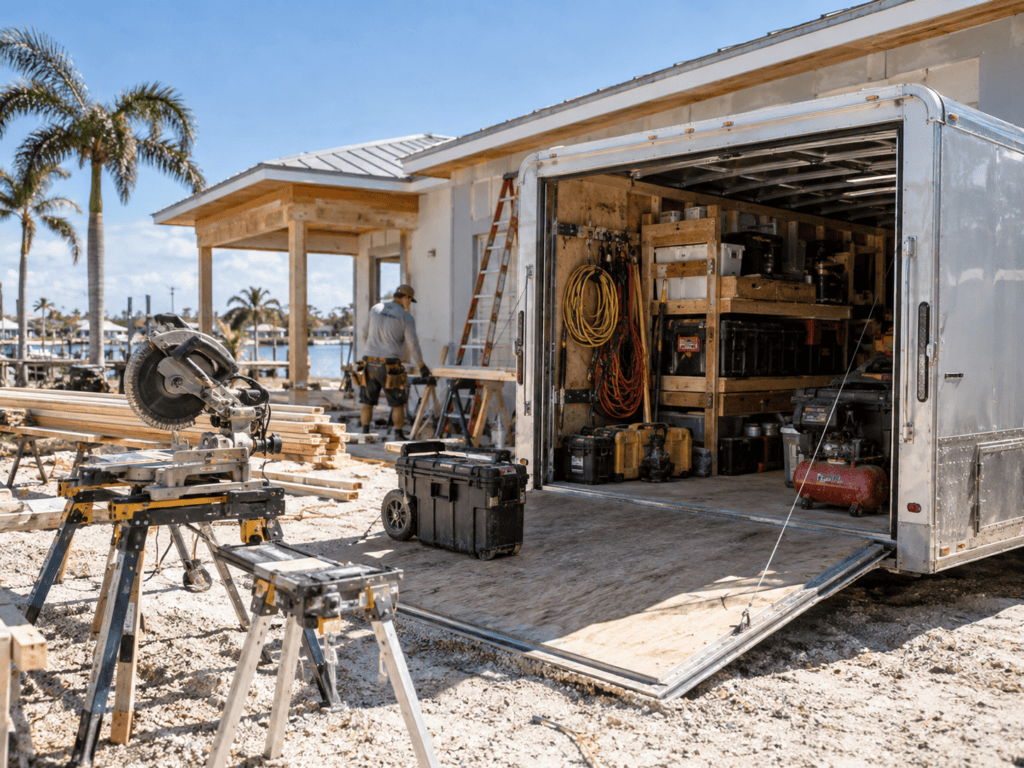 Portable tools and equipment often move between jobsites, vehicles, and trailers, making it important for carpentry businesses to review how those items are insured.
Carpentry businesses should maintain an up-to-date inventory of higher-value tools and equipment, including purchase records, serial numbers, and replacement values where practical. This can help when selecting appropriate limits and documenting property after a covered loss.
For a broader explanation of coverage for movable business property, review our Florida Inland Marine Insurance page.
Does Carpenter Insurance Cover Tools Stolen From a Truck, Trailer, or Job Site?
Coverage for stolen carpentry tools depends on the type of policy, where the tools were located when the theft occurred, and the terms, limits, deductibles, and exclusions that apply.
A Commercial Auto policy generally protects the insured vehicle itself rather than automatically covering tools, equipment, or materials carried inside it. Likewise, Commercial Property Insurance may be designed primarily for property kept at a scheduled business location. For carpenters who regularly transport tools between jobsites, Inland Marine or Contractors Equipment coverage may be needed to insure eligible property while it is in transit or temporarily away from the primary premises.
The location of the theft can matter. Tools stolen from a locked work truck, enclosed trailer, active jobsite, storage area, or other temporary location may be treated differently depending on the policy. Some policies may also include special limits, security requirements, or exclusions involving theft from an unattended vehicle or trailer.
Carpenters should review whether tools are covered at replacement cost or another valuation basis, whether higher-value items must be scheduled individually, and whether leased, rented, or borrowed equipment is included. Maintaining an inventory with photographs, serial numbers, receipts, and estimated replacement values can also make it easier to document a loss.
Because theft coverage can vary considerably by insurer and policy form, carpentry businesses should confirm where their tools are covered before relying on a vehicle, property, or equipment policy to respond.
How Does Commercial Auto Insurance Protect Carpentry Businesses?
Carpenters often use pickup trucks, vans, utility vehicles, and other vehicles to travel between jobsites, transport materials, tow trailers, and carry tools and equipment. When a vehicle is owned by the business or regularly used for business operations, a Commercial Auto policy may be appropriate.
Depending on the policy, Commercial Auto Insurance may include liability coverage for bodily injury or property damage caused to others in a covered accident, along with physical damage coverage for eligible business-owned vehicles. Collision coverage may help with damage from a covered collision, while comprehensive coverage may help with covered losses such as theft, fire, vandalism, or certain weather-related damage.
For carpentry businesses, underwriting can depend on factors such as the types of vehicles used, who drives them, how far they travel, whether trailers are towed, and how the vehicles are used in daily operations. A carpenter with one pickup used locally may have different insurance needs than a larger operation with several vans or trucks traveling between multiple jobsites.
It is also important to separate vehicle coverage from tools and equipment coverage. Commercial Auto Insurance generally protects the insured vehicle and addresses auto-related liability, but tools, equipment, lumber, cabinetry, or other business property carried inside the vehicle may require separate Inland Marine or equipment coverage.
For more information about insuring business vehicles, review our Florida Commercial Auto Insurance page.
When Might Hired and Non-Owned Auto Coverage Be Needed?
Carpentry businesses do not always rely exclusively on vehicles owned by the company. Employees may occasionally use personal vehicles for business errands, material pickups, site visits, or travel between jobs, while the business may also rent or lease vehicles for temporary use.
Hired and Non-Owned Auto (HNOA) coverage can help address certain liability exposures arising from the business use of vehicles the company does not own. Hired auto coverage generally applies to eligible rented, leased, or borrowed vehicles, while non-owned auto coverage generally applies when employees use their personal vehicles for business purposes.
For example, if an employee uses a personal pickup truck to deliver materials to a jobsite and is involved in an accident, the employee’s personal auto policy may respond first. Depending on the circumstances and policy terms, Non-Owned Auto coverage may provide additional liability protection for the business if it is named in a claim.
HNOA coverage generally does not replace the employee’s personal auto insurance and may not provide physical damage coverage for the employee’s vehicle. Likewise, coverage for rented vehicles can vary depending on the Commercial Auto policy, rental agreement, and any endorsements in place.
Carpentry businesses should review how often employees use personal vehicles for company business and whether rented or temporary vehicles are part of their operations. Even occasional use can create a liability exposure that may not be addressed by a policy covering only business-owned vehicles.
Builders Risk and Installation Floater Coverage for Carpentry Projects
Carpenters may sometimes be responsible for materials, cabinetry, millwork, doors, trim, or other property before those items are permanently installed. Depending on the project and contract, this can create a property exposure that may not be fully addressed by General Liability, Commercial Property, or standard tools and equipment coverage.
Builders Risk Insurance is generally designed to cover eligible property during the course of construction, renovation, or installation. Depending on the policy, coverage may apply to the building under construction along with certain materials, supplies, and fixtures intended to become a permanent part of the project.
An Installation Floater may be appropriate when a carpentry business needs coverage for materials or equipment while they are being transported, temporarily stored, or awaiting installation. This can be particularly relevant for custom cabinetry, millwork, doors, built-ins, trim packages, and other higher-value materials that may move between a shop, warehouse, vehicle, and jobsite before installation is complete.
 Custom cabinetry, millwork, trim, and other materials may face different exposures while in transit, temporarily stored, or awaiting installation.
The party responsible for carrying Builders Risk or installation coverage can vary by contract. In some projects, the property owner or general contractor may purchase the Builders Risk policy, while a subcontractor may still need to review whether its own materials, equipment, or installation exposures are adequately insured.
Carpenters should confirm who is responsible for insuring materials at each stage of a project and when coverage begins and ends. Policy terms can vary significantly regarding theft, water damage, wind, property in transit, temporary storage, testing, and other causes of loss.
For a broader explanation of construction-phase property coverage, review our Florida Builders Risk Insurance page.
Commercial Property Insurance for Shops, Warehouses, and Carpentry Businesses
Carpentry businesses that own or lease a shop, warehouse, office, or other business location may need Commercial Property Insurance to protect the physical property used in their operations.
Depending on the policy, coverage may apply to the building itself if the business owns it, along with eligible business personal property such as furniture, office equipment, inventory, materials, machinery, and certain tools kept at the insured premises. Coverage is subject to the policy’s limits, deductibles, valuation provisions, causes of loss, and exclusions.
For carpenters, the value of stored lumber, cabinetry, millwork, finished products, and shop equipment can be significant. Businesses that fabricate or assemble products at a fixed location should make sure their property limits reflect realistic replacement values and account for seasonal or project-related fluctuations in inventory.
Commercial Property Insurance should also be coordinated with Inland Marine or Installation Floater coverage when materials, tools, or finished products regularly leave the premises. Property kept at a shop may be insured differently from property in transit, at a temporary storage location, or on an active jobsite.
For more information about protecting business property, review our Florida Commercial Property Insurance page.
Commercial Umbrella and Excess Liability for Carpenters
A serious liability claim can exceed the limits of a carpenter’s underlying insurance policies. Commercial Umbrella or Excess Liability coverage may provide additional limits above certain underlying policies, depending on the policy structure and eligibility requirements.
For a carpentry business, this can be especially important when contracts require higher liability limits or when the company performs work with greater potential for bodily injury or property damage. Examples can include structural framing, stairs and railings, work inside occupied homes, larger commercial projects, or operations involving multiple employees and subcontractors.
Commercial Umbrella and Excess Liability policies do not automatically broaden every type of coverage. Some forms may follow underlying coverage closely, while others contain their own terms, exclusions, conditions, and coverage provisions. The policies and limits that qualify as underlying insurance should be reviewed carefully.
Carpentry businesses should review contractual limit requirements and the limits carried on General Liability, Commercial Auto, and other underlying policies to determine whether additional liability capacity is appropriate.
For more information about higher liability limits, review our Florida Commercial Umbrella Insurance page.
Other Insurance Carpenters May Need
Beyond General Liability, Workers’ Compensation, Commercial Auto, property, and equipment coverage, some carpentry businesses may need additional insurance depending on how the company operates, the work it performs, and the contracts it accepts.
A Business Owners Policy (BOP) may combine eligible General Liability and Commercial Property coverage into one policy for qualifying small businesses. Whether a carpentry operation is eligible can depend on its size, revenue, type of work, property exposures, and insurer underwriting guidelines.
Employment Practices Liability Insurance (EPLI) may be worth considering for carpentry companies with employees. It can help address certain covered employment-related claims involving allegations such as discrimination, harassment, wrongful termination, or other workplace practices, subject to policy terms and exclusions.
Cyber Liability Insurance may also be relevant for businesses that store customer information, accept electronic payments, rely on cloud-based estimating or accounting systems, or communicate electronically with clients, builders, and subcontractors.
Depending on the operation, carpenters may also need to review commercial crime coverage, equipment breakdown coverage, surety bond requirements, or specialized liability endorsements. These needs can vary considerably between a solo carpenter, a cabinet shop, a framing contractor, and a larger carpentry company working on commercial projects.
Rather than adding every available policy, the goal should be to identify the exposures that actually apply to the business and build coverage around those risks.
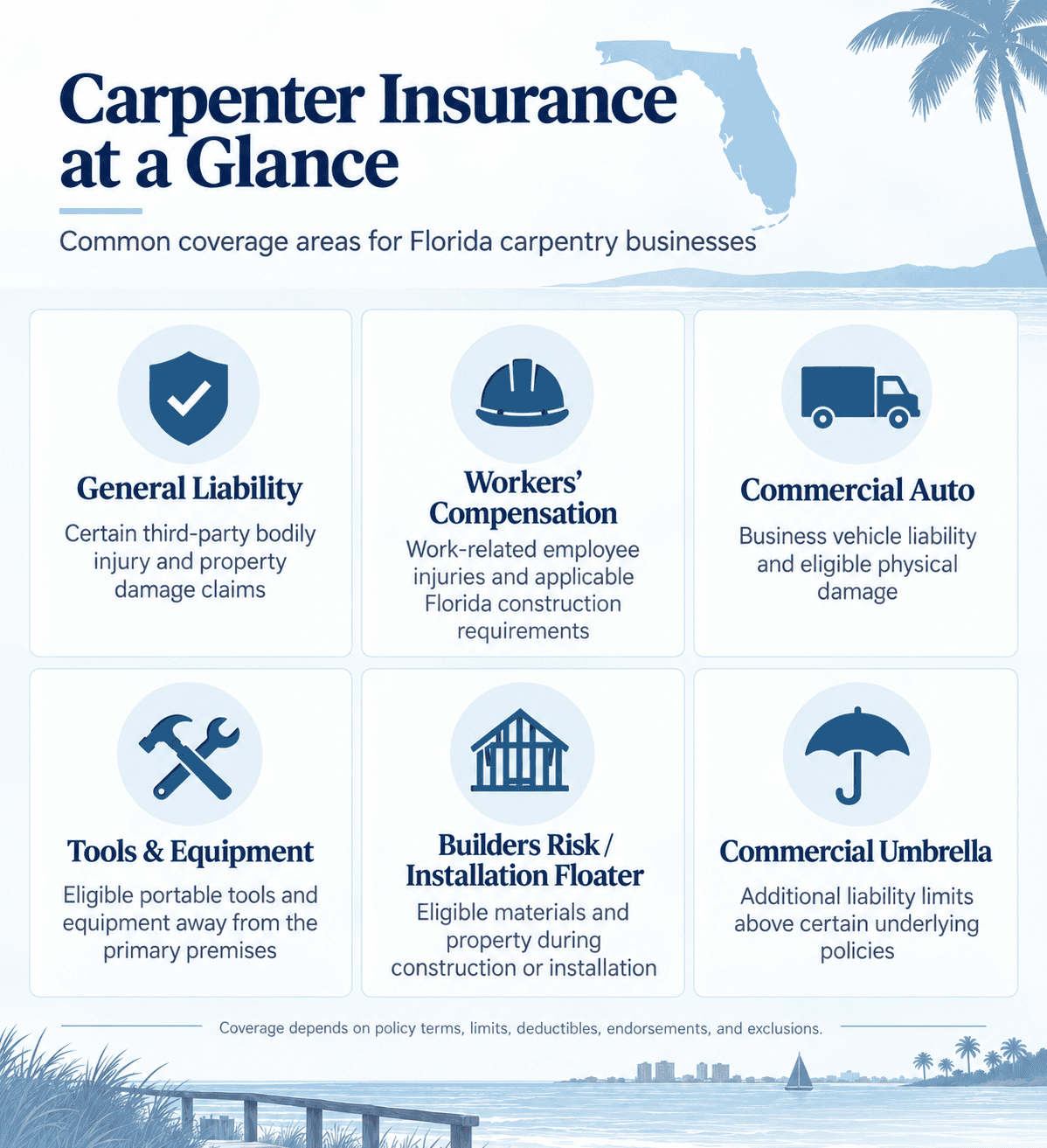 Common coverage areas for Florida carpentry businesses may include General Liability, Workers’ Compensation, Commercial Auto, tools and equipment, Builders Risk or Installation Floater, and Commercial Umbrella coverage.
Residential vs. Commercial Carpentry Insurance Considerations
Carpenters may face different insurance and contract requirements depending on whether they primarily perform residential work, commercial work, or a combination of both.
Residential carpentry can involve work inside occupied homes, custom remodeling, cabinetry, trim, stairs, built-ins, and other projects where accidental damage to a customer’s property can be a significant concern. Homeowners may also expect proof of insurance before work begins, particularly on larger renovation projects.
Commercial carpentry can involve different contractual requirements, larger project values, more formal subcontractor agreements, additional insured requests, higher liability limits, and stricter certificate requirements. Carpenters working for general contractors, developers, property managers, or commercial building owners may also need to satisfy insurance specifications before entering the jobsite.
The type of work performed matters as well. Structural framing may present different liability and workers’ compensation exposures than finish carpentry, millwork installation, or cabinet work. Commercial projects may also involve more employees, subcontractors, vehicles, equipment, and materials moving across multiple locations.
Carpentry businesses that work in both residential and commercial settings should make sure their insurance program reflects the full scope of their operations rather than being structured around only one type of project.
How Much Does Carpenter Insurance Cost in Florida?
There is no single price for carpenter insurance in Florida because coverage is built around the specific business, its operations, and the policies it needs.
A self-employed finish carpenter with limited equipment may have very different insurance costs than a framing contractor with employees, commercial vehicles, subcontractors, larger projects, and higher liability requirements.
The total cost can also change based on the combination of coverages selected, policy limits, deductibles, claims history, and insurer underwriting. The next section explains the main factors that can affect carpenter insurance premiums in more detail.
What Factors Affect Carpenter Insurance Premiums?
Insurance companies consider several characteristics of a carpentry business when determining eligibility, coverage terms, and premium. Two companies with similar revenue can receive very different insurance quotes if the work they perform, employees they hire, vehicles they operate, or projects they accept create different levels of risk.
Common underwriting factors can include:
-
Type of carpentry work: Framing, structural carpentry, finish work, cabinetry, millwork, remodeling, and other operations can present different liability and injury exposures.
-
Annual revenue and payroll: Revenue can help insurers measure the size of the operation, while payroll is especially important for Workers’ Compensation and certain liability classifications.
-
Employees and subcontractors: The number of workers, the work they perform, subcontractor costs, and whether subcontractors carry their own insurance can affect underwriting.
-
Residential versus commercial work: Project type, size, contract requirements, and work performed for general contractors can influence coverage requirements and pricing.
-
Claims history: Prior liability, property, Workers’ Compensation, or Commercial Auto claims may affect premiums and available insurance options.
-
Vehicles, tools, and equipment: The number and value of business vehicles, trailers, tools, machinery, and other property can affect the cost of insuring those exposures.
-
Coverage limits and deductibles: Higher liability limits, broader coverage, lower deductibles, and additional endorsements can increase premium but may provide more protection.
-
Experience and business history: Years in business, management experience, licensing where applicable, safety practices, and continuity of insurance may be considered during underwriting.
-
Geographic area and travel radius: Where the business operates and how far employees and vehicles travel between jobsites can affect certain coverages.
-
Contractual requirements: Additional insured endorsements, waiver requirements, higher liability limits, or other insurance provisions required by customers or general contractors may affect the overall insurance program.
Providing accurate information about the business helps insurers classify the operation correctly and reduces the risk of coverage issues, unexpected premium adjustments, or audit discrepancies later.
Common Carpenter Insurance Gaps and Exclusions to Review
Even when a carpentry business carries several insurance policies, coverage gaps can still develop if the policies do not match the way the business actually operates.
One common issue is assuming that General Liability Insurance will cover the cost of correcting defective workmanship. General Liability is generally designed to address covered third-party bodily injury and property damage claims, not simply the cost of repairing or replacing the carpenter’s own faulty work.
Tool and equipment coverage can also create surprises. Some policies may place limits on theft from vehicles or trailers, require certain property to be scheduled, or exclude particular causes of loss. Carpenters should confirm how coverage applies while tools are in transit, temporarily stored, or left at a jobsite.
Other areas that may require review include:
-
Subcontractor exclusions or limitations that can affect claims arising from work performed by others.
-
Residential or commercial work restrictions that may limit certain types of projects.
-
Roofing, structural, or other excluded operations that may apply when carpentry work extends beyond the operations originally disclosed.
-
Uninsured or improperly classified vehicles used for business purposes.
-
Personal vehicles used for company business without appropriate Non-Owned Auto coverage.
-
Materials awaiting installation that may fall outside standard property coverage.
-
Low equipment limits that may not reflect the replacement value of current tools and machinery.
-
Contractual requirements that exceed the limits or endorsements carried by the business.
-
Changes in payroll, revenue, or subcontractor costs that can affect audits, classifications, and premium.
Carpentry businesses should review their insurance whenever operations change, such as hiring employees, adding subcontractors, purchasing vehicles or equipment, moving into larger commercial projects, or expanding into new types of work.
An insurance review should focus not only on whether a policy exists, but also on whether the limits, classifications, endorsements, exclusions, and covered operations still reflect the business as it operates today.
What Information Helps When Getting a Carpenter Insurance Quote?
Insurance companies generally need a clear picture of how a carpentry business operates before they can accurately evaluate coverage and pricing. Providing complete information at the beginning of the quoting process can help reduce delays, classification issues, and unexpected changes later.
Helpful information may include:
-
Business details: Legal business name, entity type, years in business, ownership, and primary business address.
-
Description of operations: The types of carpentry performed, including framing, finish work, cabinetry, millwork, remodeling, structural work, or other services.
-
Residential and commercial work: Approximate percentage of each and the typical size or value of projects.
-
Annual revenue and payroll: Current estimates and, when available, prior-year figures.
-
Employees and subcontractors: Number of employees, payroll by job type, subcontractor costs, and whether subcontractors carry their own insurance.
-
Claims history: Prior liability, Workers’ Compensation, property, auto, or equipment claims.
-
Vehicles and drivers: Business-owned vehicles, trailers, driver information, vehicle use, and travel radius.
-
Tools and equipment: Approximate replacement value of portable tools, machinery, trailers, and higher-value equipment.
-
Business property: Details about any shop, warehouse, office, inventory, or materials kept at a permanent location.
-
Contracts and insurance requirements: Requested liability limits, additional insured requirements, waivers, or certificates required by general contractors or customers.
-
Current insurance: Existing policies, coverage limits, renewal dates, and any recent underwriting changes.
The more accurately this information reflects the business, the easier it is to compare insurance options that align with the carpenter’s actual operations, coverage needs, and underwriting requirements.
Florida Carpenter Insurance for Northeast Florida Businesses
Carpentry businesses in Northeast Florida can range from solo tradespeople and small remodeling crews to larger framing, millwork, and commercial carpentry operations working across residential and commercial projects.
First Florida Agency works with businesses in Nocatee, Ponte Vedra, Ponte Vedra Beach, Jacksonville, St. Augustine, St. Johns County, and surrounding Northeast Florida communities, while also serving clients throughout Florida.
 Carpentry businesses in Northeast Florida may work on new-home construction, coastal properties, renovations, and custom projects, all of which can create different insurance needs.
Local carpenters may work on new-home construction, coastal properties, renovations, custom cabinetry, interior trim, commercial build-outs, and larger contractor-led projects. These operations can create different insurance needs depending on the type of work performed, the size of the crew, the use of subcontractors, the value of tools and equipment, and the contracts involved.
For carpentry businesses working across multiple jobsites, it is especially important to review how coverage applies to vehicles, trailers, portable equipment, materials in transit, subcontractor exposures, and completed work. Contract requirements from builders, developers, general contractors, or commercial clients can also affect the limits and endorsements a business may need.
Working with an independent insurance agency can help carpentry businesses compare available coverage options and review whether their insurance program reflects the way the business actually operates.
What First Florida Agency Reviews When Comparing Carpenter Insurance
When reviewing insurance options for a carpentry business, First Florida Agency looks beyond the basic question of whether a policy is available. The goal is to understand how the business actually operates and whether the coverage being considered matches those exposures.
We may review factors such as:
-
Type of carpentry work performed: Framing, finish carpentry, cabinetry, millwork, remodeling, structural work, or other operations.
-
Residential and commercial work: The mix of projects, typical job size, and whether the business works directly for property owners or under general contractors.
-
Employees and subcontractors: Payroll, worker classifications, subcontractor costs, Certificates of Insurance, and contractual requirements.
-
General Liability limits and endorsements: Including completed operations, additional insured requirements, and other contract-driven provisions.
-
Tools and equipment: Replacement values, where equipment is stored, and whether it travels between vehicles, trailers, shops, and jobsites.
-
Commercial vehicles and trailers: Vehicle ownership, drivers, business use, towing, travel radius, and potential Hired and Non-Owned Auto exposures.
-
Business property and materials: Shops, warehouses, inventory, cabinetry, millwork, and materials awaiting installation.
-
Workers’ Compensation: Employee classifications, payroll, subcontractor relationships, and applicable Florida requirements.
-
Claims history and prior insurance: Past losses, coverage continuity, and underwriting issues that may affect available options.
-
Contract requirements: Higher liability limits, additional insured endorsements, waivers, or other insurance provisions required by builders, customers, or commercial clients.
As an independent insurance agency, First Florida Agency can review available insurance options from multiple markets when appropriate. Availability, eligibility, coverage terms, and pricing vary by insurer, and not every carrier or policy is appropriate for every carpentry business.
The objective is to identify coverage that reflects the business’s actual operations rather than relying on a one-size-fits-all insurance package.
Why Work With First Florida Agency for Carpenter Insurance?
Carpentry businesses often need more than a standard policy package. The right insurance program may depend on the type of work performed, contract requirements, employees and subcontractors, vehicles, tools, equipment, and the size and scope of the projects involved.
As an independent Florida insurance agency, First Florida Agency can review coverage options from multiple available insurance markets rather than relying on a single carrier. This can help identify differences in eligibility, limits, deductibles, endorsements, exclusions, and pricing that may matter to a carpentry business.
We also help clients understand how different policies work together. That can include reviewing General Liability, Workers’ Compensation, Commercial Auto, tools and equipment coverage, Commercial Property, Umbrella Liability, and other coverage when appropriate, while keeping the overall insurance program aligned with the way the business actually operates.
First Florida Agency is based in the Ponte Vedra/Nocatee area and works with businesses throughout Northeast Florida and across the state. Our goal is to provide practical coverage guidance, responsive service, and access to insurance options that fit the needs of the business, subject to carrier availability and underwriting requirements.
Get a Florida Carpenter Insurance Quote
Carpentry businesses can have very different insurance needs depending on the work they perform, the employees or subcontractors they use, the vehicles and equipment they own, and the contracts they accept. Reviewing those details can help identify coverage options that better reflect the way the business actually operates.
First Florida Agency works with carpenters and other construction-related businesses throughout Nocatee, Ponte Vedra, Ponte Vedra Beach, Jacksonville, St. Augustine, St. Johns County, Northeast Florida, and throughout the state. As an independent insurance agency, we can review available options from multiple insurance markets when appropriate and help explain differences in coverage, limits, endorsements, and exclusions.
If you are starting a carpentry business, preparing for renewal, adding employees or vehicles, purchasing new equipment, or taking on larger projects, First Florida Agency can help review how those changes may affect your insurance needs.
To discuss your carpenter insurance options, call First Florida Agency at 904-822-8800 or complete the Carpenter Insurance Quote Request form below.
Florida Carpenter Insurance FAQs
What insurance does a carpenter need in Florida?
The insurance a carpenter may need depends on the work performed, employees or subcontractors used, vehicles and equipment owned, and contractual requirements. Common coverages can include General Liability, Workers’ Compensation, Commercial Auto, Inland Marine or tools and equipment coverage, Commercial Property, and Commercial Umbrella. Additional coverage may be appropriate depending on the business.
Do carpenters need General Liability Insurance in Florida?
General Liability Insurance is not automatically required by Florida law for every carpenter, but customers, builders, general contractors, landlords, or project contracts may require it. It can help protect against certain covered third-party bodily injury, property damage, and related liability claims, subject to policy terms, limits, exclusions, and endorsements.
Do carpentry businesses need Workers’ Compensation Insurance in Florida?
Florida construction-industry employers with one or more employees generally must carry Workers’ Compensation Insurance, including non-exempt corporate officers or LLC members. Eligibility for exemptions and the treatment of subcontractors depend on Florida law and the circumstances of the business.
Are a carpenter’s tools covered if they are stolen from a truck or trailer?
Not necessarily. Commercial Auto Insurance generally does not automatically insure tools and equipment carried inside a vehicle, and Commercial Property coverage may be limited to property at a scheduled location. Inland Marine or Contractors Equipment coverage may help insure eligible tools while they are in transit, stored in a trailer, or temporarily located at a jobsite, depending on the policy.
Does carpenter insurance cover faulty workmanship?
General Liability Insurance generally is not designed to pay simply for repairing or replacing a carpenter’s own defective work. However, a claim involving resulting bodily injury or damage to other property may be treated differently. Coverage depends on the facts of the loss and the policy’s terms, exclusions, and endorsements.
Does carpenter insurance cover completed work?
Commercial General Liability policies commonly include products-completed operations coverage that may apply to certain covered bodily injury or property damage claims arising after carpentry work has been completed. This does not mean every problem with completed work is covered, and exclusions for faulty workmanship or the insured’s own work may apply.
What should carpenters know about hiring subcontractors?
Carpenters who hire subcontractors should review contracts, collect appropriate Certificates of Insurance, and confirm how subcontractor work affects their own insurance. Under Florida law, contractors engaged in construction must require subcontractors to provide evidence of Workers’ Compensation coverage when required, and contractors can face responsibility when a subcontractor fails to secure required coverage.
Do carpenters need Commercial Auto Insurance?
Commercial Auto Insurance may be appropriate when trucks, vans, or other vehicles are owned by the business or regularly used for carpentry operations. Coverage can address auto liability and, when selected, physical damage to eligible business vehicles. Tools, equipment, and materials carried in the vehicle may require separate coverage.
How much does carpenter insurance cost in Florida?
There is no single standard price for carpenter insurance. Premiums can depend on factors such as the type of carpentry performed, annual revenue, payroll, employees and subcontractors, claims history, vehicles, tools and equipment, project types, coverage limits, deductibles, and contractual requirements.
Can First Florida Agency provide Certificates of Insurance and additional insured endorsements?
First Florida Agency can assist its clients with Certificate of Insurance requests and help review additional insured requirements. A Certificate of Insurance provides evidence of coverage but does not itself change the insurance policy or automatically create additional insured status. Additional insured protection generally requires the appropriate policy provision or endorsement and is subject to its terms.
Let’s Get Started
Florida Carpenter Insurance Quote Request
"*" indicates required fields
Don’t like forms? Contact us at or email us.
