
Coverage built for commercial property owners, lessors, and real estate investors.
Insurance for Florida Commercial Property Owners and Lessors
Commercial landlord insurance options for owners of apartment buildings, multifamily properties, mixed-use buildings, retail centers, office properties, warehouses, flex space, and other tenant-occupied commercial real estate.
Insurance needs can vary depending on the type of property, tenant mix, building value, common areas, lease requirements, occupancy, loss-of-rental-income exposure, and the liability risks associated with owning and leasing commercial space. A well-structured insurance program should reflect how the property is actually used and managed rather than rely on coverage designed for residential rental homes.
What Is Commercial Landlord Insurance?
Commercial landlord insurance is designed for property owners who lease commercial buildings or space to tenants. It can help protect the building, rental income, and liability exposures associated with owning and operating tenant-occupied commercial real estate.
Depending on the property and policy, coverage may include protection for the building, certain landlord-owned property, premises liability, loss of rental income following a covered loss, equipment breakdown, Ordinance or Law, and other exposures related to the ownership of commercial rental property.
Commercial landlord insurance can apply to properties such as apartment and multifamily buildings, mixed-use properties, office buildings, retail centers, warehouses, flex space, and other commercial buildings leased to business or residential tenants.
The appropriate insurance structure can depend on the property type, number and type of tenants, lease agreements, common areas, building systems, property value, vacancy, and the owner’s liability exposure. Coverage availability, limits, deductibles, endorsements, exclusions, and underwriting requirements vary by insurer and policy.
Commercial landlord insurance should not be confused with coverage designed for an individually owned residential rental home. Owners of single-family rental homes, townhomes, condos, and similar residential properties may want to review our Florida Landlord Insurance for Rental Homes page.
Interactive Graphic

Rental Dwelling
Risk Factor
As with any building you rent out, you face risks like fire, lightning, wind and more, but if you have a single-family property like a house or a duplex you’re renting out, your coverage needs are different from those who rent out condos or own large apartment buildings.
Solution
Rental dwelling insurance provides the coverage you need for renting out a single-family structure like a house or duplex. This coverage provides protection from losses caused by fire, lightning, wind, hail, and more to the structure of your dwelling, as well as anything permanently affixed to the dwelling like kitchen cabinets, bathtubs, and more. This can also cover other structures on the property such as detached garages, barns, and sheds.
Building Property for Individual Units
Risk Factor
You own a condo or an apartment in a large building that you want to rent out. You may not be responsible for insuring the entire building and the rest of its units, but you are responsible for insuring your own. You’ll need the right coverage to protect yourself from financial losses caused by covered damage to your unit.
Solution
Fire, wind, hail, lightning, and more all pose a threat to condos and apartments, which is why having building property coverage for individual units in an apartment or condo building is important. This can cover the costs of repair and replacement to your unit if damage is caused by a covered event.
Apartment / Condo Building Property
Risk Factor
You own an apartment or condo building, and you’re renting the units out to families and individuals alike. Your property risks are similar to someone renting out a single unit or a single-family home, but your coverage needs are much different. While you face fire, lightning, wind, and more, you may need higher limits due to the nature of having a building full of units.
Solution
Apartment/condo building property coverage is key to protecting your building and your units. This coverage not only protects the building itself from covered perils, but it also protects other structures you may own on the premise—this can include swimming pools, parking garages, maintenance buildings, fences, and more.
Home-Sharing
Risk Factor
What if you live in your home and you want to rent out a spare room or the in-law suite above your garage? In many cases, a standard homeowners policy does not cover home-sharing. And because you live in your home most of the time, you don’t qualify for a landlord policy. The coverage you can get through a rental app platform is also probably inadequate. If someone is hurt or the property is damaged, you could be left with high out-of-pocket costs.
Solution
Home-sharing coverage often provides a combination of property and liability protection for people who share their homes, both as short-term rentals and long-term rentals. However, in most cases, this coverage is only offered for spaces located in primary residences. If you’re renting out a secondary home, you may need different coverage.
Personal Property
Risk Factor
As a landlord, you want to make life easier on your tenants to encourage them to stay. That might mean providing a lawnmower or snowblower so they don’t have to purchase one or even furnishing the space. What happens if that property gets damaged? Without the right coverage, you could be faced with replacing it on your own.
Solution
It’s important to have personal property coverage if you leave any major property behind for your tenants to use. Whether it’s property rented with the unit or left to be used in its maintenance, this coverage can protect you financially in the event of covered damage.
Lost Rental Income / Loss of Use
Risk Factor
Fire is a covered peril in your property coverage which means your repairs to your property are covered, but what about your rental income? If your property is uninhabitable while repairs are underway, that could mean months of lost income because you can’t rent out your property.
Solution
Lost rental income, also known as loss of use, coverage can help provide financial protection for you if your rental property becomes uninhabitable due to a covered loss through temporary rent reimbursement. Usually, this policy will have a designated time frame during which the reimbursements are provided.
Landlord Liability
Risk Factor
Lawsuits are costly, and just about any accident can set one off. Real or unfounded, the costs of defending yourself in a liability suit and potentially paying damages can be steep and leave you in financial trouble.
Solution
Having comprehensive landlord liability insurance can help protect you in the event you are sued due to an accident that occurred on your rental property. It can help cover the costs of your defense, and in the worst case, possibly help cover damage payout. This coverage may also cover suits related to wrongful eviction, depending on your policy.
Employment Practice Liability Insurance (EPLI)
Risk Factor
On average, it’s estimated that three out of five businesses will be sued by their employees. While there is nothing you can do to prevent someone from filing a lawsuit, you can limit the costs of defending a legal claim with proper insurance coverage.
Solution
If you employ anyone—from property managers to maintenance workers to landscapers and more—obtain employment practice liability insurance (EPLI) to protect your business from alleged employment-related acts such as wrongful termination, failure to promote, discrimination, and sexual harassment.
Guaranteed Income
Risk Factor
There’s always a risk when renting out your property that tenants will stop paying their rent. The eviction process can be a lengthy and costly one, all the while you’re losing out on rental income because your current tenant won’t or can’t pay.
Solution
Some insurance companies offer coverage for guaranteed income. Similar to loss of rental income insurance, guaranteed income provides rent reimbursements in the event that a tenant stops making their rent payment.
Emergency Coverage
Risk Factor
As a landlord, you have a responsibility to your tenants. If they encounter an emergency, such as being locked out of the property or an urgent maintenance issue, you need to be there to help. If you are your own maintenance person or you’re running your rental property on the side, it could mean dropping everything to go help your tenant.
Solution
Emergency coverage can help you if you find yourself in a situation where you have to suddenly go help a tenant. These policies can cover most, if not all, of the costs related to traveling to your property and resolving your tenant’s issue.
Ordinance or Law
Risk Factor
Your rental property has been damaged and it just seems like one thing after another when it comes to the repair. You’ve just learned that not only do you have to fix the property, you also have to upgrade it to meet new building codes that were put into place after your structure was built—and these upgrades could cost more than you anticipated.
Solution
If you’re informed during a repair of your property that you need to bring your building up to code, ordinance and law coverage can help cover the associated expenses. Even if your property was to code when it was constructed, building codes can change. Therefore, it’s important to consider this coverage in the event your property does get damaged.
Eviction
Risk Factor
If there’s one word landlords fear more than others, it’s eviction. When a tenant stops paying their rent, you may have no choice but to evict them. It’s a long process though, and it’s often costly as well. The costs of attorney fees, filing fees, and more can add up fast.
Solution
Eviction insurance can help you cover the costs associated with the eviction process. It can cover things such as attorney fees, court fees, filing fees, and more. Similar to guaranteed income insurance, some policies may also cover the amount of your tenant’s missing rent payments.
Vacant Property
Risk Factor
If you own an apartment or condo building, condo, or a single-family home, it’s possible that your property could be vacant for an extended period of time—whether that’s because of renovations or a transition between tenants. Your normal property insurance may not cover your building while it’s vacant, which could leave you in a tricky financial situation if damage were to happen to your property.
Solution
If you know your rental property will be uninhabited for some time, it’s important to find out if it will be covered under your existing policies. If not, consider obtaining a vacant property policy to cover you until a tenant moves in.
Natural Disasters
Risk Factor
The forces of nature are strong, and you know what kind of damage they can do to a property. From floods to hurricanes to earthquakes, it’s important to have the right coverage in place in case you face a loss due to these perils.
Solution
If your rental property is located in an area prone to natural disasters, be sure to look into specific natural disaster insurance coverage as they often aren’t covered by your standard property insurance policy. Some insurance companies offer bundled coverage for natural disasters while others offer individual policies for flood insurance, hurricane insurance, earthquake insurance, and more.
Vandalism
Risk Factor
Damage to your property is usually an accident, but sometimes it's intentional—and not all property insurance policies cover vandalism. That means you could be paying the costs to repair your property out of pocket.
Solution
Check your property insurance policy to see if it covers losses from vandalism. If not, consider investing in vandalism coverage to provide financial protection for yourself and your property.
Tenant Move Back
Risk Factor
Your rental property was damaged, but now it’s repaired and ready for your tenants to move back in. This can be a costly process, so it’s important to make sure you aren’t on the hook for the expenses.
Solution
Tenant move back covers the costs of moving your tenants back into your building who were forced to relocate from your rental property after it was made uninhabitable due to a covered peril. This coverage often works in tandem with your rental property and loss of rental income insurance policies.
Equipment Breakdown
Risk Factor
The equipment required to run a rental property and make it comfortable is often large and expensive, especially if you’re running a condo or apartment building. Mechanical appliances like water heaters, boilers, and HVAC systems can run you a pretty penny in repair and replacement if they break down.
Solution
More often than not, rental property insurance doesn’t cover the breakdown of large equipment like HVAC systems, boilers, hot water heaters, and more. If that’s the case with your policy, consider looking into equipment breakdown coverage. This coverage provides financial protection for losses associated with the damaged equipment and can help cover the costs of repairing or replacing it.
What Is Lessor’s Risk Only (LRO) Insurance?
Lessor’s Risk Only (LRO) insurance is a term commonly used for insurance designed around the liability and property exposures of a commercial building owner who leases space to tenants rather than operating the tenant’s business.
An LRO arrangement may help address the landlord’s exposure when a tenant, customer, vendor, or other visitor is injured or property is damaged in connection with the insured premises and the building owner is alleged to be legally responsible. Depending on the insurer and policy structure, coverage may also be combined with insurance for the building, loss of rental income, landlord-owned property, or other commercial property exposures.
For example, an owner who leases a retail storefront to a restaurant, an office suite to a professional firm, or warehouse space to another business may have lessor’s-risk exposures even though the landlord does not control the tenant’s day-to-day operations.
The term Lessor’s Risk Only does not mean every policy provides the same package of coverage. Some insurers use LRO primarily to describe premises liability coverage for the property owner, while others may offer broader commercial property or Businessowners Policy arrangements for eligible landlord risks.
Property owners should review the actual policy rather than relying on the LRO label alone. The building coverage, liability limits, loss-of-rents protection, tenant occupancy, exclusions, endorsements, and lease requirements should all be evaluated as part of the overall insurance program.
Commercial Landlord Insurance vs. Residential Landlord Insurance
Commercial landlord insurance and residential landlord insurance both protect property owners who rent space to others, but the exposures can be very different.
-
Residential landlord insurance is generally designed for properties such as single-family rental homes, townhomes, condos, and similar residential dwellings leased to individuals or families.
-
Commercial landlord insurance is designed around properties used for business, multifamily, mixed-use, or other more complex tenant arrangements. This can include apartment buildings, retail centers, office properties, warehouses, flex space, and buildings leased to multiple tenants.
Commercial properties often involve additional considerations such as:
-
Multiple tenants or units
-
Shared common areas
-
Parking lots, sidewalks, elevators, or stairwells
-
Commercial leases and insurance requirements
-
Tenant improvements and betterments
-
Building mechanical systems
-
Larger property values
-
Business-income and loss-of-rents exposures
-
Higher liability limits
-
Vacancy within individual suites or units
-
More complex ownership structures or real estate portfolios
Because of these differences, a policy designed for a residential rental home should not be assumed to provide the appropriate protection for a commercial building or larger multifamily property.
Owners of single-family rental homes, townhomes, condos, and similar residential properties can review our Florida Landlord Insurance for Rental Homes page.
What Types of Properties May Need Commercial Landlord Insurance?
Commercial landlord insurance may be appropriate for a wide range of income-producing properties where the owner leases space to residential or business tenants.
Examples can include:
-
Apartment and multifamily buildings: Properties with several residential units under common ownership.
-
Mixed-use properties: Buildings that combine residential units with retail, office, restaurant, or other commercial space.
-
Retail buildings and shopping centers: Properties leased to stores, restaurants, salons, service businesses, or other commercial tenants.
-
Office buildings: Single-tenant or multi-tenant office properties leased to professional firms and other businesses.
-
Warehouses and distribution properties: Buildings used for storage, logistics, wholesale operations, or light industrial activity.
-
Flex and light-industrial properties: Buildings that combine office, showroom, warehouse, or light manufacturing space.
-
Medical and professional buildings: Properties leased to physicians, dentists, attorneys, accountants, or other professional tenants.
-
Commercial condominiums or units held for lease: Individually owned commercial spaces that are rented to business tenants.
-
Multi-building commercial properties: Real estate investments involving several buildings, tenants, or locations under common ownership.
 Commercial landlord insurance may apply to a wide range of tenant-occupied properties, including apartment and multifamily buildings, mixed-use developments, office properties, retail centers, warehouses, flex space, and other income-producing commercial real estate.
The appropriate coverage can vary substantially between these property types. An apartment building may have significant common-area and habitational liability exposures, while a retail center may require closer attention to tenant operations, parking areas, signage, and customer traffic.
Insurers may also evaluate the tenant mix when underwriting a property. A building leased primarily to professional offices may present different exposures than one occupied by restaurants, contractors, automotive businesses, manufacturers, or other higher-hazard operations.
Property owners should disclose the actual occupancy of each building or suite and update the insurer when tenants change, because a change in use can affect eligibility, pricing, coverage requirements, or available insurance markets.
What Does Commercial Landlord Insurance Cover?
Commercial landlord insurance can combine several types of protection for owners of tenant-occupied commercial property, depending on the building, occupancy, policy form, and coverage selected.
Common coverage areas may include:
-
Commercial Property Insurance: May help pay to repair or rebuild the insured building after a covered loss.
-
Landlord-owned business property: May cover certain property owned by the landlord and used to maintain or operate the building.
-
Premises Liability: May help protect the property owner against certain covered claims involving bodily injury or property damage for which the landlord is legally responsible.
-
Loss of Rental Income: May help replace eligible rental income when a covered property loss makes all or part of the building unusable.
-
Other Structures or Exterior Property: Depending on the policy, coverage may apply to eligible detached structures, fencing, signs, or other property associated with the premises.
-
Equipment Breakdown: May be available for certain landlord-owned mechanical, electrical, or building systems.
-
Ordinance or Law: May help address certain increased costs required to comply with current building codes after a covered loss.
-
Additional endorsements: Depending on the property and insurer, coverage may be available for water backup, building glass, outdoor property, higher liability limits, or other exposures.
Commercial landlord insurance does not automatically cover every exposure associated with owning and leasing commercial real estate. Flood, wear and tear, maintenance problems, pollution, vacancy, tenant property, certain tenant operations, and other risks may require separate coverage or may be limited or excluded.
The appropriate policy should reflect the building, tenant mix, lease requirements, common areas, building systems, property value, and the way the premises are actually used.
Commercial Property Coverage for the Building
Commercial property coverage can help protect the physical building owned by the landlord when it is damaged by a covered cause of loss.
Depending on the policy, covered building property may include:
-
Walls, roofs, floors, and permanently installed fixtures
-
Electrical, plumbing, and HVAC systems
-
Built-in cabinets, counters, and other permanent improvements
-
Certain exterior structures or features
-
Landlord-owned equipment or property used to service or maintain the building
The exact causes of loss covered depend on the policy form. Some policies provide named-peril coverage, while others may offer broader coverage subject to exclusions and limitations.
For commercial landlords, it is especially important to insure the building using an appropriate valuation method and limit. Construction costs, building age, code requirements, specialized materials, and the property’s current use can all affect how much coverage may be needed.
The landlord should also understand which portions of the premises are insured by the building owner and which improvements, contents, or equipment are the tenant’s responsibility under the lease. These responsibilities should be consistent with the insurance carried by both parties.
Commercial property coverage is generally designed for sudden and accidental covered losses. It typically does not replace routine maintenance or cover deterioration, wear and tear, neglect, or every type of water, flood, or structural damage.
How Should a Commercial Rental Building Be Valued for Insurance?
The insurance value of a commercial rental building should generally be based on the amount required to repair or rebuild the insured structure, not simply its purchase price, market value, or tax-assessed value.
For many commercial properties, insurers use a replacement cost estimate that considers factors such as:
-
Building size and construction type
-
Current labor and material costs
-
Roof type and building systems
-
Interior finishes and permanently installed features
-
Demolition and debris-removal expenses
-
Local construction costs
-
Building-code requirements
-
Specialized architectural or structural features
Commercial property owners should pay close attention to whether the policy settles covered building losses on a replacement cost or actual cash value basis. Actual cash value generally reflects depreciation, while replacement cost coverage may provide broader protection for eligible rebuilding costs, subject to the policy terms and conditions.
Some policies may also include coinsurance requirements or other valuation provisions that can affect a claim if the property is insured below the required percentage of its value. For that reason, choosing an adequate building limit is an important part of structuring commercial landlord insurance.
Older buildings, properties with specialized construction, and buildings that would be expensive to bring into compliance with current codes may require additional review. Replacement cost estimates should also be revisited periodically because construction costs can change over time.
Premises Liability and Lessor’s Risk Exposures
Commercial landlords can face liability claims arising from the ownership, maintenance, and condition of tenant-occupied property, even when the landlord does not operate the tenant’s business.
Premises liability coverage may help protect the property owner against certain covered claims involving bodily injury or property damage for which the landlord is alleged to be legally responsible.
Examples of lessor-related liability exposures can include:
-
A customer slipping and falling in a common walkway
-
A visitor being injured in a parking lot
-
A tenant or guest being hurt because of an allegedly unsafe stairway, railing, or exterior condition
-
Property damage caused by a condition originating from a landlord-maintained portion of the building
-
Claims involving shared entrances, hallways, elevators, or other common areas
-
Allegations that the property owner failed to properly maintain or repair part of the premises
The lease can assign certain maintenance responsibilities to the tenant, but that does not necessarily eliminate the landlord’s liability exposure. Property owners should understand which areas they are responsible for maintaining and make sure the insurance program reflects those obligations.
The appropriate liability limit can depend on the size and value of the property, number of tenants, customer traffic, common areas, tenant operations, contractual requirements, and the owner’s overall asset exposure.
Larger properties, higher-risk occupancies, or owners with multiple locations may also want to review whether a commercial umbrella or excess liability policy is appropriate above the primary liability limits.
Who Is Responsible for Common Areas, Parking Lots, and Walkways?
Responsibility for common areas can be a significant part of a commercial landlord’s liability exposure. In multi-tenant properties, the building owner often retains responsibility for areas that are shared by tenants, customers, employees, vendors, and visitors.
Common areas may include:
-
Parking lots and parking garages
-
Sidewalks and exterior walkways
-
Shared entrances and vestibules
-
Hallways and stairwells
-
Elevators
-
Lobbies and waiting areas
-
Loading areas
-
Landscaping and exterior lighting
-
Shared restrooms or other common facilities
 Commercial landlords may retain responsibility for maintaining shared areas such as parking lots, sidewalks, entrances, landscaping, hallways, and other common spaces. Clearly defining those responsibilities in the lease and maintaining these areas appropriately can help reduce property and liability exposures.
The lease should clearly identify which areas the landlord is responsible for maintaining and which responsibilities belong to the tenant. Maintenance obligations can also vary by property type, lease structure, and applicable law.
Commercial property owners should pay particular attention to conditions that could contribute to injuries or property damage, such as uneven pavement, inadequate lighting, damaged handrails, water accumulation, deteriorated walkways, or deferred maintenance.
Regular inspections, prompt repairs, documented maintenance procedures, and clear communication with tenants can help reduce risk. Insurance should then be structured around the areas and responsibilities the landlord actually retains.
Does Commercial Landlord Insurance Cover Loss of Rental Income?
Commercial landlord insurance may include coverage for loss of rental income when a covered property loss makes all or part of the building unusable and tenants are unable to occupy the damaged space.
Depending on the policy, this protection may be provided through Business Income, Rental Value, or a similar time-element coverage form. It can help replace eligible rental income the property owner would have received during the period needed to repair or restore the property after a covered loss.
For example, if a fire damages several suites in a commercial building and the affected tenants must temporarily relocate, qualifying coverage may help replace lost rents while covered repairs are being completed.
Coverage can vary significantly by policy and may depend on:
-
The cause of the property damage being covered
-
The amount of rental-income coverage selected
-
The policy’s defined period of restoration
-
Applicable waiting periods or deductibles
-
Whether certain continuing expenses are covered
-
The treatment of lease obligations and rental-value calculations
-
Any coinsurance, monthly limitation, or other policy provisions
Loss-of-rental-income coverage generally does not protect against every reason a tenant stops paying rent. Tenant default, lease disputes, ordinary vacancy, economic downturns, or a tenant simply going out of business would not typically be covered unless a specific policy or endorsement provides otherwise.
Commercial property owners should review how much rental income could be lost after a major covered event and how long rebuilding or repairs could realistically take, especially for properties with specialized construction or multiple tenants.
 Commercial landlord insurance can involve several interconnected coverage areas. Building protection, premises liability, loss of rental income, landlord-owned property, building systems, and code-related rebuilding costs should be reviewed together with exposures such as wind, flood, vacancy, tenant occupancy, common areas, and higher liability limits.
Tenant Improvements and Betterments: Who Insures Them?
Commercial tenants often make changes to leased space, such as installing flooring, built-in cabinetry, partitions, lighting, plumbing, electrical work, or other permanent improvements. These are commonly referred to as tenant improvements and betterments.
Who is responsible for insuring those improvements can depend on the lease agreement, who paid for the work, how the improvements are treated under the lease, and the terms of the landlord’s and tenant’s insurance policies.
Depending on the arrangement:
-
The landlord may be responsible for insuring improvements that become part of the building.
-
The tenant may be responsible for improvements it paid for or is required to insure under the lease.
-
Responsibility may be divided between the landlord and tenant.
-
Certain improvements may need to be specifically included in the property values used for insurance purposes.
This can become especially important after a significant loss. If a fire, water loss, or other covered event damages a tenant’s build-out, the landlord and tenant should already understand which policy is expected to respond.
Commercial property owners should review lease provisions dealing with improvements, repairs, restoration obligations, and insurance requirements so the insurance program is consistent with the responsibilities assigned in the lease.
The value of tenant improvements can also affect the overall cost to rebuild a commercial property, particularly in restaurants, medical offices, professional spaces, retail stores, and other properties with substantial interior build-outs.
Why Tenant Type and Occupancy Matter to Commercial Landlords
The type of tenants occupying a commercial property can have a significant effect on how insurers evaluate the building and its liability exposures.
A property leased primarily to professional offices may present a different risk profile than one occupied by restaurants, contractors, manufacturers, automotive businesses, fitness facilities, or other higher-hazard operations.
Insurers may consider factors such as:
-
The type of business operated by each tenant
-
Customer and visitor traffic
-
Cooking or food-service operations
-
Use of flammable materials or specialized equipment
-
Manufacturing, repair, or contractor activities
-
Hours of operation
-
Storage practices
-
Security concerns
-
Fire-protection features
-
The percentage of the building occupied by each type of tenant
Tenant occupancy can affect underwriting eligibility, pricing, required limits, deductibles, and the types of insurers willing to consider the property.
Commercial landlords should also notify their insurance professional when tenant occupancy changes. Replacing a low-hazard office tenant with a restaurant, automotive operation, or other higher-risk business may materially change the property’s insurance exposure.
For multi-tenant buildings, the overall tenant mix should be reviewed periodically so the insurance policy continues to reflect how the property is actually being used.
Insurance for Apartment and Multifamily Buildings
Apartment and multifamily properties can create a combination of property, liability, rental-income, and habitational exposures that may require a commercial insurance program tailored to the building and its operations.
Coverage considerations may include:
-
Building coverage: Protection for apartment buildings and other insured structures against covered causes of loss.
-
Loss of rental income: Coverage that may help replace eligible rents when covered property damage makes units temporarily uninhabitable.
-
Premises liability: Protection for certain covered claims involving tenants, guests, vendors, or other visitors.
-
Common areas: Exposure involving hallways, stairwells, elevators, parking areas, sidewalks, pools, clubhouses, and other shared spaces.
-
Landlord-owned property: Certain appliances, maintenance equipment, furnishings, or other property owned by the landlord.
-
Equipment breakdown: Coverage that may be available for certain boilers, electrical systems, HVAC equipment, elevators, or other building systems.
-
Ordinance or Law: Coverage that may help address certain increased rebuilding costs caused by current building-code requirements after a covered loss.
Insurers may also consider the number of units, building age, construction type, roof condition, fire-protection systems, maintenance history, vacancy, prior losses, amenities, and whether the property is professionally managed.
Habitational properties can also present exposures that differ from office, retail, or warehouse buildings because residents occupy the premises for extended periods and may use shared facilities throughout the day and night.
The appropriate insurance structure can vary substantially between a small multifamily property and a larger apartment complex with multiple buildings, amenities, employees, and extensive common areas. Coverage should reflect the actual property, operations, and ownership structure rather than relying on a one-size-fits-all approach.
Insurance for Mixed-Use Properties
Mixed-use properties combine more than one type of occupancy within the same building or development, such as residential apartments above retail stores, offices alongside restaurants, or other combinations of commercial and residential tenants.
These properties can require more careful insurance planning because the building may contain several different exposures under one roof.
Coverage considerations may include:
-
Building coverage: Protection for the structure and permanently installed building features.
-
Loss of rental income: Coverage for eligible rental income lost when a covered property loss affects part of the building.
-
Premises liability: Protection for certain covered claims involving tenants, customers, residents, vendors, or visitors.
-
Common areas: Exposure involving shared entrances, hallways, stairwells, elevators, sidewalks, parking areas, and other jointly used spaces.
-
Tenant improvements and betterments: Responsibility for interior build-outs may vary between the landlord and individual tenants.
-
Equipment breakdown: Coverage may be important when multiple tenants rely on shared electrical, HVAC, elevator, or mechanical systems.
-
Ordinance or Law: Older mixed-use buildings may face increased rebuilding costs if damaged property must be brought into compliance with current codes.
 Mixed-use properties can create more complex insurance needs because residential, retail, office, restaurant, and other occupancies may share the same building, common areas, parking, and mechanical systems. Coverage should reflect the actual tenant mix and how each part of the property is used.
Tenant mix can be especially important. A building with professional offices and apartments may present a different underwriting profile than one containing restaurants, bars, fitness facilities, contractors, or other higher-hazard commercial occupancies.
Commercial landlords should make sure each tenant’s use is accurately disclosed and that lease requirements are consistent with the landlord’s insurance program. Changes in tenant occupancy can affect eligibility, pricing, required limits, and available insurance markets.
Because mixed-use properties combine different occupancy types and liability exposures, coverage should be reviewed as a coordinated commercial property program rather than as separate unrelated risks.
Insurance for Office, Retail, Warehouse, and Flex Properties
Commercial landlord insurance needs can vary considerably depending on how a building is used and the types of tenants occupying the space.
-
An office property may have relatively low-hazard tenant operations but still present exposures involving building systems, common areas, parking lots, elevators, water damage, and premises liability.
-
A retail property may involve heavier customer traffic, storefront glass, exterior signage, parking areas, deliveries, and tenant operations that can affect both property and liability underwriting.
-
A warehouse or distribution property may create different concerns, including storage practices, loading areas, forklifts, higher-value building contents, fire protection, and the type of goods or operations conducted by tenants.
-
Flex properties can combine office, showroom, warehouse, service, or light-industrial uses within the same building. Because tenants may use similar-looking spaces very differently, insurers may pay close attention to the actual operations taking place in each unit.
When evaluating these properties, insurers may consider:
-
Building construction and age
-
Roof condition
-
Fire alarms, sprinklers, and other protection systems
-
Tenant operations and occupancy
-
Percentage of the building that is vacant
-
Parking and common-area exposures
-
Building values and rental income
-
Prior claims or loss history
-
Distance to fire protection
-
Landlord-maintained mechanical and electrical systems
Property owners should keep tenant occupancy information current and disclose material changes in use. A suite that changes from professional office space to a restaurant, contractor operation, automotive use, or other higher-hazard occupancy may affect eligibility, pricing, or required coverage.
The insurance program should reflect the actual use of the property rather than relying only on how the building is described in a lease, listing, or property record.
How Tenant Insurance Requirements Can Protect a Commercial Landlord
Commercial leases often require tenants to carry their own insurance so the landlord is not expected to absorb risks arising from the tenant’s business operations.
Depending on the lease and type of tenant, insurance requirements may include:
-
Commercial General Liability: To address certain liability claims arising from the tenant’s operations or use of the premises.
-
Commercial Property or Business Personal Property coverage: To protect the tenant’s furniture, equipment, inventory, and other property.
-
Business Income coverage: To help protect the tenant’s income after certain covered losses.
-
Workers’ Compensation: When required based on the tenant’s employees and applicable law.
-
Commercial Auto: When vehicles are used in the tenant’s business.
-
Umbrella or Excess Liability: When higher liability limits are appropriate for the tenant’s operations.
The landlord may also require specific liability limits, evidence of coverage, and certain contractual insurance provisions as part of the lease.
Tenant insurance requirements can help create a clearer division of responsibility between the landlord and tenant, but they do not replace the landlord’s own commercial property and liability insurance.
Commercial landlords should review insurance provisions in leases carefully and make sure the requirements are appropriate for the tenant’s operations. A professional office may need very different limits and coverages than a restaurant, contractor, manufacturer, fitness facility, or automotive business.
Insurance requirements should also be reviewed when a new tenant moves in, when a lease is renewed, or when the tenant materially changes its operations.
Certificates of Insurance, Additional Insureds, and Lease Requirements
Commercial landlords often use lease requirements to document the insurance tenants are expected to maintain during the lease term.
A Certificate of Insurance (COI) is commonly used as evidence that certain insurance policies and limits are in place. However, a certificate generally does not change the policy itself or automatically provide coverage to the landlord.
A lease may also require the landlord, property manager, ownership entity, or other party to be included as an additional insured on certain tenant liability policies. Additional insured status can provide certain liability protection under the tenant’s policy, subject to the policy wording and applicable endorsements.
Commercial landlords may want lease requirements to address items such as:
-
Required liability limits
-
Property insurance carried by the tenant
-
Workers’ Compensation when applicable
-
Commercial Auto when relevant to the tenant’s operations
-
Umbrella or Excess Liability limits
-
Additional insured requirements
-
Certificates of Insurance
-
Notice or documentation requirements when coverage changes
-
Responsibility for tenant improvements, property, and restoration after a loss
A COI should not be treated as a substitute for reviewing the actual contractual insurance requirements. When additional insured status, waiver of subrogation, primary and noncontributory wording, or other specific provisions are required, the corresponding policy endorsements may also need to be reviewed.
Already insured with First Florida Agency and need proof of coverage? Use our Request a Certificate service to submit a Certificate of Insurance request.
Commercial property owners should coordinate insurance requirements with their lease language and legal counsel so the obligations imposed on tenants are clear and consistent with the landlord’s overall risk-management program.
What Happens When Part of a Commercial Property Becomes Vacant?
Vacancy can affect commercial landlord insurance even when only part of a building is unoccupied. A shopping center with several empty suites, an office building between tenants, or a partially vacant mixed-use property may be treated differently by insurers than a fully occupied building.
Commercial property policies may contain vacancy provisions that can reduce or restrict coverage after a building has been vacant for a specified period. The exact definition of vacancy, the time period involved, and the effect on coverage depend on the policy.
Vacancy can increase risk because an unoccupied space may be more vulnerable to:
-
Undetected water leaks
-
Vandalism or theft
-
Fire or electrical problems
-
Unauthorized entry
-
Delayed discovery of damage
-
Deterioration or deferred maintenance
A partially vacant property can also create underwriting concerns if a significant percentage of the building is unoccupied, even when other tenants remain in place.
Commercial landlords should notify their insurance professional when occupancy changes materially, especially when a major tenant leaves, several suites become vacant, or a property is expected to remain partially unoccupied for an extended period.
Depending on the situation, the insurer may require additional information, impose different terms, restrict certain coverage, or recommend a vacancy endorsement or other specialized coverage.
Property owners should also maintain regular inspections, utilities, security, and basic building maintenance during periods of vacancy so changing conditions are identified promptly.
Commercial Property Under Renovation or Construction
Renovation, remodeling, and construction can materially change the insurance exposures of a commercial rental property. A standard commercial property policy may not be designed to cover every risk that arises while a building is undergoing substantial work.
Projects involving major structural changes, additions, roof replacement, extensive interior renovations, or periods when the building is largely unoccupied may require special underwriting or a different type of coverage.
Depending on the scope of work, considerations may include:
-
The value of the existing building
-
The cost of the renovation or construction project
-
Materials and equipment awaiting installation
-
Structural alterations
-
Temporary protection from weather
-
Fire and theft exposures
-
Whether tenants remain in the building during construction
-
Contractor and subcontractor insurance requirements
-
Changes in occupancy or vacancy
-
The expected duration of the project
For more substantial construction or renovation projects, Builders Risk Insurance may be appropriate to help protect the building, construction work, and certain materials from covered causes of loss during the course of construction.
Commercial landlords should notify their insurance professional before significant work begins. Starting a major renovation without reviewing the existing policy could result in coverage limitations, underwriting issues, or gaps between the property policy and the insurance carried by contractors.
Lease agreements and construction contracts should also be reviewed to determine who is responsible for insuring the work, materials, temporary structures, and completed improvements.
Equipment Breakdown for Landlord-Owned Building Systems
Commercial landlords may be responsible for mechanical, electrical, and other building systems that serve tenants throughout the property. A sudden equipment failure can create repair costs, tenant disruption, and potential loss of rental income.
Equipment Breakdown Insurance may help protect certain landlord-owned systems and equipment when damage results from a covered mechanical or electrical breakdown rather than from a cause typically addressed by standard commercial property coverage.
Depending on the property and policy, covered equipment may include:
-
Heating and air-conditioning systems
-
Boilers and pressure equipment
-
Electrical panels and distribution equipment
-
Elevators and certain lift systems
-
Pumps and motors
-
Refrigeration or cooling equipment owned by the landlord
-
Building automation and control systems
-
Certain other mechanical or electrical equipment
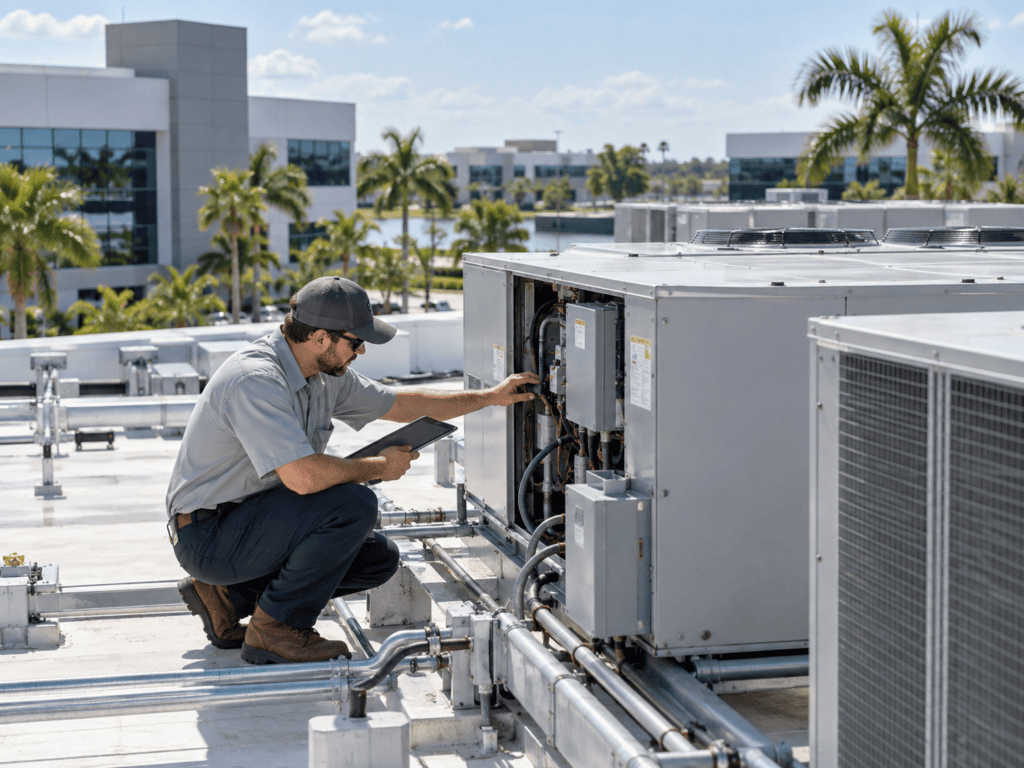 Commercial landlords may be responsible for major building systems such as HVAC, electrical equipment, pumps, elevators, and other mechanical systems. Equipment Breakdown Insurance may help address certain covered mechanical or electrical failures that can otherwise lead to costly repairs and disruption for tenants.
For example, if a covered electrical breakdown damages a central HVAC system serving several commercial tenants, Equipment Breakdown coverage may help with eligible repair or replacement costs, subject to the policy terms, limits, deductibles, and exclusions.
Coverage may also include certain related expenses, such as expediting repairs or eligible business-income and rental-income losses caused by a covered equipment breakdown, depending on how the policy is structured.
Equipment Breakdown insurance generally does not replace routine maintenance and should not be expected to cover normal wear and tear, corrosion, deterioration, or equipment that simply reaches the end of its useful life.
Commercial property owners should identify which major building systems they own and maintain, understand their replacement costs, and review whether the commercial property policy already includes Equipment Breakdown coverage or whether an endorsement or separate policy is appropriate.
Ordinance or Law Coverage for Commercial Rental Buildings
Older commercial buildings may need to be repaired or rebuilt to meet current building codes after a covered loss. The cost of complying with newer codes can be substantially higher than simply restoring the damaged portion of the property to its prior condition.
Ordinance or Law coverage may help address certain increased costs associated with rebuilding or repairing insured property to comply with applicable building codes after a covered loss, subject to the policy terms and limits.
Depending on the policy, coverage may address items such as:
-
Demolition of undamaged portions of a building when required by code
-
Increased construction costs to meet current building standards
-
Upgrades to electrical, plumbing, roofing, accessibility, or structural systems
-
Certain additional expenses caused by code-enforcement requirements
For example, a fire may damage only part of an older commercial building, but local code requirements could require additional upgrades to areas that were not directly damaged. Without adequate Ordinance or Law coverage, some of those additional costs may not be covered by the basic property limit.
This exposure can be especially important for older apartment buildings, mixed-use properties, retail centers, office buildings, and other commercial structures that may have been built under earlier construction standards.
Commercial property owners should review the age of the building, prior renovations, local code requirements, and the amount of Ordinance or Law coverage included in the policy rather than assuming all code-upgrade costs are automatically covered.
Wind, Hurricane, and Named-Storm Coverage for Florida Commercial Property
Wind and hurricane exposure is an important consideration for commercial landlords in Florida. Damage from hurricanes, tropical storms, and other severe wind events can affect the building, exterior property, tenant spaces, and rental income.
Depending on the insurer and policy, wind coverage may be included within a commercial property insurance policy, subject to separate terms or deductibles, or it may need to be arranged separately.
Commercial property owners should review items such as:
-
Whether wind or named-storm damage is covered
-
The applicable hurricane, named-storm, or wind deductible
-
Whether the deductible is a percentage or fixed amount
-
Building and roof valuation
-
Coverage for exterior signs, awnings, fencing, and other outdoor property
-
Loss-of-rental-income protection after a covered storm
-
Debris removal and related cleanup expenses
-
Ordinance or Law coverage following substantial damage
-
Any wind-related exclusions, limitations, or protective-safeguard requirements
A percentage deductible can result in a much larger out-of-pocket expense than a standard property deductible because it may be calculated from the insured value specified by the policy rather than from the amount of the loss.
Roof age, construction type, building condition, location, prior losses, and documented wind-mitigation features can also affect underwriting, eligibility, pricing, and available coverage options.
Commercial landlords should review wind and hurricane protection together with the property limit, valuation method, rental-income exposure, and building-code considerations so the policy is structured for the property’s actual risk.
Does Commercial Landlord Insurance Cover Flood Damage?
Standard commercial property insurance generally does not cover damage caused by flooding from rising water, storm surge, overflowing waterways, or similar flood events. Commercial landlords may need separate Commercial Flood Insurance to protect eligible buildings and other covered property from flood losses.
Flood exposure can be especially important for Florida commercial properties because risk can vary based on elevation, drainage, nearby waterways, coastal exposure, construction characteristics, and other property-specific factors.
Depending on the flood policy, coverage may be available for:
-
The commercial building
-
Certain permanently installed systems and fixtures
-
Landlord-owned equipment or other eligible property
-
Certain building contents, depending on ownership and policy structure
Commercial landlords should also pay attention to loss-of-rental-income exposure. NFIP commercial flood insurance does not provide business-interruption or loss-of-use coverage, while some private commercial flood policies may offer business-income options. Availability and terms vary by insurer and policy.
A property owner should not assume that being outside a designated high-risk flood zone means the property has no meaningful flood exposure. Heavy rainfall, tropical storms, hurricanes, storm surge, drainage problems, and other conditions can cause flooding outside traditionally high-risk areas.
Commercial landlords should review flood coverage separately from their standard property insurance and consider the building value, lender requirements, desired limits, deductibles, rental-income exposure, and available NFIP or private flood-insurance options.
Crime, Vandalism, and Tenant-Related Property Damage
Commercial rental properties can be exposed to theft, vandalism, malicious damage, and other losses involving tenants, visitors, employees, or third parties. How these losses are covered depends on who caused the damage, what property was affected, and the terms of the applicable insurance policy.
A commercial property policy may provide coverage for certain vandalism or theft-related losses when the cause of loss is covered. However, coverage can be limited or excluded in situations involving vacancy, dishonest acts, intentional damage, missing property, or other circumstances addressed by the policy.
Commercial landlords should pay particular attention to the distinction between ordinary property damage and intentional damage caused by a tenant. A tenant damaging walls, fixtures, doors, plumbing, or other building property is not automatically covered simply because the landlord carries commercial property insurance. Coverage depends on the policy language and the circumstances surrounding the loss.
Other exposures may include:
-
Vandalism to the building or common areas
-
Theft of landlord-owned equipment or building materials
-
Damage following unauthorized entry
-
Copper, wiring, HVAC component, or fixture theft
-
Broken windows, doors, locks, or exterior property
-
Damage discovered after a tenant vacates
-
Dishonest acts involving employees or property-management personnel
Commercial Crime Insurance addresses certain crime-related financial losses, such as employee theft, forgery, fraud, or other covered dishonest acts, depending on the policy. It should not be assumed to provide blanket protection against every act of vandalism, theft, or tenant-caused damage.
Commercial landlords can also reduce these exposures through appropriate lighting, locks, alarms, cameras, controlled access, regular inspections, documented tenant move-in and move-out procedures, and prompt attention to vacant spaces.
Insurance coverage should be reviewed together with lease provisions, security deposits, property-management procedures, and the landlord’s responsibility for the building and common areas.
Employment Practices Liability for Property Owners With Employees
Commercial landlords and real estate ownership entities that employ property managers, maintenance workers, leasing staff, administrative personnel, or other employees may face employment-related liability exposures in addition to property and premises risks.
Employment Practices Liability Insurance (EPLI) may help protect an employer against certain covered claims alleging wrongful employment practices, subject to the policy terms, limits, exclusions, and applicable retentions or deductibles.
Claims may involve allegations such as:
-
Wrongful termination
-
Discrimination
-
Harassment
-
Retaliation
-
Failure to hire or promote
-
Certain employment-related misrepresentation
-
Other covered workplace practices
For commercial property owners, the need for EPLI can depend on whether employees are hired directly by the ownership entity, a separate property-management company, or another affiliated business.
Landlords that outsource property management should still review contracts carefully to understand which party employs the staff, what insurance each party is required to maintain, and whether indemnification or additional insured provisions apply.
Employment Practices Liability Insurance does not replace Workers’ Compensation, General Liability, or other business insurance. Each addresses different exposures.
When Might Pollution or Environmental Liability Need Review?
Commercial landlords can face environmental exposures that are not always addressed by standard commercial property or general liability insurance. The need for specialized pollution or environmental coverage depends heavily on the property, tenant operations, prior use of the site, and the types of materials stored or handled there.
Potential concerns can include:
-
Fuel, oil, solvents, chemicals, or other hazardous materials
-
Mold or indoor air-quality allegations
-
Contaminated soil or groundwater
-
Leaks from tanks, mechanical systems, or tenant equipment
-
Waste handling or disposal practices
-
Pollution conditions created by current or former tenants
-
Environmental cleanup requirements after a covered or discovered condition
These exposures may be more significant at properties occupied by automotive businesses, manufacturers, contractors, dry cleaners, laboratories, industrial tenants, or other operations involving chemicals, fuels, or regulated materials.
A landlord should not assume that a tenant’s insurance automatically protects the property owner from every environmental claim. Lease provisions, indemnification language, tenant insurance requirements, prior environmental reports, and the landlord’s own coverage should all be reviewed together.
Depending on the exposure, Environmental Liability Insurance may be appropriate to address certain cleanup costs, third-party claims, legal defense expenses, or other covered environmental losses.
Property owners considering the purchase of an older, industrial, or previously contaminated property may also want to review environmental due diligence before closing, because known or pre-existing conditions may be treated differently by insurers.
Commercial Umbrella and Excess Liability for Property Owners
A serious liability claim involving a commercial rental property can exceed the limits of the landlord’s underlying liability insurance. Commercial Umbrella Insurance or excess liability coverage may provide additional limits above certain underlying liability policies, depending on the policy structure and eligibility requirements.
For commercial property owners, higher liability limits may be worth reviewing when the property has exposures such as:
-
Multiple tenants or locations
-
Significant customer or visitor traffic
-
Large parking lots or common areas
-
Elevators, stairwells, or shared facilities
-
Apartment or multifamily occupancies
-
Higher-value real estate assets
-
Contractual or lender requirements for higher limits
-
Employees involved in property management or maintenance
For example, a severe injury occurring in a landlord-maintained common area could result in a claim that exceeds the primary liability limit. If the claim is covered and the applicable underlying limits are exhausted, qualifying umbrella or excess coverage may provide additional protection up to its own limits.
Commercial umbrella and excess policies should not be assumed to cover every liability exposure or every underlying policy. The landlord should review which policies are scheduled or eligible beneath the additional limits, the required underlying limits, exclusions, and other policy conditions.
These policies are also liability coverage; they do not increase the amount of insurance available to repair the landlord’s own building after a property loss.
The appropriate amount of additional liability protection depends on the property portfolio, tenant mix, contractual requirements, underlying insurance, and the owner’s overall exposure.
Insurance for Multiple Commercial Rental Properties and Real Estate Portfolios
Commercial property owners with multiple rental buildings may need an insurance program that considers the portfolio as a whole rather than evaluating each property in isolation.
Depending on the ownership structure, locations, property types, and insurer, multiple properties may be insured under one policy, a package program, or separate policies coordinated across the portfolio.
Important considerations can include:
-
The number and location of properties
-
Whether the properties share common ownership
-
Building values at each location
-
Tenant mix and occupancy by property
-
Geographic concentration of risk
-
Wind, flood, and catastrophe exposure
-
Loss-of-rental-income exposure
-
Common-area and premises liability
-
Shared property-management operations
-
Differences in construction, age, and protection systems
Owners with several properties should also pay attention to how limits apply. Some policies may use separate limits by location, while others may involve blanket limits, scheduled values, or other structures that can affect how much coverage is available after a loss.
Geographic concentration can be especially important in Florida. A portfolio with several properties in the same coastal or hurricane-exposed area may present a different catastrophe exposure than properties spread across multiple regions.
Commercial landlords should also review whether ownership entities, property-management companies, or affiliated businesses are properly identified in the insurance program where appropriate.
As portfolios grow, the insurance structure may need to be revisited to account for new acquisitions, property sales, renovations, tenant changes, changing values, and evolving liability exposures.
Common Commercial Landlord Insurance Gaps and Exclusions to Review
Commercial landlord insurance can provide broad protection, but no policy covers every exposure. Property owners should review exclusions, limitations, deductibles, and optional endorsements carefully so the insurance program reflects how the property is actually used.
Common areas to review include:
-
Flood: Rising water, storm surge, and similar flood events generally require separate flood insurance.
-
Wind or Named-Storm restrictions: Some Florida policies may apply separate deductibles, limitations, or exclusions for wind-related losses.
-
Vacancy: Coverage can be reduced or restricted when a building or significant portion of it remains vacant for too long.
-
Wear and tear or maintenance: Deterioration, corrosion, deferred maintenance, and other gradual damage are generally not treated the same as sudden covered losses.
-
Tenant property: A landlord’s policy generally does not insure the tenant’s business personal property, inventory, equipment, or furnishings.
-
Tenant-caused intentional damage: Intentional or malicious damage by a tenant may be limited or excluded depending on the policy.
-
Pollution or environmental exposures: Certain cleanup costs, contamination, mold, or pollution claims may require specialized coverage.
-
Earth movement: Sinkhole, earth movement, or ground-related losses can be subject to separate terms or exclusions.
-
Cyber exposures: A commercial property policy typically does not replace dedicated Cyber Liability Insurance for data breaches, network incidents, or cybercrime.
-
Employment-related claims: Claims involving employees may require Employment Practices Liability Insurance or other specialized coverage.
-
Equipment breakdown: Mechanical or electrical breakdown may require separate coverage or an endorsement.
-
Ordinance or Law: Additional rebuilding costs caused by current building-code requirements may need separate limits or endorsements.
Lease terms can create additional gaps if the landlord assumes responsibilities that are not reflected in the insurance policy. This is especially important when the lease assigns responsibility for tenant improvements, common areas, repairs, indemnification, or specific insurance requirements.
Property owners should also review whether policy limits are adequate for the building value, rental-income exposure, liability risk, and any contractual requirements imposed by lenders or tenants.
A good commercial landlord insurance review should focus not only on what is covered, but also on what is excluded, limited, or dependent on a separate policy or endorsement.
How Much Does Commercial Landlord Insurance Cost in Florida?
The cost of commercial landlord insurance in Florida can vary significantly because commercial rental properties differ widely in size, value, construction, occupancy, location, tenant mix, and coverage needs.
A small office building with a few professional tenants may have a very different insurance cost than a large apartment complex, mixed-use property, retail center, warehouse, or multi-location real estate portfolio.
Premiums may be influenced by factors such as:
-
Building replacement cost
-
Property age and construction type
-
Roof age and condition
-
Location and catastrophe exposure
-
Wind, hurricane, and flood risk
-
Number and type of tenants
-
Occupancy and vacancy levels
-
Fire protection and sprinkler systems
-
Loss-of-rental-income exposure
-
Liability limits
-
Deductibles
-
Prior claims history
-
Building maintenance and condition
-
Security and risk-management features
-
Optional endorsements and additional coverages
Florida commercial property owners may also see meaningful differences between insurers because underwriting guidelines, capacity, deductible structures, wind treatment, and appetite for certain tenant occupancies can vary.
For that reason, there is no single reliable average premium that applies to every commercial landlord. The best way to estimate cost is to evaluate the specific property, tenant mix, building values, requested limits, and coverage structure.
Price should also be reviewed together with policy terms. A lower premium may reflect higher deductibles, narrower coverage, lower limits, or different exclusions, so comparing policies based only on premium can be misleading.
What Factors Affect Commercial Landlord Insurance Premiums?
Commercial landlord insurance premiums are based on a combination of property characteristics, tenant exposures, requested coverage, and insurer underwriting guidelines.
Factors that may affect pricing include:
-
Building value: Higher replacement costs generally require higher property limits.
-
Construction type: Masonry, frame, concrete, steel, and other construction types can be evaluated differently by insurers.
-
Building age: Older properties may present greater concerns involving roofs, plumbing, electrical systems, and code compliance.
-
Roof age and condition: Roof material, age, maintenance, and remaining useful life can affect eligibility and pricing.
-
Location: Coastal exposure, hurricane risk, crime, fire protection, and other geographic considerations may influence premiums.
-
Tenant occupancy: Restaurants, contractors, automotive businesses, manufacturers, and other higher-hazard tenants may affect underwriting differently than professional offices.
-
Vacancy: Buildings with vacant units or substantial unoccupied space may present additional risk.
-
Claims history: Prior property or liability losses may affect pricing and insurer appetite.
-
Fire protection: Sprinklers, alarms, hydrants, fire stations, and other protective features may be considered.
-
Building condition and maintenance: Deferred maintenance or aging systems can affect underwriting.
-
Loss-of-rental-income limits: Higher rental-income exposure may require additional coverage.
-
Liability limits: Higher primary liability limits can increase premium.
-
Deductibles: Higher deductibles may reduce premium but increase the property owner’s out-of-pocket responsibility after a covered loss.
-
Wind and hurricane exposure: Florida properties may have separate wind considerations, deductibles, or coverage arrangements.
-
Additional coverages and endorsements: Equipment Breakdown, Ordinance or Law, water backup, flood, umbrella liability, and other coverage can affect the overall cost.
The insurer may also evaluate how the property is managed. Regular inspections, documented maintenance, updated electrical or plumbing systems, strong tenant-screening practices, and appropriate lease requirements may help demonstrate better risk management.
Two commercial properties with similar market values can still have very different insurance premiums because their construction, tenant mix, location, occupancy, building systems, and coverage needs may differ substantially.
For this reason, commercial landlords should compare more than premium alone. Limits, deductibles, exclusions, valuation methods, wind treatment, and optional coverages should also be reviewed when comparing insurance options.
What Information Helps When Getting a Commercial Landlord Insurance Quote?
Providing complete and accurate information can help insurers evaluate a commercial rental property more efficiently and reduce delays during the quoting process.
Commercial property owners may be asked for information such as:
-
Property address and location
-
Building size and number of stories
-
Year built and construction type
-
Roof age, type, and condition
-
Electrical, plumbing, HVAC, and other major building-system updates
-
Estimated building replacement cost
-
Current occupancy and tenant mix
-
Number of residential units or commercial suites
-
Percentage of the building that is vacant
-
Annual rental income
-
Requested property and liability limits
-
Desired deductibles
-
Fire alarms, sprinkler systems, security, and other protective features
-
Parking lots, elevators, pools, or other common-area exposures
-
Current insurance information
-
Prior claims or loss history
-
Ownership entity information
-
Property-management arrangements
-
Copies of leases or insurance requirements when relevant
For multi-tenant properties, insurers may also want a tenant schedule showing who occupies each space and the type of business operated there.
Properties with restaurants, contractors, automotive businesses, manufacturers, storage operations, or other higher-hazard tenants may require additional underwriting details.
For larger buildings or portfolios, supporting documents such as property schedules, rent rolls, replacement-cost estimates, inspections, valuation reports, or prior insurance loss runs may also be helpful.
Accurate information is especially important when a property has recently been purchased, renovated, refinanced, partially vacated, or changed tenants, because those changes may affect underwriting and coverage needs.
Florida Commercial Landlord Insurance for Northeast Florida Property Owners
Commercial property owners in Northeast Florida face many of the same insurance considerations as landlords throughout the state, along with local exposures related to coastal weather, hurricane risk, rapid development, changing property values, and a diverse mix of commercial and multifamily properties.
First Florida Agency serves commercial property owners in communities including Jacksonville, Ponte Vedra, Ponte Vedra Beach, Nocatee, St. Augustine, St. Johns County, and surrounding Northeast Florida areas.
 Commercial property owners in Northeast Florida may face a combination of wind, flood, property-value, tenant-occupancy, and liability exposures that can vary by location and property type. Insurance should reflect the building, the tenant mix, the surrounding environment, and the way the property is actually used and managed.
Local commercial landlord exposures may include:
-
Hurricane and wind exposure
-
Flood and drainage concerns
-
Coastal and inland property differences
-
Roof age and building-condition requirements
-
Older buildings with code-upgrade considerations
-
Rapidly changing construction and replacement costs
-
Mixed-use and multi-tenant developments
-
Apartment and multifamily properties
-
Retail, office, warehouse, and flex-space occupancies
-
Properties held in LLCs or other ownership entities
-
Multiple-location real estate portfolios
A commercial property near the coast may require a different insurance strategy than an inland office building, apartment property, warehouse, or neighborhood retail center. Tenant occupancy, construction, building age, roof condition, flood exposure, and wind protection can all influence available coverage and underwriting.
For property owners with multiple Northeast Florida locations, it can also be important to review how catastrophe exposure is concentrated across the portfolio and whether limits, deductibles, and wind coverage are structured appropriately for each location.
First Florida Agency can help property owners compare coverage options for commercial rental properties throughout Northeast Florida while also serving commercial landlords across the state.
What First Florida Agency Reviews When Comparing Commercial Landlord Insurance
Commercial landlord insurance should be evaluated on more than price alone. When comparing coverage options, First Florida Agency reviews the property, tenant exposures, policy structure, and major coverage differences that can affect how the insurance responds after a loss.
Depending on the property, areas we may review include:
-
Building limits and valuation: Whether the insured value appears appropriate for the cost to repair or rebuild the property.
-
Property coverage form: The types of covered causes of loss, exclusions, and limitations that apply.
-
Wind and hurricane treatment: Whether wind is included, excluded, or subject to separate deductibles or coverage arrangements.
-
Loss of rental income: The amount of coverage available and how long eligible rental income may be protected after a covered loss.
-
Liability limits: Whether the primary liability limits are appropriate for the property, tenant mix, and common-area exposures.
-
Tenant occupancy: How the types of businesses or residents occupying the property affect underwriting and coverage.
-
Vacancy provisions: How unoccupied space may affect coverage.
-
Deductibles: The landlord’s potential out-of-pocket responsibility for property, wind, or other covered losses.
-
Ordinance or Law coverage: Whether additional protection is available for increased rebuilding costs caused by current building-code requirements.
-
Equipment Breakdown: Whether landlord-owned mechanical or electrical systems have appropriate protection.
-
Flood exposure: Whether separate Commercial Flood Insurance should be considered.
-
Umbrella or Excess Liability: Whether additional liability limits may be appropriate above eligible underlying policies.
-
Optional endorsements: Additional coverage that may be relevant to the building, ownership structure, or tenant exposures.
We also look for material differences between insurance proposals. Two policies with similar premiums may provide different deductibles, limits, valuation methods, exclusions, wind treatment, rental-income coverage, or optional endorsements.
For properties with multiple buildings or locations, we may also review how values are scheduled, how limits apply by location, and whether the insurance structure reflects the overall real estate portfolio.
The goal is to help commercial property owners understand the differences between available options so they can make an informed decision based on coverage, cost, and the exposures associated with the property.
Why Work With First Florida Agency for Commercial Landlord Insurance?
Commercial rental properties can present a combination of property, liability, tenant, lease, and catastrophe exposures that may not fit neatly into a standard one-size-fits-all policy.
First Florida Agency works with commercial property owners to help identify the exposures associated with the building, tenant mix, common areas, rental income, ownership structure, and location before comparing available insurance options.
As an independent insurance agency, we can help review coverage from multiple insurance carriers rather than being limited to a single company. Depending on the property and available markets, that can help us compare differences in:
-
Building coverage and valuation
-
Wind and hurricane treatment
-
Liability limits
-
Loss of rental income coverage
-
Vacancy provisions
-
Tenant occupancy requirements
-
Ordinance or Law coverage
-
Equipment Breakdown
-
Flood options
-
Umbrella or excess liability
-
Deductibles, exclusions, and endorsements
We also help commercial landlords identify situations where a separate policy or additional coverage may need to be considered, such as Commercial Flood Insurance, Environmental Liability Insurance, Builders Risk Insurance, or Commercial Umbrella Insurance.
Our goal is to help property owners understand how the available options differ so they can choose coverage that fits the property, the lease structure, and the risks they are trying to protect.
First Florida Agency serves commercial property owners throughout Northeast Florida and across the state of Florida.
Get a Florida Commercial Landlord Insurance Quote
Commercial landlord insurance should be structured around the property, tenant mix, building value, liability exposure, and lease requirements rather than treated as a generic package.
First Florida Agency can help you review insurance options for apartment and multifamily properties, mixed-use buildings, office properties, retail centers, warehouses, flex space, and other commercial rental properties throughout Florida.
To discuss coverage options for your commercial rental property, call First Florida Agency at 904-822-8800 or complete the Commercial Landlord Insurance Quote Request form below.
Florida Commercial Landlord Insurance FAQs
What is commercial landlord insurance?
Commercial landlord insurance is designed for owners of tenant-occupied commercial or multifamily property. Depending on the policy, it may include building coverage, premises liability, loss of rental income, landlord-owned property coverage, and other protections related to owning and leasing commercial real estate.
What types of properties can commercial landlord insurance cover?
Commercial landlord insurance may be used for apartment and multifamily buildings, mixed-use properties, office buildings, retail centers, warehouses, flex space, commercial condominiums, and other properties leased to residential or business tenants. Eligibility and coverage vary by insurer and property type.
What is Lessor’s Risk Only insurance?
Lessor’s Risk Only, or LRO, is a term commonly used for insurance designed around the exposures of a property owner who leases commercial space to tenants. Depending on the insurer, LRO may primarily address premises liability or may be part of a broader commercial property or package policy.
Does commercial landlord insurance cover the building?
It may. Commercial property coverage can help pay to repair or rebuild an insured building after a covered loss, subject to the policy terms, limits, deductibles, valuation provisions, exclusions, and endorsements.
Does commercial landlord insurance cover lost rental income?
Loss of rental income may be covered when a covered property loss makes all or part of the building unusable. The amount and duration of coverage depend on the policy and may be subject to waiting periods, limits, coinsurance provisions, or other conditions.
Does commercial landlord insurance cover flood damage?
Standard commercial property insurance generally does not cover flooding caused by rising water, storm surge, or similar flood events. Commercial property owners may need separate Commercial Flood Insurance to protect eligible buildings and property from flood losses.
Does a commercial landlord need liability insurance if tenants carry their own insurance?
Yes, the landlord can still have separate liability exposures involving the building, common areas, parking lots, walkways, structural conditions, and other portions of the premises for which the landlord may be responsible. Tenant insurance does not replace the landlord’s own liability protection.
What happens if part of a commercial property becomes vacant?
Vacancy can affect underwriting and coverage. Some commercial property policies contain vacancy provisions that may reduce, restrict, or exclude certain coverage after a property or substantial portion of it has been vacant for a specified period. Property owners should report material occupancy changes to their insurance professional.
How much does commercial landlord insurance cost in Florida?
The cost can vary substantially based on building value, construction, roof condition, location, wind and hurricane exposure, tenant mix, vacancy, loss history, rental income, liability limits, deductibles, and the coverage selected. There is no single average premium that applies to every commercial rental property.
What information is needed to get a commercial landlord insurance quote?
Insurers may request the property address, building size, year built, construction type, roof information, building-system updates, replacement cost, tenant mix, vacancy percentage, annual rental income, requested limits, prior claims, current insurance information, ownership details, and property-management information. Larger or multi-tenant properties may also require rent rolls, tenant schedules, inspections, or loss runs.
Let’s Get Started
Florida Commercial Landlord Insurance Quote Request
"*" indicates required fields
Don’t like forms? Contact us at or email us.
