Published October 22, 2026
A Business Owners Policy, commonly called a BOP, can provide an efficient insurance foundation for an eligible Florida business. Instead of purchasing certain property, liability, and income-protection coverages under entirely separate policies, a qualifying company may be able to combine them within one coordinated policy.
However, the word “package” should not be confused with “complete.” A BOP does not automatically insure every property, operation, employee, vehicle, professional service, cyber exposure, or catastrophe risk a business may face.
Insurance companies also use different forms, endorsements, exclusions, limits, deductibles, and eligibility requirements. Two policies described as Business Owners Policies may therefore provide substantially different protection.
This guide explains what a Florida BOP typically covers, which businesses may qualify, what is commonly excluded or insured separately, how hurricanes and flooding affect coverage, and what business owners should review when comparing policies.
Quick Answer: What Does a Florida Business Owners Policy Cover?
A Florida Business Owners Policy typically combines three core coverages for an eligible business:
-
Commercial property insurance
-
General liability insurance
-
Business income and extra expense coverage
The exact protection depends on the insurance company, policy forms, covered locations, business operations, property values, limits, deductibles, exclusions, and endorsements.
A BOP does not automatically include workers’ compensation, commercial auto, professional liability, cyber liability, employment practices liability, commercial flood, or umbrella insurance. Some of these coverages may be available by endorsement, while others require separate policies.
For a broader explanation of the policies Florida companies may need, read our What Insurance Does a Florida Small Business Need? A Complete Guide.
Table of Contents
-
What Is a Florida Business Owners Policy?
-
What Does a BOP Typically Include?
-
Which Florida Businesses May Qualify for a BOP?
-
What Does a BOP Not Automatically Cover?
-
How Do Hurricanes, Windstorms, and Flooding Affect a BOP?
-
BOP vs. Commercial Package Policy vs. Separate Policies
-
How Much Does a Business Owners Policy Cost in Florida?
-
How Much BOP Coverage Does a Business Need?
-
How to Compare Business Owners Policy Quotes
-
Information Needed for a BOP Quote
-
Common Business Owners Policy Mistakes
-
When to Review or Update a BOP
-
What to Do After a BOP Loss or Liability Incident
-
BOP Insurance Across Florida and Northeast Florida
-
Frequently Asked Questions
-
Request a Florida Business Owners Policy Quote
-
About the Author
-
Recommended External Resources
-
Related Articles and Coverage Guides
-
Insurance Disclaimer
What Is a Florida Business Owners Policy?
A Business Owners Policy is a commercial insurance package designed for eligible small and midsize businesses whose property and liability exposures fit an insurance company’s underwriting guidelines.
The policy commonly places commercial property, general liability, and business income coverage under one policy. This can simplify policy administration and may sometimes be more cost-effective than purchasing comparable coverage separately. Eligibility and savings are not guaranteed.
Although the coverages are packaged together, they continue to operate as separate components. The property portion has its own limits, deductibles, valuation provisions, covered causes of loss, conditions, and exclusions. General liability has occurrence limits, aggregate limits, exclusions, and endorsements. Business income coverage has separate triggers, time periods, limits, and documentation requirements.
A claim involving one component is evaluated under the terms applicable to that component. Paying one premium does not make every loss subject to a single limit or coverage rule.
Not Every BOP Is the Same
Insurance companies can differ in how they address:
-
Property valuation
-
Causes of loss
-
Windstorm or hurricane coverage
-
Water damage
-
Business income
-
Products-completed operations
-
Equipment breakdown
-
Utility interruption
-
Property away from the insured location
-
Outdoor signs and property
-
Cyber incidents
-
Employee dishonesty
-
Industry-specific operations
-
Optional endorsements
The policy’s declarations, coverage forms, definitions, conditions, exclusions, and endorsements determine the protection—not the BOP label alone.
For a complete review of the packaged-policy concept and available options, visit our Florida Business Owners Policy coverage page.
What Does a BOP Typically Include?
A Business Owners Policy typically includes commercial property, general liability, and business income and extra expense coverage. Each component addresses a different category of loss.
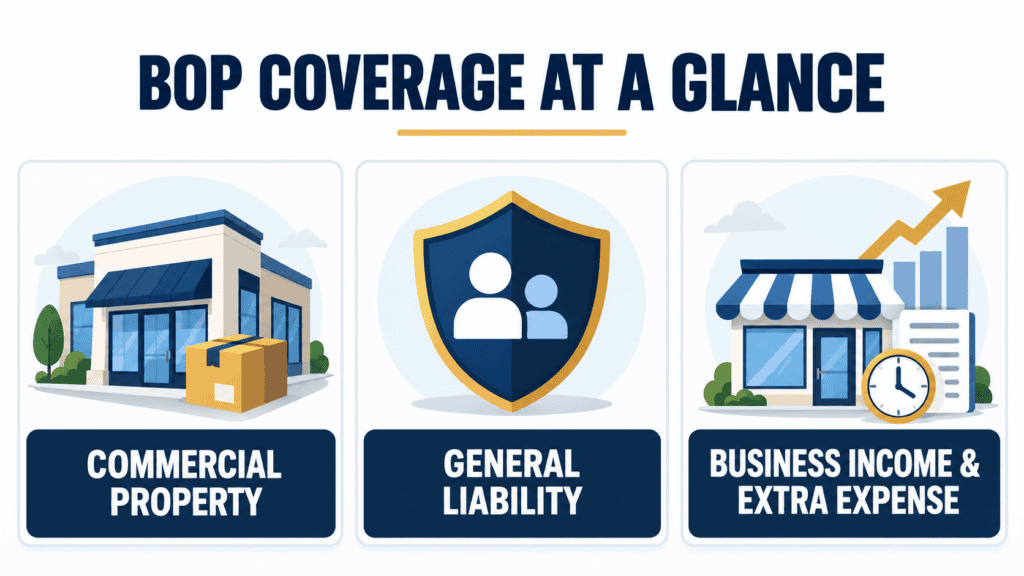
A Business Owners Policy commonly combines commercial property, general liability, and business income coverage for eligible businesses, subject to its terms, limits, exclusions, and endorsements.
Commercial Property Coverage
The commercial property portion of a BOP may help insure physical property the business owns, leases, uses, or is contractually responsible for protecting.
Depending on the policy and scheduled property, coverage may apply to:
-
A commercial building owned by the insured business
-
Furniture and fixtures
-
Computers and office equipment
-
Machinery
-
Inventory and stock
-
Supplies and materials
-
Tenant improvements and betterments
-
Certain exterior signs
-
Certain property belonging to others
-
Other eligible business personal property
A business that leases its location may not need to insure the entire building, but it may still need substantial coverage for equipment, inventory, furniture, fixtures, computers, and improvements made to the leased space.
A building owner may need coverage for the structure and other property for which it is responsible. The lease, mortgage, and other agreements should be reviewed to determine which party is responsible for insuring particular property.
Covered Causes of Loss
Commercial property coverage applies only when the damaged property and cause of loss satisfy the policy’s requirements.
Depending on the policy, covered causes of loss may include fire, theft, vandalism, wind, and certain types of accidental water damage. Other causes may be limited or excluded.
Important considerations include:
-
Whether coverage is written on a named-peril, broad, special, or other causes-of-loss form
-
Whether windstorm coverage is included
-
Whether a separate wind, hurricane, or named-storm deductible applies
-
How water damage is treated
-
Whether theft is covered
-
Whether property away from the insured location is covered
-
Whether outdoor property and signs have sublimits
-
Whether equipment breakdown requires an endorsement
-
Whether vacancy affects coverage
A policy described as providing broad property coverage can still contain exclusions or limitations that are important to the business’s location and operations.
Replacement Cost vs. Actual Cash Value
Replacement-cost coverage generally values qualifying property using the cost to repair or replace it with property of like kind and quality, without deducting for depreciation, subject to policy requirements.
Actual-cash-value coverage generally considers depreciation. This can result in a lower settlement for older furniture, machinery, equipment, roofs, or other property.
Business owners should also review coinsurance provisions, agreed-value options, reporting requirements, deductibles, and the time allowed to repair or replace damaged property.
The purchase price, tax assessment, market value, loan balance, and accounting value of a building are not necessarily the amount required to rebuild it after a major loss.
For more information about insuring buildings, equipment, inventory, furnishings, and other business property, read our Florida Commercial Property Insurance guide.
General Liability Insurance
The general liability portion of a BOP may help protect the insured business against certain third-party claims involving:
-
Bodily injury
-
Property damage
-
Personal and advertising injury
-
Medical payments
-
Products-completed operations
-
Legal defense
-
Qualifying settlements or judgments
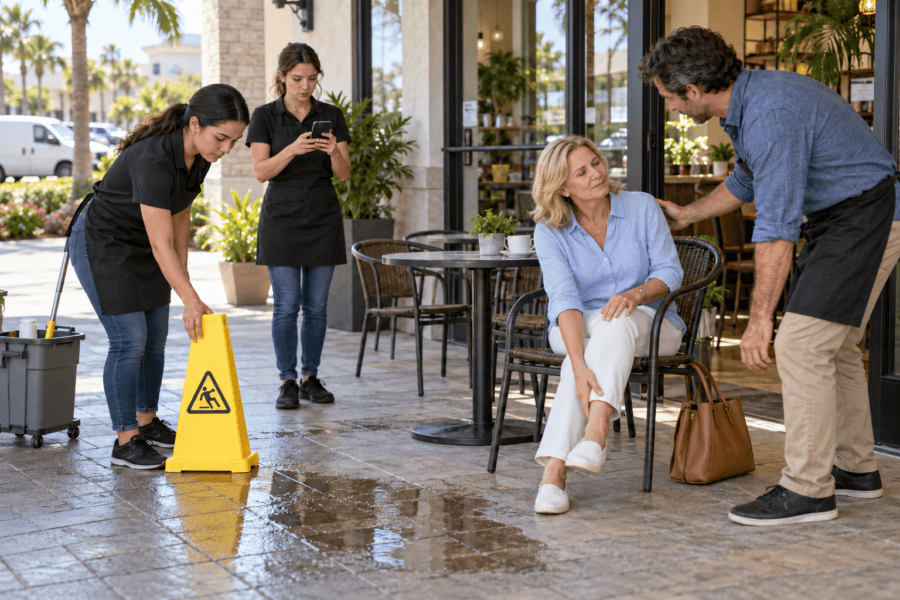
For example, a customer could slip and fall inside a store, an employee could accidentally damage property at a customer’s location, or a completed service could allegedly cause damage after the work is finished.
Coverage depends on whether the claim satisfies the applicable insuring agreement and whether an exclusion or endorsement limits coverage.
Liability Limits and Aggregates
General liability coverage commonly includes several interacting limits, such as:
-
Each-occurrence limit
-
General aggregate limit
-
Products-completed operations aggregate
-
Personal and advertising injury limit
-
Medical-expense limit
-
Damage-to-premises-rented-to-you limit
The each-occurrence limit generally establishes the maximum available for one covered occurrence. An aggregate generally establishes the maximum available for certain covered claims during the policy period.
Claim payments can reduce the aggregate remaining for later claims. Defense costs may be handled inside or outside the applicable limits depending on the policy form.
What General Liability Usually Does Not Replace
General liability should not be assumed to cover:
-
Damage to the business’s own property
-
Employee work-related injuries
-
Liability arising from owned vehicles
-
Professional errors or negligent advice
-
Employment-related claims
-
Cyber incidents
-
Pollution
-
Product recall expenses
-
Every contractual obligation
-
The cost of correcting defective work
-
Intentional injury or damage
-
Every claim involving the business’s products or completed operations
For a detailed explanation of liability limits, exclusions, products-completed operations, subcontractors, certificates, and additional insureds, read our Florida General Liability Insurance guide.
Business Income and Extra Expense Coverage
Business income coverage may help replace qualifying lost income and continuing operating expenses when the company’s operations are suspended or reduced because of covered physical damage at an insured location.
Depending on the policy, covered amounts may involve:
-
Net income the business would have earned
-
Continuing payroll
-
Rent or mortgage expenses
-
Taxes
-
Loan payments
-
Certain ordinary operating expenses
-
Extra expenses reasonably incurred to continue or restore operations
Extra expense coverage may help pay additional qualifying costs required to reduce the interruption. Examples could include renting temporary space, leasing replacement equipment, paying additional shipping charges, or temporarily relocating operations.
Business Income Requires a Covered Trigger
A decline in revenue by itself does not establish a covered business income claim.
Coverage generally requires qualifying direct physical loss or damage from a covered cause of loss. The policy may also require the damage to affect an insured location or other property described by the coverage form.
A business income claim can be affected by:
-
The underlying cause of loss
-
Waiting periods
-
Coverage limits
-
Period-of-restoration provisions
-
Payroll treatment
-
Extended business income provisions
-
Civil-authority coverage
-
Dependent-property coverage
-
Utility-service limitations
-
Ordinance or law delays
-
Policy exclusions
-
Financial documentation
If flood is excluded from the property coverage, the standard business income provision ordinarily should not be assumed to cover an interruption caused by flood. The same concern can arise when wind, utility interruption, equipment breakdown, or another underlying cause is excluded or restricted.
Financial Records Matter
Business income losses are commonly evaluated using financial records showing how the company performed before and after the loss.
Useful records may include:
-
Profit-and-loss statements
-
Tax returns
-
Sales reports
-
Payroll records
-
Bank statements
-
Invoices
-
Expense records
-
Inventory information
-
Seasonal sales history
-
Contracts and pending orders
-
Records of temporary operating expenses
Businesses should preserve current records securely and maintain appropriate backups away from the primary location.
Which Florida Businesses May Qualify for a BOP?
A BOP is generally intended for eligible small and midsize businesses whose operations fall within an insurance company’s program.
Businesses that may qualify, depending on their activities and underwriting characteristics, include:
-
Retail stores
-
Professional and administrative offices
-
Consultants and business-service firms
-
Medical and dental offices
-
Salons and personal-care businesses
-
Restaurants and cafés
-
Technology-service companies
-
Printers, photographers, and creative businesses
-
Pet-care businesses
-
Fitness studios
-
Wholesalers and distributors
-
Certain light manufacturers
-
Certain artisan contractors
-
Janitorial and landscaping businesses
-
Nonprofit organizations
-
Owners of qualifying commercial buildings
-
Certain home-based businesses
This list does not establish eligibility. A company’s actual operations matter more than its general industry label.
A restaurant with limited cooking may present a different risk from one offering delivery, late-night entertainment, substantial alcohol service, or extensive commercial cooking. A contractor performing lower-hazard interior work may be evaluated differently from a contractor performing roofing, structural, demolition, excavation, or exterior-height work.
Factors That Can Affect BOP Eligibility
Insurance companies may consider:
-
Business classification
-
Complete description of operations
-
Products manufactured, sold, distributed, installed, or repaired
-
Professional services provided
-
Annual revenue
-
Payroll
-
Employees and subcontractors
-
Years in business
-
Management experience
-
Number of locations
-
Building ownership or tenancy
-
Square footage
-
Building construction
-
Roof age and condition
-
Electrical, plumbing, and fire-protection systems
-
Property and inventory values
-
Cooking or manufacturing processes
-
Customer traffic
-
Delivery and installation operations
-
Off-premises work
-
Vehicle use
-
Liquor sales
-
Prior claims
-
Wind and flood exposure
-
Required coverage limits
Different insurance companies can establish different limits for revenue, payroll, property values, building size, number of locations, subcontracting, and other characteristics.
Can a Startup Qualify?
A new business may qualify for a BOP even without an established commercial insurance history.
The insurance company may request projected revenue and payroll, the owner’s industry experience, property values, lease information, licenses, safety procedures, products and services, and information about anticipated customers.
Projections should be reasonable. Material changes should be reported when the business’s actual operations differ from the original application.
Can a Home-Based Business Qualify?
Certain home-based businesses may qualify for a BOP, particularly when homeowners or renters insurance provides limited protection for business property, inventory, liability, or lost income.
Eligibility may depend on customer visits, employee activity, inventory, deliveries, signs, products, professional services, detached structures, and vehicle use.
A BOP does not replace homeowners insurance or automatically insure the residence itself.
What Does a BOP Not Automatically Cover?
A BOP can be a valuable foundation, but additional policies or endorsements may be necessary.
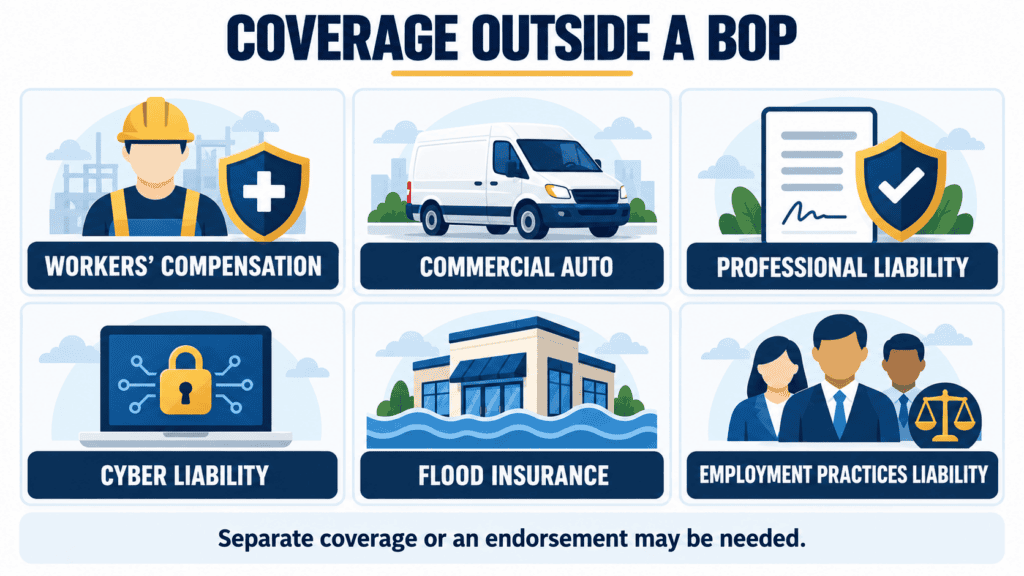
A BOP does not automatically cover every business exposure. Separate policies or endorsements may be needed based on the company’s operations, employees, vehicles, technology, contracts, and property.
Workers’ Compensation
Workers’ compensation is not automatically included in a BOP.
Florida construction employers with one or more employees generally must maintain workers’ compensation coverage. Non-construction employers with four or more employees generally must maintain coverage. Different rules and possible exemptions apply to certain owners, officers, LLC members, agricultural employers, and other situations.
An exemption applies to the qualifying individual and should not be treated as an automatic exemption for the entire company.
For more information about employee thresholds, exemptions, classifications, subcontractors, and audits, read our Florida Workers’ Compensation Insurance guide and confirm current requirements with the Florida Division of Workers’ Compensation.
Commercial Auto and Hired or Non-Owned Vehicles
A BOP generally does not insure automobiles owned by the business.
A separate commercial auto policy may be needed for company-owned or company-titled cars, vans, pickups, service vehicles, and other automobiles. Important considerations include ownership, drivers, vehicle use, travel radius, equipment carried, deliveries, and applicable regulatory requirements.
A business can also have an auto liability exposure when employees use personal vehicles or when the company rents, hires, or borrows vehicles. Hired and non-owned auto coverage may sometimes be added to an eligible BOP, but it is not automatically included.
For additional guidance, read our Florida Commercial Auto Insurance guide.
Professional Liability
General liability ordinarily should not be assumed to cover claims alleging negligent professional advice, design errors, missed deadlines, inadequate services, or other professional mistakes resulting primarily in financial loss.
Consultants, accountants, technology companies, medical providers, designers, real estate professionals, and other service businesses may need professional liability or errors and omissions insurance.
Cyber Liability
A standard BOP may provide little or no protection for data breaches, ransomware, privacy claims, cyber extortion, fraudulent fund transfers, network interruption, notification expenses, forensic investigation, or restoration of electronic data.
Some insurance companies offer limited cyber endorsements. Others provide separate cyber policies with broader features and specialized claim services.
For more information about first-party and third-party cyber risks, read our Florida Cyber Liability Insurance guide.
Employment Practices Liability
Employment practices liability insurance may help address certain allegations involving discrimination, harassment, retaliation, wrongful termination, and other employment-related actions.
General liability ordinarily excludes many employment practices claims. EPLI may be available by endorsement or under a separate policy.
Commercial Flood Insurance
Standard BOP property coverage generally does not cover flooding caused by rising surface water, storm surge, overflowing waterways, or widespread water accumulation.
Commercial flood coverage may be available through the National Flood Insurance Program or private flood insurers. Building, contents, valuation, deductibles, waiting periods, and business income provisions can differ considerably.
For more information about protecting business buildings and contents from qualifying flood losses, read our Florida Commercial Flood Insurance guide.
Commercial Umbrella or Excess Liability
A BOP’s liability limits may not be sufficient for a severe injury, completed-operations claim, product-related loss, or lawsuit involving multiple injured parties.
Commercial umbrella or excess liability insurance may provide additional limits above certain underlying liability policies. The underlying policies, required limits, exclusions, and scheduled coverage should be reviewed together.
Other Coverage That May Be Needed
Depending on the business, additional protection may include:
-
Inland marine insurance
-
Contractors equipment coverage
-
Equipment breakdown
-
Crime and employee dishonesty
-
Builders risk
-
Installation coverage
-
Liquor liability
-
Pollution liability
-
Product recall
-
Directors and officers liability
-
Fiduciary liability
-
Ocean marine
-
Cargo or transit coverage
-
International insurance
-
Surety bonds
A business should not purchase every available policy. It should identify its material exposures and determine which risks should be insured, controlled, transferred by contract, or retained.
How Do Hurricanes, Windstorms, and Flooding Affect a BOP?
Florida businesses should review catastrophe coverage carefully because one storm can involve several different causes of damage.
Wind can damage the roof or exterior of a building. Rain may then enter through a storm-created opening. At the same time, storm surge or rising surface water may enter at ground level.
Those losses may be handled differently.
Windstorm and Hurricane Coverage
Depending on the insurance company, location, building, and policy:
-
Wind coverage may be included
-
Wind coverage may be limited
-
A separate wind policy may be required
-
A percentage-based deductible may apply
-
A separate named-storm or hurricane deductible may apply
-
Roof coverage may contain special valuation provisions
-
Wind-driven rain may depend on how water entered the building
-
Outdoor property may have limited coverage
-
Business income may depend on whether the underlying wind loss is covered
Business owners should convert percentage-based deductibles into dollar amounts. A percentage that appears modest can create a substantial out-of-pocket responsibility when applied to a high building or property limit.
Flood and Storm Surge
Flooding and storm surge are generally excluded from standard commercial property and BOP coverage.
A flood exclusion can remain important even when a hurricane causes the loss. The fact that a hurricane occurred does not automatically convert rising water into wind damage.
Businesses should evaluate flood exposure based on the property’s elevation, drainage, nearby waterways, storm-surge potential, building characteristics, and business contents—not solely on whether the address is inside a designated high-risk flood zone.

Wind and flood damage can occur during the same hurricane but may be insured differently. Coverage depends on the cause of loss, policy terms, exclusions, and applicable deductibles.
Business Income After a Hurricane
Business income coverage should not be assumed to respond merely because a hurricane caused a closure.
The underlying physical damage generally must result from a covered cause of loss and satisfy the other requirements of the policy. Closures caused by excluded flood damage, loss of customers, evacuation without qualifying damage, utility interruption, or access restrictions may be treated differently.
Businesses should review wind, flood, business income, utility service, civil authority, dependent property, and extra expense coverage together.
BOP vs. Commercial Package Policy vs. Separate Policies
A BOP is not the only way to structure business insurance.
Business Owners Policy
A BOP provides a relatively standardized package for eligible businesses. It commonly combines commercial property, general liability, and business income coverage.
It may be appropriate for businesses whose operations fit an insurance company’s eligibility rules and whose exposures can be addressed through the available forms and endorsements.
Commercial Package Policy
A Commercial Package Policy, often called a CPP, can provide greater flexibility for companies with more complex operations, higher property values, multiple locations, specialized equipment, unusual liability exposures, or coverage needs outside a standard BOP program.
A CPP may combine several commercial coverage parts, but it is not one universal policy and does not automatically include every type of insurance.
Separate Policies
Standalone policies may be necessary for exposures such as:
-
Workers’ compensation
-
Commercial auto
-
Professional liability
-
Cyber liability
-
Employment practices liability
-
Commercial flood
-
Pollution liability
-
Commercial umbrella
-
Builders risk
-
Inland marine
A company may use a BOP as its foundation and purchase separate policies for specialized exposures. Another company may be better served by a CPP or several coordinated standalone policies.
The correct structure depends on eligibility, operations, property, contractual obligations, limits, catastrophe exposure, and available insurance markets.
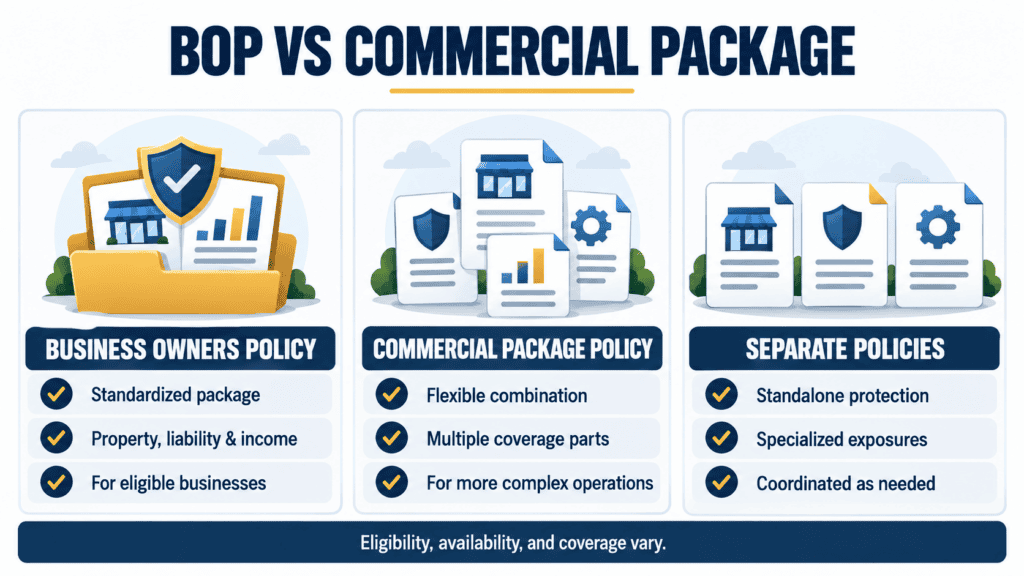
A BOP, Commercial Package Policy, or combination of separate policies may be appropriate depending on the business’s eligibility, complexity, property, operations, and insurance needs.
How Much Does a Business Owners Policy Cost in Florida?
There is no standard price for a Florida BOP.
Premium can depend on:
-
Industry and business classification
-
Products and services
-
Annual revenue
-
Payroll
-
Number of employees
-
Subcontracting
-
Customer traffic
-
Property values
-
Building size and construction
-
Roof age and condition
-
Fire-protection systems
-
Location
-
Wind and hurricane exposure
-
Flood exposure
-
Coverage limits
-
Deductibles
-
Property valuation
-
Business income selections
-
Optional endorsements
-
Prior claims
-
Insurance history
-
Years in business
-
Number of locations
A professional office with limited customer traffic and modest property may be priced differently from a restaurant with commercial cooking, a retailer with substantial inventory, or a contractor performing work at customer locations.
A lower premium does not necessarily represent a better value. One proposal may exclude wind, use actual-cash-value property settlement, provide less business income coverage, or contain restrictive endorsements that are important to the company’s operations.
The useful question is not simply, “Which policy costs less?” It is, “What protection does each quoted premium purchase, and what risk remains with the business?”
How Much BOP Coverage Does a Business Need?
The appropriate limits should reflect the company’s property, liability exposures, income, contractual requirements, and ability to absorb an uninsured loss.
Property Limits
Property limits should account for the cost of repairing or replacing the property the business is responsible for insuring.
Consider:
-
Building rebuilding cost
-
Furniture and fixtures
-
Computers
-
Machinery
-
Inventory
-
Supplies
-
Tenant improvements
-
Exterior signs
-
Property belonging to others
-
Seasonal increases
-
Debris removal
-
Ordinance or law expenses
Property values should be reviewed periodically. Equipment purchases, inventory growth, renovations, inflation, and construction-cost changes can leave older limits inadequate.
Business Income
Business income limits or time periods should reflect how long the company could realistically need to restore operations.
Businesses should consider the time required for:
-
Damage assessment
-
Permits
-
Demolition
-
Building repairs
-
Code upgrades
-
Equipment replacement
-
Inventory replacement
-
Utility restoration
-
Employee return
-
Customer recovery
A major Florida property loss can take longer to resolve when many businesses and property owners need contractors, materials, adjusters, and temporary space at the same time.
Liability Limits
Liability limits should reflect customer traffic, off-premises work, products, completed operations, contractual requirements, potential injury severity, and assets at risk.
A landlord’s or customer’s minimum requirement should be treated as one factor rather than an automatic recommendation for the entire business.
When a serious liability loss could exceed the available BOP limit, commercial umbrella or excess liability insurance may be appropriate.
How to Compare Business Owners Policy Quotes
Compare BOP proposals using equivalent assumptions whenever possible. A meaningful comparison should examine more than the annual premium.
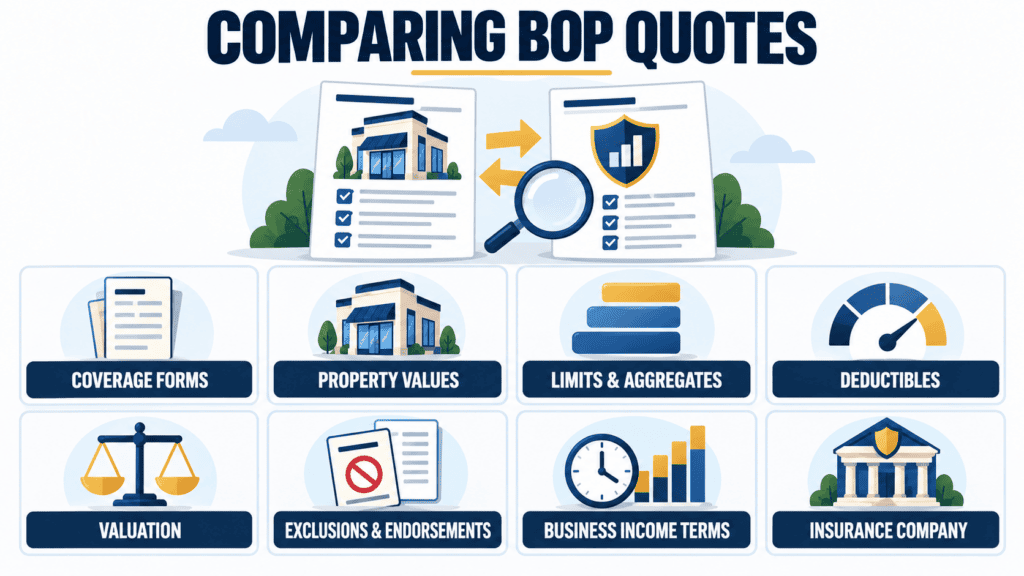
Compare BOP quotes using equivalent coverage forms, property values, limits, deductibles, exclusions, endorsements, and insurer terms—not premium alone.
Review:
-
Named insureds
-
Covered locations
-
Description and classification of operations
-
Property limits
-
Building and contents valuation
-
Covered causes of loss
-
Windstorm coverage
-
Hurricane or named-storm deductibles
-
Water-damage provisions
-
Business income limits or time periods
-
Extra expense coverage
-
General liability limits
-
Products-completed operations coverage
-
Property of others
-
Equipment breakdown
-
Utility-service coverage
-
Cyber or crime endorsements
-
Exclusions
-
Protective-safeguard requirements
-
Audit or reporting provisions
-
Insurance-company underwriting requirements
Confirm that every legal entity, location, product, service, and material operation is accurately described.
A quote is not the policy. Proposals and summaries can be useful, but the issued declarations, forms, endorsements, conditions, definitions, and exclusions control coverage.
Information Needed for a BOP Quote
Providing accurate and complete information helps insurance companies evaluate eligibility and prepare meaningful proposals.
Information commonly requested includes:
-
Legal business name
-
Entity type
-
Ownership
-
Mailing and physical addresses
-
Years in business
-
Complete description of operations
-
Products and services
-
Website address
-
Annual revenue
-
Payroll
-
Employees
-
Subcontracting costs
-
Building ownership or lease information
-
Construction type
-
Building age
-
Roof age and type
-
Square footage
-
Fire and burglar protection
-
Distance to fire protection
-
Business personal property values
-
Equipment and inventory
-
Tenant improvements
-
Requested limits and deductibles
-
Prior insurance
-
Claims history
-
Contracts or leases with insurance requirements
-
Vehicle use
-
Professional services
-
Cyber and data exposures
-
Wind and flood exposure
Insurance companies may request applications, supplemental questionnaires, photographs, inspections, leases, contracts, loss runs, financial records, or other documentation.
Incomplete information can lead to inaccurate pricing, eligibility problems, policy changes, cancellation or nonrenewal, premium adjustments, or claim disputes.
Common Business Owners Policy Mistakes
Assuming the BOP Covers Everything
A BOP is a package, not an all-risk solution. Workers’ compensation, commercial auto, professional liability, cyber, flood, employment practices liability, and umbrella coverage commonly require additional consideration.
Underinsuring Business Property
Book value, original purchase price, and depreciated accounting value may not represent the cost to replace property after a loss.
Overlooking Business Income Coverage
Insuring the building and equipment without evaluating lost income and continuing expenses can leave the company financially vulnerable during repairs.
Ignoring Wind and Flood Exclusions
Wind and flood can occur during the same storm but may require different policies, deductibles, and claim evaluations.
Failing to Disclose Operations
Delivery, installation, subcontracting, residential work, manufacturing, alcohol service, new products, professional advice, and operations in other states can materially affect eligibility and coverage.
Forgetting Property Away From the Business Location
Tools, equipment, laptops, inventory, property in transit, and property at jobsites may not receive the same protection as property located at the scheduled premises.
Relying on a Certificate of Insurance
A certificate provides evidence of insurance but does not create coverage, override exclusions, amend the policy, or automatically make another organization an additional insured.
Treating the Landlord’s Insurance as the Tenant’s Coverage
A landlord’s property insurance should not be assumed to protect a tenant’s equipment, inventory, furniture, improvements, income, or liability exposure.
Choosing Coverage Only by Price
A lower premium may reflect lower limits, higher deductibles, narrower causes of loss, reduced valuation, less business income protection, or significant exclusions.
When to Review or Update a BOP
Review the policy before each renewal and whenever the business changes materially.
Contact your insurance agency when the business:
-
Adds products or services
-
Begins delivery or installation
-
Hires employees
-
Uses subcontractors
-
Purchases equipment
-
Increases inventory
-
Renovates its location
-
Opens or closes a location
-
Relocates
-
Signs a new lease
-
Purchases a building
-
Adds customer property
-
Expands into another state
-
Begins professional services
-
Starts collecting new types of customer data
-
Adds cooking or alcohol service
-
Purchases or leases a vehicle
-
Allows employees to drive for work
-
Changes ownership or legal entity
-
Materially increases revenue or payroll
-
Signs a major customer contract
-
Experiences a claim
Waiting until renewal can be too late if the new exposure has already begun.
What to Do After a BOP Loss or Liability Incident
Protect people first. Contact emergency services when necessary and restrict access to unsafe areas.
When it is safe and reasonable to do so:
-
Stop or reduce additional damage
-
Photograph and record the scene
-
Preserve damaged property and relevant evidence
-
Record witness information
-
Save surveillance footage
-
Retain contracts, invoices, and maintenance records
-
Document temporary repairs
-
Keep receipts
-
Track lost sales and continuing expenses
-
Preserve payroll and financial records
-
Notify the appropriate insurance company promptly
-
Cooperate with reasonable claim requests

Document damage and relevant conditions when it is safe to do so, preserve important records and evidence, and report the loss promptly to the appropriate insurance company.
Do not discard, repair, or destroy important evidence unless necessary to protect people or prevent additional damage. If immediate action is required, document conditions before and after the temporary work whenever possible.
Avoid admitting legal responsibility, promising payment, signing releases, or negotiating directly with a claimant without consulting the insurance company and appropriate professional advisers.
One incident can involve several coverages or insurance companies. For example, a storm might involve property, wind, flood, equipment breakdown, business income, and commercial auto issues. Notice should be provided under every potentially applicable policy in accordance with its requirements.
BOP Insurance Across Florida and Northeast Florida
First Florida Agency serves businesses throughout Florida.
We are based in Ponte Vedra and have local knowledge of Nocatee, Ponte Vedra Beach, Jacksonville, St. Augustine, St. Johns County, and surrounding Northeast Florida communities.

First Florida Agency serves businesses throughout Florida, with local knowledge of Nocatee, Ponte Vedra, Ponte Vedra Beach, Jacksonville, St. Augustine, St. Johns County, and surrounding Northeast Florida communities.
Florida businesses can face different combinations of coastal wind, flooding, heavy rainfall, rapid development, construction activity, tourism, transportation, customer traffic, and contractual requirements.
Location is only one part of the analysis. The appropriate BOP should reflect what the company actually does, the property and people it depends on, the customers it serves, and the financial consequences of a loss.
As an independent insurance agency, First Florida Agency can review available options from multiple insurance companies and markets when appropriate.
Frequently Asked Questions
Is a Business Owners Policy required in Florida?
Florida does not require every company to purchase a BOP. However, particular coverages may be required by law, a landlord, lender, licensing authority, customer, general contractor, franchise agreement, or other contract.
Does a BOP include general liability insurance?
A BOP typically includes general liability coverage, but the limits, exclusions, products-completed operations provisions, endorsements, and other terms vary. The policy should be reviewed rather than relying only on the BOP label.
Does a BOP cover business property?
A BOP typically includes commercial property coverage for eligible scheduled property. Coverage may apply to a building, business personal property, equipment, furniture, inventory, fixtures, or tenant improvements, depending on the policy and selected limits.
Do I need property coverage if I lease my business location?
A tenant may still need coverage for equipment, inventory, furniture, computers, fixtures, supplies, and tenant improvements. The landlord’s policy should not be assumed to insure the tenant’s property or lost business income.
Does a BOP include business interruption insurance?
A BOP typically includes some form of business income and extra expense coverage. It generally requires qualifying physical damage from a covered cause of loss and is subject to limits, time periods, exclusions, and documentation requirements.
Does a Florida BOP cover hurricane damage?
It may cover qualifying wind damage, but wind coverage can be included, restricted, excluded, or insured separately. A wind, hurricane, or named-storm deductible may apply. The actual policy must be reviewed.
Does a BOP cover flood or storm surge?
Standard BOP property coverage generally excludes flood and storm surge. Separate NFIP or private commercial flood insurance may be needed.
Does a BOP include workers’ compensation?
Workers’ compensation is not automatically included. A separate workers’ compensation policy is generally required when the business is subject to Florida’s coverage requirements.
Does a BOP cover company vehicles?
A BOP generally does not insure automobiles owned by the business. Commercial auto insurance may be needed. Hired and non-owned auto liability may sometimes be added by endorsement for certain vehicles the company does not own.
Does a BOP cover professional mistakes?
General liability ordinarily should not be assumed to cover claims arising from professional advice, design, consulting, or services. Professional liability or errors and omissions insurance may be required.
Does a BOP include cyber insurance?
Some BOPs offer limited cyber endorsements, but cyber coverage is not automatically included and can vary significantly. A separate cyber policy may offer broader protection.
Can a home-based business obtain a BOP?
Certain home-based businesses may qualify. Eligibility depends on the operations, property, inventory, customer and employee visits, deliveries, products, professional services, and vehicle use.
What is the difference between a BOP and a Commercial Package Policy?
A BOP is a relatively standardized package for eligible businesses. A Commercial Package Policy can offer more flexibility for larger, specialized, or more complex operations. Neither structure automatically includes every coverage.
How much does a Florida Business Owners Policy cost?
Pricing depends on the business’s industry, operations, revenue, payroll, property values, location, building characteristics, limits, deductibles, endorsements, claims history, and catastrophe exposure. The most reliable way to determine cost is to quote the specific business.
How often should a BOP be reviewed?
Review the BOP before every renewal and whenever the business changes operations, employees, locations, property, vehicles, contracts, ownership, products, services, revenue, payroll, or subcontracting.
Request a Florida Business Owners Policy Quote
The appropriate BOP should reflect the company’s actual operations—not merely a generic business description or the lowest advertised premium.
First Florida Agency can help review:
-
Business operations and classifications
-
Buildings and business personal property
-
General liability exposures
-
Business income needs
-
Wind, hurricane, and flood exposure
-
Employees and workers’ compensation requirements
-
Vehicles and drivers
-
Professional services
-
Cyber and employment risks
-
Contracts and insurance requirements
-
Limits, deductibles, exclusions, and endorsements
-
Need for a BOP, Commercial Package Policy, or separate policies
As an independent Florida insurance agency, we can compare available options from multiple insurance companies and markets when appropriate.
Request a Florida business insurance quote or call First Florida Agency at 904-822-8800.
First Florida Agency
90 Fort Wade Road, Suite 100
Ponte Vedra, FL 32081
Your Nocatee Neighbor. Your Insurance Advocate.
About the Author
John Closterides is the Founder and Principal Agent of First Florida Agency, an independent insurance agency serving families and businesses throughout Florida.
John is a Florida-licensed 2-20 General Lines insurance agent with more than a decade of insurance-industry experience. He helps business owners evaluate commercial insurance options involving Business Owners Policies, general liability, commercial property, business income, commercial auto, workers’ compensation, professional liability, cyber liability, employment practices liability, commercial umbrella, and other specialized coverages.
Based in Ponte Vedra, John understands the insurance considerations facing businesses in Nocatee, Ponte Vedra Beach, Jacksonville, St. Augustine, St. Johns County, Northeast Florida, and communities throughout the state.
His approach centers on helping clients understand their coverage, identify potential gaps, and compare insurance options based on protection and suitability—not premium alone.
Recommended External Resources
For additional information, consult these official resources:
-
Florida Department of Financial Services: Business and Commercial Insurance
-
Florida Department of Financial Services: Small Business Owners’ Insurance Guide
-
Florida Division of Workers’ Compensation: Coverage Requirements
Related Articles and Coverage Guides
For additional information about the coverages discussed in this guide, explore these First Florida Agency resources:
Insurance Disclaimer
The information in this article is provided for general educational purposes only. It is not intended as insurance, legal, financial, tax, accounting, employment, risk-management, or claims advice.
Insurance coverage, eligibility, premiums, classifications, limits, deductibles, self-insured retentions, exclusions, endorsements, audits, underwriting requirements, claim decisions, and availability vary by insurance company, policy form, business, location, and individual circumstances.
Laws, regulations, licensing requirements, insurance-company guidelines, policy forms, government programs, and other requirements may change. Current requirements should be confirmed with the appropriate government agency, insurance company, and qualified professional.
Examples in this article are illustrative only and do not establish that coverage applies to a particular loss. No coverage is created, bound, extended, or modified by this article, a website submission, proposal, certificate of insurance, or general description of coverage.
The declarations, coverage forms, definitions, conditions, exclusions, and endorsements of the issued insurance policy control. Coverage cannot be confirmed without reviewing the actual policy and facts of the loss.