
Published October 9, 2026
Florida small-business owners often ask what insurance they actually need. The answer depends on more than the company’s size or industry. A complete review should consider what the business does, where it operates, whether it has employees, the property and equipment it owns, how vehicles are used, the contracts it signs, the customers it serves, and the losses it could not comfortably absorb.
A contractor, restaurant, retailer, professional office, property owner, manufacturer, nonprofit, and home-based consultant can all face very different exposures. Even two companies in the same industry may need different insurance because of differences in payroll, subcontracting, locations, vehicles, property values, products, services, and contractual obligations.
There is no single policy called “small-business insurance” that automatically covers everything. Protection may involve a Business Owners Policy, general liability, commercial property, business income, workers’ compensation, commercial auto, professional liability, cyber liability, commercial umbrella, flood insurance, or other specialized coverage.
This guide explains the principal insurance coverages Florida small businesses should evaluate, which requirements may apply, how policies work together, what commonly creates coverage gaps, and what to review when comparing quotes.
Quick Answer: What Insurance Does a Florida Small Business Need?
Most Florida small businesses should evaluate a combination of property, liability, employee, vehicle, income, technology, and catastrophe protection.
Depending on the business, that may include:
-
General liability insurance
-
Commercial property insurance
-
Business income and extra-expense coverage
-
A Business Owners Policy
-
Workers’ compensation insurance
-
Commercial auto insurance
-
Hired and non-owned auto coverage
-
Professional liability or errors and omissions insurance
-
Cyber liability and data-breach coverage
-
Employment practices liability insurance
-
Commercial umbrella or excess liability
-
Inland marine or equipment coverage
-
Commercial crime insurance
-
Equipment breakdown coverage
-
Commercial flood insurance
-
Builders risk or installation coverage
-
Liquor liability, product recall, pollution, directors and officers, or other specialized insurance
No Florida business needs every policy on this list, and having one type of coverage does not eliminate the need for another. The appropriate insurance program should reflect the company’s actual operations and the financial consequences of the losses it could experience.
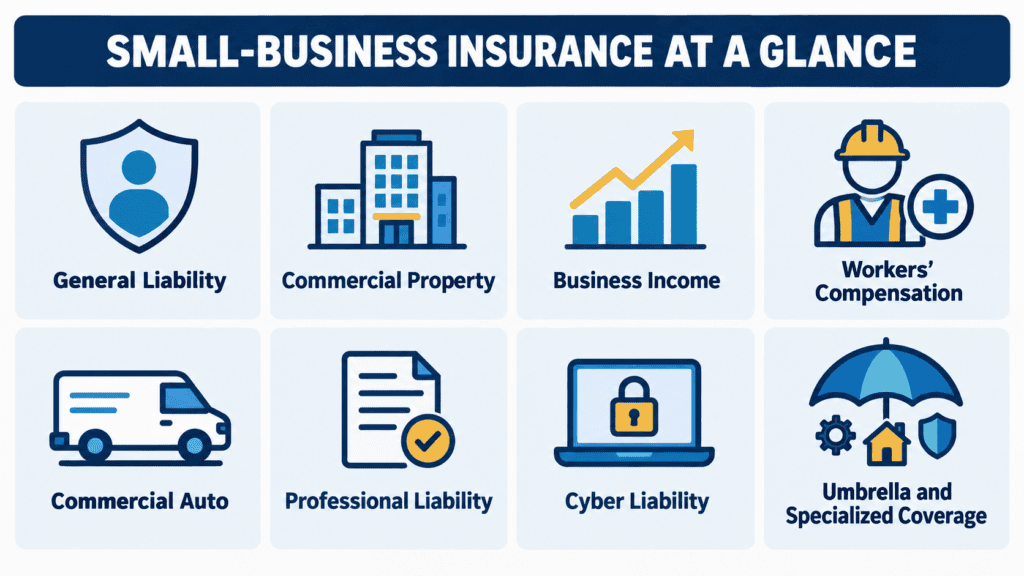
Florida small-business insurance may combine property, liability, employee, vehicle, income, technology, and specialized protection based on the company’s actual exposures.
Table of Contents
-
Why Florida Small-Business Insurance Is Different
-
Is Business Insurance Required in Florida?
-
How to Determine Which Insurance Your Business Needs
-
Core Insurance Coverages for Florida Small Businesses
-
Business Owners Policy vs. Commercial Package and Separate Policies
-
Additional and Industry-Specific Business Insurance
-
Hurricanes, Windstorms, Flooding, and Other Florida Property Risks
-
Business Insurance Examples by Industry
-
Does an LLC Eliminate the Need for Business Insurance?
-
Limits, Deductibles, Policy Forms, and Other Important Details
-
How Much Does Small-Business Insurance Cost in Florida?
-
How to Compare Florida Business Insurance Quotes
-
Information Needed for a Business Insurance Quote
-
Common Florida Small-Business Insurance Mistakes
-
When to Review or Update Business Insurance
-
What to Do After a Business Loss or Liability Incident
-
Business Insurance Across Florida and Northeast Florida
-
Frequently Asked Questions
-
Request a Florida Small-Business Insurance Quote
-
About the Author
-
Recommended External Resources
-
Related Articles
-
Insurance Disclaimer
Why Florida Small-Business Insurance Is Different
Florida businesses face many of the same risks as companies in other states, including customer injuries, property damage, employee accidents, vehicle collisions, theft, professional mistakes, cyber incidents, and lawsuits.
Florida can also create additional considerations involving:
-
Hurricanes and tropical storms
-
Wind and wind-driven rain
-
Storm surge and flooding
-
Lightning and power interruption
-
Heavy rainfall and water intrusion
-
Coastal and near-coastal locations
-
Rapidly changing construction and repair costs
-
Building-code requirements
-
Roof age and building condition
-
Availability of windstorm coverage
-
Percentage-based wind or named-storm deductibles
-
Seasonal operations and tourism
-
Businesses operating across multiple counties
-
Property located near rivers, wetlands, canals, tidal water, or the Intracoastal Waterway
Insurance-company eligibility and policy terms can vary significantly by location, building construction, roof condition, occupancy, industry, prior losses, and catastrophe exposure.
A policy appropriate for an inland professional office may not be suitable for a coastal restaurant, contractor with mobile equipment, warehouse storing customer property, or manufacturer with substantial machinery and product liability exposure.
The objective is not to purchase as many policies as possible. It is to identify the business’s material exposures and determine which risks should be insured, reduced through risk management, transferred by contract, retained by the business, or addressed through another financial strategy.
Is Business Insurance Required in Florida?
Florida does not require every company to purchase one universal business-insurance package. However, particular types of insurance may be required because of state law, vehicle ownership, professional licensing, construction activity, leases, loans, or contracts.
Workers’ Compensation Requirements
Florida workers’ compensation requirements depend on the company’s industry, number of employees, and organizational structure.
Under current Florida guidance:
-
Construction employers with one or more employees generally must maintain workers’ compensation coverage. This can include non-exempt corporate officers or limited-liability-company members.
-
Non-construction employers with four or more employees generally must maintain coverage.
-
Agricultural employers may be subject to coverage requirements when they have six regular employees or twelve seasonal workers who meet Florida’s applicable work-duration thresholds.
-
Contractors must address additional responsibilities involving subcontractors and evidence of workers’ compensation coverage.
Owner, officer, and LLC-member exemptions may be available in certain situations, but an exemption applies to the qualifying individual rather than automatically exempting the entire business. An exempt person ordinarily gives up workers’ compensation benefits while the exemption is effective.
Businesses should confirm their current requirements directly rather than relying only on an employee count or assuming that paying someone as an independent contractor resolves the issue.
For more information about employee thresholds, exemptions, benefits, audits, and subcontractors, read our Florida Workers’ Compensation Insurance guide and consult the Florida Division of Workers’ Compensation coverage requirements.
Business-Owned Vehicles
Vehicles titled to or owned by a business must satisfy applicable Florida registration and financial-responsibility requirements. Additional limits or filings can apply to certain commercial motor vehicles, motor carriers, passenger transportation operations, or vehicles based on weight and use.
A vehicle may need commercial auto insurance even if only one pickup truck, van, SUV, or car is involved. Important considerations include who owns the vehicle, who drives it, how it is used, what it carries, where it travels, and whether employees operate it.
A personal auto policy should not be assumed to cover a vehicle titled to a business or used primarily for commercial operations.
For additional guidance, read our Florida Commercial Auto Insurance guide and review the Florida Highway Safety and Motor Vehicles insurance information.
Licensed Contractors and Regulated Professionals
Contractors and certain regulated businesses or professionals may have insurance requirements established by state law, licensing boards, local authorities, or the contracts under which they work.
Requirements can vary by occupation, license classification, governmental jurisdiction, and project. A contractor, healthcare provider, transportation business, childcare operation, security company, or other regulated business should confirm the requirements applicable to its exact activities.
Maintaining the minimum insurance required for a license does not necessarily provide enough protection for the business’s property, employees, vehicles, income, contracts, and potential liability claims.
Contracts, Leases, Loans, and Client Requirements
A business may be contractually required to maintain insurance even when a particular policy is not mandated by state law.
Requirements may arise from:
-
Commercial leases
-
Construction contracts
-
Customer or vendor agreements
-
Franchise agreements
-
Equipment leases
-
Loans and mortgages
-
Government contracts
-
Professional-services agreements
-
Property-management agreements
-
Licensing arrangements
-
Event or venue contracts
A contract may specify policy types, minimum limits, additional insured status, primary and noncontributory wording, waivers of subrogation, completed-operations protection, or notice requirements.
Signing a contract does not guarantee that an insurance policy satisfies the obligation. Contracts and policies are separate documents, and an insurance policy does not automatically cover every responsibility accepted in an agreement.
How to Determine Which Insurance Your Business Needs
The starting point should be what the business actually does—not merely the name used on a website, business card, certificate of insurance, or state registration.
A thorough review should examine six principal areas.
Operations
Describe every product, service, trade, and activity performed by the business. Identify work conducted at the company’s location, customer premises, construction sites, events, temporary locations, or online.
Higher-risk activities, residential work, structural work, installation, delivery, manufacturing, importing, subcontracting, and work performed at height may affect eligibility and coverage.
People
Identify owners, officers, members, employees, temporary workers, volunteers, leased workers, independent contractors, and subcontractors.
The business should understand who may qualify as an insured, who requires workers’ compensation protection, who drives for work, and whose actions could create liability for the company.
Property
Create an inventory of buildings, tenant improvements, furniture, fixtures, computers, inventory, tools, machinery, mobile equipment, signs, records, and property belonging to others.
Property should be evaluated based on how much it would cost to repair or replace—not simply its tax value, purchase price, book value, or outstanding loan balance.
Vehicles and Transportation
Identify business-owned, leased, rented, borrowed, and employee-owned vehicles used for work.
Also review property transported in vehicles, tools taken to jobsites, customer property, cargo, deliveries, trailers, mobile equipment, and employees who drive on company business.
Contracts
Review leases, customer agreements, subcontractor contracts, loan documents, franchise agreements, and other arrangements that contain insurance or indemnification requirements.
A certificate request may reveal only part of the obligation. The contract itself should be reviewed to determine which limits, endorsements, and policy provisions are required.
Financial Consequences
Consider how the business would respond if it experienced:
-
A serious customer injury
-
Major damage to someone else’s property
-
A fire or wind loss
-
A prolonged closure
-
An employee injury
-
A vehicle accident
-
Theft of equipment or money
-
A cyberattack
-
A professional-liability allegation
-
A flood
-
A lawsuit exceeding the primary liability limits
Insurance cannot eliminate every risk, but it can help transfer losses that the business may not be able to absorb independently.
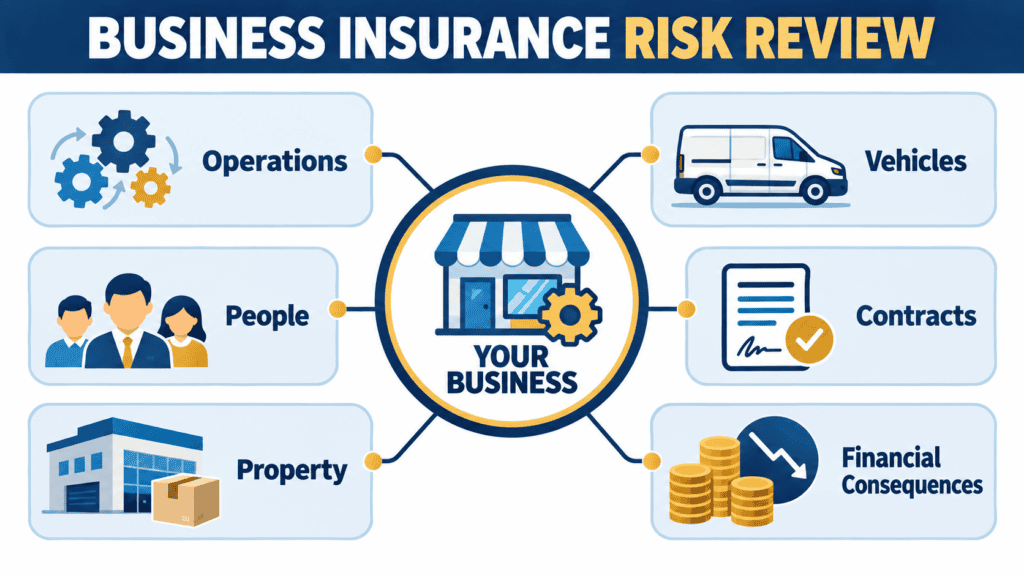
A business-insurance review should begin with the company’s actual operations, people, property, vehicles, contracts, and potential financial losses.
Core Insurance Coverages for Florida Small Businesses
General Liability Insurance
Commercial general liability insurance can help protect a business against certain third-party claims involving bodily injury, property damage, personal and advertising injury, medical payments, and products-completed operations.
Examples may include:
-
A customer slipping and being injured at the business
-
An employee accidentally damaging property at a customer’s location
-
A completed installation allegedly causing later property damage
-
A product allegedly causing bodily injury
-
Certain allegations of libel, slander, or advertising injury
-
Legal defense costs arising from a covered claim
General liability does not cover every business exposure. Employee injuries, professional mistakes, commercial auto accidents, damage to the company’s own property, cyber incidents, employment disputes, and pollution may require separate coverage.
Limits, exclusions, classifications, products-completed operations coverage, subcontracting provisions, additional insured endorsements, and defense-cost treatment should all be reviewed.
For more information about covered claims, exclusions, completed operations, additional insureds, and policy limits, read our Florida General Liability Insurance guide.
Business Owners Policy
A Business Owners Policy, commonly called a BOP, can combine general liability, commercial property, and business income coverage in one policy for an eligible business.
A BOP may be appropriate for certain retailers, offices, service companies, restaurants, property owners, and other small or midsize businesses with relatively common property and liability exposures.
Eligibility may depend on:
-
Industry and operations
-
Annual sales
-
Payroll
-
Number of employees
-
Building size and construction
-
Property values
-
Location
-
Claims history
-
Amount of subcontracted work
-
Whether higher-hazard activities are performed
A BOP does not automatically include workers’ compensation, commercial auto, professional liability, cyber liability, flood insurance, or every other coverage a business may need. Some protection may be available by endorsement, while other exposures require separate policies.
For more information about eligibility, included coverage, and what may require a separate policy, read our Florida Business Owners Policy guide.
Commercial Property Insurance
Commercial property insurance can help protect buildings, business personal property, equipment, inventory, furniture, fixtures, tenant improvements, and other eligible physical assets against covered causes of loss.
Important considerations include:
-
Building and contents values
-
Replacement cost or actual cash value
-
Coinsurance provisions
-
Causes-of-loss form
-
Roof age and condition
-
Windstorm coverage
-
Deductibles
-
Protective safeguards
-
Vacancy provisions
-
Property belonging to others
-
Outdoor signs and property
-
Debris removal
-
Ordinance or law coverage
-
Property at temporary or unscheduled locations
-
Seasonal changes in inventory
A business that leases its location may still have substantial property exposure involving furniture, equipment, inventory, improvements, glass, signs, and other property for which it is responsible.
The landlord’s policy ordinarily should not be expected to insure the tenant’s business property or income.
For more information about buildings, business personal property, valuation, causes of loss, wind coverage, and common exclusions, read our Florida Commercial Property Insurance guide.
Business Income and Extra-Expense Coverage
Property damage can affect more than the building and equipment. A fire, windstorm, or other covered event may prevent the company from operating and producing revenue.
Business income coverage may help replace certain lost income and continuing operating expenses when operations are suspended because of covered direct physical loss or damage. Extra-expense coverage may help pay qualifying additional costs incurred to continue operations or shorten the interruption.
Depending on the policy, relevant considerations may include:
-
The covered cause of loss
-
Required physical damage
-
Waiting periods
-
The period of restoration
-
Payroll treatment
-
Continuing expenses
-
Extended business income
-
Civil-authority coverage
-
Utility-service interruption
-
Dependent properties
-
Temporary locations
-
Ordinary payroll
-
Monthly limitations or maximum periods
Business income should be estimated from financial records rather than selected arbitrarily. A company should consider how long repairs, permits, equipment replacement, inventory replenishment, and customer recovery could take after a major loss.
Business income coverage ordinarily follows the cause-of-loss provisions of the related property coverage. If flood or wind is excluded from the property policy, income losses resulting from that excluded event may also be uninsured.
For more information about income replacement and continuing expenses after a covered property loss, read our Florida Business Interruption Insurance guide.
Workers’ Compensation and Employers Liability
Workers’ compensation insurance can provide medical, wage-replacement, disability, rehabilitation, and certain death benefits after a compensable work-related injury or occupational illness.
A workers’ compensation policy also generally includes employers liability coverage for certain employee-injury lawsuits not resolved exclusively through statutory workers’ compensation benefits.
Premiums are commonly based on payroll, employee classifications, operations, and claims experience. The insurer may conduct an audit after the policy period to compare estimated payroll and classifications with the company’s actual exposure.
Business owners should accurately describe employee duties and avoid placing workers in a lower-rated classification merely because it costs less. Incorrect classifications, uninsured subcontractors, unreported payroll, or worker misclassification can create additional premium and coverage problems.
For more information, read our Florida Workers’ Compensation Insurance guide.
Commercial Auto Insurance
Commercial auto insurance can help protect vehicles owned, leased, or used by a business.
Depending on the policy and selected coverage, protection may include:
-
Liability for bodily injury or property damage
-
Physical damage to covered vehicles
-
Comprehensive coverage
-
Collision coverage
-
Medical payments
-
Personal injury protection
-
Uninsured or underinsured motorist coverage
-
Towing or roadside assistance
-
Rental reimbursement
-
Hired and non-owned auto liability
-
Coverage for permanently attached equipment
-
Specialized forms for fleets, trucking, transportation, or other operations
The appropriate coverage depends on vehicle ownership, registration, weight, radius, garaging, driver qualifications, business use, cargo, trailers, and whether employees take vehicles home.
Tools, equipment, inventory, or customer property transported in a vehicle may require inland marine or cargo coverage rather than relying on the commercial auto policy.
For a detailed explanation of owned business vehicles, drivers, limits, physical damage, trailers, and transported property, read our Florida Commercial Auto Insurance guide.
Hired and Non-Owned Auto Insurance
A company can have an auto liability exposure even when it owns no vehicles.
Hired auto coverage generally addresses certain liability exposures involving vehicles the business rents, hires, borrows, or temporarily leases. Non-owned auto coverage generally addresses the company’s potential liability when employees or other authorized individuals use personally owned vehicles on company business.
Examples may include an employee:
-
Visiting a customer
-
Attending a meeting
-
Making a bank deposit
-
Picking up supplies
-
Traveling between work locations
-
Making a delivery
-
Renting a vehicle for a business trip
Hired and non-owned auto liability generally protects the business rather than replacing the vehicle owner’s insurance. It also does not necessarily cover physical damage to the rented, borrowed, or employee-owned vehicle.
For more information about rented vehicles and employee-owned vehicles used for work, read our Florida Hired and Non-Owned Auto Insurance guide.
Professional Liability or Errors and Omissions Insurance
General liability insurance principally addresses certain bodily injury, property damage, and defined personal or advertising injury claims. It generally does not address every allegation that professional advice, services, designs, recommendations, or failures caused a customer financial loss.
Professional liability or errors and omissions insurance may be important for:
-
Consultants
-
Technology companies
-
Accountants
-
Real estate professionals
-
Insurance professionals
-
Property managers
-
Designers
-
Architects and engineers
-
Medical or healthcare businesses
-
Marketing companies
-
Other professional or service-based operations
Many professional liability policies are written on a claims-made basis. Coverage may depend on the policy being active when the claim is made and reported, the date of the alleged act, the retroactive date, and compliance with reporting requirements.
Switching insurers or allowing coverage to lapse can create a gap involving prior services. Business owners should review prior-acts coverage and available extended reporting provisions before replacing or ending a claims-made policy.
For more information about claims involving professional services and financial loss, read our Florida Errors and Omissions Insurance guide.
Cyber Liability and Data-Breach Insurance
A small business can face cyber exposure even if it does not consider itself a technology company.
Email, online banking, cloud storage, customer records, employee information, payment systems, remote access, websites, scheduling software, and third-party vendors can all create potential loss exposures.
Depending on the policy, cyber coverage may help address:
-
Data-breach response
-
Customer notification
-
Credit or identity monitoring
-
Digital forensics
-
Privacy liability
-
Regulatory investigations
-
Cyber extortion
-
Ransomware
-
Data restoration
-
Network interruption
-
Business income loss
-
Payment-card assessments
-
Social-engineering fraud
-
Funds-transfer fraud
-
Cyber-related legal defense
-
Crisis-management expenses
Coverage varies substantially. Some policies include limited social-engineering or funds-transfer protection, while others exclude or sublimit those losses. Security-control requirements, multifactor authentication, backups, vendor management, encryption, and incident-response procedures may affect eligibility and claim handling.
For more information about data breaches, ransomware, network interruption, and cybercrime exposures, read our Florida Cyber Liability Insurance guide.
Commercial Umbrella or Excess Liability Insurance
A commercial umbrella or excess liability policy may provide additional limits above specified underlying liability policies.
It may sit over coverages such as:
-
General liability
-
Commercial auto liability
-
Employers liability
-
Other eligible scheduled policies
Umbrella and excess policies are not interchangeable in every situation. Some principally provide additional limits, while others may contain different terms or potentially broader protection. The underlying policies, required minimum limits, exclusions, policy periods, and covered operations must be coordinated.
An umbrella does not automatically cover every exposure excluded by the underlying policy. Professional liability, cyber liability, employment practices liability, pollution, and other specialized risks may require their own limits or separate excess policies.
For more information about limits above eligible underlying policies, read our Florida Commercial Umbrella Insurance guide.
Business Owners Policy vs. Commercial Package and Separate Policies
A small business may obtain insurance through a Business Owners Policy, a Commercial Package Policy, separate monoline policies, or a combination of these approaches.
Business Owners Policy
A BOP is generally designed for eligible businesses with relatively common property and liability exposures. It commonly packages commercial property, general liability, and business income coverage.
A BOP can be convenient and cost-effective, but it is not appropriate for every industry or risk.
Commercial Package Policy
A Commercial Package Policy can combine two or more commercial coverage parts into a coordinated package. It may provide more flexibility for a business with larger values, multiple locations, specialized operations, or more complex insurance needs.
A package does not mean every exposure is covered. The selected coverage parts, declarations, forms, endorsements, limits, and exclusions determine the protection provided.
Separate or Monoline Policies
Certain coverages are commonly issued separately even when the company has a BOP or package policy. These may include workers’ compensation, commercial auto, professional liability, cyber liability, flood insurance, and commercial umbrella.
The appropriate structure depends on the business and available insurance markets. The key is to understand how the policies work together and where gaps, conflicting terms, or uninsured exposures may remain.
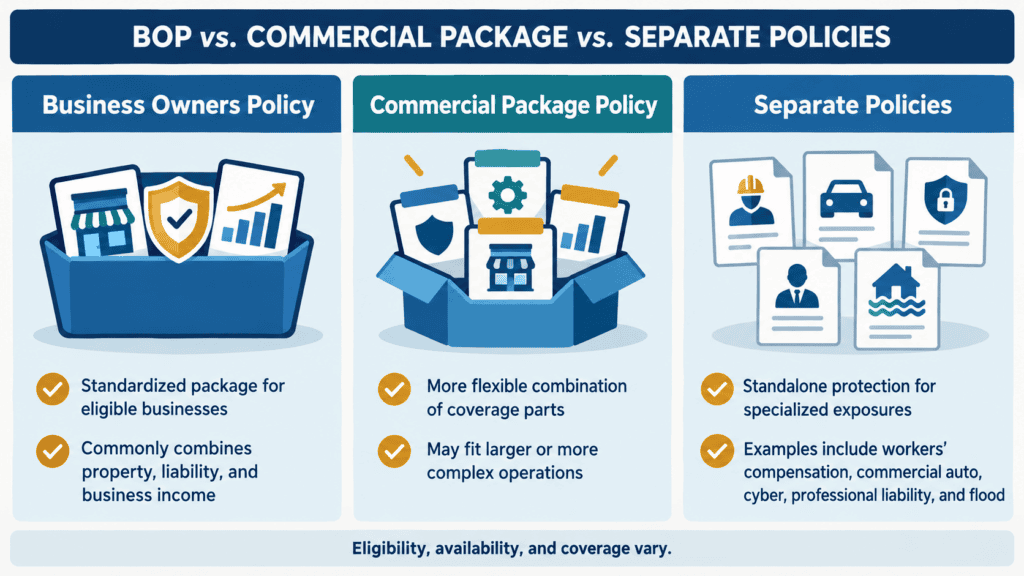
A Business Owners Policy, Commercial Package Policy, or combination of separate policies may be appropriate depending on the business’s eligibility, complexity, and coverage needs.
For more information about whether a package may be appropriate, read our Florida Business Owners Policy guide.
Additional and Industry-Specific Business Insurance
Core coverage does not address every exposure. Depending on the business, additional policies or endorsements may be appropriate.
Employment Practices Liability Insurance
Employment practices liability insurance, or EPLI, may address certain claims involving wrongful termination, discrimination, harassment, retaliation, failure to hire or promote, and other alleged employment-related wrongful acts.
Coverage is commonly written on a claims-made basis. Defense costs, retention amounts, reporting requirements, exclusions, and coverage for third-party claims should be reviewed.
For more information, read our Employment Practice Liability Insurance guide.
Inland Marine and Equipment Coverage
Commercial property insurance is generally centered on scheduled premises. Tools, equipment, materials, valuable property, or customer property that travels, is stored off premises, or moves between jobsites may require inland marine coverage.
Contractors, installers, photographers, technology companies, medical-equipment businesses, repair companies, and other mobile operations can have significant inland marine exposure.
For more information about mobile property and equipment away from the primary premises, read our Florida Inland Marine Insurance guide.
Equipment Breakdown Insurance
Commercial property insurance may cover equipment damaged by an external covered event but exclude or restrict internal mechanical, electrical, or pressure-system breakdown.
Equipment breakdown coverage may address qualifying damage involving boilers, refrigeration, production machinery, electrical systems, HVAC equipment, computers, and other covered equipment. Depending on the policy, it may also include certain spoilage, business income, or extra-expense losses.
For more information, read our Systems and Equipment Breakdown Insurance guide.
Commercial Crime Insurance
Commercial crime insurance may address certain losses involving employee dishonesty, theft of money or securities, forgery, computer fraud, funds-transfer fraud, or other covered criminal acts.
A property or cyber policy does not necessarily provide the same protection. Crime forms can differ in who committed the act, what property was taken, how the loss occurred, and when it was discovered.
For more information, read our Commercial Crime Insurance guide.
Products Liability and Product Recall
Businesses that manufacture, import, distribute, sell, install, repair, package, or label products may face products liability claims.
Products-completed operations coverage within a general liability policy may respond to certain bodily injury or property damage caused by a product after it leaves the insured’s possession. It does not necessarily pay to recall, withdraw, inspect, repair, replace, or dispose of the business’s defective product.
Separate product-recall or product-withdrawal coverage may be necessary for recall expenses, customer notification, shipping, disposal, crisis management, and certain income losses.
Liquor Liability Insurance
Restaurants, bars, breweries, caterers, event businesses, retailers, and other operations that manufacture, distribute, sell, serve, or furnish alcoholic beverages may need liquor liability insurance.
The host-liquor coverage sometimes found in general liability insurance should not be assumed to protect a business that sells or serves alcohol as part of its operations.
For more information, read our Florida Liquor Liability Insurance guide.
Builders Risk and Installation Coverage
Buildings under construction, substantial renovations, materials awaiting installation, and property in transit to a project may not be adequately protected by a standard completed-building property policy.
Builders risk and installation coverage may help protect qualifying structures, materials, and work in progress during construction. Coverage should be coordinated among the owner, general contractor, subcontractors, lenders, and other parties with an insurable interest.
For more information, read our Florida Builders Risk Insurance guide.
Directors and Officers Liability
Corporations, nonprofits, associations, and other organizations may face claims alleging wrongful management decisions by directors, officers, board members, or organizational leaders.
Directors and officers liability insurance may address certain claims involving governance, fiduciary decisions, alleged mismanagement, or other covered wrongful acts. The organization and its individual leaders may have different coverage needs.
Pollution and Environmental Liability
General liability and commercial property policies often contain significant pollution exclusions.
Contractors, manufacturers, property owners, environmental firms, fuel-related businesses, agricultural operations, and companies working with chemicals, paints, solvents, mold, asbestos, lead, waste, or contaminated materials may need specialized pollution coverage.
Key Person, Buy-Sell, and Employee Benefits Coverage
Property and liability insurance protect important business exposures, but a company may also need life, disability, key-person, buy-sell, health, or employee-benefit solutions.
These coverages serve different purposes from property and casualty insurance and should be evaluated with appropriate insurance, legal, tax, and financial professionals.
Hurricanes, Windstorms, Flooding, and Other Florida Property Risks
Florida businesses should evaluate catastrophe exposure separately from ordinary property risks.
Windstorm and Hurricane Coverage
Commercial property policies may include windstorm coverage, exclude it, restrict it, or require a separate wind policy. Terms vary by insurance company, property, location, construction, roof condition, and distance from the coast.
A commercial policy may apply a separate windstorm, named-storm, or hurricane deductible. The deductible may be stated as a flat amount or percentage and may apply differently than a standard property deductible.
Business owners should determine:
-
Whether wind is included
-
Whether wind-driven rain is covered
-
Which deductible applies
-
What value the percentage deductible uses
-
Whether roof or exterior-property restrictions apply
-
Whether protective safeguards are required
-
Whether business income follows the wind coverage
-
Whether a separate wind policy is necessary
-
How multiple policies would respond to the same storm
A property being outside a beachfront area does not eliminate wind exposure. Hurricane-force winds, tornadoes, falling trees, lightning, heavy rain, and utility interruption can affect businesses well inland.
Flood and Storm Surge
Standard commercial property insurance generally does not cover flooding caused by rising surface water, storm surge, overflowing waterways, or widespread water accumulation.

Wind and flood damage can occur during the same storm but may be insured differently. Coverage depends on the cause of loss, policy terms, exclusions, and applicable deductibles.
Separate commercial flood insurance may be available through the National Flood Insurance Program or private flood insurers. Building and contents coverage may need to be purchased and evaluated separately.
Flood coverage does not automatically include business income or every expense associated with a closure. A business should review how direct flood damage, inventory, machinery, tenant improvements, income loss, and temporary relocation would be addressed.
A lender’s flood-insurance requirement is designed primarily to protect the lender’s financial interest. It does not establish the full amount or range of coverage the business may need.
For more information about NFIP and private-market options, read our Florida Commercial Flood Insurance guide.
Ordinance or Law Coverage
After major property damage, current building codes may require a business to demolish undamaged portions of the structure, upgrade electrical or structural systems, or rebuild differently from the original construction.
Standard property coverage may not fully pay these additional code-related costs. Ordinance or law coverage can help address qualifying expenses, subject to its limits and terms.
For more information, read our Florida Ordinance or Law Coverage for Businesses guide.
Water Backup, Utility Interruption, and Equipment Failure
Sewer or drain backup, off-premises utility interruption, equipment breakdown, spoilage, and service interruption may require endorsements or separate coverage.
The cause of a shutdown matters. Business income coverage ordinarily requires the loss to result from a covered cause and satisfy the applicable policy conditions.
A company that depends on refrigeration, production machinery, communications, electricity, water, cloud services, or a particular supplier should review those dependencies before a loss occurs.
Business Insurance Examples by Industry
The following examples illustrate why coverage should be based on actual operations rather than a generic small-business package.
Contractors and Trades
A contractor may need general liability, products-completed operations, workers’ compensation, commercial auto, hired and non-owned auto, inland marine, installation coverage, builders risk, pollution liability, and commercial umbrella insurance.
Subcontractor controls, certificates, additional insured endorsements, residential-work exclusions, height limitations, classification wording, and prior-work provisions can materially affect protection.
For industry-specific information, explore our Florida Contractor Insurance resources.
Restaurants, Bars, and Food-Service Businesses
A restaurant may need property, general liability, business income, equipment breakdown, spoilage, workers’ compensation, cyber liability, employment practices liability, commercial auto, food-contamination protection, and liquor liability.
Delivery, catering, outdoor dining, entertainment, and alcohol service can introduce additional exposures not addressed by a basic property and liability package.
Retailers and Wholesalers
Retailers may need property coverage for inventory, general liability, products liability, business income, cyber coverage, crime insurance, equipment breakdown, workers’ compensation, and commercial auto.
Wholesalers and distributors may also need cargo, warehouse legal liability, product recall, international coverage, or higher products liability limits.
Professional and Service Businesses
A professional office may need general liability, business personal property, business income, professional liability, cyber insurance, employment practices liability, workers’ compensation, hired and non-owned auto, and umbrella protection.
A general liability policy ordinarily does not replace professional liability coverage when the allegation involves advice, a professional service, missed deadline, design error, or financial loss without accompanying bodily injury or property damage.
Manufacturers
A manufacturer may need property, equipment breakdown, business income, products liability, product recall, pollution liability, inland marine, cargo, workers’ compensation, commercial auto, cyber, crime, and umbrella or excess liability.
The company should accurately disclose its products, component parts, manufacturing processes, quality-control procedures, geographic distribution, foreign sourcing, and intended product uses.
Commercial Property Owners and Landlords
A commercial landlord may need building coverage, general liability, rental-income protection, ordinance or law coverage, equipment breakdown, flood insurance, wind protection, environmental coverage, and umbrella liability.
Coverage should reflect the building’s occupants, leases, common areas, parking lots, maintenance obligations, vacancy, property-management arrangements, and responsibility for tenant improvements.
Home-Based Businesses
Homeowners insurance may provide little or no coverage for business property, customer injuries, professional services, inventory, employees, or business interruption.
A home-based company may need a business endorsement, in-home business policy, BOP, general liability, professional liability, cyber insurance, commercial auto, or other coverage.
The business should be disclosed to both the homeowners and business insurance companies. Operating from home does not make commercial exposures personal.
Nonprofits and Community Organizations
Nonprofits may need general liability, property, workers’ compensation, commercial auto, directors and officers liability, employment practices liability, cyber insurance, crime coverage, volunteer accident protection, and abuse or molestation coverage.
The absence of a profit motive does not eliminate liability, employment, property, vehicle, governance, or cyber exposure.
For additional industry-specific options, explore our Florida Business Insurance by Industry resources.
Does an LLC Eliminate the Need for Business Insurance?
No. Forming a limited liability company can provide important legal separation between the company and its owners, but an LLC does not prevent accidents, property damage, employee injuries, lawsuits, vehicle collisions, professional allegations, or cyber incidents.
An owner may still face personal exposure because of:
-
A personal guarantee
-
Personal negligence
-
Commingling of business and personal assets
-
Failure to follow corporate formalities
-
Certain taxes or employment obligations
-
An excluded or uninsured loss
-
Conduct outside the protection of the business entity
-
A claim against both the company and individual owner
Even when the business entity protects personal assets, the company’s own property, income, reputation, contracts, and ability to continue operating may remain at risk.
Business formation and insurance serve different purposes. Business owners should obtain legal and tax advice about entity structure and separately evaluate the insurance needed for the company’s operations.
Limits, Deductibles, Policy Forms, and Other Important Details
Purchasing the right policy type is only part of the decision. The limits, definitions, classifications, exclusions, endorsements, deductibles, and reporting provisions determine how coverage may apply.
Named Insureds, Legal Entities, and DBAs
The policy should correctly identify the legal entity or entities that need coverage.
A trade name or DBA is not necessarily a separate legal entity. If the business operates through multiple corporations, LLCs, partnerships, subsidiaries, or property-owning entities, those organizations should be reviewed individually.
A policy issued to the wrong entity may create serious questions after a claim. Changes in ownership, legal structure, partnerships, acquisitions, or business names should be reported before assuming coverage automatically transfers.
Operations, Classifications, and Locations
Insurance applications and policies should accurately describe:
-
Services performed
-
Products sold or manufactured
-
Work performed by subcontractors
-
Residential or commercial work
-
Installation and delivery
-
Geographic territory
-
Business locations
-
Temporary operations
-
Foreign sourcing or distribution
-
Online sales
-
Special events
-
Alcohol service
-
New divisions or trades
Coverage can be affected when a loss arises from an operation, product, location, or service that was not disclosed or is excluded by endorsement.
Limits and Aggregates
Liability policies may contain several limits that interact.
A general liability policy may include:
-
Each-occurrence limit
-
General aggregate
-
Products-completed operations aggregate
-
Personal and advertising injury limit
-
Damage-to-premises-rented-to-you limit
-
Medical-expense limit
Claim payments can reduce the amount available for later claims during the policy period. Defense expenses may be paid outside the limits under some policies and reduce the limits under others.
The limit required by a contract is not automatically the amount appropriate for the company. Limits should reflect the potential severity of claims, property values, contracts, vehicle use, payroll, operations, and assets at risk.
Occurrence and Claims-Made Coverage
An occurrence policy generally looks to when covered bodily injury or property damage occurred, even if the claim is reported later.
A claims-made policy generally requires the claim to be made—and often reported—while the policy or an applicable reporting period is active. The alleged act may also need to occur on or after the retroactive date.
Professional liability, cyber liability, employment practices liability, directors and officers liability, and certain pollution policies are frequently written on a claims-made basis.
Before replacing or canceling claims-made coverage, review the retroactive date, prior-acts protection, reporting requirements, and available extended reporting period.
Deductibles and Self-Insured Retentions
A deductible or self-insured retention represents financial responsibility the business accepts before or alongside the insurer’s payment.
The two terms do not always operate identically. A self-insured retention may require the business to manage or fund defense and loss expenses until the retention is satisfied, depending on the policy.
Businesses should evaluate whether the amount would remain manageable after a major loss and whether different deductibles apply to wind, named storms, property, vehicles, water, theft, cyber incidents, or other exposures.
Premium Audits
Workers’ compensation and general liability premiums may be based on estimated payroll, sales, subcontractor costs, or other exposure measures.
After the policy period, an audit may compare the estimates with actual business activity. The result can produce additional premium or a return premium, depending on the policy and final exposure.
Accurate records should be maintained for:
-
Payroll
-
Employee duties
-
Sales
-
Subcontracted work
-
Certificates of insurance
-
Workers’ compensation exemptions
-
Independent contractor payments
-
Locations
-
Ownership
-
Changes in operations
A certificate from a subcontractor does not by itself establish that every relevant exposure is covered or that the subcontractor has been classified correctly.
Certificates and Additional Insured Status
A certificate of insurance provides evidence of insurance as of the date it is issued. It ordinarily does not amend the policy, create coverage, or make the certificate holder an insured.
Additional insured status generally must be supported by an endorsement or qualifying policy language. The protection provided can be limited by the endorsement, contract, scope of work, timing, causation language, and policy exclusions.
An organization can be both a certificate holder and an additional insured, but the two statuses are separate.
Existing First Florida Agency clients who need evidence of coverage can use our Request a Certificate of Insurance service.
Admitted and Surplus Lines Insurance
Florida commercial insurance may be obtained through admitted insurers or eligible surplus lines insurers.
An admitted insurer holds authority to transact insurance in Florida and is generally subject to state-approved forms and rates for applicable coverage. Eligible surplus lines insurers can provide coverage for risks the admitted market may be unable or unwilling to insure, including unusual, complex, or higher-hazard operations.
Surplus lines insurance is not inherently inferior, but policy forms, exclusions, pricing, fees, cancellation provisions, and insolvency protections can differ. Eligible surplus lines insurers do not participate in the Florida Insurance Guaranty Association in the same manner as admitted insurers.
Business owners should understand which market is offering the quote and evaluate the actual policy terms and financial strength rather than selecting coverage solely by carrier type or premium.
How Much Does Small-Business Insurance Cost in Florida?
There is no standard price for Florida small-business insurance.
Premiums can vary substantially based on:
-
Industry and operations
-
Annual revenue
-
Payroll
-
Number and duties of employees
-
Subcontracting costs
-
Products and services
-
Property values
-
Building construction, age, and roof condition
-
Business location
-
Wind and flood exposure
-
Vehicles and drivers
-
Radius of operation
-
Policy limits
-
Deductibles and self-insured retentions
-
Prior claims
-
Years in business
-
Professional experience
-
Safety and risk-management practices
-
Cybersecurity controls
-
Insurance-company underwriting guidelines
-
Admitted or surplus lines placement
-
Optional endorsements and specialized coverage
A lower premium does not necessarily mean that two policies provide comparable protection. One quote may exclude wind, omit business income, use lower property values, restrict completed operations, apply a larger deductible, exclude subcontracted work, or provide defense costs differently.
Some liability and workers’ compensation policies are auditable. The final premium may differ from the initial amount if actual payroll, sales, or subcontracting exposure exceeds the estimate.
The most reliable way to determine cost is to obtain quotes using complete and accurate business information and compare them on an equivalent basis.
How to Compare Florida Business Insurance Quotes
A useful quote comparison should examine far more than the total premium.
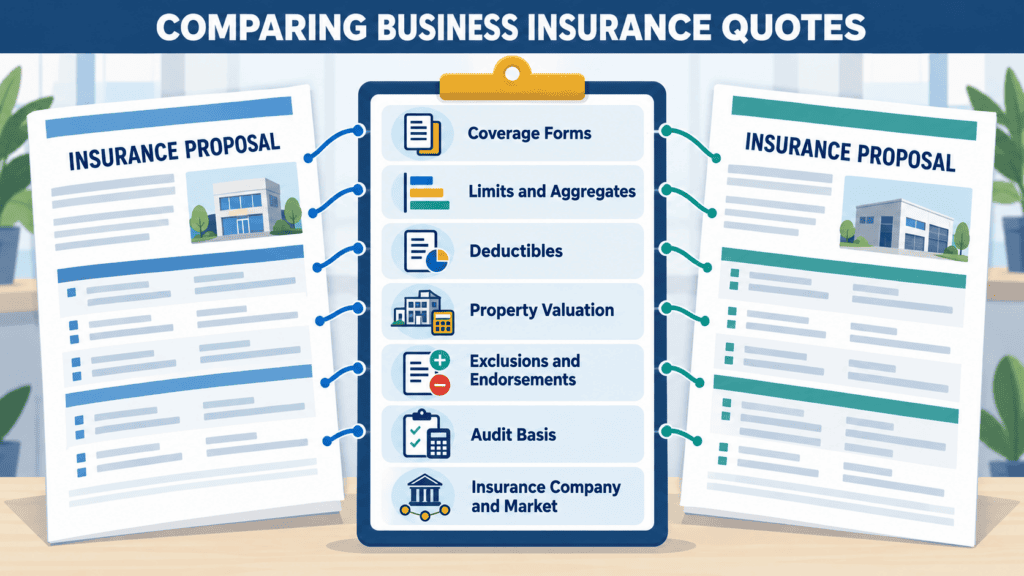
Compare business-insurance quotes using equivalent coverage, limits, deductibles, valuation, exclusions, endorsements, and insurer terms—not premium alone.
Review:
-
Named insureds and covered entities
-
Business descriptions and classifications
-
Covered locations
-
Policy periods
-
Coverage forms
-
Limits and aggregates
-
Deductibles and self-insured retentions
-
Property values
-
Replacement cost or actual cash value
-
Coinsurance provisions
-
Wind, named-storm, and flood treatment
-
Business income limits and periods
-
Products-completed operations coverage
-
Professional-services exclusions
-
Residential-work or designated-operations exclusions
-
Subcontractor restrictions
-
Hired and non-owned auto coverage
-
Additional insured endorsements
-
Defense-cost treatment
-
Claims-made retroactive dates
-
Premium-audit basis
-
Minimum-earned premium provisions
-
Cancellation terms
-
Insurance-company financial strength
-
Admitted or surplus lines status
-
Important endorsements and exclusions
A proposal is a summary, not the complete insurance contract. A certificate of insurance is evidence of coverage, not a substitute for reviewing the policy.
Ask what the lower-priced quote removes, limits, excludes, or shifts back to the business. The meaningful comparison is how each policy might respond to the same loss—not simply which proposal has the lowest initial price.
Information Needed for a Business Insurance Quote
Accurate information can make quoting more efficient and reduce changes during underwriting or after an audit.
Depending on the requested coverage, helpful information may include:
-
Full legal business name
-
DBAs or trade names
-
Entity type
-
Business address and all operating locations
-
Ownership information
-
Years in business
-
Description of every operation and service
-
Products manufactured, imported, distributed, or sold
-
Annual revenue
-
Payroll by employee duty
-
Number of employees
-
Subcontracting costs
-
Certificates and insurance requirements for subcontractors
-
Building information
-
Property, equipment, and inventory values
-
Business income estimates
-
Vehicle information
-
Driver information
-
Vehicle use and operating radius
-
Customer contracts and lease requirements
-
Required limits and endorsements
-
Cybersecurity controls
-
Professional qualifications or licenses
-
Prior insurance
-
Current policy declarations
-
Claims history or loss runs
-
Requested effective date
-
Changes planned during the coming year
A preliminary quote can change if the application is incomplete, property values are inaccurate, inspections identify different conditions, drivers are added, or the insurer learns that operations differ from what was originally described.
Do not include Social Security numbers, banking information, passwords, or other sensitive data in an unsecured website message. An insurance professional can explain how to provide required confidential information securely.
Common Florida Small-Business Insurance Mistakes
Assuming General Liability Covers Everything
General liability does not replace property, workers’ compensation, commercial auto, professional liability, cyber, employment practices, crime, flood, or other specialized coverage.
Relying on Personal Insurance for Business Exposures
Personal homeowners and auto policies may exclude or restrict business property, business liability, employees, inventory, deliveries, commercial vehicles, or regular business use.
Insuring Property Based on Purchase Price or Book Value
A building’s purchase price, tax assessment, loan balance, and market value may differ substantially from its rebuilding cost.
Equipment and inventory should also be reviewed using the policy’s valuation method and the cost of replacing what the business depends on.
Selecting Limits Only to Satisfy a Contract
Contractual minimums may not be sufficient for the company’s overall exposure. A serious injury, commercial auto accident, fire, completed-operations loss, or cyber incident can exceed minimum requirements.
Failing to Disclose New Operations
Adding installation, delivery, residential work, subcontracting, alcohol service, new products, another location, or operations in a different state can change the risk materially.
The insurance company should be notified before assuming the existing policy covers the new activity.
Relying Only on a Certificate of Insurance
A certificate does not show every exclusion, endorsement, condition, or limitation. It also does not create additional insured coverage or override the policy.
Ignoring Wind and Flood Exclusions
A policy can provide substantial commercial property coverage while excluding wind or flood. Florida businesses should understand how each catastrophe exposure is insured and which deductible applies.
Allowing Claims-Made Coverage to Lapse
Replacing or canceling a claims-made policy without addressing prior acts, retroactive dates, and reporting periods can leave earlier services uninsured.
Underestimating Business Income Needs
Businesses may underestimate how long rebuilding, permits, equipment replacement, supply restoration, and customer recovery could take.
Failing to Keep Policies and Records
Companies should retain policies, endorsements, contracts, certificates, audits, applications, loss records, project documents, and other important records.
Completed work or professional services can produce claims years later.
When to Review or Update Business Insurance
Business insurance should ordinarily be reviewed before renewal and whenever the company changes materially.
Contact your insurance agency when the business:
-
Adds employees
-
Uses independent contractors or subcontractors
-
Purchases or leases a vehicle
-
Allows employees to drive personal vehicles for work
-
Opens, closes, buys, sells, or relocates a location
-
Signs a new lease
-
Purchases equipment
-
Increases inventory
-
Renovates a building
-
Adds products or services
-
Begins delivery or installation
-
Starts residential or structural work
-
Enters another state or country
-
Hosts events
-
Begins serving alcohol
-
Collects new types of customer information
-
Changes legal entity or ownership
-
Acquires another company
-
Signs a major customer contract
-
Materially increases sales, payroll, or subcontracting
-
Experiences a claim
-
Changes cybersecurity systems
-
Begins construction or substantial renovation
Waiting until renewal may be too late if the new exposure has already begun.
Existing clients can request a review through the First Florida Agency Insurance Policy Review service.
What to Do After a Business Loss or Liability Incident
Protect people first. Call emergency services when necessary, obtain appropriate medical assistance, and restrict access to unsafe areas.
When it is safe to do so:
-
Stop or reduce additional damage when reasonable
-
Photograph or record the scene
-
Preserve damaged property and relevant evidence
-
Record witness names and contact information
-
Save surveillance footage
-
Retain contracts, invoices, maintenance records, and communications
-
Document temporary repairs
-
Keep receipts and expense records
-
Track closures, lost sales, payroll, and continuing expenses
-
Notify the appropriate insurance company promptly
-
Cooperate with reasonable claim requests

Document damage and relevant conditions when it is safe to do so, preserve important records and evidence, and report the loss promptly to the appropriate insurance company.
Do not alter, discard, repair, or destroy important evidence unless necessary to protect people or prevent additional damage. If an unsafe condition must be corrected immediately, document it before and after the temporary action whenever circumstances permit.
Avoid admitting legal responsibility, promising payment, signing a release, or negotiating a settlement without consulting the insurance company and appropriate professional advisers.
The business should follow the notice requirements in every potentially applicable policy. One incident can involve several policies, insurance companies, and reporting obligations.
First Florida Agency clients can begin the process through our Report an Insurance Claim service.
Business Insurance Across Florida and Northeast Florida
First Florida Agency serves businesses throughout Florida.
We are based in Ponte Vedra and have local knowledge of Nocatee, Ponte Vedra Beach, Jacksonville, St. Augustine, St. Johns County, and surrounding Northeast Florida communities.

First Florida Agency serves businesses throughout Florida, with local knowledge of Nocatee, Ponte Vedra, Ponte Vedra Beach, Jacksonville, St. Augustine, St. Johns County, and surrounding Northeast Florida communities.
Local businesses can face exposures involving coastal wind, flooding, rapid regional growth, construction activity, commercial development, tourism, transportation, and contracts involving property owners, general contractors, vendors, and larger organizations.
However, location is only one part of the insurance analysis. The appropriate program should reflect what the company actually does, the people and property it depends on, the agreements it signs, and the financial consequences of a loss.
As an independent insurance agency, First Florida Agency can review available options from multiple insurance companies and markets when appropriate. Our role is to help business owners understand differences in coverage, limits, deductibles, endorsements, exclusions, underwriting requirements, and pricing.
Frequently Asked Questions
What insurance does a small business typically need in Florida?
Many small businesses should evaluate general liability, commercial property, business income, workers’ compensation, commercial auto, professional liability, cyber liability, and commercial umbrella insurance. The appropriate combination depends on the company’s operations, employees, property, vehicles, contracts, products, services, and potential loss exposures.
Is general liability insurance legally required in Florida?
Florida does not impose one universal general liability requirement on every business. However, general liability may be required by a license, lease, lender, customer, general contractor, venue, or other contract. Even when it is not mandatory, businesses can face third-party bodily injury, property damage, and completed-operations claims.
Does an LLC need business insurance?
Yes, an LLC may still need insurance. The entity structure can provide certain legal protections, but it does not pay to defend lawsuits, repair property, replace income, cover employee injuries, respond to cyber incidents, or satisfy insurance requirements in contracts.
Is a Business Owners Policy enough for a small business?
Sometimes, but not always. A BOP commonly combines general liability, commercial property, and business income coverage for an eligible business. Workers’ compensation, commercial auto, professional liability, cyber liability, flood insurance, and other specialized protection may require separate policies or endorsements.
Do home-based businesses need commercial insurance?
They may. Homeowners insurance may provide little or no coverage for business inventory, equipment, customer injuries, employees, professional services, or lost business income. The appropriate solution may involve a business endorsement, in-home business policy, BOP, general liability, professional liability, or other commercial coverage.
When is workers’ compensation required in Florida?
Requirements depend on industry, employee count, and business structure. Construction employers with one or more employees and non-construction employers with four or more employees generally must maintain coverage, subject to applicable definitions and exemptions. Agricultural employers have separate thresholds. Confirm current requirements with the Florida Division of Workers’ Compensation.
Does paying a worker on a 1099 make that person an independent contractor?
Not automatically. Worker status depends on the actual relationship and applicable law, not only the tax form or label used. Construction businesses face particularly important rules involving subcontractors, exemptions, and responsibility for uninsured workers.
Does a business need commercial auto insurance for only one vehicle?
It may. One pickup truck, van, SUV, or car can require commercial coverage when it is owned or titled by the business, used primarily for work, operated by employees, used for delivery, carries equipment, or regularly travels to customer locations or jobsites.
What if employees use personal vehicles for work?
The business may have a non-owned auto liability exposure. An employee’s personal auto insurance should not be assumed to fully protect the company. Hired and non-owned auto coverage may help address the business’s liability, subject to the policy terms.
Does business insurance cover hurricanes?
Commercial property insurance may include hurricane or windstorm coverage, but it can also exclude or restrict wind. A separate deductible or policy may apply. Businesses should confirm whether wind, wind-driven rain, business income, outdoor property, and roof damage are covered.
Does commercial property insurance cover flooding?
Standard commercial property insurance generally excludes flooding caused by rising surface water, storm surge, or overflowing waterways. Separate NFIP or private commercial flood insurance may be needed.
How much does Florida small-business insurance cost?
There is no standard price. Premiums depend on the industry, operations, revenue, payroll, employees, property values, vehicles, drivers, location, limits, deductibles, claims history, subcontracting, catastrophe exposure, and insurer.
How much liability insurance should a business carry?
The appropriate limits depend on the possible severity of claims, contractual requirements, customer traffic, completed work, products, vehicle use, payroll, locations, and assets at risk. Contract minimums should be treated as one consideration rather than an automatic recommendation.
What is the difference between a certificate holder and an additional insured?
A certificate holder receives evidence of insurance. Additional insured status may provide limited protection under the policy when supported by an endorsement or qualifying policy language. A certificate alone does not make an organization an insured or change the policy.
How often should business insurance be reviewed?
Coverage should generally be reviewed before each renewal and whenever the business changes operations, employees, locations, vehicles, property, contracts, products, ownership, revenue, payroll, subcontracting, or technology.
Request a Florida Small-Business Insurance Quote
The right business insurance program should reflect your company—not a generic industry label or the lowest advertised price.
First Florida Agency can help review:
-
Business operations and classifications
-
Property and equipment
-
Employees and workers’ compensation requirements
-
Vehicles and drivers
-
General and professional liability exposures
-
Contracts and certificate requirements
-
Cyber and crime risks
-
Business income needs
-
Wind, hurricane, and flood exposure
-
Limits, deductibles, endorsements, and exclusions
As an independent Florida insurance agency, we can compare available options from multiple insurance companies and markets when appropriate.
Request a Florida business insurance quote or call First Florida Agency at 904-822-8800.
First Florida Agency
90 Fort Wade Road, Suite 100
Ponte Vedra, FL 32081
Your Nocatee Neighbor. Your Insurance Advocate.
About the Author
John Closterides is the Founder and Principal Agent of First Florida Agency, an independent insurance agency serving families and businesses throughout Florida.
John is a Florida-licensed 2-20 General Lines insurance agent with more than three decades of insurance-industry experience. He helps business owners evaluate commercial insurance options involving general liability, Business Owners Policies, commercial property, business income, commercial auto, workers’ compensation, professional liability, cyber liability, employment practices liability, commercial umbrella, and other specialized coverages.
Based in Ponte Vedra, John understands the insurance considerations facing businesses in Nocatee, Ponte Vedra Beach, Jacksonville, St. Augustine, St. Johns County, Northeast Florida, and communities throughout the state.
His approach centers on helping clients understand their coverage, identify potential gaps, and compare insurance options based on protection and suitability—not premium alone.
Recommended External Resources
For additional information, consult these official resources:
-
Florida Department of Financial Services: Business and Commercial Insurance
-
Florida Department of Financial Services: Small Business Owners’ Insurance Guide
-
Florida Division of Workers’ Compensation: Coverage Requirements
-
Florida Highway Safety and Motor Vehicles: Insurance Requirements
-
National Flood Insurance Program: Commercial Flood Insurance Information
-
Cybersecurity and Infrastructure Security Agency: Cyber Guidance for Small Businesses
Related Articles
For more detailed explanations of the coverages introduced in this guide, explore these First Florida Agency resources:
As additional commercial-insurance articles are published, this section can be updated to connect them with this comprehensive guide.
Insurance Disclaimer
The information in this article is provided for general educational purposes only. It is not intended as insurance, legal, financial, tax, accounting, cybersecurity, employment, risk-management, or claims advice.
Insurance coverage, eligibility, premiums, classifications, limits, deductibles, self-insured retentions, exclusions, endorsements, audits, underwriting requirements, claim decisions, and availability vary by insurance company, policy form, business, location, and individual circumstances.
Laws, regulations, licensing requirements, insurance-company guidelines, policy forms, government programs, and other requirements may change. Current requirements should be confirmed with the appropriate government agency, insurance company, and qualified professional.
Examples in this article are illustrative only and do not establish that coverage applies to a particular loss. No coverage is created, bound, extended, or modified by this article, a website submission, proposal, certificate of insurance, or general description of coverage.
The declarations, coverage forms, definitions, conditions, exclusions, and endorsements of the issued insurance policy control. Coverage cannot be confirmed without reviewing the actual policy and facts of the loss.
Consult a licensed insurance professional and, when appropriate, a qualified attorney, accountant, tax adviser, cybersecurity professional, human-resources professional, or other adviser regarding your business’s individual circumstances.