
Published October 26, 2026
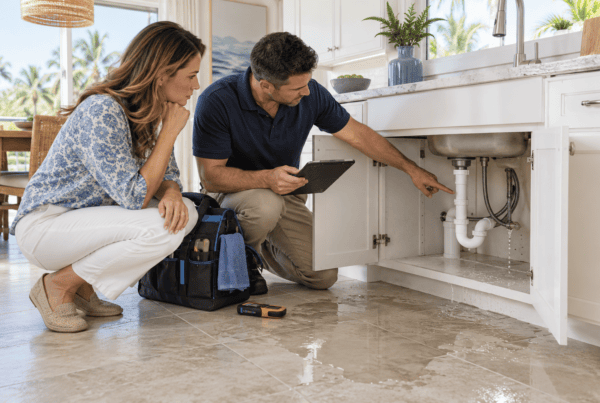
A hurricane, fire, burst pipe, severe windstorm, or another disaster can make a Florida home unsafe or impossible to occupy. The physical repairs may receive most of the attention, but displaced homeowners must also determine where they will live, how they will prepare meals, where they will keep their belongings, and how they will manage additional transportation and household expenses.
Loss of Use coverage may help with certain increased living costs when a covered loss makes the insured residence unfit to live in. This protection commonly appears as Coverage D on a homeowners policy and may include Additional Living Expense, Fair Rental Value, and limited coverage when a civil authority prohibits use of the residence.
Coverage is not triggered merely because an event is described as a disaster, a state of emergency is declared, or a homeowner decides to leave. The cause of damage, condition of the residence, expenses incurred, applicable limits, restoration period, exclusions, and policy language all matter.
This guide explains how Florida loss of use coverage works, which expenses may qualify, how additional living expenses are calculated, how hurricanes and flooding affect coverage, and what homeowners should document after being displaced.
Quick Answer: What Is Loss of Use Coverage?
Loss of Use coverage may help pay the reasonable increase in living expenses necessary to maintain a household’s normal standard of living when a covered loss makes the insured residence unfit to live in.
Depending on the policy and circumstances, Coverage D may include:
-
Additional Living Expense: Certain necessary increases in household costs while the home is being repaired or the household permanently relocates.
-
Fair Rental Value: Qualifying rental income lost when a covered loss makes an insured portion of the residence unfit for a tenant.
-
Prohibited Use: Limited benefits when a civil authority prohibits access to the residence because of covered damage to nearby property.
Loss of Use coverage does not automatically apply after every hurricane, evacuation, flood, power outage, or government disaster declaration. The underlying cause generally must be covered by the policy, and all applicable conditions, limits, and exclusions still apply.
For a broader explanation of dwelling, personal-property, liability, deductible, windstorm, flood, and other protection, read our Florida Homeowners Insurance: A Complete Guide.
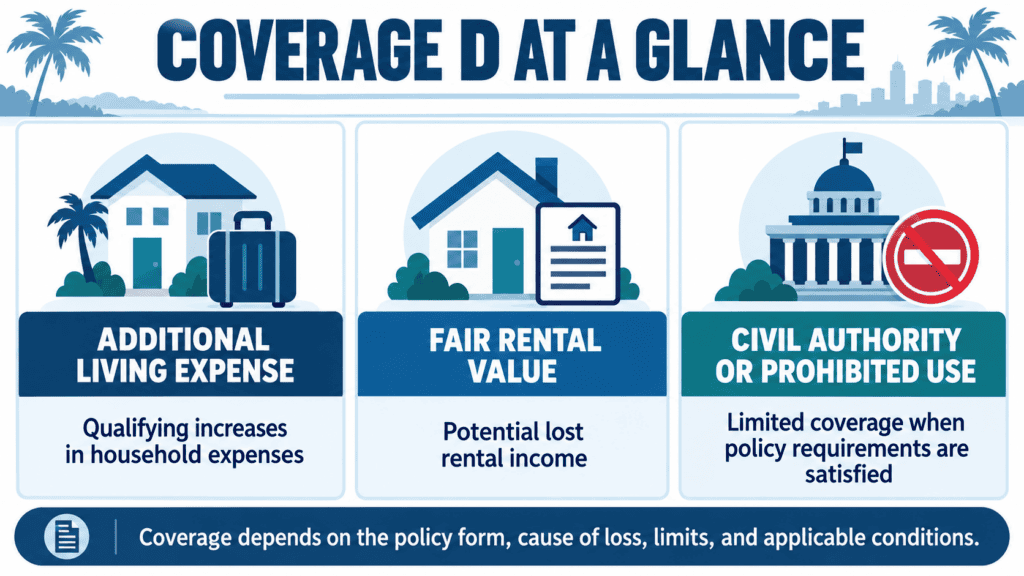
Coverage D may include Additional Living Expense, Fair Rental Value, and limited prohibited-use protection, depending on the policy form and circumstances.
Table of Contents
-
What Does Coverage D Loss of Use Mean?
-
What Are the Three Parts of Loss of Use Coverage?
-
When Does Additional Living Expense Coverage Apply?
-
What Does “Unfit to Live In” Mean?
-
Which Additional Living Expenses May Be Covered?
-
Which Expenses Are Generally Not Covered?
-
How Are Additional Living Expenses Calculated?
-
How Much Loss of Use Coverage Do You Have?
-
How Long Can Loss of Use Benefits Continue?
-
Does a Hurricane Evacuation Trigger Loss of Use Coverage?
-
How Does Loss of Use Work After Hurricane or Wind Damage?
-
What About Water Damage, Mold, and Power Outages?
-
Does Flood Insurance Pay for Temporary Housing?
-
How Does Coverage Work for Condo Owners, Renters, and Landlords?
-
What Should You Do After Being Displaced?
-
Common Loss of Use Claim Mistakes
-
Five Florida Loss of Use Examples
-
Loss of Use Coverage Review Checklist
-
Frequently Asked Questions
-
Final Thoughts
-
How First Florida Agency Can Help
-
About the Author
-
Recommended External Resources
-
Related Articles
-
Insurance Disclaimer
What Does Coverage D Loss of Use Mean?
Loss of Use coverage addresses some of the financial consequences of temporarily losing the ability to use an insured residence after a covered loss.
It serves a different purpose from the other principal homeowners coverages:
-
Coverage A generally addresses covered damage to the dwelling.
-
Coverage B generally addresses covered other structures.
-
Coverage C generally addresses covered personal property.
-
Coverage D generally addresses qualifying loss-of-use expenses.
-
Coverage E generally addresses covered personal-liability claims.
-
Coverage F generally addresses certain medical expenses incurred by others.
Coverage D does not pay to repair the house or replace damaged belongings. Instead, it may help with temporary living expenses or qualifying lost rental value while covered damage is repaired.
The policy’s declarations page may show the Coverage D limit as a percentage of dwelling coverage, a fixed dollar amount, or another policy-specific limit. Renters, condominium, dwelling-fire, and specialized residential policies may calculate or describe the coverage differently.
The term “loss of use” is broader than “hotel coverage.” A household might stay in a hotel, furnished apartment, rental house, recreational vehicle, or other reasonable accommodation. The policy may also address certain increases in meals, laundry, transportation, storage, utilities, moving expenses, or pet boarding.
Every expense must still satisfy the policy. An expense does not become covered merely because it was incurred while the homeowner was displaced.
What Are the Three Parts of Loss of Use Coverage?
Many residential policies divide loss-of-use protection into three concepts. The exact names and provisions can vary.
Additional Living Expense
Additional Living Expense, commonly abbreviated as ALE, may pay the necessary increase in living expenses incurred so the household can maintain its normal standard of living after a covered loss makes the residence unfit to live in.
The word additional is essential. ALE generally addresses the amount by which a qualifying expense exceeds what the household normally would have spent.
If a household normally spends a certain amount on groceries but must spend more on restaurant meals because a covered loss makes the kitchen unusable, the potential claim generally concerns the reasonable increase—not the household’s entire food expense.
Fair Rental Value
Fair Rental Value may apply when part of the insured residence is rented to another person and a covered loss makes that portion unfit to live in.
The benefit generally considers the fair rental value of the affected premises, reduced by expenses that do not continue while the property is uninhabitable.
It is not intended to compensate for every form of lost income. Vacancy, ordinary tenant turnover, unpaid rent, market conditions, noncovered damage, and business-related rental arrangements may be treated differently.
Prohibited Use or Civil Authority
Some policies provide limited loss-of-use coverage when a civil authority prohibits use of the residence because of direct damage to neighboring premises caused by a covered peril.
This provision may apply for a much shorter period than ordinary Additional Living Expense coverage. The government order, reason for the order, location of the damage, and cause of the neighboring damage can all affect coverage.
A mandatory evacuation order does not automatically satisfy these requirements. The policy may require actual nearby damage from a covered cause rather than a precautionary evacuation based only on a storm forecast.
When Does Additional Living Expense Coverage Apply?
A loss-of-use claim generally requires more than displacement or inconvenience. The insurance company may evaluate several questions.
Was There Physical Damage?
Many claims begin with direct physical damage to the insured residence. Examples may include a fire, wind-damaged roof, fallen tree, or sudden plumbing discharge.
A precautionary departure without qualifying property damage may not activate ordinary Additional Living Expense coverage.
Was the Cause of Damage Covered?
The event that made the residence unfit to live in generally must be covered under the policy.
For example, temporary displacement following covered fire damage may be treated differently from displacement caused by excluded flooding, long-term deterioration, unresolved maintenance, or an excluded water loss.
Is the Residence Unfit to Live In?
A home may be inconvenient or uncomfortable without necessarily being unfit to live in under the policy.
The insurance company may consider structural safety, utilities, sanitation, contamination, the extent of repairs, government orders, professional recommendations, and whether essential areas of the residence remain usable.
Were the Expenses Necessary and Reasonable?
The expense ordinarily must result from the displacement and be reasonably related to maintaining the household’s normal living standard.
A reasonable furnished apartment may qualify. A luxury vacation property significantly exceeding the household’s normal standard of living may not be approved in full.
Was the Expense Actually Incurred?
ALE is generally reimbursement-based, although an insurer may sometimes provide an advance or arrange accommodations directly.
An estimate of what lodging might cost does not necessarily create a payable expense. Receipts, invoices, proof of payment, dates, and other documentation may be required.
Is the Claim Within the Available Limit and Time Period?
Even an otherwise qualifying expense may not be payable after the applicable Coverage D limit or restoration period has been exhausted.
Coverage depends on all these factors—not simply the fact that the household left the property.
What Does “Unfit to Live In” Mean?
There is no single condition that makes every home uninhabitable for insurance purposes. The answer depends on the damage, household, policy, and available professional or government findings.
Relevant conditions might include:
-
Structural instability
-
Extensive fire or smoke damage
-
Dangerous electrical conditions
-
Significant water intrusion
-
Contamination
-
A storm-created opening exposing the interior
-
Lack of essential plumbing or sanitation
-
A covered loss affecting necessary utilities
-
Repairs that cannot be completed safely while the home is occupied
-
A building official, fire department, or other authority prohibiting occupancy
The loss of one room does not always make the entire residence unfit. However, the loss of a kitchen, only bathroom, essential electrical service, or another critical area may create a legitimate habitability issue, depending on the facts.
Household circumstances may also matter. Young children, an elderly resident, a disability, necessary medical equipment, pets, or other reasonable needs can affect which temporary arrangements are practical. Those circumstances should be communicated to the adjuster promptly.
Do not decide on your own that the home is uninhabitable and sign a lengthy rental agreement without notifying the insurance company. Ask the insurer to confirm its position, available limit, approved housing period, documentation requirements, and any advance-authorization process.
Which Additional Living Expenses May Be Covered?
The following expenses may qualify when they are necessary, reasonable, caused by covered displacement, and supported by the policy and documentation.
Temporary Housing
Potentially qualifying accommodations may include:
-
Hotel or motel charges
-
Short-term apartment rental
-
Furnished rental home
-
Reasonable application or booking fees
-
Required deposits that are not later refunded
-
Temporary furniture rental
-
Utility connection charges
-
Necessary taxes and fees associated with lodging
The insurer may consider household size, pets, accessibility, school or work location, the normal standard of living, expected repair duration, and local availability.
Increased Meal Costs
If the temporary residence does not have a usable kitchen, the household may incur increased restaurant or prepared-food expenses.
Coverage generally concerns the amount above normal grocery or meal spending. Keep itemized receipts and records showing the household’s usual food costs.
Alcohol, entertainment, unusually expensive dining, and other discretionary charges may not qualify.
Additional Transportation
A temporary residence farther from work, school, medical appointments, or other necessary destinations may create additional mileage, fuel, toll, parking, or public-transportation costs.
The potentially covered amount is generally the reasonable increase over normal transportation expenses.
Laundry and Household Services
Hotel laundry, laundromat costs, or other necessary household services may qualify when the displaced household would not otherwise have incurred them.
Moving and Storage
Reasonable expenses to move and temporarily store undamaged belongings may be considered when necessary because of covered repairs or temporary relocation.
Pet Boarding
A hotel or rental may not accept pets, or repairs may create an unsafe environment for animals. Reasonable additional pet-boarding expenses may qualify, depending on the policy and circumstances.
Other Necessary Increased Costs
Other potentially qualifying expenses can include increased utility costs, mail forwarding, rental of necessary household items, or other reasonable costs directly associated with displacement.
Approval should never be assumed. Ask the adjuster how each category will be evaluated and which records are required.
Which Expenses Are Generally Not Covered?
Loss of Use coverage is not a general household-expense account. Expenses that usually continue regardless of displacement generally are not considered additional.
Examples may include:
-
Mortgage payments
-
Property taxes
-
Homeowners association assessments
-
Homeowners insurance premiums
-
Normal grocery spending
-
Existing vehicle payments
-
Ordinary childcare expenses
-
Normal household subscriptions
-
Regular debt payments
-
Routine pet expenses
-
Optional vacations or entertainment
-
Luxury upgrades beyond the household’s normal standard of living
-
Costs unrelated to the displacement
-
Expenses incurred after the limit or approved period ends
-
Undocumented expenses
-
Repair or replacement of the damaged dwelling
-
Replacement of damaged personal property
-
Lost wages or business income
-
Expenses arising from an excluded cause of loss
Some normal expenses may decrease while the home is vacant. The insurance company may subtract those savings when calculating the actual increase in living costs.
For example, if utility costs at the damaged home decline while temporary-housing utility costs increase, the insurer may evaluate the combined net change rather than reimbursing the new utility bill in full.
How Are Additional Living Expenses Calculated?
ALE is generally based on the reasonable increase over the household’s normal expenses.
A simplified calculation is:
Qualifying temporary expense minus normal or discontinued expense equals the potential additional living expense.
The final amount remains subject to coverage, reasonableness, documentation, policy limits, and insurer review.
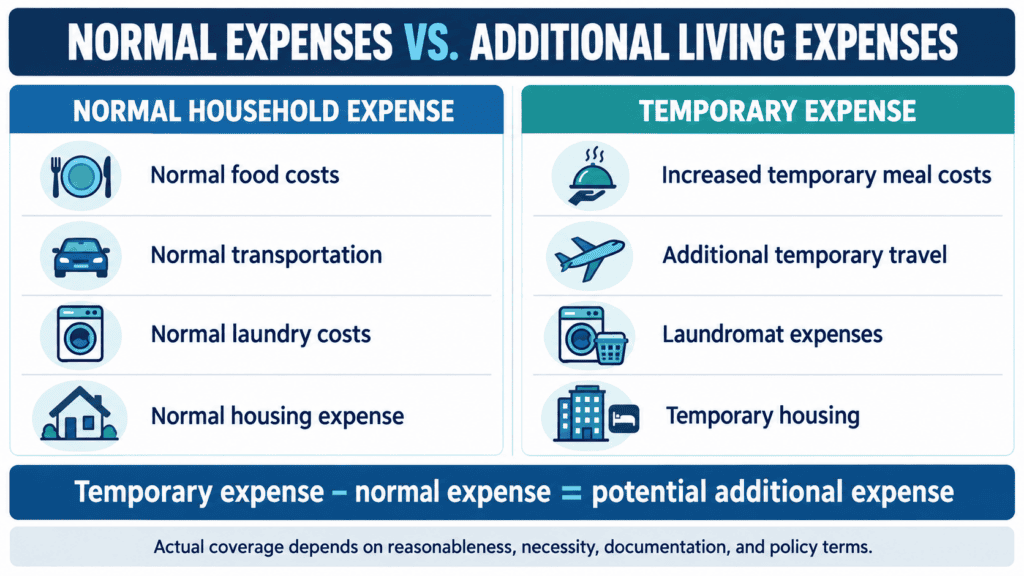
Loss of Use coverage generally addresses qualifying increases above normal household expenses—not the household’s entire temporary budget.
Example 1: Increased Meal Costs
Assume a household normally spends one thousand dollars per month on groceries.
After a covered fire makes the kitchen unusable, the household spends one thousand six hundred dollars on groceries and prepared meals.
The potential increased food expense is six hundred dollars—not the entire one thousand six hundred dollars.
Example 2: Temporary Rent
Assume the homeowner continues paying the mortgage on the damaged residence and incurs three thousand dollars for an approved temporary apartment.
Because the mortgage continues and the temporary rent is an added expense, the qualifying temporary rent may be considered as ALE, subject to the policy and insurer’s evaluation.
If the household selects a significantly more expensive rental than reasonably necessary, the insurer may dispute the difference.
Example 3: Utility Savings
Assume the household usually spends three hundred fifty dollars on monthly utilities.
While displaced, utilities at the damaged home fall to one hundred dollars, and utilities at the temporary residence total two hundred fifty dollars.
The combined expense remains three hundred fifty dollars. In this simplified example, there may be no additional utility expense even though the household received a new temporary-residence bill.
Establish Your Normal Baseline
The insurer may request records showing what the household ordinarily spent before the loss. Useful records can include:
-
Bank and credit-card statements
-
Grocery receipts
-
Utility bills
-
Commuting records
-
Toll statements
-
Childcare invoices
-
Pet-care records
-
Lease or mortgage documentation
-
Prior household budgets
Keep ordinary costs separate from additional costs. A simple spreadsheet or claim journal can make the calculation easier to understand and verify.
How Much Loss of Use Coverage Do You Have?
There is no single Coverage D limit used by every Florida homeowners policy.
A policy may express the limit as:
-
A percentage of Coverage A
-
A percentage of personal-property coverage
-
A fixed dollar amount
-
A stated time period
-
A combination of dollar and time limitations
-
Actual loss sustained for a specified period
-
A policy-specific amount modified by endorsement
The declarations page is the starting point, but it may not explain every restriction. Review the Coverage D provision, definitions, conditions, endorsements, and any separate prohibited-use limitation.
Convert the Percentage Into Dollars
If Coverage D is shown as a percentage, calculate the actual amount.
For example, if the dwelling limit is five hundred thousand dollars and Coverage D equals ten percent of that amount, the available limit would be fifty thousand dollars, subject to the policy.
That amount might sound substantial before a loss. After a widespread hurricane, however, hotel rates, furnished rentals, restaurant meals, storage, transportation, and pet accommodations can consume the limit quickly.
A Limit Is Not a Guaranteed Payment
A fifty-thousand-dollar Coverage D limit does not mean the insurer automatically pays fifty thousand dollars.
The limit is the maximum potentially available under that coverage. Payment still depends on qualifying expenses, documentation, the cause of loss, habitability, the approved restoration period, and all other policy terms.
Household Needs Matter
When evaluating the limit, consider:
-
Number of household members
-
Local temporary-housing costs
-
Pets
-
Accessibility requirements
-
School and work locations
-
Potential hurricane-related housing shortages
-
Length of time required for substantial reconstruction
-
Whether specialized medical or household equipment is needed
A limit that works for one household may be insufficient for another.
How Long Can Loss of Use Benefits Continue?
Additional Living Expense coverage commonly applies for the shortest reasonable period required to repair or replace the damaged property or, if the household permanently relocates, the shortest reasonable period required to settle elsewhere.
That does not necessarily mean benefits continue until every repair is completed.
The policy may include:
-
A maximum dollar limit
-
A maximum number of months
-
An “actual loss sustained” period
-
A shorter prohibited-use period
-
Different rules for permanent relocation
-
Conditions requiring reasonable progress toward repair or relocation
If the available dollar limit is exhausted first, payments may stop even though repairs remain incomplete. If the maximum time period expires first, unused dollars may no longer be available.
Repair Delays
Permitting, inspections, contractor availability, material shortages, mortgage-company procedures, scope disagreements, and widespread catastrophe demand can delay reconstruction.
Document these issues and update the adjuster in writing. Ask whether the insurer agrees with the anticipated restoration period and whether additional records are needed.
Coverage should not be assumed to extend automatically because a contractor is delayed. Conversely, homeowners should not assume a delay is irrelevant. The cause of the delay, policy wording, reasonableness of the repair plan, and remaining limit may all matter.
Permanent Relocation
If the household decides not to return to the damaged residence, the policy may limit ALE to the shortest reasonable time required to establish a permanent household elsewhere.
A personal decision to delay moving or wait for a preferred property may not extend the benefit.
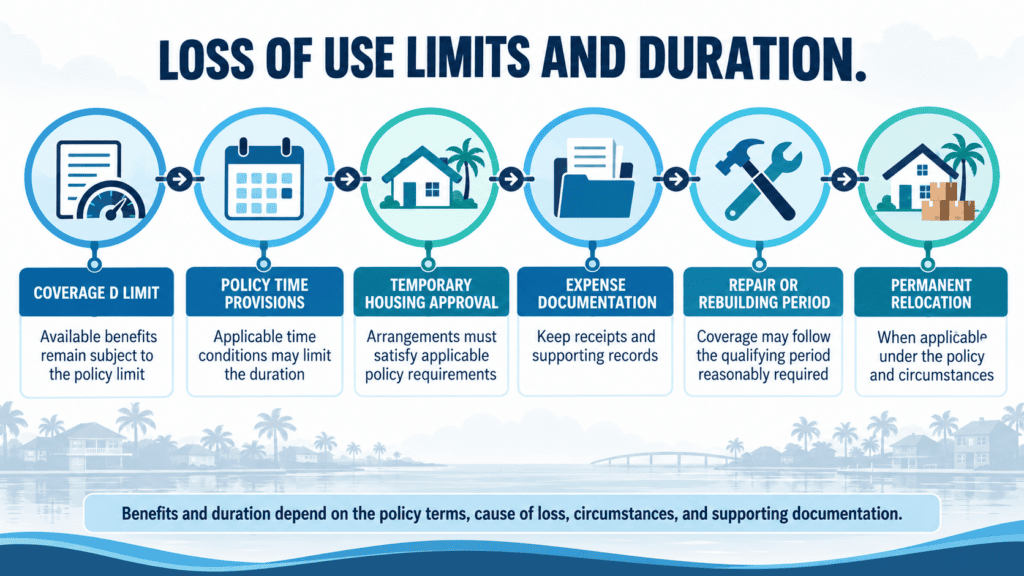
Loss of Use benefits may be constrained by the policy limit, applicable time provisions, and the qualifying period reasonably required to repair, rebuild, or relocate.
Does a Hurricane Evacuation Trigger Loss of Use Coverage?
Not automatically.
Florida residents may leave before a hurricane because of an evacuation order, storm forecast, transportation concern, medical need, or personal preference. Those are reasonable safety decisions, but they do not necessarily activate insurance coverage.
Ordinary Additional Living Expense coverage usually depends on covered damage making the residence unfit to live in.
A separate prohibited-use or civil-authority provision may apply when:
-
A civil authority prohibits use of the residence
-
The order results from qualifying damage to nearby property
-
The nearby damage was caused by a peril covered under the policy
-
The expense occurs within the provision’s limited coverage period
The exact trigger matters. A precautionary order issued before any nearby property damage may be treated differently from an order issued after covered damage makes an area inaccessible.
The Florida Department of Financial Services advises that many policies provide limited ALE when a civil authority prohibits use because of covered damage to neighboring homes. However, the duration and terms vary, and many policies restrict this protection to a relatively short period.
Before assuming evacuation lodging will be reimbursed, contact the insurer and ask:
-
Has the insurer recognized a prohibited-use event?
-
Which order or affected area qualifies?
-
What start and end dates apply?
-
Is there a daily or total limit?
-
Are meals, mileage, or pet expenses included?
-
Which receipts are required?
-
Does a deductible apply under this provision?
Personal safety should always come before coverage questions. Evacuate when instructed, then confirm the insurance details as soon as reasonably possible.
How Does Loss of Use Work After Hurricane or Wind Damage?
A hurricane can cause wind, rain, flood, storm surge, utility interruption, fallen trees, and several other types of damage during the same event.
Those causes are not necessarily insured in the same way.
Covered Wind Damage
Suppose hurricane wind damages the roof and creates an opening through which rain enters. If the homeowners or wind policy covers the loss and the resulting conditions make the residence unfit to live in, Coverage D may apply.
The insurance company will evaluate the wind damage, interior water entry, habitability, repairs, temporary expenses, deductible, and applicable limits.
Excluded or Separately Insured Wind
Some Florida properties have a homeowners policy that excludes windstorm coverage and a separate wind policy. Others may have specialized coverage arrangements.
Do not assume one policy will address the dwelling damage and temporary living expenses. Report the claim under every potentially applicable policy and ask which policy provides loss-of-use protection.
Hurricane Deductible
The underlying property claim may be subject to a hurricane deductible calculated from the dwelling limit.
Coverage D does not erase that deductible. The way the deductible applies to the overall Section I claim and any separate treatment of prohibited-use benefits depends on the policy.
For a detailed explanation of percentage deductibles, hurricane duration, multiple storms, and out-of-pocket responsibility, read Florida Hurricane Deductibles Explained.
What About Water Damage, Mold, and Power Outages?
Sudden Water Damage
A sudden and accidental plumbing discharge, appliance overflow, or similar covered water event may make part or all of a home unfit to occupy.
If the underlying water loss is covered, loss-of-use protection may help with qualifying temporary expenses while covered repairs are completed.
Long-term leakage, repeated seepage, maintenance conditions, deterioration, and excluded water sources may be treated differently. For more information about how the source and duration of water affect coverage, read Water Damage and Homeowners Insurance in Florida.
Mold
Mold coverage often depends on the moisture source, the policy’s mold limitations, and whether the mold resulted from a covered water loss.
Temporary relocation may become necessary during testing, containment, removal, or reconstruction. However, ALE should not be assumed merely because mold is present. The underlying cause, habitability, remediation plan, mold sublimit, and loss-of-use provisions all matter.
For a detailed explanation of covered water events, long-term moisture, assessment, remediation, and policy limits, read Mold Coverage in Florida Home Insurance.
Power Outages
A neighborhood-wide power outage without covered physical damage to the residence may not activate Loss of Use coverage.
The outcome may be different when covered damage at the insured home interrupts essential electrical service or when a utility-service endorsement applies. Food spoilage, equipment breakdown, off-premises utility interruption, and temporary housing can have separate coverage requirements.
Ask the insurer to identify the applicable coverage rather than assuming every extended outage creates an ALE claim.
Does Flood Insurance Pay for Temporary Housing?
Standard homeowners insurance generally excludes flooding caused by rising surface water, storm surge, overflowing waterways, or widespread water accumulation.
That means Coverage D under a homeowners policy generally will not pay temporary living expenses when an excluded flood is the sole cause of displacement.
National Flood Insurance Program
The National Flood Insurance Program’s Standard Flood Insurance Policy does not provide Additional Living Expense coverage.
An NFIP policy may help with qualifying covered flood damage to the building or personal property, but it generally does not pay for a hotel, temporary apartment, increased meals, or other displacement expenses.
Private Flood Insurance
Some private flood policies may offer Additional Living Expense coverage or an optional benefit for temporary housing. Others do not.
Review:
-
Whether ALE is included
-
The available dollar limit
-
Any waiting period
-
Covered flood definition
-
Required habitability determination
-
Time limitation
-
Deductible
-
Whether building and contents coverage must also be purchased
-
Whether the benefit is included or optional
Wind and Flood During the Same Storm
A hurricane can cause covered wind damage and excluded or separately insured flood damage at the same property.
Report:
-
Wind damage to the homeowners or wind insurer
-
Flood damage to the flood insurer
-
Vehicle flood damage to the auto insurer when comprehensive coverage applies
Photograph roof and exterior damage, interior rain paths, water lines, debris patterns, and ground-level flooding when it is safe.
Do not assume the flood insurer will pay ALE or that the homeowners insurer will pay all displacement costs merely because some wind damage occurred. Each company will evaluate which cause made the residence unfit and how its policy applies.
For more information about storm surge, rising water, the NFIP, private flood policies, waiting periods, and available coverage, read our Florida Flood Insurance Guide.

Wind and flood damage can occur during the same hurricane, but temporary-living expenses may be handled differently. Coverage depends on the cause of loss and the applicable policy terms.
FEMA Disaster Assistance
FEMA assistance is separate from homeowners and flood insurance. It requires an eligible federal disaster declaration, application, verification, and satisfaction of program requirements.
Assistance is not guaranteed, does not replace insurance, cannot duplicate benefits available from another source, and may not compensate the household for its entire loss.
How Does Coverage Work for Condo Owners, Renters, and Landlords?
Loss-of-use protection is not limited to traditional homeowners policies, but the policy structure and limit may differ.

Homeowners, condo, renters, and landlord policies may address displacement and lost rental value differently. Coverage depends on the applicable policy form and endorsements.
Condominium Unit Owners
A condominium association’s master policy generally protects association-insured property. Unit owners should not assume that the master policy pays their personal temporary living expenses.
An individual condominium unit-owner policy may include Additional Living Expense and Fair Rental Value coverage. Coverage depends on the HO-6 policy, the cause of damage, responsibility for repairs, master-policy coordination, and applicable limits.
Repair delays involving both the association and unit owner can complicate the restoration period. Keep written records showing which party is responsible for each portion of the work.
Renters
A renters policy may provide Loss of Use coverage when a covered loss makes the rented residence unfit to live in.
The landlord’s property policy generally does not replace the tenant’s renters insurance. A tenant should review the HO-4 policy’s ALE limit, qualifying expenses, prohibited-use provision, and claim procedures.
Landlords
A landlord or dwelling policy may include Fair Rental Value or loss-of-rents coverage rather than the same ALE protection available to an owner occupant.
The benefit may address qualifying lost rental value during the shortest reasonable restoration period, reduced by expenses that do not continue.
It generally does not insure every missed rent payment, ordinary vacancy, tenant dispute, lease cancellation, or loss caused by an excluded event.
Mixed-Use and Short-Term Rentals
Home-sharing, short-term rental, seasonal occupancy, or business use can create additional restrictions.
Disclose the actual occupancy and rental arrangement to the insurance company. A homeowners form written for an owner-occupied residence may not properly insure a property used primarily as a rental or lodging business.
What Should You Do After Being Displaced?
1. Protect People First
Leave immediately if the property is unsafe. Follow instructions from emergency officials, the fire department, building officials, utility companies, or other authorities.
Do not enter a damaged structure solely to obtain photographs or receipts.
2. Report the Property Claim Promptly
Contact the insurance company and describe:
-
What happened
-
When it occurred
-
Known damage
-
Whether the home is currently occupied
-
Why it may be unsafe or unusable
-
Where the household can be reached
-
Which emergency measures have been taken
You do not need a final repair estimate before reporting the loss.
3. Ask Specifically About Loss of Use
Do not assume the property adjuster will automatically explain every Coverage D requirement.
Ask:
-
Has the insurer determined that the residence is unfit to live in?
-
What Coverage D limit is available?
-
Which expenses are eligible?
-
Is advance approval required?
-
What temporary-housing amount is considered reasonable?
-
How long is currently authorized?
-
How should receipts be submitted?
-
Can the insurer provide an advance?
-
Will a temporary-housing vendor be used?
-
How often will payments be issued?
-
Which normal expenses will be deducted?
-
How will the remaining limit be tracked?
Request written confirmation when possible.
4. Document the Condition of the Home
When safe, photograph and record:
-
Structural damage
-
Roof and exterior damage
-
Water entry
-
Fire and smoke damage
-
Affected rooms
-
Utility conditions
-
Temporary repairs
-
Government notices
-
Contractor or mitigation findings
Documentation helps establish why the residence could not be occupied and how long repairs reasonably may take.
5. Establish Normal Household Expenses
Gather several months of pre-loss records showing normal spending for food, utilities, transportation, laundry, pet care, and other relevant categories.
These records help distinguish ordinary expenses from increases caused by displacement.
6. Keep Itemized Receipts
A credit-card total may not show what was purchased. Keep itemized receipts, invoices, rental agreements, booking confirmations, bank records, and proof of payment.
A useful recordkeeping system includes:
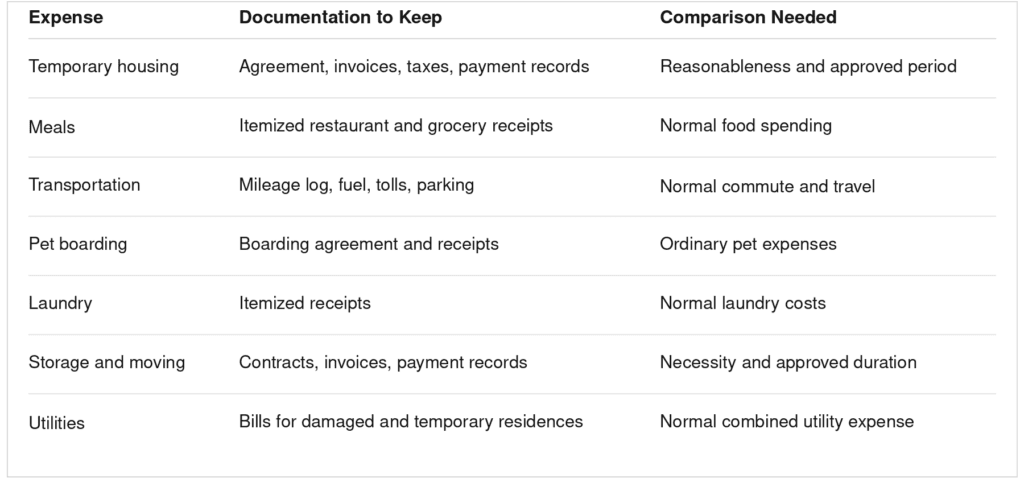
Organized records can help distinguish normal household expenses from qualifying additional living expenses after a covered loss.
7. Submit Expenses Regularly
Do not wait until the end of the claim to submit months of undocumented expenses.
Regular submissions can identify disputed categories early and help the household monitor the remaining limit.
8. Track the Repair Schedule and Remaining Limit
Maintain a timeline of:
-
Inspections
-
Mitigation
-
Estimates
-
Permits
-
Contractor selection
-
Material orders
-
Mortgage-company requirements
-
Repair start dates
-
Expected completion
-
Causes of delay
-
Temporary-housing extensions
-
ALE payments
-
Remaining Coverage D amount
Notify the insurer promptly when the repair timeline changes.
For a complete explanation of documentation, emergency repairs, insurance adjusters, claim payments, and supplemental claims, read our Florida Home Insurance Claim Guide.
Common Loss of Use Claim Mistakes
Assuming Every Disaster Triggers Coverage
A named hurricane, emergency declaration, or neighborhood evacuation does not independently establish coverage. The cause of loss and policy requirements control.
Booking Long-Term Housing Without Approval
A homeowner may select a rental that exceeds the insurer’s approved cost, duration, location, or standard.
Discuss the proposed arrangement before signing a lengthy lease whenever possible.
Saving Only Credit-Card Statements
A statement proves that a payment occurred but may not show the expense category, items purchased, dates, people served, taxes, tips, refunds, or alcohol charges.
Keep itemized receipts.
Claiming the Entire Cost Instead of the Increase
ALE generally concerns increased expenses. Normal grocery, transportation, utility, and household expenses may need to be deducted.
Failing to Report Savings
If an expense stops while the home is unoccupied, the insurer may consider that savings when calculating the net increase.
Provide accurate information rather than allowing a later reconciliation to delay the claim.
Confusing Flood and Wind Coverage
Wind and flood damage from the same storm can require different policies and separate claims. NFIP flood insurance generally does not include ALE.
Ignoring the Coverage D Limit
Temporary expenses can exhaust the limit before reconstruction is complete. Track every payment and request the remaining balance periodically.
Assuming Contractor Delays Automatically Extend Coverage
The policy’s dollar and time limitations still apply. Document delays, act reasonably, and communicate with the insurer.
Failing to Explain Household Needs
Pets, accessibility, school transportation, work location, medical equipment, and household size can affect reasonable temporary-housing needs.
Provide this information early.
Discarding Relevant Documents
Keep government notices, inspection reports, repair estimates, hotel records, leases, receipts, emails, texts, claim letters, and proof of every expense submitted.
Five Florida Loss of Use Examples
These examples are simplified and do not determine coverage for an actual claim.
Example 1: Hurricane Wind Creates a Roof Opening
Hurricane wind damages the roof, and rain enters through the storm-created opening. The electrical system and several rooms are unsafe, requiring the family to relocate.
If the wind and resulting interior damage are covered, ALE may help with reasonable temporary housing and increased living costs, subject to the hurricane deductible, Coverage D limit, restoration period, and other policy terms.
Example 2: Storm Surge Enters at Ground Level
Storm surge enters a coastal residence and makes it uninhabitable.
Standard homeowners insurance generally excludes the flood damage. An NFIP policy may address qualifying building or contents damage but generally will not pay ALE. A private flood policy may provide temporary-living protection if that benefit is included.
Example 3: A Supply Line Suddenly Ruptures
A plumbing supply line suddenly ruptures and damages the kitchen, flooring, and electrical components. Mitigation and reconstruction make the residence temporarily unusable.
If the water loss is covered and the home is considered unfit to live in, Coverage D may help with qualifying additional expenses.
The result could be different if the damage developed from long-term leakage, deterioration, or another excluded condition.
Example 4: The Family Evacuates Before a Hurricane
A family leaves before landfall because of a precautionary evacuation order. The storm changes course, the neighborhood is undamaged, and the family returns two days later.
The hotel and meal expenses may not qualify because there was no covered damage making the home unfit and the policy’s prohibited-use requirements may not have been satisfied.
The decision to evacuate still may have been prudent for safety.
Example 5: A Covered Fire Affects a Rented Apartment
A covered fire makes part of an owner-occupied home that was rented to a tenant uninhabitable.
Depending on the policy and rental arrangement, Fair Rental Value coverage may address qualifying lost rental value, less expenses that do not continue. The owner’s personal ALE and the tenant’s renters-policy ALE would be evaluated separately.
Loss of Use Coverage Review Checklist
Review these items before a disaster:
-
Locate the Coverage D limit on the declarations page.
-
Convert any percentage into an actual dollar amount.
-
Read the Additional Living Expense provision.
-
Read the Fair Rental Value provision.
-
Read the prohibited-use or civil-authority provision.
-
Identify applicable time limitations.
-
Determine whether wind or hurricane coverage is included.
-
Review hurricane and all-other-perils deductibles.
-
Confirm how off-premises utility interruption is treated.
-
Review water, mold, seepage, and repeated-leakage limitations.
-
Determine whether a separate flood policy provides ALE.
-
Confirm how condo, rental, seasonal, or short-term-rental occupancy affects coverage.
-
Consider temporary-housing costs for the entire household.
-
Account for pets and accessibility requirements.
-
Maintain a current home inventory.
-
Store policy and claim-contact information electronically.
-
Preserve several months of normal household-expense records.
-
Keep an emergency fund for expenses awaiting reimbursement.
-
Review the policy annually and after a move, renovation, occupancy change, or household change.
The objective is not merely to know that Coverage D appears on the policy. It is to understand how much is available, what activates it, which expenses qualify, and how long it can last.
Frequently Asked Questions
Is Loss of Use coverage the same as Additional Living Expense coverage?
Not exactly.
Additional Living Expense is commonly one component of broader Loss of Use coverage. Coverage D may also include Fair Rental Value and limited prohibited-use or civil-authority coverage.
Does homeowners insurance pay for a hotel after a disaster?
It may when a covered loss makes the insured residence unfit to live in and the hotel expense is necessary and reasonable.
A hotel is not automatically covered after every storm, evacuation, power outage, flood, or emergency declaration.
Does Loss of Use coverage pay for a temporary apartment or rental house?
It may. The insurer may consider household size, normal living standard, expected repair duration, pets, accessibility, school and work locations, local availability, and cost.
Obtain approval before signing a long-term agreement whenever possible.
Does ALE pay the full cost of restaurant meals?
Usually not. ALE generally addresses the reasonable increase above the household’s normal food expense.
If restaurant and grocery spending totals one thousand six hundred dollars but the household normally spends one thousand dollars, the potential additional expense is six hundred dollars, subject to the policy and insurer’s review.
Does Loss of Use coverage pay the mortgage?
A mortgage payment generally is not an additional expense because it would have continued without the loss.
Temporary rent may qualify as an added expense while the mortgage continues, subject to coverage and reasonableness.
Does a mandatory evacuation automatically activate ALE?
No. A prohibited-use provision may require a civil authority to prohibit access because of covered damage to neighboring premises.
A precautionary evacuation issued before damage occurs may not satisfy the policy’s trigger.
Does homeowners insurance pay temporary living expenses after a flood?
Standard homeowners insurance generally does not cover rising surface water or storm surge. Consequently, Coverage D under a homeowners policy generally does not pay when excluded flooding is the sole cause of displacement.
Does an NFIP flood policy pay for a hotel?
No. The NFIP Standard Flood Insurance Policy generally does not provide Additional Living Expense coverage.
Some private flood policies may provide ALE, depending on the form and options selected.
How much Loss of Use coverage should I have?
There is no universal amount appropriate for every household.
Evaluate the actual dollar limit, local temporary-housing costs, household size, pets, accessibility, catastrophe-related shortages, and the potential time required for major reconstruction.
How long will Additional Living Expense coverage pay?
Coverage commonly applies for the shortest reasonable period required to repair or replace covered damage or, if the household permanently relocates, the shortest reasonable period needed to settle elsewhere.
The policy may also impose a dollar limit, maximum time period, or both.
Can I use an Airbnb or vacation rental?
Possibly, if the accommodation is necessary, reasonable, permitted by the policy, and approved by the insurer.
The insurer may limit reimbursement to the cost of reasonably comparable temporary housing.
Are pet-boarding expenses covered?
Reasonable additional pet-boarding expenses may qualify when temporary accommodations cannot accept the household’s animals or repairs create an unsafe environment.
Ordinary pet expenses generally do not become covered merely because a claim occurred.
Do I need receipts for Additional Living Expenses?
Yes, receipts and other documentation are normally essential.
Keep itemized receipts, invoices, leases, booking confirmations, mileage records, proof of payment, and records of normal pre-loss expenses.
Does Coverage D have its own deductible?
Do not assume that every policy handles deductibles identically.
The underlying Section I property claim may be subject to a hurricane, windstorm, or all-other-perils deductible. Some prohibited-use benefits may be treated differently. Ask the insurer to explain in writing how the deductible applies.
What happens if repairs take longer than expected?
Notify the adjuster, document the reason, provide an updated construction schedule, and request written confirmation of any extension.
The Coverage D dollar limit and policy time restrictions may still apply even when repairs are delayed.
Can a landlord claim lost rent under Coverage D?
A qualifying residential policy may include Fair Rental Value coverage when covered damage makes an insured rental portion unfit to live in.
Payment generally is limited to the applicable restoration period and reduced by expenses that do not continue. Ordinary vacancy, nonpayment, or excluded damage is not automatically covered.
Does FEMA replace homeowners Loss of Use coverage?
No. FEMA assistance is not a substitute for insurance, is available only after qualifying declarations and approvals, cannot duplicate other benefits, and may not cover the household’s complete loss.
Final Thoughts
Loss of Use coverage can become one of the most immediately valuable parts of a Florida homeowners policy after a serious covered loss.
Repairing the home may take months. During that time, a displaced household may incur temporary rent, hotel charges, increased meals, storage, laundry, transportation, utility, moving, and pet expenses.
Whether those costs are paid depends on much more than the word “disaster.” Homeowners should understand:
-
Which causes of loss are covered
-
What makes the residence unfit to live in
-
Which expenses qualify
-
How increases are calculated
-
Which documentation is required
-
How much Coverage D is available
-
How long benefits may continue
-
Whether wind and flood require separate policies
-
Whether private flood coverage includes ALE
Reviewing these details before a hurricane, fire, or major water loss is far easier than discovering a restrictive limit after the household has already been displaced.
How First Florida Agency Can Help
First Florida Agency helps Florida homeowners evaluate Loss of Use coverage as part of a complete homeowners-insurance review.
We can help review:
-
Coverage D limits
-
Additional Living Expense provisions
-
Fair Rental Value
-
Prohibited-use or civil-authority coverage
-
Hurricane and windstorm protection
-
Deductibles
-
Water and mold limitations
-
Condominium and renters coverage
-
Landlord and dwelling-fire policies
-
NFIP and private flood options
-
Private flood ALE benefits
-
Policy exclusions and endorsements
As an independent insurance agency, we can compare available options from multiple insurance companies and help explain how the policies work together.
First Florida Agency serves homeowners throughout Florida, with local knowledge of Nocatee, Ponte Vedra, Ponte Vedra Beach, Jacksonville, St. Augustine, St. Johns County, and surrounding Northeast Florida communities.

First Florida Agency provides local homeowners-insurance service in Northeast Florida and assists homeowners throughout the state.
Request a Florida homeowners insurance quote or call First Florida Agency at 904-822-8800.
About the Author
John Closterides is the Founder and Principal Agent of First Florida Agency, an independent insurance agency serving homeowners, families, and businesses throughout Florida.
John is a Florida-licensed 2-20 General Lines insurance agent with more than a decade of insurance-industry experience. He specializes in homeowners, flood, auto, umbrella, and commercial insurance and helps clients evaluate coverage, exclusions, deductibles, and available insurance options.
Based in Ponte Vedra and serving Nocatee and communities throughout Florida, John is committed to providing clear, practical insurance education so homeowners can make informed decisions before a loss occurs.
Recommended External Resources
-
Florida Department of Financial Services: Homeowners Insurance Overview
-
Florida Department of Financial Services: Homeowners’ Insurance Toolkit
Related Articles
Continue learning about Florida homeowners insurance, disasters, water damage, flooding, and claims with these First Florida Agency guides:
Insurance Disclaimer
The information in this article is provided for general educational purposes only. It is not intended as individualized insurance, legal, financial, tax, construction, remediation, disaster-recovery, or claims advice.
Insurance coverage, eligibility, premiums, deductibles, limits, sublimits, exclusions, endorsements, definitions, restoration periods, habitability determinations, documentation requirements, claim decisions, and availability vary by insurance company, policy form, property, occupancy, cause of loss, location, and individual circumstances.
Government programs, disaster declarations, laws, regulations, insurance-company guidelines, and policy forms may change. Current requirements should be confirmed with the appropriate insurance company, government agency, and qualified professional.
Examples in this article are simplified and illustrative only. They do not establish that coverage applies to a particular loss or expense. No coverage is created, bound, extended, or modified by this article, a website submission, an insurance proposal, or a general description of coverage.
The declarations, coverage forms, definitions, conditions, exclusions, endorsements, and other terms of the issued insurance policy control. Coverage cannot be confirmed without reviewing the actual policy and facts of the loss.