
Last Updated: September 17, 2026
When Florida homeowners compare insurance policies, two terms can have an enormous effect on what happens after a covered loss: Actual Cash Value (ACV) and Replacement Cost Value (RCV).
The difference can determine whether an insurance settlement reflects the current cost to repair or replace damaged property or whether depreciation is deducted because of the property’s age, condition, or remaining useful life.
That difference may affect a roof, furniture, appliances, electronics, personal belongings, other structures, and, depending on the policy, portions of the home itself.
A policy with a lower premium may sometimes contain more restrictive loss-settlement provisions. Two homeowners policies with similar coverage limits can therefore produce very different claim outcomes.
Understanding ACV and replacement cost before a loss occurs is one of the most important parts of comparing Florida homeowners insurance.
For a broader explanation of dwelling limits and why the amount used to insure a home may differ from its real-estate value, read Replacement Cost vs. Market Value in Florida.
Quick Answer: What Is the Difference Between ACV and Replacement Cost?
Replacement Cost Value generally reflects the cost to repair or replace covered damaged property with materials or property of similar kind and quality without deducting for depreciation, subject to the policy’s limits and terms.
Actual Cash Value generally reflects the cost to repair or replace covered damaged property after depreciation is deducted.
Florida’s Department of Financial Services explains that actual cash value generally reflects replacement cost after depreciation, while replacement-cost coverage is based on replacing an item without that depreciation reduction.
For example, suppose covered property would cost $20,000 to replace today and $8,000 of depreciation applies.
Replacement Cost Value: $20,000
Depreciation: $8,000
Actual Cash Value: $12,000
This is a simplified example. Actual claim payments can also be affected by deductibles, policy limits, exclusions, endorsements, the cause of loss, depreciation methodology, claim-payment procedures, and other policy conditions.
Key Takeaways: ACV vs. Replacement Cost in Florida
-
Actual Cash Value generally deducts depreciation from the cost of repairing or replacing covered damaged property.
-
Replacement Cost Value generally provides broader protection because qualifying depreciation may not be permanently deducted when applicable policy requirements are satisfied.
-
A Florida home can have replacement-cost dwelling coverage while the roof is settled differently, including under ACV or another roof-settlement provision.
-
Personal property may be insured differently from the dwelling, so homeowners should review Coverage C separately.
-
Replacement cost does not mean unlimited coverage. Policy limits, deductibles, exclusions, and conditions still apply.
-
Recoverable depreciation may be paid later as qualifying repairs or replacement are completed and expenses are incurred.
-
Two policies with similar Coverage A limits can produce very different financial results after the same covered loss.
Not sure whether your dwelling, roof, or personal property is insured on an ACV or replacement-cost basis? First Florida Agency can help review your Florida homeowners policy before a loss occurs. Call 904-822-8800 or request a policy review online.
ACV vs. Replacement Cost at a Glance
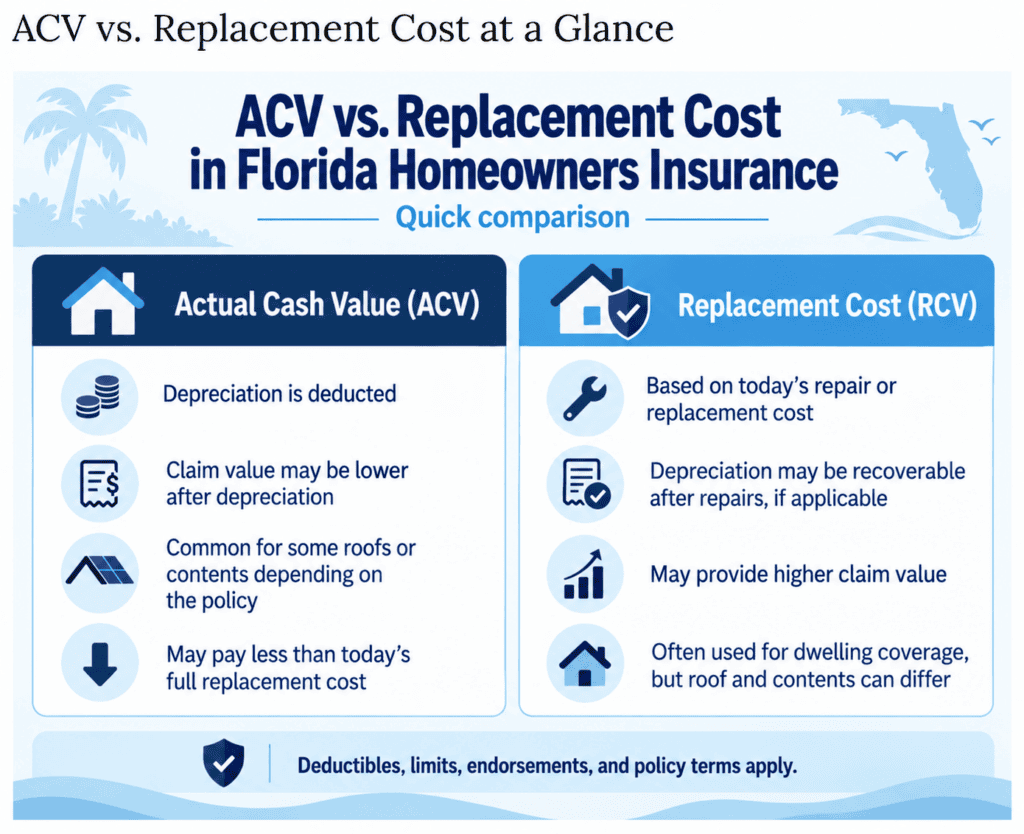
Actual Cash Value and Replacement Cost can produce very different claim outcomes. ACV generally reflects depreciation, while replacement-cost coverage may provide additional payment when qualifying repairs or replacement are completed, subject to the policy’s deductibles, limits, endorsements, and other terms.
Actual Cash Value
Actual Cash Value generally:
-
Accounts for depreciation
-
May result in a lower claim valuation for older property
-
Can apply differently to roofs, personal property, or other insured property
-
Does not necessarily mean the property is uninsured
-
Remains subject to the deductible, policy limits, exclusions, and other provisions
Replacement Cost Value
Replacement Cost Value generally:
-
Focuses on the current reasonable cost to repair or replace covered damaged property
-
Does not permanently deduct qualifying depreciation when applicable replacement-cost requirements are satisfied
-
May involve an initial ACV payment followed by additional payments as repairs are performed
-
Does not automatically pay for upgrades or improvements
-
Does not eliminate deductibles, limits, exclusions, or other policy provisions
The exact loss-settlement method can differ by insurer, policy form, endorsement, property type, and cause of loss.
What Is Replacement Cost Value in Homeowners Insurance?
Replacement Cost Value, commonly abbreviated RCV, generally refers to the cost of repairing or replacing covered damaged property with property of similar kind and quality at current prices without reducing the value solely because the damaged property was older.
Suppose a covered fire destroys kitchen cabinets that were installed 15 years ago.
If comparable cabinets cost $30,000 to replace today, replacement-cost coverage generally looks toward the reasonable current cost of replacing the covered damaged cabinets rather than paying only what the 15-year-old cabinets were worth immediately before the fire.
Replacement-cost coverage does not automatically mean:
-
The insurance company will pay any amount requested by a contractor
-
The homeowner can upgrade to substantially better materials at the insurer’s expense
-
Coverage is unlimited
-
Every type of property under the policy is settled at replacement cost
-
The policy will pay more than the applicable coverage limit
-
Excluded damage becomes covered
-
Deductibles no longer apply
-
Building-code upgrades are automatically included without regard to Ordinance or Law Coverage
-
The entire replacement-cost amount will necessarily be paid immediately
The policy still controls.
Coverage limits, deductibles, exclusions, endorsements, reasonable repair costs, claim procedures, and other provisions can all affect the amount payable.
What Is Actual Cash Value?
Actual Cash Value, commonly abbreviated ACV, generally accounts for depreciation.
A simple way to understand the concept is:
Replacement cost minus applicable depreciation = actual cash value.
Depreciation reflects the reduction in value associated with factors such as:
-
Age
-
Condition
-
Wear and tear
-
Remaining useful life
-
Obsolescence
-
Physical deterioration
Florida consumer guidance describes ACV as replacement cost after a reduction for depreciation.
For example, imagine that a covered loss destroys an appliance that would cost $4,000 to replace today.
If $1,500 of depreciation applies, the simplified comparison would be:
Replacement Cost Value: $4,000
Actual Cash Value: $2,500
The actual calculation may vary by insurer, policy, type of property, and facts of the claim.
What Is Depreciation in an Insurance Claim?
Depreciation is the reduction in value assigned to property because it is no longer new.
Age can be important, but it may not be the only consideration.
Depending on the policy, property, and adjustment method, factors can include:
-
Age
-
Pre-loss condition
-
Expected useful life
-
Remaining useful life
-
Maintenance
-
Physical deterioration
-
Type and quality of the property
Homeowners should be cautious about assuming that a generic online depreciation calculator can predict an actual insurance claim.
Two items of the same age can be in very different condition.
For example, one roof may have been professionally installed, well maintained, and kept clear of damaging debris, while another roof of the same age may have experienced deterioration or prior repairs.
The applicable policy and claim facts determine how the loss is evaluated.
Actual Cash Value vs. Replacement Cost: A Simple Florida Home Example
Consider a covered kitchen fire that damages flooring, cabinetry, appliances, and personal property.
Assume the reasonable cost of repairing or replacing the covered damaged property is $60,000 and that $15,000 of depreciation applies.
The simplified values would be:
Replacement Cost Value: $60,000
Depreciation: $15,000
Actual Cash Value: $45,000
If applicable property is insured on a replacement-cost basis, qualifying additional amounts may become payable as repair or replacement requirements are satisfied.
That is very different from an ACV-only settlement in which the applicable depreciation may remain deducted.
Does Florida Law Require Insurers to Offer Replacement-Cost Coverage?
Florida law contains important requirements involving replacement-cost coverage for qualifying homeowners policies.
Florida Statute §627.7011 generally requires an insurer, before issuing a homeowners policy subject to the statute, to offer a policy or endorsement under which qualifying repaired or replaced dwelling losses are adjusted on a replacement-cost basis, subject to policy limits and other provisions.
That does not mean every category of property under every Florida insurance policy is automatically insured at replacement cost.
Different provisions may apply to:
-
The dwelling
-
The roof
-
Other structures
-
Personal property
-
Screened enclosures
-
Fences
-
Outdoor property
-
Specialty property
Florida’s Office of the Insurance Consumer Advocate recommends asking specifically whether a homeowners policy provides replacement cost or actual cash value.
The declarations page, policy forms, endorsements, and loss-settlement provisions should all be reviewed.
How Are Replacement-Cost Dwelling Claims Paid in Florida?
Replacement-cost coverage does not necessarily mean the insurer pays the entire replacement cost immediately after a loss.
For a qualifying dwelling insured on a replacement-cost basis, Florida Statute §627.7011 provides that the insurer must initially pay at least the actual cash value of the insured loss, less the applicable deductible. Remaining amounts necessary to perform qualifying repairs are paid as work is performed and expenses are incurred.
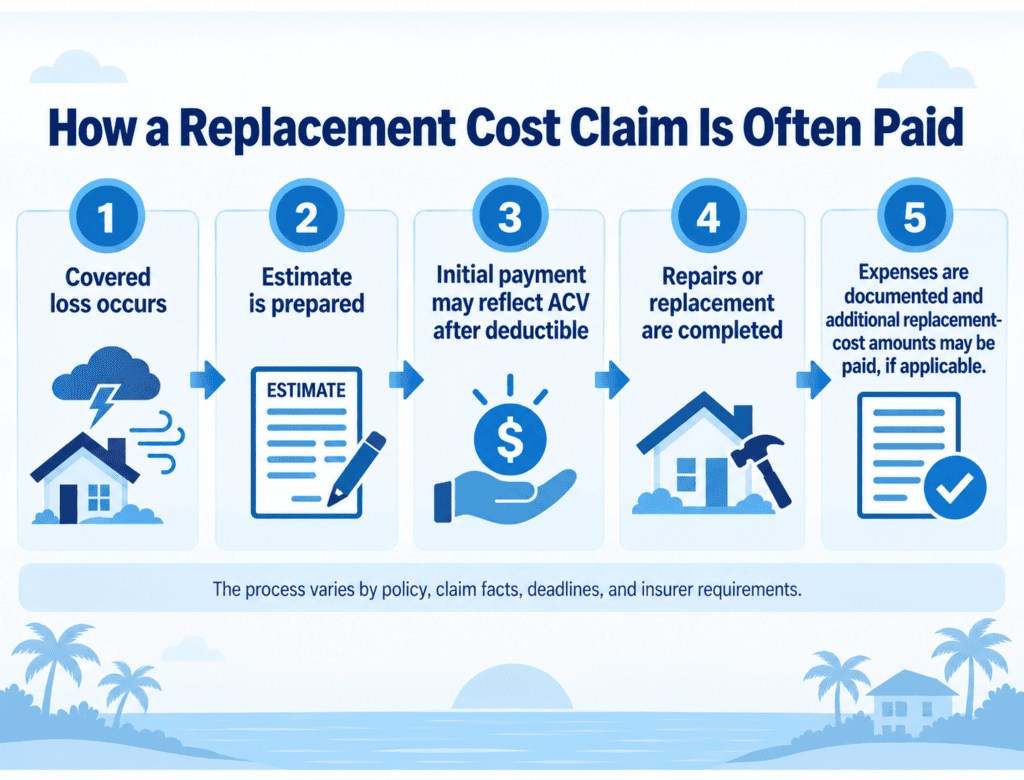
Replacement-cost claims are often paid in stages rather than all at once. In many cases, the insurer first issues an initial payment based on the claim estimate and applicable policy terms, and additional amounts may be paid after repairs or replacement are completed and required documentation is submitted, if recoverable depreciation applies.
Consider a simplified example:
Covered replacement-cost damage: $100,000
Actual Cash Value after depreciation: $75,000
Depreciation difference: $25,000
Applicable deductible: $5,000
The initial claim payment may reflect the ACV amount after application of the deductible, with qualifying additional replacement-cost amounts becoming payable as repairs are completed and expenses are documented.
The exact claim calculation depends on the policy and circumstances.
Homeowners should carefully review:
-
The insurer’s estimate
-
Depreciation calculations
-
Applicable deductible
-
Contractor estimates
-
Repair invoices
-
Proof of completed work
-
Supplemental claim procedures
-
Applicable deadlines
-
Policy limits
-
Mortgage-company requirements
For a more complete discussion of documenting and handling a homeowners claim, read Florida Home Insurance Claim Guide (2026).
What Is Recoverable Depreciation?
Recoverable depreciation generally refers to depreciation that may become payable under qualifying replacement-cost coverage after applicable repair or replacement requirements are satisfied.
Consider covered property with:
Replacement Cost Value: $25,000
Initial Actual Cash Value: $18,000
The difference is:
$7,000
Depending on the policy and the insured’s actual repair or replacement expenses, some or all of that difference may become payable after qualifying requirements are satisfied.
Recoverable depreciation is not an additional coverage limit.
It is part of the loss-settlement process.
What May Be Required to Recover Depreciation?
Depending on the policy and claim, a homeowner may need to:
-
Complete qualifying repairs or replacement
-
Submit invoices, receipts, or other documentation
-
Show the actual cost incurred
-
Follow the insurer’s supplemental-payment procedures
-
Meet applicable deadlines and policy conditions
Homeowners should ask the insurer what documentation is required rather than assuming additional amounts will be released automatically.
Is Depreciation Always Recoverable?
No.
Whether depreciation can be recovered depends on the type of coverage and applicable policy provisions.
If property is insured strictly on an actual-cash-value basis, depreciation generally remains part of the settlement calculation.
Even where replacement-cost coverage applies, additional payment may depend on satisfying repair, replacement, documentation, expense, and timing requirements.
Homeowners should determine:
-
Which property is insured at replacement cost
-
Which property is insured at ACV
-
Whether depreciation may be recoverable
-
What documentation is required
-
Whether actual repair or replacement expenses limit the final payment
-
What deadlines or policy conditions apply
What Happens if You Do Not Repair or Replace the Damaged Dwelling?
Replacement-cost coverage is designed around repairing or replacing covered damaged property.
If the homeowner chooses not to perform repairs or replacement, the full replacement-cost amount may not necessarily become payable.
For qualifying Florida dwelling claims under §627.7011, remaining replacement-cost amounts generally become payable as qualifying work is performed and expenses are incurred.
Homeowners considering a different use of claim proceeds should review the applicable policy provisions carefully rather than assuming all withheld amounts will still be paid.
What Happens After a Total Loss?
A total dwelling loss can be treated differently from a partial loss.
Florida Statute §627.7011 provides that when a total loss of a dwelling occurs under qualifying replacement-cost coverage, the insurer must pay replacement-cost coverage without withholding depreciation, subject to Florida’s valued-policy law and other applicable provisions.
Total-loss situations can involve additional policy and legal considerations, so the specific circumstances should always be reviewed carefully.
Can My House Be Replacement Cost While My Roof Is ACV?
Yes.
One of the most important issues Florida homeowners should review is whether the roof is settled differently from the rest of the dwelling.
Depending on the policy and insurer, covered roof damage may potentially be subject to:
-
Replacement Cost Value
-
Actual Cash Value
-
A roof payment schedule
-
Another policy-specific roof endorsement or settlement provision
A homeowner should never assume that “replacement-cost homeowners insurance” automatically means every roof loss will be settled at full replacement cost.
The roof endorsement and loss-settlement provisions should be reviewed separately.

Roof settlement provisions can significantly affect how much a homeowner receives after a covered loss. If the roof is settled on an Actual Cash Value basis, depreciation may reduce the amount payable compared with replacement-cost coverage, while deductibles and other policy terms can further affect the final claim payment.
How Can ACV Roof Settlement Change a Florida Roof Claim?
ACV roof settlement can substantially affect the amount a homeowner receives after a covered loss because depreciation may reduce the value assigned to an older roof.
Suppose covered wind damage would cost $30,000 to repair or replace.
If significant depreciation applies because of age, condition, or applicable settlement provisions, the ACV value may be considerably less than $30,000.
The deductible may then further affect the amount payable.
The financial difference between the cost of a new roof and an ACV settlement can therefore become substantial.
For more information about roof age, insurance eligibility, inspections, and remaining useful life, read How Roof Age Affects Homeowners Insurance in Florida.
Does an ACV Roof Mean the Roof Is Not Insured?
No.
Actual Cash Value is a loss-settlement method.
It does not necessarily mean the roof has no insurance coverage.
If a covered cause of loss damages a roof subject to ACV settlement, the insurer may still provide coverage, but depreciation may reduce the settlement.
That is different from:
-
A roof exclusion
-
An excluded cause of loss
-
Wear and tear
-
Maintenance
-
Deterioration
-
Damage below the deductible
-
A loss otherwise outside the policy’s coverage
The first question is whether the cause of loss is covered.
The next question is how the policy values that covered damage.
Why ACV Roof Coverage Became Especially Important in 2026
Mortgage-market rules changed significantly in 2026.
On March 18, 2026, the Federal Housing Finance Agency announced that Fannie Mae and Freddie Mac would accept Actual Cash Value coverage for roofs on qualifying single-family homes and condominium properties. The roof must still be insured, while applicable replacement-cost requirements continue for the rest of the building.
This does not mean ACV roof coverage is automatically the best choice.
It means that, in applicable situations, homeowners may have additional insurance options while still satisfying certain Fannie Mae or Freddie Mac mortgage requirements.
Loan-specific, lender, servicer, insurer, and policy requirements should still be confirmed for the individual property.
An ACV roof option may sometimes reduce premium or expand available coverage choices, but it can also shift more of the financial responsibility for a future covered roof loss to the homeowner.
The better question is not simply:
Which policy costs less?
It is:
What am I paying, what coverage am I receiving, and what could I have to pay myself after a covered loss?
How Can Roof Age Affect Actual Cash Value?
Depreciation can become increasingly important as a roof ages.
Imagine a roof approaching the later portion of its expected useful life.
Even if a covered event damages the roof, ACV settlement may reflect that the roof had already provided many years of service before the loss occurred.
That can create a significant difference between:
The cost of installing a new roof today
and
The value assigned to the older damaged roof under the policy’s settlement provisions.
Roof material, age, condition, maintenance, prior repairs, deterioration, and policy language can all matter.
Florida homeowners should understand roof settlement before hurricane season—not after filing a claim.
How Can a Hurricane Deductible and ACV Affect the Same Claim?
Actual Cash Value and a hurricane deductible perform completely different functions.
ACV addresses how covered damaged property is valued.
The deductible represents the amount applied to the covered loss under the policy.
Consider a simplified example:
Current replacement cost of covered roof damage: $40,000
Determined Actual Cash Value after depreciation: $25,000
Applicable hurricane deductible: $10,000
The combination of depreciation and the deductible may leave the homeowner responsible for a substantial portion of the roof replacement expense.
This example is illustrative only. Actual claim calculations depend on the policy, cause of loss, deductible, depreciation, settlement provisions, exclusions, and applicable law.
For more information, read Florida Hurricane Deductibles Explained for a closer look at how hurricane deductibles work, when they apply, and how they can affect a Florida homeowners insurance claim.
Unsure whether your roof is settled at replacement cost, actual cash value, or under another roof provision? First Florida Agency can help review the roof settlement language in your current homeowners policy before a loss occurs.
Is Personal Property Automatically Covered at Replacement Cost?
No.
Homeowners should review Coverage C — Personal Property separately from the dwelling.
Florida’s Office of the Insurance Consumer Advocate explains that homeowners policies may provide ACV coverage for personal property and that replacement-cost personal-property coverage may be available as an endorsement or option.
Florida law also allows different payment structures for replacement-cost personal property. Under Florida Statute §627.7011, insurers must offer a replacement-cost option that does not withhold depreciation whether or not the insured replaces the property, while another permitted option may use an initial ACV payment followed by additional replacement-cost payments as qualifying receipts are submitted. The specific policy provisions determine which process applies.
Personal property can include:
-
Furniture
-
Clothing
-
Televisions
-
Computers
-
Appliances
-
Kitchenware
-
Sporting equipment
-
Tools
-
Household belongings
-
Home-office equipment
A homeowner should not assume that because the dwelling has replacement-cost coverage, every item inside the home is also settled the same way.
Actual Cash Value vs. Replacement Cost for Personal Belongings
Imagine a television purchased several years ago.
A comparable new television costs $1,200 today.
Under qualifying replacement-cost coverage, the settlement may reflect the cost of replacing the covered damaged television with a comparable new item, subject to policy terms.
Under ACV coverage, depreciation may reduce the settlement because the television was older at the time of loss.
Now multiply that difference across an entire household:
-
Sofas
-
Beds
-
Dining furniture
-
Clothing
-
Computers
-
Televisions
-
Appliances
-
Kitchen items
-
Children’s belongings
-
Home-office equipment
After a severe fire, hurricane, or another major covered event, the difference between ACV and replacement-cost treatment of an entire household can become significant.
A regularly updated home inventory can help homeowners document what they own before a loss.

Personal property can be settled differently from the dwelling itself. If Coverage C is subject to Actual Cash Value, depreciation may reduce the amount paid for damaged belongings. Replacement-cost personal property can be handled differently depending on the policy and applicable Florida requirements, so homeowners should review the specific loss-settlement provisions.
Are Jewelry, Artwork, and Other Valuable Items Automatically Covered at Replacement Cost?
Not necessarily.
Certain valuable property may be subject to special limits, valuation provisions, exclusions, or settlement methods that differ from ordinary household contents.
Examples can include:
-
Jewelry
-
Watches
-
Fine art
-
Collectibles
-
Antiques
-
Silverware
-
Musical instruments
-
Valuable cameras
-
Other specialty items
A homeowner with valuable property should review whether items should be separately scheduled or insured under an appropriate specialty policy.
The overall Coverage C limit does not tell you everything about how individual categories of property are covered or valued.
Is Replacement Cost the Same as the Coverage A Dwelling Limit?
No.
The Coverage A dwelling limit is the amount of insurance shown for the dwelling.
Replacement Cost Value can also describe the basis used to determine the reasonable cost of repairing or replacing covered damaged property.
They are related concepts, but they are not interchangeable.
For example:
Coverage A: $600,000
If a covered kitchen fire causes $75,000 of qualifying damage, the claim is based on the covered damage and applicable policy provisions—not automatically the entire $600,000 Coverage A limit.
Likewise, replacement-cost settlement does not normally make coverage unlimited.
The applicable limits still matter.
Is Replacement Cost the Same as Market Value?
No.
This is another distinction Florida homeowners frequently misunderstand.
Replacement cost focuses on what it may cost to reconstruct or replace insured property.
Market value focuses on what a buyer may be willing to pay for the property in the real-estate market.
Market value can be affected by:
-
Land
-
Location
-
School district
-
Waterfront access
-
Community amenities
-
Lot size
-
Neighborhood desirability
-
Housing supply and demand
-
Real-estate conditions
A waterfront Ponte Vedra property may have a market value substantially above its estimated reconstruction cost because the land and location contribute heavily to what a buyer would pay.
The reverse can also happen.
A highly customized home may be expensive to reconstruct even when its market value is lower.
For a complete explanation, read Replacement Cost vs. Market Value in Florida.
Replacement-Cost Estimate vs. Replacement-Cost Claim Settlement
Another important distinction is the difference between the replacement-cost estimate used to help establish Coverage A and replacement-cost settlement after an actual covered loss.
Before a policy is issued, an insurer or agent may use a reconstruction-cost estimator to help determine an appropriate dwelling amount.
The estimate may consider:
-
Square footage
-
Construction type
-
Number of stories
-
Roof material and shape
-
Exterior walls
-
Kitchens and bathrooms
-
Flooring
-
Ceiling height
-
Interior finishes
-
Attached structures
-
Architectural features
-
Local labor costs
-
Material costs
That calculation helps establish an insurance limit.
After a loss, the insurer evaluates the reasonable cost of repairing or replacing the actual covered damage.
Those calculations serve different purposes.
Does Replacement-Cost Coverage Pay for Building-Code Upgrades?
Not necessarily through ordinary replacement-cost dwelling coverage alone.
When a covered loss requires repairs to comply with newer building codes, additional expenses created by code enforcement may involve Ordinance or Law Coverage.
Those additional costs can potentially involve:
-
Electrical systems
-
Structural connections
-
Roof construction
-
Plumbing
-
Demolition
-
Debris removal
-
Other code-required work
Florida Statute §627.7011 specifically distinguishes dwelling replacement-cost coverage from additional costs associated with applicable laws and ordinances.
For a detailed discussion of Florida’s 25% and 50% options, building-code expenses, and the frequently misunderstood 50% concepts, read Florida Ordinance or Law Coverage for Homeowners.
What Is Extended Replacement Cost Coverage?
Some insurers offer extended replacement cost coverage.
This can provide an additional amount above the stated Coverage A dwelling limit when qualifying reconstruction costs exceed that limit following a covered loss.
Depending on the insurer and endorsement, the additional protection may be expressed as a percentage above Coverage A.
Extended replacement cost can provide additional protection against circumstances such as unexpected increases in labor and material costs after a major disaster.
Homeowners should determine:
-
The additional percentage or dollar amount
-
What triggers the additional coverage
-
Whether insurance-to-value requirements apply
-
Whether certain expenses are excluded
-
Whether the endorsement contains other conditions
Extended replacement cost should not be interpreted as unlimited insurance.
What Is Guaranteed Replacement Cost?
Guaranteed replacement cost is a broader form of protection that may be available from certain insurers for qualifying properties.
Under the applicable policy provisions, it may allow covered rebuilding costs to exceed the stated Coverage A limit.
Florida law expressly recognizes that insurers may offer guaranteed replacement-cost policies.
Guaranteed replacement cost does not mean every expense associated with a claim is automatically covered.
Deductibles, exclusions, covered causes of loss, eligibility requirements, policy conditions, and other provisions still apply.
Homeowners should distinguish among:
-
Replacement Cost
-
Extended Replacement Cost
-
Guaranteed Replacement Cost
They are not interchangeable.
Can Inflation Affect Replacement-Cost Coverage?
Yes.
Labor and material prices change over time.
A home that might have been rebuilt for $400,000 several years ago may require considerably more today.
Many homeowners policies contain inflation-related provisions designed to increase dwelling limits over time. Florida’s Department of Financial Services cautions, however, that an automatic inflation adjustment does not guarantee that insurance limits will keep pace with actual construction costs and recommends reviewing coverage regularly.
Major renovations can create another issue.
Tell your insurance agent about substantial improvements such as:
-
Room additions
-
Major kitchen renovations
-
Custom cabinetry
-
Premium flooring
-
Bathroom renovations
-
Outdoor kitchens
-
Finished bonus rooms
-
Structural additions
-
High-end interior finishes
A strong replacement-cost policy can still be undermined by an outdated dwelling limit.
Does Replacement-Cost Coverage Mean You Cannot Be Underinsured?
No.
-
Replacement-cost settlement and adequate insurance limits are separate issues.
-
A policy can provide replacement-cost settlement while still carrying an insufficient dwelling limit.
-
Suppose reconstruction costs increase substantially over time but the Coverage A amount is not adequately updated.
-
Replacement-cost loss settlement does not necessarily erase the consequences of inadequate insurance limits.
-
Some policies may also contain insurance-to-value requirements or other provisions affecting coverage.
Florida consumer guidance encourages homeowners to review replacement values annually and not rely only on automatic inflation adjustments.
Why Two Similar Homeowners Quotes Can Provide Very Different Protection
Two Florida homeowners quotes may display nearly identical Coverage A limits and still provide meaningfully different protection.
One policy could include:
-
Replacement-cost dwelling settlement
-
Replacement-cost roof coverage
-
Replacement-cost personal property
-
Broader water coverage
-
Higher Ordinance or Law Coverage
Another might contain:
-
ACV roof settlement
-
ACV personal-property settlement
-
A roof payment schedule
-
More restrictive water coverage
-
Lower Ordinance or Law Coverage
-
Different deductibles
The premium difference might initially appear attractive.
The financial difference after a major covered loss could be far greater than the amount saved each year.
Florida’s Office of the Insurance Consumer Advocate recommends making apples-to-apples comparisons when evaluating replacement-cost and actual-cash-value coverage.
Where Should You Look for ACV or Replacement-Cost Language in Your Policy?
Start with the declarations page, but do not stop there.
Review:
-
Coverage A — Dwelling
-
Coverage B — Other Structures
-
Coverage C — Personal Property
-
Loss Settlement provisions
-
Roof endorsements
-
Personal-property endorsements
-
Special limits
-
Deductibles
-
Ordinance or Law Coverage
-
Replacement-cost endorsements
-
Scheduled-property endorsements
-
Other applicable forms
Terms such as Replacement Cost, Actual Cash Value, Loss Settlement, Roof Surface Payment Schedule, or similar language deserve careful attention.
If the wording is unclear, ask your agent to identify the specific provision governing each important category of property.
ACV vs. Replacement Cost in Northeast Florida
The distinction between ACV and replacement cost can be particularly important throughout Nocatee, Ponte Vedra, Ponte Vedra Beach, Jacksonville, St. Augustine, St. Johns County, and surrounding Northeast Florida communities.

Homes throughout Northeast Florida can vary significantly in age, construction, finishes, roofing systems, and rebuilding costs. Reviewing how the dwelling, roof, and personal property are valued under the policy can help homeowners understand how much financial responsibility they may face after a covered loss.
The region includes:
-
New construction
-
Older established homes
-
Coastal properties
-
Waterfront residences
-
High-value custom homes
-
Historic homes
-
Properties with older roofs
-
Master-planned communities
-
Homes with pools and screened enclosures
A newer Nocatee home can present very different valuation and roof-settlement considerations from an older Jacksonville property or historic St. Augustine home.
Ponte Vedra and Ponte Vedra Beach homes may also contain custom construction, impact-resistant openings, high-end finishes, specialty roofing, outdoor living spaces, and other features that can materially affect reconstruction cost.
Coastal storms can also create periods of increased contractor demand and higher labor or material costs.
The appropriate insurance approach therefore depends on the individual property and policy—not simply the ZIP code.
First Florida Agency serves homeowners throughout Northeast Florida and communities across Florida.
Why Wind-Mitigation Features Can Affect the Replacement-Cost Conversation
Florida homeowners often install features designed to improve a home’s ability to withstand wind.
Those features may include:
-
Impact-resistant windows
-
Hurricane shutters
-
Reinforced garage doors
-
Stronger roof-to-wall connections
-
Improved roof-deck attachment
-
Secondary water resistance
-
Qualifying roofing systems
Properly documented wind-resistant features may help homeowners qualify for available insurance credits.
But stronger or more specialized construction can also be more expensive to repair or replace.
A home with impact glass, premium roofing, custom doors, and upgraded structural features needs an insurance-to-value estimate that reasonably reflects those characteristics.
For more information about inspections and qualifying wind features, read Florida Wind Mitigation Inspection.
How Does New Construction Affect Replacement Cost?
A newly built Florida home still needs an appropriate reconstruction-cost estimate.
New homes can contain:
-
Premium flooring
-
Custom cabinetry
-
High-end appliances
-
Specialty windows
-
Outdoor kitchens
-
Pools
-
Screened enclosures
-
Generators
-
Custom lighting
-
Architectural upgrades
The purchase price or builder contract should not automatically be assumed to equal the correct Coverage A amount.
Land value, lot premiums, builder profit, incentives, market conditions, and community demand can all affect a sales price.
For more information, read New Construction Insurance in Florida for a closer look at replacement cost, coverage limits, and important insurance considerations for newly built homes.
What Happens When a Mortgage Company Is Involved in a Claim?
When a mortgage exists, the lender or loan servicer may have an interest in insurance proceeds because the home secures the loan.
For significant dwelling claims, an insurance check may be issued jointly to the homeowner and mortgage company or may become subject to a lender-controlled repair process.
The mortgage servicer may require:
-
Contractor documentation
-
Inspections
-
Repair-progress verification
-
Endorsement of claim checks
-
Draw schedules
-
Evidence that repairs were completed
These lender procedures are separate from the insurer’s ACV-versus-replacement-cost calculation.
After a major loss, homeowners should communicate with both the insurer and mortgage servicer early in the repair process.
What We Review When Comparing ACV and Replacement-Cost Coverage
At First Florida Agency, comparing Florida homeowners insurance involves more than matching premiums and Coverage A limits.
We also review how the policy treats:
-
The dwelling
-
The roof
-
Personal property
-
Other structures
-
Depreciation
-
Hurricane and other deductibles
-
Ordinance or Law Coverage
-
Available replacement-cost endorsements
-
Roof-specific endorsements or schedules
-
Other provisions that may affect how a covered loss is settled
A policy that appears less expensive may not provide equivalent protection if important property is valued or settled differently after a claim.
Understanding those differences before selecting a policy can help homeowners make a more informed decision about both premium and potential out-of-pocket exposure.
Questions to Ask When Comparing Florida Homeowners Policies
When comparing coverage, ask more than, “What is the premium?”
-
Is the dwelling settled at replacement cost?
-
How is the roof settled—RCV, ACV, payment schedule, or another method?
-
Is personal property under Coverage C settled at replacement cost or ACV?
-
Is depreciation recoverable, and what must I do to recover it?
-
What deductibles apply, including hurricane and All Other Perils deductibles?
-
Is there a separate roof deductible or roof-specific provision?
-
What percentage of Ordinance or Law Coverage is included?
-
Is extended or guaranteed replacement cost available?
-
Are there special limits for valuable personal property?
-
Are screened enclosures, pools, fences, or other structures settled differently?
-
Are there special settlement provisions for older property or roofs?
-
What documentation will be required after a loss?
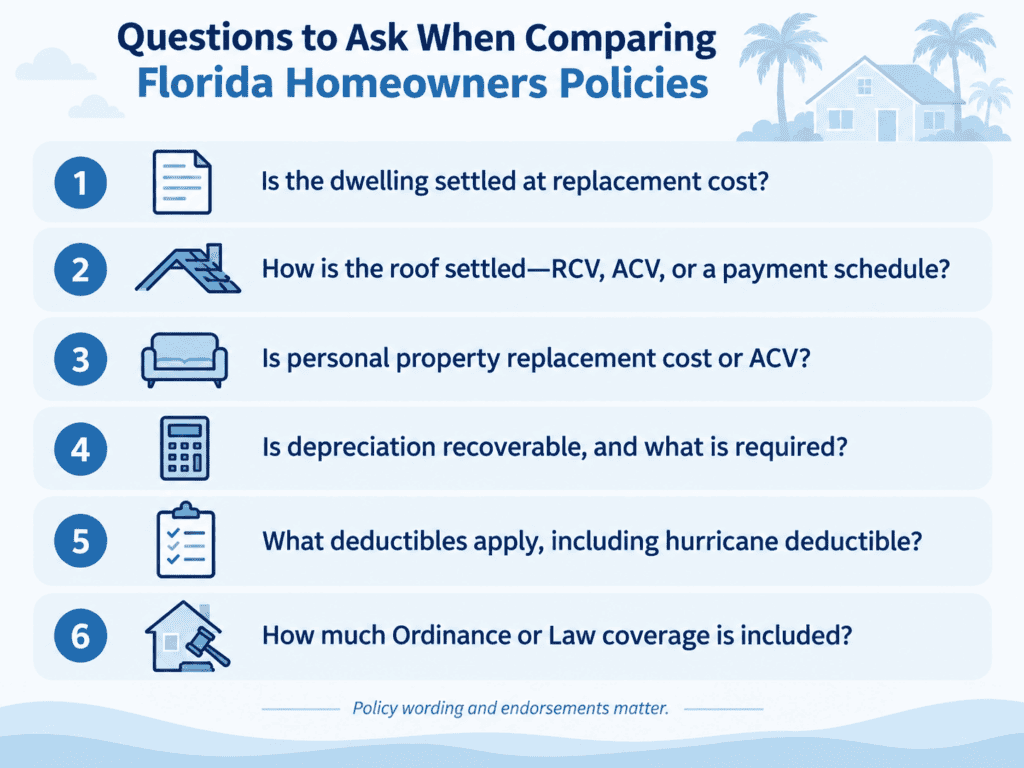
Comparing homeowners insurance requires more than looking at the premium and Coverage A limit. Reviewing how the dwelling, roof, personal property, depreciation, deductibles, and Ordinance or Law Coverage are handled can help reveal meaningful differences between policies before a loss occurs.
These questions can reveal important differences that may not be obvious from the declarations page or premium alone.
Common Actual Cash Value and Replacement Cost Mistakes
Assuming Every Homeowners Policy Provides Replacement Cost Everywhere
Different categories of property can have different loss-settlement methods.
Looking Only at Coverage A
A large dwelling limit does not tell you how the roof or personal property is settled.
Ignoring Roof Settlement
An ACV roof provision or roof payment schedule can materially affect the homeowner’s responsibility after a covered Florida wind or hurricane loss.
Forgetting Coverage C
Personal belongings can represent a substantial financial exposure after a severe loss.
Confusing Replacement Cost With Market Value
Replacement cost concerns reconstruction or replacement. Market value concerns what the real estate may sell for.
Assuming ACV Means No Coverage
ACV is a valuation method. Covered property may still be insured even though depreciation affects the settlement.
Assuming Replacement Cost Is Unlimited
Policy limits and other provisions still apply.
Assuming Recoverable Depreciation Is Paid Automatically
Repair, replacement, documentation, actual expenses, and policy conditions may need to be satisfied first.
Failing to Update Dwelling Limits
Replacement-cost settlement cannot necessarily overcome inadequate insurance limits.
Frequently Asked Questions About Actual Cash Value and Replacement Cost in Florida
1. What Is the Difference Between Actual Cash Value and Replacement Cost?
Actual Cash Value generally reflects the cost to repair or replace covered damaged property after applicable depreciation is deducted. Replacement Cost Value generally reflects the current cost to repair or replace covered property without permanently deducting qualifying depreciation, subject to the policy’s terms, limits, and conditions.
2. How Is Actual Cash Value Calculated in a Homeowners Insurance Claim?
Actual Cash Value generally starts with the current cost to repair or replace covered damaged property and then accounts for applicable depreciation. Age, condition, remaining useful life, and the policy’s loss-settlement provisions may affect the calculation.
3. Is Replacement Cost Always Better Than Actual Cash Value?
Replacement-cost coverage generally provides broader financial protection because qualifying depreciation may not be permanently deducted. However, premium, eligibility, policy terms, deductibles, and the homeowner’s ability to absorb out-of-pocket costs should also be considered.
4. Is Actual Cash Value the Same as Market Value?
No. Actual Cash Value is an insurance loss-settlement concept that generally reflects replacement cost after applicable depreciation. Market value is the amount a buyer may be willing to pay for real estate and can be affected by land, location, and market conditions.
5. Can My Roof Be ACV While My Dwelling Is Replacement Cost?
Yes. Depending on the insurer and policy, the dwelling may generally be settled on a replacement-cost basis while the roof is subject to Actual Cash Value, a roof payment schedule, or another policy-specific settlement provision.
6. What Is Recoverable Depreciation?
Recoverable depreciation is the portion of applicable depreciation that may become payable under qualifying replacement-cost coverage after required repair, replacement, expense, and documentation requirements are satisfied.
7. Do I Have to Repair or Replace Property to Receive Replacement Cost?
It depends on the policy and type of property. For qualifying Florida dwelling losses, Florida Statute §627.7011 generally provides for additional replacement-cost amounts to be paid as work is performed and expenses are incurred.
8. Is Personal Property Automatically Covered at Replacement Cost?
No. Personal property under Coverage C can be subject to different loss-settlement provisions from the dwelling. Homeowners should review whether their policy provides Actual Cash Value or replacement-cost coverage for personal belongings.
9. Does Florida Require Homeowners Insurers to Offer Replacement-Cost Coverage?
Florida Statute §627.7011 generally requires insurers issuing qualifying homeowners policies to offer specified replacement-cost dwelling coverage or endorsements, subject to the statute’s provisions and exceptions.
10. Where Can I Find Out Whether My Policy Uses ACV or Replacement Cost?
Review the declarations page, Loss Settlement provisions, roof forms, personal-property endorsements, and other applicable policy forms. If the wording is unclear, ask your agent or insurer how the dwelling, roof, personal property, and other structures would each be settled after a covered loss.
Request a Florida Homeowners Insurance Review
Actual Cash Value and Replacement Cost can sound like technical insurance terms until a claim occurs. At that point, the difference can represent thousands—or tens of thousands—of dollars.
First Florida Agency can help review your homeowners insurance and identify how important parts of your policy are structured.
A policy review can include:
-
Dwelling loss settlement
-
Roof settlement
-
Personal-property settlement
-
Applicable deductibles
-
Ordinance or Law Coverage
-
Replacement-cost endorsements
-
Roof-specific provisions
-
Other coverage features that may affect a future claim
We serve homeowners throughout Nocatee, Ponte Vedra, Ponte Vedra Beach, Jacksonville, St. Augustine, St. Johns County, Northeast Florida, and communities throughout Florida.
Call First Florida Agency at 904-822-8800 or request a Florida homeowners insurance review online.
About the Author
John Closterides is the Founder and Principal Agent of First Florida Agency, an independent insurance agency based in Ponte Vedra, Florida.
As a Florida-licensed 2-20 General Lines insurance agent with decades of insurance-industry experience, John helps homeowners, families, and business owners understand coverage options, identify potential coverage gaps, and make informed insurance decisions.
He works with homeowners, flood, auto, umbrella, and commercial insurance and regularly helps Florida clients evaluate dwelling coverage, roof settlement, deductibles, replacement cost, actual cash value, hurricane exposures, inspections, and other important policy provisions.
Recommended External Resources
-
Florida Department of Financial Services — Homeowners Insurance Overview
-
Florida Office of the Insurance Consumer Advocate — Tips for Shopping for Homeowners Insurance
-
Florida Office of the Insurance Consumer Advocate — Homeowners Insurance Policy Endorsements
Related Articles
Insurance Disclaimer
Insurance availability, eligibility, limits, exclusions, endorsements, premiums, underwriting requirements, valuation methods, depreciation, deductibles, and claim decisions vary by insurance company, policy form, property, and individual circumstances.
Florida law, mortgage requirements, and insurance-company guidelines can change. This article is provided for general educational purposes only and is not legal, claims, financial, tax, appraisal, construction, or individualized insurance advice.
No coverage is created or modified by this article. The terms, conditions, definitions, exclusions, endorsements, limits, declarations, and loss-settlement provisions of the issued insurance policy control.
Review the complete policy and consult a licensed insurance professional regarding your specific situation.