Last Updated: August 10, 2026
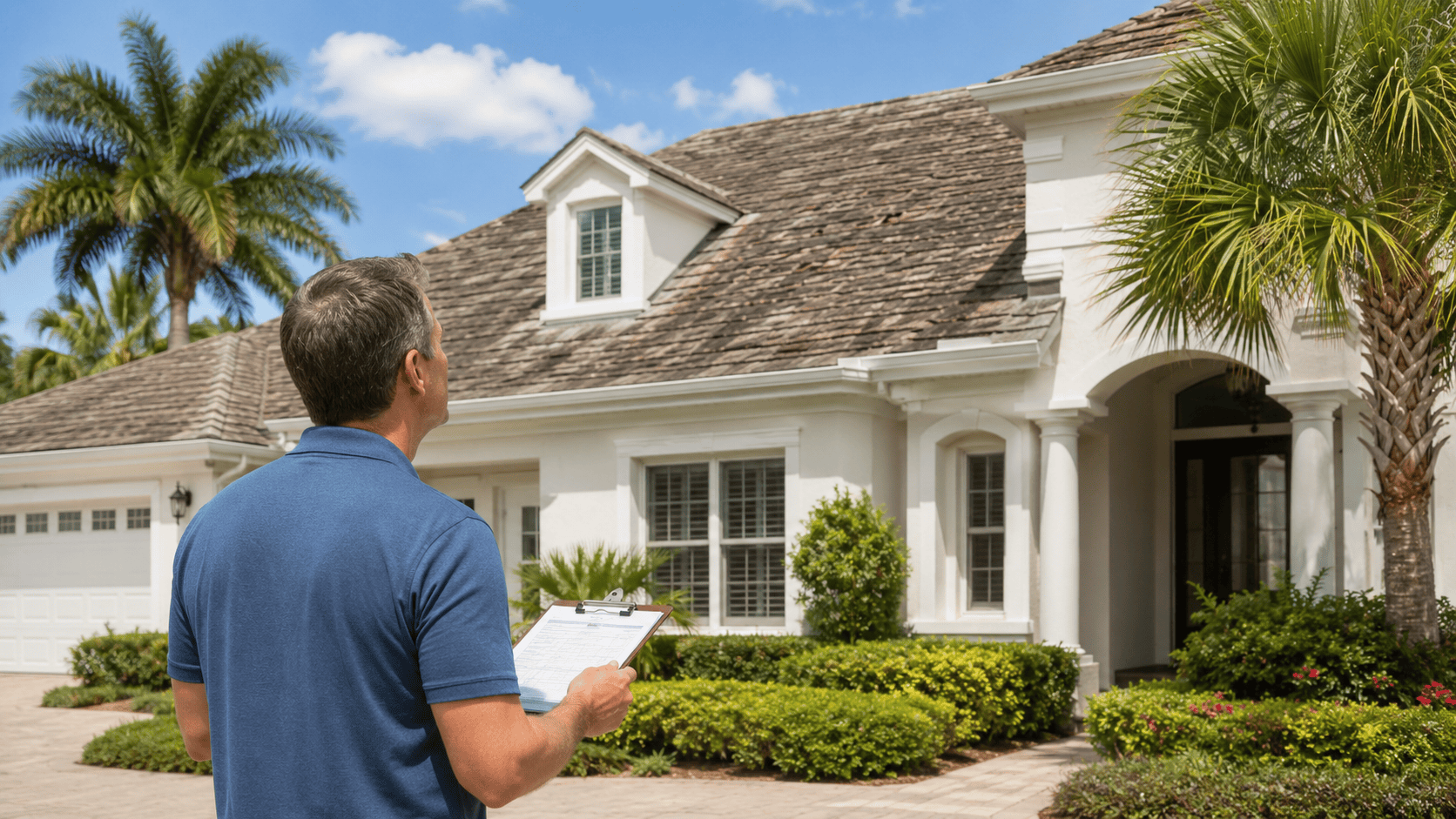
For many Florida homeowners, the age of the roof can significantly influence homeowners-insurance eligibility, coverage options, inspections, premiums, and renewal decisions.
When you request a Florida homeowners-insurance quote, one of the first questions an agent will likely ask is:
How old is your roof?
Insurance companies pay close attention to roofs because they are a home’s primary defense against hurricanes, wind, rain, debris, and water intrusion. A roof that is aging, deteriorated, damaged, or poorly maintained may increase the possibility of a future loss and make a property more difficult or expensive to insure.
However, roof age is not the only factor that matters.
Insurance companies may also consider:
-
Roofing material
-
Visible condition
-
Installation quality
-
Permit history
-
Maintenance
-
Previous repairs
-
Remaining useful life
-
Prior roof claims
-
Wind-resistant construction features
-
Roof-loss settlement provisions
-
The insurer’s current underwriting requirements
A newer roof does not automatically guarantee approval, and an older roof is not always uninsurable. The condition of the roof and the documentation available can be just as important as its chronological age.
This guide explains how roof age affects homeowners insurance in Florida, what state law says about older roofs, when an inspection may help, how Citizens evaluates certain older roofs, and what homeowners can do to improve their insurance options.
For a broader explanation of coverage, deductibles, exclusions, inspections, flood insurance, costs, and other important Florida homeowners insurance considerations, read Florida Homeowners Insurance: A Complete Guide.
Quick Answer: How Does Roof Age Affect Homeowners Insurance in Florida?
Roof age can affect:
-
Whether an insurance company will consider the home
-
Whether a roof inspection is required
-
Whether repairs or replacement are requested
-
Which insurance companies may be available
-
Whether a policy is issued or renewed
-
How covered roof damage may be settled
-
Whether updated wind-mitigation credits are available
-
The premium and deductible options offered
Florida does not impose one universal maximum roof age that every insurance company must accept. Insurers may use different underwriting guidelines based on roofing material, condition, documentation, remaining useful life, location, and other characteristics.
Florida law generally prevents an insurer from refusing to issue or renew a homeowners policy solely because a residential roof is less than 15 years old. When a roof is at least 15 years old, the insurer generally must allow the homeowner to obtain an inspection from an authorized inspector before requiring replacement based on age. If the inspection shows at least five years of useful life remaining, the insurer generally cannot refuse to issue or renew the policy solely because of the roof’s age.
These protections do not require an insurer to accept a roof with active leaks, existing damage, deterioration, improper installation, structural problems, or other valid underwriting concerns.
Table of Contents
-
Why Florida Insurance Companies Care About Roof Age
-
How Old Can a Roof Be for Homeowners Insurance?
-
Florida’s 15-Year Roof Rule
-
Roof Age Versus Roof Condition
-
What Is Remaining Useful Life?
-
Typical Roof Lifespans in Florida
-
How Roof Age Is Determined
-
What If You Do Not Know the Roof’s Age?
-
How Roof Age Affects New Applications
-
How Roof Age Can Affect Renewals
-
Does Citizens Insurance Cover Older Roofs?
-
What Is a Four-Point Inspection?
-
What Happens When an Inspection Finds Roof Problems?
-
Can Roof Repairs Help?
-
Do Roof Coatings Reset Roof Age?
-
Does Replacing a Roof Lower Insurance Premiums?
-
Wind Mitigation After Roof Replacement
-
Replacement Cost Versus Actual Cash Value
-
Does Insurance Pay to Replace an Old Roof?
-
Can an Insurer Require Replacement Without a Leak?
-
Should You Replace the Roof Before Shopping for Insurance?
-
Documentation to Keep After Roof Replacement
-
Tips for Florida Homeowners With Older Roofs
-
Frequently Asked Questions
-
How First Florida Agency Can Help
-
About the Author
-
Recommended External Resources
-
Related Articles
-
Insurance Disclaimer
Why Florida Insurance Companies Care About Roof Age
A roof protects the home’s structure, interior, personal property, and occupants from rain, wind, debris, and other weather-related hazards.
When a roof deteriorates, the possibility of water intrusion and related property damage can increase.
Florida roofs endure demanding conditions, including:
-
Intense sunlight and ultraviolet exposure
-
High heat and humidity
-
Heavy rainfall
-
Tropical storms and hurricanes
-
Wind-driven debris
-
Salt-air exposure in coastal communities
-
Repeated expansion and contraction
-
Mold and organic growth
-
Falling branches
-
Previous storm damage
Because roof-related losses can become expensive, insurance companies may carefully evaluate the roof before agreeing to insure a home.
An underwriter may consider:
-
Roof age
-
Roofing material
-
Visible condition
-
Estimated remaining useful life
-
Evidence of active or previous leakage
-
Missing, cracked, loose, or curling materials
-
Granule loss
-
Prior repairs
-
Partial roof replacement
-
Permits and final inspections
-
Roof-to-wall connections
-
Roof-deck attachment
-
Secondary water resistance
-
Roof shape
-
Opening protection
-
The date and scope of the installation
A newer roof typically creates fewer underwriting concerns, but age alone does not determine eligibility. Poor installation, visible damage, unpermitted work, incomplete documentation, or an unresolved leak can still create problems.
Likewise, an older roof may remain acceptable to certain insurers when it is in serviceable condition, has sufficient remaining useful life, and meets the insurer’s requirements.
Roof age and condition are only two of the factors affecting premiums and eligibility. Learn more in Florida Home Insurance Costs Explained.
How Old Can a Roof Be for Homeowners Insurance in Florida?
There is no single roof-age limit used by every Florida insurance company.
Each insurer establishes its own underwriting guidelines, subject to Florida law and regulatory requirements.
One company may accept a particular roof while another may:
-
Request an inspection
-
Require additional photographs
-
Request permits or proof of installation
-
Require repairs
-
Change the roof-loss settlement method
-
Offer limited coverage
-
Require replacement
-
Decline the property
Guidelines may differ based on:
-
Asphalt shingle, tile, metal, slate, or another roof material
-
Property location
-
Distance from the coast
-
Wind exposure
-
Roof condition
-
Remaining useful life
-
Prior roof claims
-
Property occupancy
-
Whether the policy is new or renewing
-
The insurer’s current geographic appetite
-
The amount of dwelling coverage
-
The availability of replacement-cost coverage
A 20-year-old architectural-shingle roof in good condition may be acceptable to one insurer but outside another company’s guidelines.
Similarly, a tile or metal roof may have a long physical service life but still require documentation concerning its underlayment, installation, condition, or remaining useful life.
This is one reason an independent insurance agency can be helpful. An independent agency can compare multiple insurers rather than relying on the requirements of only one company.
Florida’s 15-Year Roof Rule Explained
Florida law provides important protections involving roof age.
Under Florida Statute § 627.7011, an insurer generally may not refuse to issue or renew a homeowners policy covering a residential structure with a roof less than 15 years old solely because of the roof’s age.
For a roof that is at least 15 years old, the insurer generally must allow the homeowner to obtain a roof inspection from an authorized inspector, at the homeowner’s expense, before requiring replacement as a condition of issuing or renewing the policy.
An authorized inspector must be approved by the insurer and may include:
-
A Florida-licensed home inspector
-
A certified building-code inspector
-
A licensed general, building, residential, or roofing contractor
-
A licensed professional engineer
-
A licensed professional architect
-
Another qualified person or entity recognized by the insurer
When the inspection indicates that the roof has at least five years of useful life remaining, the insurer generally may not refuse to issue or renew the policy solely because of roof age.
The law does not require an insurer to disregard:
-
Active leaks
-
Existing storm damage
-
Deterioration
-
Poor maintenance
-
Improper installation
-
Structural deficiencies
-
Inadequate replacement-cost eligibility
-
Other lawful underwriting concerns
For purposes of this statutory protection, roof age is calculated using:
-
The last date on which 100% of the roof’s surface area was built or replaced under the applicable building code; or
-
The initial date in a series of partial roof replacements that ultimately resulted in 100% of the roof surface being built or replaced
The statutory roof-age provision applies to qualifying homeowners policies and does not apply to mobile-home policies. It also does not prevent insurers from taking action for other lawful underwriting reasons.

Florida’s roof-age protections may give homeowners an opportunity to document a roof’s remaining useful life, but insurers may still consider its condition, material, maintenance, permits, and other underwriting factors.
Roof Age Versus Roof Condition
Roof age and roof condition are related, but they are not the same thing.
Two roofs installed in the same year can be in very different condition.
One may have been professionally installed, properly ventilated, consistently maintained, and protected from significant storm damage. Another may have experienced poor installation, wind damage, tree contact, deferred maintenance, inadequate flashing, or repeated leakage.
Insurance underwriters may look for signs such as:
-
Curling or lifting shingles
-
Missing shingles or tiles
-
Cracked or broken roofing materials
-
Widespread granule loss
-
Soft or deteriorated decking
-
Sagging sections
-
Damaged flashing
-
Moss or organic growth
-
Water staining
-
Active leakage
-
Previous leakage
-
Temporary patches
-
Exposed underlayment
-
Uneven surfaces
-
Ponding water
-
Tree limbs contacting the roof
-
Debris blocking drainage
An older roof in good condition may have more insurance options than a substantially younger roof showing deterioration or damage.
A roof inspection also represents only the observable condition at the time of the inspection. Hidden defects, concealed moisture, or future performance cannot always be determined from a limited visual inspection.
What Is Remaining Useful Life?
Remaining useful life is an estimate of how many additional years a roof is expected to remain serviceable before replacement is anticipated.
The inspector may consider:
-
Roof material
-
Approximate installation date
-
Visible deterioration
-
Previous repairs
-
Evidence of leakage
-
Surface wear
-
Roof slope
-
Flashing and penetrations
-
Underlayment condition, when visible
-
Drainage
-
Weather exposure
-
Storm history
-
Overall workmanship
Remaining useful life is not a warranty or guarantee.
It is a professional estimate based on observable conditions at the time of inspection. Citizens states that it relies on the experience and expertise of an appropriately licensed inspector when evaluating roof condition, remaining useful life, and visible deterioration.
An insurance company may require a minimum remaining useful life before accepting the roof.
The inspector’s estimate also does not obligate every insurer to accept the property. Each company may review the report under its own rules.
Typical Roof Lifespans in Florida
Roofing manufacturers may advertise long product lifespans, but those figures do not necessarily represent guaranteed service life or guaranteed insurance eligibility.
Actual roof life depends on:
-
Roofing material
-
Installation quality
-
Ventilation
-
Underlayment
-
Maintenance
-
Weather exposure
-
Storm history
-
Coastal conditions
-
Roof slope
-
Drainage
-
Repairs
-
Tree coverage
General lifespan ranges often discussed include:
-
Three-tab asphalt shingles: approximately 15–20 years
-
Architectural asphalt shingles: approximately 20–30 years
-
Metal roofing: often 40 years or longer
-
Concrete or clay tile: often 40–50 years or longer
-
Slate roofing: potentially several decades or longer
These are broad estimates—not guaranteed insurance-acceptance periods.
A tile roof also consists of more than the visible tiles. The underlayment beneath the tiles plays an important role in preventing water intrusion and may deteriorate before the tile itself reaches the end of its physical life.
For insurance purposes, the insurer’s current guidelines and the roof’s documented condition generally matter more than a broad industry lifespan estimate.
How Is Roof Age Determined?
Insurance companies may rely on several forms of documentation to establish the roof’s age, including:
-
Building permits
-
Permit closure
-
Final inspection records
-
Roofing contracts
-
Paid invoices
-
Previous insurance documents
-
Prior four-point inspections
-
Wind mitigation reports
-
Roof-condition reports
-
Contractor certifications
-
Closing documents
-
County or municipal property records
-
Warranty documents
Homeowners should retain complete records whenever a roof is repaired or replaced.
A paid invoice may not always establish that the entire roof was replaced. An insurer may request documentation showing:
-
Scope of work
-
Property address
-
Completion date
-
Permit number
-
Materials installed
-
Whether old roofing was removed
-
Whether decking was repaired
-
Whether underlayment was replaced
-
Whether the project involved a full or partial replacement
-
Final inspection approval
Partial Roof Replacement
Replacing one section of a roof does not automatically make the entire roof new.
For purposes of Florida’s statutory roof-age protection, roof age is determined under the calculation described in Florida Statute § 627.7011.
Individual insurers may also apply underwriting requirements to roof sections of different ages. Citizens has stated that when the entire roof was not replaced at the same time, its underwriting roof age may be based on the oldest portion.
What If You Do Not Know the Roof’s Age?
Many homeowners do not know the exact installation date, especially when a previous owner completed the work.
Start by checking:
-
Closing documents
-
The buyer’s home-inspection report
-
Seller disclosures
-
County or city permit records
-
Prior insurance applications
-
Four-point or wind-mitigation reports
-
Warranty documents
-
Records from the previous owner
-
Local roofing-contractor records
-
Permit stickers or labels near the attic or electrical panel
When no reliable documentation is available, an inspector may estimate the roof’s age based on observable condition and materials.
However, an estimate may not satisfy every insurance company’s requirement for proof of installation.
A homeowner may need additional documentation, permit research, contractor records, or an inspection accepted by the proposed insurer.
How Roof Age Affects New Insurance Applications
An older roof can result in additional underwriting requirements during a new insurance application.
The insurer may request:
-
A four-point inspection
-
A roof-condition inspection
-
Photographs of every roof slope
-
Close-up photographs of damaged areas
-
Proof of replacement
-
Roofing permits
-
Paid invoices
-
Repair documentation
-
Remaining-useful-life certification
-
A wind mitigation inspection
-
Contractor certification
Depending on the roof and insurance company, the insurer may:
-
Approve the property normally
-
Approve it after reviewing an inspection
-
Request clarification
-
Require limited repairs
-
Require a follow-up inspection
-
Offer different roof-loss settlement provisions
-
Require replacement before coverage begins
-
Decline the application under its guidelines
Never assume that replacing a few shingles will satisfy an insurer.
Before authorizing work solely for insurance purposes:
-
Confirm the specific underwriting concern.
-
Ask what repair or documentation is required.
-
Verify who must perform the work.
-
Confirm whether permits are necessary.
-
Determine whether a new inspection will be required.
-
Submit the documentation before relying on the insurance offer.
How Roof Age Can Affect Renewals
Roof concerns can also arise when an existing policy approaches renewal.
An insurer may:
-
Review aerial imagery
-
Conduct an exterior survey
-
Request updated photographs
-
Request a four-point inspection
-
Request a roof-condition report
-
Ask for proof of replacement
-
Require repairs
-
Review remaining useful life
-
Change roof-loss settlement provisions
-
Issue a nonrenewal for a legally permitted reason
Do not ignore an inspection request, repair notice, or nonrenewal.
Contact your insurance agent promptly and determine:
-
Why the notice was issued
-
What deadline applies
-
Whether an inspection is required
-
Whether repairs may resolve the issue
-
What documentation must be submitted
-
Whether another insurer may accept the roof
-
When replacement coverage must begin
Waiting until the expiration date approaches may leave insufficient time to schedule inspections, obtain estimates, complete permitted work, submit documents, and compare replacement policies.
Does Citizens Insurance Cover Older Roofs?
Citizens Property Insurance Corporation may insure certain homes with older roofs, but the property must meet Citizens’ current eligibility and underwriting requirements.
Citizens identifies additional roof-documentation requirements for:
-
Shingle and similar soft-surface roofs more than 25 years old
-
Tile, slate, clay, concrete, or metal roofs more than 50 years old
-
Mobile-home roofs more than 25 years old
Citizens’ current published guidance generally requires full-roof-replacement documentation for roofs exceeding those ages. However, Citizens notes that certain exceptions may be reviewed when documentation shows at least five years of remaining useful life.
Citizens’ inspection page states that roofs beyond those age thresholds require documentation showing at least five years of remaining useful life and an inspection by a Florida-licensed inspector for visible damage or deterioration. When a roof has less than five years of remaining useful life, Citizens generally requires proof of full replacement before a policy is written, subject to any available underwriting exception.
Citizens may review:
-
A roof inspection report
-
A properly completed four-point inspection
-
Photographs of each roof slope
-
Remaining-useful-life documentation
-
Finalized roof permits
-
Proof of completed replacement
-
Documentation from a verifiable Florida-licensed professional
A four-point inspection may be submitted instead of Citizens’ roof inspection form when the report contains the required roof photographs and is completed and signed by a verifiable Florida-licensed professional.
Satisfying Citizens’ roof requirement does not guarantee approval. Eligibility also depends on the home’s electrical, plumbing, HVAC, condition, occupancy, replacement cost, flood requirements, and other underwriting factors.
Citizens and private insurers may apply different roof and property requirements. Review the broader comparison in Citizens vs. Private Insurance in Florida.
What Is a Four-Point Inspection?
A four-point inspection evaluates four major systems:
-
Roof
-
Electrical
-
Plumbing
-
Heating, ventilation, and air conditioning
For the roof, the inspector generally documents:
-
Roof material
-
Approximate age
-
Installation or permit information
-
Number of roof sections
-
Overall condition
-
Visible damage
-
Evidence of leakage
-
Previous repairs
-
Remaining useful life
-
Photographs of roof slopes
Insurance companies frequently request four-point inspections for older homes, although the age threshold and required form vary by insurer.
A four-point inspection is not a complete home inspection. It is primarily an underwriting document focused on systems commonly associated with significant property losses.
For a detailed explanation, read Four-Point Inspections in Florida.
What Happens When an Inspection Finds Roof Problems?
A roof does not receive a universal pass-or-fail grade that applies to every insurance company.
The inspector documents the visible condition. The insurer then decides whether the roof meets its requirements.
Possible outcomes include:
-
Approval without additional requirements
-
A request for clearer photographs
-
A request for permits or age documentation
-
Required repairs
-
Contractor certification
-
A second inspection
-
An amended report
-
Required roof replacement
-
Different roof-loss settlement terms
-
A decline from that particular insurer
When repairs are required, use a properly licensed roofing professional and retain:
-
Written proposal
-
Contract
-
Paid invoice
-
Permit records
-
Final inspection
-
Before-and-after photographs
-
Contractor completion statement
-
Warranty documents
-
Product information
Ask your insurance agent what the underwriter needs before beginning the work.
A documentation problem may sometimes be resolved without major construction. For example, the report may be missing a photograph, permit, completion date, inspector signature, or explanation of a prior stain.
An active leak, unsafe condition, or substantial deterioration should be addressed promptly regardless of the insurance outcome.
Can Roof Repairs Help You Obtain Insurance?
Repairs may help when a roof has isolated, correctable problems and sufficient remaining useful life.
Examples may include:
-
Replacing a limited number of damaged shingles or tiles
-
Repairing flashing
-
Correcting a roof penetration
-
Repairing localized damage
-
Removing accumulated debris
-
Trimming overhanging branches
-
Correcting a limited source of leakage
-
Securing loose materials
However, repairs generally do not change the roof’s original installation date.
Replacing a small section also does not make the entire roof new.
When deterioration is widespread or the roof is near the end of its useful life, repeated repairs may not satisfy an insurer. Full replacement may be required or may provide a better long-term solution.
Before completing repairs for insurance eligibility, confirm:
-
What the insurer requires
-
Whether a licensed roofer must perform the work
-
Whether a permit is required
-
Whether photographs are sufficient
-
Whether the inspector must return
-
Whether an amended report is needed
Do Roof Coatings Reset the Roof’s Age?
Generally, applying a roof coating or sealant does not reset the age of the original roofing system or establish that the roof was fully replaced.
Citizens states that when a coating or sealant is applied, its underwriters continue to review the age and condition of the original roof.
Citizens also states that maintenance coatings—including acrylic, silicone, urethane, elastomeric, and similar products used for waterproofing or ultraviolet protection—do not satisfy its requirements for proof of roof replacement.
When roof replacement is required and a coating is used instead, Citizens states that the property remains ineligible based on the replacement requirement.
Homeowners should not authorize a coating based solely on a promise that it will make the roof “new” for insurance purposes.
Before spending money, confirm:
-
Whether the insurer accepts the proposed work
-
Whether the work is considered maintenance or replacement
-
Whether a licensed roofing contractor is required
-
Whether a permit is required
-
Whether a new inspection will be necessary
A coating may have legitimate maintenance uses, but it should not be confused with full roof replacement.
Does Replacing a Roof Lower Homeowners-Insurance Premiums?
A new roof can improve insurance eligibility and may provide access to additional insurers, but it does not guarantee a lower premium.
A homeowners-insurance premium is based on many factors, including:
-
Dwelling replacement cost
-
Location
-
Distance from the coast
-
Construction type
-
Prior claims
-
Coverage limits
-
Deductibles
-
Roof shape
-
Wind-resistant construction
-
Opening protection
-
Protective devices
-
Carrier rates
-
Available discounts
-
Flood exposure
-
Occupancy
The most significant insurance benefit of replacing an old roof may be improved access to coverage.
A homeowner who previously had only one or two options may qualify for additional private-market insurers after completing and documenting a full roof replacement.
Because carrier options and discounts may change after replacement, an Annual Insurance Review can help determine whether improved coverage or pricing may now be available.
Why a Wind Mitigation Inspection Matters After Roof Replacement
After replacing a roof, consider obtaining an updated wind mitigation inspection.
A wind mitigation inspection may document:
-
Roof-covering compliance
-
Roof-deck attachment
-
Roof-to-wall connections
-
Roof geometry
-
Secondary water resistance
-
Impact-rated windows and doors
-
Hurricane shutters
-
Garage-door protection
Qualifying features may result in available premium credits, depending on the home, documentation, and insurer.
Citizens explains that documenting qualifying mitigation features through a wind mitigation inspection may help a property qualify for wind-related discounts.
The age of the roof is not itself a wind-mitigation feature.
A new roof may improve eligibility, while documented improvements to attachment, secondary water resistance, or opening protection may qualify for separate credits.
For a detailed explanation, read Florida Wind Mitigation Inspection.
Replacement Cost Versus Actual Cash Value for Roof Damage
Roof age may also influence how covered roof damage is settled.
Replacement Cost
Replacement-cost coverage generally bases payment on the reasonable cost to repair or replace covered damage with materials of similar kind and quality, subject to:
-
Policy limits
-
Deductibles
-
Exclusions
-
Roof endorsements
-
Applicable settlement procedures
-
Required documentation
Some policies initially pay the actual cash value and release additional recoverable depreciation as repairs are completed and expenses are documented.
Actual Cash Value
Actual cash value generally accounts for depreciation based on factors such as:
-
Age
-
Condition
-
Expected service life
-
Prior deterioration
-
Obsolescence
For an older roof, depreciation may be substantial and leave the homeowner responsible for a larger portion of the replacement cost.
Homeowners should review:
-
Roof-loss settlement provisions
-
Replacement-cost endorsements
-
Actual-cash-value endorsements
-
Cosmetic-damage exclusions
-
Matching provisions
-
Hurricane deductibles
-
Windstorm deductibles
-
Separate roof deductibles
-
Depreciation schedules
Do not assume a policy will pay the full cost of a new roof simply because a covered peril damaged it.
For a deeper explanation, read Replacement Cost vs. Market Value in Florida.
Does Homeowners Insurance Pay to Replace an Old Roof?
Homeowners insurance is not a maintenance plan.
A policy generally does not replace a roof merely because it is:
-
Old
-
Worn
-
Deteriorated
-
Poorly maintained
-
Near the end of its useful life
-
Leaking from long-term wear
Wear and tear is only one of several important exclusions homeowners should understand. Learn more in [What Homeowners Insurance Does Not Cover in Florida].
Coverage may apply when a roof is damaged by a covered cause of loss, subject to:
-
Policy terms
-
Exclusions
-
Deductibles
-
The cause of damage
-
The roof’s prior condition
-
Settlement provisions
-
Notice requirements
-
Duties after loss
Potentially covered causes may include wind, hail, fire, or falling objects, depending on the policy.
Wear and tear, deterioration, faulty maintenance, and repeated or long-term leakage are commonly excluded or limited.
For a broader look at these and other common homeowners insurance exclusions and coverage limitations, read What Homeowners Insurance Does Not Cover in Florida.
A resulting loss may sometimes be treated differently from the defective or deteriorated item that caused it. Coverage depends on the specific policy language and facts of the loss.
Homeowners dealing with covered roof damage may also find Florida Home Insurance Claim Guide (2026).
Can an Insurance Company Require Roof Replacement Without a Leak?
Potentially, yes.
An insurer evaluates the possibility of a future loss—not only whether water is currently visible inside the home.
A roof may show limited remaining useful life or visible deterioration before an interior leak appears.
Underwriting may identify:
-
Lifted shingles
-
Surface wear
-
Cracking
-
Granule loss
-
Deteriorated flashing
-
Damaged tiles
-
Inadequate repairs
-
Soft decking
-
Ponding water
-
Sagging
-
Exposed underlayment
Florida law provides an inspection opportunity in certain situations involving roofs at least 15 years old, but an insurer may still act on documented condition problems or other lawful underwriting concerns.
Should You Replace the Roof Before Shopping for Insurance?
Not automatically.
Before committing to a major expense, ask an independent insurance agent to review the situation.
Depending on the home and roof, you may be able to:
-
Obtain coverage with the existing roof
-
Complete an authorized inspection
-
Document at least five years of remaining useful life
-
Make limited repairs
-
Provide missing permits or records
-
Compare insurers with different guidelines
-
Replace the roof after confirming the requirements
When replacement is clearly necessary, coordinate the timing carefully.
Some insurers may consider an application with a signed roofing contract. Others may require:
-
Completed work
-
Final photographs
-
Closed permits
-
Paid invoices
-
Final inspection records
-
Updated four-point report
-
Updated wind mitigation report
Do not assume every insurer will accept work that is only scheduled or partially completed.
What Documentation Should You Keep After Replacing a Roof?
Retain permanent copies of:
-
Signed roofing contract
-
Detailed scope of work
-
Paid final invoice
-
Building permit
-
Permit closure
-
Final municipal inspection
-
Material and manufacturer information
-
Warranty documents
-
Before-and-after photographs
-
Updated wind mitigation inspection
-
Updated roof inspection
-
Contractor license information
-
Proof of completion date
Ask the roofing contractor to state clearly whether the work involved:
-
Full roof replacement
-
Partial replacement
-
Re-roofing
-
Repair only
-
Replacement of underlayment
-
Replacement of damaged decking
-
Installation of secondary water resistance
-
Updated roof-deck attachment
-
Replacement of flashing
Clear documentation can make future insurance applications and renewals substantially easier.
Store electronic copies in addition to paper records.

Keeping roofing contracts, permits, invoices, inspection reports, warranties, and before-and-after photos can make future homeowners insurance applications and renewals easier.
Tips for Florida Homeowners With Older Roofs
Inspect the Roof Before Shopping for Insurance
Do not wait until an underwriter identifies a visible problem. A qualified professional may help identify concerns before the application is submitted.
Address Minor Problems Promptly
A loose shingle, damaged tile, flashing problem, or small leak can become more serious during heavy rain or high winds.
Keep Trees Away From the Roof
Branches can scrape roofing materials, trap moisture, block drainage, and damage the roof during a storm.
Maintain Gutters and Drainage
Blocked drainage may contribute to standing water, leakage, and deterioration.
Avoid Unlicensed Contractors
Unlicensed or improper work may create insurance, safety, permitting, warranty, and property-value problems.
Keep Records Indefinitely
Roof documentation may be needed many years after installation.
Update the Wind Mitigation Inspection
A replacement roof or improved attachment features may qualify for additional credits when properly documented.
Start Early
After receiving a nonrenewal, repair request, or inspection notice, contact your agent immediately. Inspectors and roofing contractors may become especially busy before hurricane season.
Compare Multiple Insurance Companies
Underwriting requirements vary. A roof that is unacceptable to one company may be considered by another, depending on its condition and current rules.
Frequently Asked Questions About Roof Age and Florida Homeowners Insurance
1. How old can a roof be and still qualify for homeowners insurance in Florida?
There is no universal maximum age accepted by every insurer. Eligibility depends on the insurance company, roofing material, condition, remaining useful life, documentation, inspection results, and other underwriting factors.
2. Can an insurer refuse a roof that is less than 15 years old?
Florida law generally prevents an insurer from refusing to issue or renew a qualifying homeowners policy solely because the roof is less than 15 years old. The insurer may still act on damage, deterioration, structural problems, or other lawful concerns.
3. What happens when a roof reaches 15 years old?
A roof does not automatically become uninsurable at 15 years. Before requiring replacement based on age, the insurer generally must allow the homeowner to obtain an inspection from an authorized inspector.
4. What happens when an inspection shows five years of useful life remaining?
The insurer generally may not refuse to issue or renew the qualifying homeowners policy solely because of roof age. Other underwriting requirements may still apply.
5. Can I insure a home with a 20-year-old shingle roof?
Possibly. Approval depends on condition, remaining useful life, documentation, property characteristics, and the insurer’s guidelines.
6. Can I insure a home with a 25-year-old shingle roof?
Possibly, although available insurers may be limited and an inspection, repairs, replacement, or additional documentation may be required.
7. Does Citizens insure shingle roofs older than 25 years?
Citizens generally requires full replacement documentation for qualifying shingle and other soft-surface roofs over 25 years old. Certain exceptions may be reviewed when acceptable documentation shows at least five years of remaining useful life.
8. Does Citizens insure tile or metal roofs older than 50 years?
Citizens generally requires replacement documentation for qualifying tile, slate, clay, concrete, or metal roofs over 50 years old. Certain exceptions may be reviewed based on remaining useful life and condition.
9. What does five years of remaining useful life mean?
It means an authorized or qualified inspector estimates that the roof should remain serviceable for at least five additional years based on its observable condition. It is an estimate, not a guarantee.
10. Who can inspect an older roof for insurance purposes?
The credentials and forms accepted vary by insurer. Under Florida’s statutory provision, the inspector must be approved by the insurer and meet one of the listed professional qualifications.
11. Is a four-point inspection enough for the roof?
Sometimes. Certain insurers accept a properly completed four-point report, while others require a separate roof-condition form. Citizens may accept a qualifying four-point inspection containing the required photographs and signatures.
12. Does a favorable inspection guarantee insurance approval?
No. The inspection supplies information, but the insurance company makes the final underwriting decision.
13. Will replacing a few shingles reset the roof’s age?
No. Repairs may improve the roof’s condition but generally do not change its original installation date.
14. Does replacing one roof section make the entire roof new?
No. Roof sections may have different ages. Florida law and individual insurer rules determine how the roof’s age is calculated.
15. Does a roof coating make the roof new for insurance purposes?
Generally, no. A coating does not ordinarily establish full roof replacement or reset the age of the original roof.
16. Will a new roof reduce my insurance premium?
It may improve eligibility or provide access to additional insurers, but premium savings are not guaranteed.
17. Will a metal roof automatically produce an insurance discount?
No. The roof material alone does not guarantee a discount. The insurer may consider installation, code compliance, roof-deck attachment, roof-to-wall connections, secondary water resistance, and other mitigation features.
18. Is a tile roof always better for insurance than a shingle roof?
Not necessarily. Tile may have a long physical life, but cracked tiles, deteriorated underlayment, installation problems, age, and prior damage can still create concerns.
19. Can an insurer inspect my roof after issuing the policy?
Yes. The policy and application may permit property inspections. An insurer may request photographs, conduct an exterior survey, or ask for additional documentation.
20. Can aerial imagery create an insurance problem?
Insurers may use aerial imagery and inspection technology to identify possible deterioration, debris, missing materials, tree contact, or roof changes. A homeowner may need to provide clearer photographs or a professional inspection.
21. Can an insurer require roof replacement even when there is no leak?
Potentially, yes. Underwriting considers visible condition, remaining useful life, and future loss potential—not only current interior leakage.
22. Does homeowners insurance pay to replace a roof because it is old?
Generally, no. Age, wear, deterioration, and maintenance are not sudden covered losses.
23. Will insurance cover a roof leak?
It depends on the cause. A sudden leak caused by a covered event may be treated differently from long-term seepage, deterioration, defective workmanship, or poor maintenance.
24. What is actual-cash-value roof coverage?
Actual cash value generally subtracts depreciation from the repair or replacement amount, subject to policy terms and the deductible.
25. What is replacement-cost roof coverage?
Replacement-cost coverage generally bases payment on the reasonable cost of repairing or replacing covered damage without permanent depreciation, subject to policy terms and payment procedures.
26. How do I prove when my roof was replaced?
Permits, final inspections, contracts, paid invoices, warranties, photographs, and prior insurance reports can help establish the date and scope of replacement.
27. Should I obtain a new wind mitigation inspection after roof replacement?
Often, yes—especially when replacement changed the roof covering, roof-deck attachment, secondary water resistance, or roof-to-wall connections. Ask your agent whether a new inspection could document additional credits.
28. Can an independent insurance agent help with an older roof?
Yes. An independent agent can review documentation, identify likely inspection requirements, and compare insurers with different guidelines.
29. Should I replace my roof before obtaining quotes?
Not automatically. First determine whether any insurers may accept the existing roof and whether an inspection, documentation, or limited repair could satisfy their requirements.
30. What should I do after receiving a roof-related nonrenewal?
Contact your agent immediately, review the stated reason and deadline, obtain required inspections, gather documentation, and begin comparing alternatives.
How First Florida Agency Can Help
Roof age can make Florida homeowners insurance more complicated, but an older roof does not always mean coverage is unavailable.
At First Florida Agency, we can help homeowners:
-
Review roof-age documentation
-
Identify likely inspection requirements
-
Evaluate remaining-useful-life reports
-
Compare insurance-company roof guidelines
-
Review roof-settlement provisions
-
Confirm required repair documentation
-
Evaluate wind-mitigation credits
-
Compare available private-market and Citizens options
-
Review coverage after roof replacement
-
Compare available deductibles and endorsements
As an independent Florida insurance agency, First Florida Agency compares available options from more than 200 trusted insurance carriers.
Call 904-822-8800 or visit FirstFloridaAgency.com to request a personalized homeowners-insurance review.
First Florida Agency
90 Fort Wade Road, Suite 100
Ponte Vedra, FL 32081
Your Nocatee Neighbor. Your Insurance Advocate.
Nocatee families reviewing their broader personal insurance needs may also find Home and Auto Insurance in Nocatee, Florida (2026 Guide) helpful.
About the Author
John Closterides is the Founder and Principal Agent of First Florida Agency, an independent insurance agency serving homeowners, families, and business owners throughout Florida.
With more than a decade of insurance experience, John helps clients understand their insurance options and make informed decisions about protecting their homes, vehicles, businesses, and financial futures.
John specializes in homeowners, auto, flood, umbrella, and commercial insurance. As a local independent agent based in Nocatee, he understands the insurance challenges facing property owners throughout Nocatee, Ponte Vedra, Ponte Vedra Beach, St. Johns County, Northeast Florida, and communities across the state.
First Florida Agency compares available coverage from more than 200 trusted insurance carriers, helping clients evaluate options based on their individual needs and circumstances.
Recommended External Resources
For current information, consult these official resources:
-
Florida Statute § 627.7011: Homeowners Policies and Roof-Age Provisions
-
Citizens Property Insurance Corporation: Property Inspections
-
Citizens: Roof-Age Requirements for Personal Residential Policies
Related Articles
Continue learning about Florida homeowners insurance, inspections, underwriting, and coverage with these related guides from First Florida Agency:
Insurance Disclaimer
The information in this article is provided for general educational purposes only and is not intended as insurance, legal, financial, construction, roofing, inspection, engineering, claims, or regulatory advice.
Insurance eligibility, roof-age requirements, inspection standards, remaining-useful-life requirements, premiums, discounts, deductibles, roof-settlement provisions, required repairs, underwriting decisions, and coverage availability vary by insurance company, policy, property, and individual circumstances.
A roof inspection does not guarantee that a roof is free from hidden defects, will remain serviceable for a particular period, or will be accepted by an insurance company.
No coverage is created or modified by this article. The terms, conditions, exclusions, limits, endorsements, and declarations of the issued insurance policy control.
Consult a licensed insurance professional and, when appropriate, a properly licensed home inspector, roofing contractor, engineer, attorney, or other qualified professional regarding your individual circumstances.