
Last Updated: August 17, 2026
When Florida homeowners review their insurance policies, one question comes up repeatedly:
Why is my dwelling coverage different from what my home is worth?
A homeowner in Nocatee might purchase a property for $750,000 but see $525,000 in dwelling coverage on the homeowners insurance policy. Another homeowner may own a property with a market value of $400,000 but receive a replacement-cost estimate of $475,000.
Neither situation is automatically wrong.
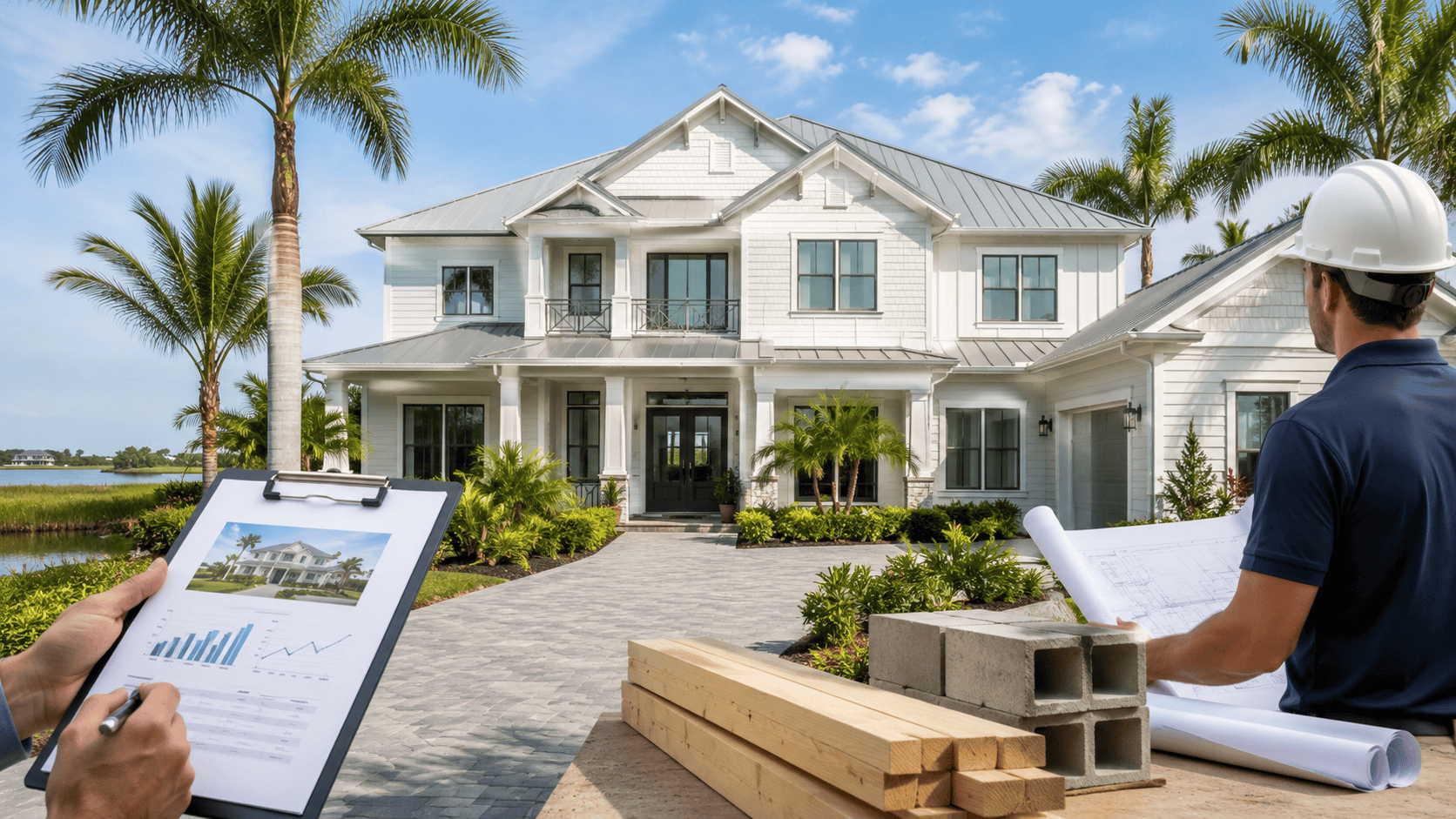
The difference usually exists because market value and replacement cost measure two different things:
-
Market value estimates what a buyer may pay for the entire property, including the land, location, neighborhood, amenities, and current real estate conditions.
-
Replacement cost estimates what it may cost to reconstruct the insured dwelling after a covered loss using current labor, material, design, permitting, and construction expenses.
Florida’s Department of Financial Services explains that homeowners insurance limits are generally based on the cost to rebuild the structure—not the property’s real estate value. Market value includes land, while dwelling replacement cost generally does not.
This distinction is especially important in Florida, where rebuilding costs can be affected by hurricanes, changing construction requirements, contractor demand, labor availability, material prices, debris removal, and specialized wind-resistant construction.
For a broader overview of coverage, deductibles, exclusions, inspections, flood insurance, costs, and other important Florida homeowners insurance considerations, read Florida Homeowners Insurance: A Complete Guide.
Quick Answer: Replacement Cost vs. Market Value
Replacement cost is the estimated amount required to repair or rebuild the insured structure using materials of similar kind and quality at current construction prices.
Market value is the estimated amount a buyer might pay for the entire property in the current real estate market.
Your homeowners insurance dwelling limit normally should not be expected to equal:
-
The purchase price
-
The mortgage balance
-
The county tax assessment
-
A real estate appraisal
-
An online home-value estimate
-
The amount for which the property could be sold
The purpose of dwelling coverage is to help repair or reconstruct the insured building after a covered loss—not to purchase the land or compensate the homeowner for the property’s neighborhood, school district, amenities, or buyer demand.
In This Guide
-
What replacement cost means
-
What market value means
-
Actual cash value versus replacement cost
-
What dwelling coverage protects
-
Why market value and replacement cost differ
-
How insurers estimate reconstruction cost
-
Why Florida rebuilding costs can be high
-
Replacement cost and claim payments
-
Extended and guaranteed replacement cost
-
Inflation guard
-
Ordinance or law coverage
-
The risks of being underinsured
-
How renovations affect Coverage A
-
How to review your dwelling limit
-
Common valuation mistakes
-
Frequently asked questions
What Is Replacement Cost?
Replacement cost is the estimated amount needed to repair or reconstruct damaged covered property with materials of similar kind and quality at current prices, without subtracting depreciation.
For the dwelling, a replacement-cost estimate may account for:
-
Demolition
-
Debris removal
-
Construction labor
-
Building materials
-
Contractor overhead and profit
-
Architectural or engineering services
-
Building permits
-
Required inspections
-
Electrical work
-
Plumbing
-
Roofing
-
Heating and air-conditioning systems
-
Interior finishes
-
Current construction requirements
-
Temporary increases in demand following a catastrophe
Replacement cost does not necessarily equal what the homeowner originally paid for the property. It also is not automatically equal to the mortgage, appraisal, tax assessment, or current selling price.
Florida consumer guidance describes replacement-cost coverage as paying the present cost of replacing covered property without deducting its decrease in value, subject to the policy’s terms and limits.
What Is Market Value?
Market value is the estimated price a willing buyer might pay for the property under current real estate conditions.
It may reflect:
-
Land value
-
Location
-
Neighborhood desirability
-
School districts
-
Lot size
-
Waterfront, golf-course, or preserve views
-
Community amenities
-
Proximity to beaches, shopping, and employment
-
Interest rates
-
Available housing inventory
-
Comparable sales
-
Buyer demand
-
Property condition
-
Local economic conditions
For example, a Nocatee home’s market value may be influenced by access to pools, parks, trails, golf-cart paths, schools, retail areas, and community events.
Those features may make the property more valuable to a buyer, but they do not necessarily increase the physical cost of reconstructing the house by the same amount.
Market value can change quickly as buyer demand and financing conditions change. Replacement cost is driven more directly by the cost of reconstructing the insured building.
Replacement Cost vs. Market Value: The Main Differences
Replacement cost focuses on the estimated expense of rebuilding the insured structure. It generally excludes land value and helps establish the dwelling coverage limit.
Market value reflects what a buyer may pay for the entire property. It includes the land and may be influenced by location, schools, neighborhood amenities, interest rates, and buyer demand.
Either amount may be higher than the other. The two values serve different purposes and should not be expected to match.

Replacement cost estimates what it may cost to rebuild the insured home, while market value reflects what a buyer may pay for the entire property—including the land and location.
What Is Actual Cash Value?
Actual cash value, commonly abbreviated as ACV, generally means replacement cost minus depreciation.
Depreciation may reflect:
-
Age
-
Wear and tear
-
Condition
-
Remaining useful life
-
Obsolescence
Suppose a 15-year-old roof is damaged by a covered loss and would cost $30,000 to replace. An actual-cash-value calculation may subtract depreciation based on the roof’s age and condition. The resulting amount could be substantially lower than the cost of installing a new roof.
Florida’s consumer insurance guidance distinguishes the two settlement methods this way:
-
Replacement cost generally pays the present replacement expense without deducting depreciation.
-
Actual cash value generally deducts depreciation from the replacement expense.
A homeowners policy may provide replacement-cost coverage for the dwelling while treating other property differently. Depending on the policy, personal property, roofing, screened enclosures, or other property may be subject to actual cash value, schedules, special limits, or separate endorsements.
What Is Dwelling Coverage?
Dwelling coverage, usually shown as Coverage A, protects the insured residential structure when it is damaged by a covered cause of loss.
It may include:
-
The main house
-
Attached garages
-
Attached porches
-
Permanently installed flooring
-
Built-in cabinets
-
Plumbing systems
-
Electrical systems
-
Heating and cooling systems
-
Permanently attached fixtures
-
Other components considered part of the dwelling
Detached property—such as a detached garage, fence, gazebo, shed, or certain pool structures—may fall under Coverage B: Other Structures.
Dwelling coverage ordinarily does not insure the land beneath the home. It also does not cover every cause of property damage.
Flooding, storm surge, earth movement, wear and tear, deterioration, maintenance problems, and other losses may be excluded or require separate coverage.
Our Florida Flood Insurance Guide explains why flood damage is generally insured separately from homeowners insurance.
Why Is Homeowners Insurance Based on Rebuilding Cost?
The primary purpose of dwelling coverage is to help repair or reconstruct the insured building after a covered loss.
If a covered fire or hurricane wind loss destroys a home, the homeowner normally still owns the land. The insurer is not purchasing the property or compensating the homeowner for the value of the neighborhood.
The claim is evaluated according to:
-
The covered cause of loss
-
The cost of covered repairs
-
The dwelling limit
-
Deductibles
-
Exclusions
-
Endorsements
-
Loss-settlement provisions
-
Ordinance or law coverage
-
Documentation
-
Other policy conditions
That is why a mortgage appraisal or real estate valuation generally is not the correct basis for determining Coverage A.
Why Is Land Usually Excluded From Dwelling Coverage?
Land can represent a substantial portion of a property’s market value, particularly when the home is located:
-
Near the Atlantic Ocean
-
Along the Intracoastal Waterway
-
On a large or premium homesite
-
Along a golf course
-
Beside a preserve
-
In a highly rated school district
-
Inside a popular master-planned community
-
Near shopping, dining, and recreation
A fire or hurricane wind loss may destroy the building, but it does not ordinarily destroy the land itself.
That is why a home with a $900,000 market value might reasonably have a $600,000 dwelling replacement-cost estimate.
The reverse can also occur: a property in an area with lower land values may cost more to rebuild than it would sell for in the current real estate market.
Example: Replacement Cost Lower Than Market Value
Consider a newer 2,800-square-foot Nocatee home with a market value of $825,000.
Its market value may reflect:
-
The land
-
Neighborhood demand
-
Community amenities
-
St. Johns County schools
-
Preserve or water views
-
Proximity to Ponte Vedra Beach
-
Limited inventory
-
Current buyer demand
The estimated cost to reconstruct the house might be $575,000.
The $250,000 difference does not necessarily mean the home is underinsured. Much of the additional market value may be attributable to the land, location, and community.
Example: Replacement Cost Higher Than Market Value
Consider an older Northeast Florida home with a market value of $390,000 and an estimated reconstruction cost of $475,000.
Rebuilding it might require:
-
Demolition
-
Debris removal
-
New permits
-
Current-code construction
-
Updated electrical systems
-
Updated plumbing
-
Modern wind-resistance features
-
New roofing
-
Current labor rates
-
Contractor supervision
-
Architectural or engineering services
Buyers in that neighborhood may not be willing to pay $475,000 for the property, but contractors could still charge that amount to reconstruct the home.
What Affects Replacement Cost in Florida?
Replacement cost is not based on a single universal price per square foot.
Two homes with similar living areas may have substantially different reconstruction costs because of their construction, finishes, location, design, accessibility, and structural features.
Construction Labor
Florida rebuilding may require:
-
General contractors
-
Roofers
-
Electricians
-
Plumbers
-
Carpenters
-
HVAC contractors
-
Engineers
-
Drywall installers
-
Painters
-
Masonry contractors
-
Specialty trades
Labor expenses may increase when contractors are already committed to other projects or when widespread storm damage creates extraordinary demand.
Building Materials
Replacement cost may be affected by the price and availability of:
-
Concrete block
-
Lumber
-
Roofing materials
-
Windows and doors
-
Drywall
-
Cabinets
-
Countertops
-
Flooring
-
Electrical components
-
Plumbing fixtures
-
HVAC systems
-
Fasteners
-
Structural connectors
-
Impact-resistant products
Transportation, supply constraints, manufacturing capacity, and regional demand can also affect costs.
Building Requirements
A reconstructed home may need to satisfy current requirements rather than those in effect when the original house was built.
Potential expenses may involve:
-
Roof-to-wall connections
-
Wind-load requirements
-
Roof coverings
-
Electrical systems
-
Plumbing systems
-
Energy-efficiency standards
-
Impact protection
-
Structural components
-
Floodplain requirements
-
Permits and inspections
Demolition and Debris Removal
Before reconstruction begins, damaged portions of the home may need to be demolished and removed.
This can involve:
-
Labor
-
Heavy equipment
-
Disposal charges
-
Hauling
-
Environmental precautions
-
Site preparation
-
Sorting and removing damaged materials
Contractor Demand After a Hurricane
Following a widespread hurricane, thousands of homes may need repairs simultaneously.
Demand for contractors, engineers, roofing materials, temporary storage, debris removal, and skilled labor may rise sharply. This is one reason an additional or extended replacement-cost endorsement can be valuable when available.
Custom Features
Replacement cost may increase when the property includes:
-
Custom cabinetry
-
Premium flooring
-
Designer lighting
-
Imported materials
-
Detailed millwork
-
High-end appliances
-
Specialty roofing
-
Large glass systems
-
Outdoor kitchens
-
Elevators
-
Multiple HVAC systems
-
Complex architectural features
Homeowners who want a broader explanation of Florida insurance pricing can read Florida Home Insurance Costs Explained.

Florida reconstruction costs may be affected by labor, materials, current building requirements, demolition and debris removal, post-hurricane contractor demand, and the home’s design and finishes.
How Do Insurance Companies Estimate Replacement Cost?
Insurance companies commonly use replacement-cost estimating software.
The estimate may consider:
-
Heated living area
-
Total square footage
-
Number of stories
-
Construction type
-
Exterior wall material
-
Foundation
-
Roof shape
-
Roofing material
-
Number of kitchens and bathrooms
-
Ceiling heights
-
Interior quality
-
Flooring
-
Cabinetry
-
Built-in features
-
Attached garages
-
Porches and lanais
-
Local labor and material costs
-
Custom construction
The resulting estimate helps establish the dwelling limit.
However, an estimator is only as accurate as the information entered.
A mistake involving square footage, construction type, roof design, number of bathrooms, interior quality, or attached structures can materially change the result.
Different insurers may also use different estimating systems, assumptions, labor rates, quality classifications, and underwriting rules. Therefore, two companies may calculate different dwelling limits for the same home.
Purchase Price, Mortgage Balance, Appraisal, and Tax Value
These figures serve different purposes and should not automatically be used as the dwelling limit.
Purchase Price
The purchase price may include:
-
Land
-
Builder profit
-
Lot premiums
-
Community demand
-
Financing incentives
-
Market conditions
-
Location value
It is not automatically the cost of rebuilding the physical structure.
Mortgage Balance
The mortgage balance represents how much the borrower owes the lender.
A homeowner may owe $300,000 on a home that costs $600,000 to reconstruct—or owe $600,000 on a structure that costs $450,000 to rebuild.
The loan balance does not determine construction costs.
Real Estate Appraisal
A real estate appraisal helps estimate the property’s value for a sale, purchase, or loan.
It normally considers land, location, comparable sales, and current market conditions. Those factors do not provide a complete reconstruction estimate.
County Tax Assessment
A tax assessment is prepared for property-tax purposes. It may differ significantly from both the property’s market value and its reconstruction cost.
Replacement Cost Estimate vs. Replacement-Cost Claim Settlement
These terms are related but not identical.
A replacement-cost estimate helps establish the dwelling limit shown on the declarations page.
A replacement-cost loss-settlement provision describes how a covered claim will be calculated and paid.
A policy can have a large Coverage A limit but still contain important settlement restrictions involving:
-
Roof losses
-
Personal property
-
Matching
-
Cosmetic damage
-
Screened enclosures
-
Water damage
-
Older construction
-
Functional replacement
-
Scheduled property
Under Florida law, when a dwelling loss is insured on a replacement-cost basis, the insurer generally must initially pay at least the actual cash value of the covered loss, less the applicable deductible, subject to statutory exceptions. Remaining covered replacement-cost amounts are generally paid as repairs are performed and expenses are incurred. For a covered total loss, the statute generally requires replacement-cost coverage to be paid without withholding depreciation.
This is why homeowners should review both:
-
The dwelling limit
-
The claim-settlement language
An adequate dwelling limit does not mean every type of damage or loss is covered. Homeowners policies also contain exclusions, limitations, and conditions that can affect coverage. For a closer look, read What Homeowners Insurance Does Not Cover in Florida.
What Is Recoverable Depreciation?
Recoverable depreciation is the portion of a covered replacement-cost claim that may be withheld initially and paid later after qualifying repairs or replacement are completed and documented.
A simplified example:
-
Covered replacement cost: $40,000
-
Depreciation: $10,000
-
Deductible: $5,000
The initial payment could be based on:
$40,000 − $10,000 depreciation − $5,000 deductible = $25,000
After the covered work is completed and documented, the policyholder may be eligible to recover some or all of the withheld $10,000, subject to the policy, actual expenses, and coverage limit.
Claim calculations vary. This example is for general illustration only.
The Risks of Being Underinsured
A home is underinsured when the available dwelling coverage may not be sufficient to repair or reconstruct it after a major covered loss.
Possible consequences include:
-
Significant out-of-pocket costs
-
Inability to rebuild the home as it existed
-
Reducing the size or quality of the rebuilt home
-
Insufficient code-upgrade protection
-
Delays while arranging additional financing
-
Coverage limitations on partial losses
-
Insurance-to-value penalties when applicable
Florida’s Department of Financial Services explains that replacement-cost policies may require homeowners to maintain coverage equal to 80%, 90%, or 100% of the estimated replacement value, depending on the insurer and policy. Carrying less than the required percentage may affect how a partial loss is settled. The actual policy terms control.
Simplified Underinsurance Example
Suppose:
-
Estimated rebuilding cost: $600,000
-
Dwelling limit: $420,000
After a covered total loss, the homeowner could face a potential $180,000 difference before considering:
-
The deductible
-
Exclusions
-
Ordinance or law expenses
-
Debris-removal limitations
-
Detached structures
-
Pools or enclosures
-
Landscaping
-
Other uncovered costs

If the estimated cost to rebuild a Florida home exceeds its dwelling coverage, the homeowner may face a substantial coverage gap and higher out-of-pocket reconstruction expenses.
Can a Home Be Overinsured?
A dwelling limit also can be higher than the reasonable estimated reconstruction cost.
A higher limit does not normally mean the insurer will automatically pay the full limit after every claim. Claim payments remain subject to:
-
The amount of covered damage
-
Reasonable repair or replacement expenses
-
The policy limit
-
Deductibles
-
Exclusions
-
Loss-settlement provisions
-
Documentation
-
Other policy terms
An unnecessarily high estimate may increase premiums, but a higher dwelling limit does not automatically result in a higher claim payment.
The goal is not to choose the highest possible limit or the lowest affordable limit. The goal is to establish a reasonable estimate based on the home’s actual construction and features.
What Is Extended Replacement Cost?
Extended replacement cost may provide a stated amount of additional dwelling coverage when covered rebuilding expenses exceed Coverage A.
Depending on the insurer, the extension might provide:
-
10%
-
20%
-
25%
-
50%
-
Another stated percentage
For example:
-
Dwelling limit: $600,000
-
Extended replacement cost: 25%
-
Potential additional amount: $150,000
-
Potential total available dwelling protection: $750,000
This remains subject to the policy’s requirements, exclusions, and limits.
Extended replacement cost can be useful when:
-
Inflation rises unexpectedly
-
A hurricane creates widespread contractor demand
-
Material prices increase
-
Skilled labor becomes scarce
-
Rebuilding takes longer than expected
-
The original estimate proves insufficient
It does not eliminate the need for an accurate Coverage A limit. Insurers may require the home to be insured at the full estimated replacement cost and may require the homeowner to report renovations and additions.
What Is Guaranteed Replacement Cost?
Guaranteed replacement cost generally provides broader protection to rebuild the insured dwelling after a covered total loss when the reconstruction expense exceeds the stated dwelling limit.
It is not universally available, especially in catastrophe-exposed markets.
Eligibility may require the homeowner to:
-
Insure the dwelling at the insurer’s estimated replacement value
-
Accept annual adjustments
-
Report renovations
-
Report additions
-
Maintain accurate property information
-
Comply with policy conditions
Do not assume a policy provides guaranteed replacement cost unless the coverage is specifically shown in the policy or endorsement.
What Is Inflation Guard?
An inflation-guard provision automatically increases the dwelling limit periodically to help account for rising construction expenses.
For example:
-
Current dwelling limit: $500,000
-
Annual adjustment: 5%
-
Adjusted limit: $525,000
Inflation guard is helpful, but it is not a substitute for a complete review.
An automatic adjustment may not account for:
-
A room addition
-
A remodeled kitchen
-
A new bathroom
-
Upgraded flooring
-
An enclosed porch
-
An outdoor kitchen
-
Custom built-ins
-
A generator
-
Impact windows
-
Incorrect information in the original estimate
-
Changes in local reconstruction expenses
Coverage A should be reviewed at least annually and after significant improvements.
Our Annual Insurance Reviews in Nocatee guide explains why policy limits, deductibles, endorsements, and property information should be reviewed regularly.
What Is Ordinance or Law Coverage?
Ordinance or law coverage helps pay certain additional expenses resulting from the enforcement of current building codes after a covered loss.
It may help address:
-
Demolition of undamaged portions of the building
-
Removal of demolished materials
-
Reconstruction to current codes
-
Electrical upgrades
-
Plumbing upgrades
-
Structural improvements
-
Wind-resistance requirements
-
Other legally required changes
Florida law requires homeowners insurers to offer replacement-cost and ordinance-or-law options. The additional ordinance-or-law amount may generally be limited to 25% or 50% of the dwelling limit, depending on the policyholder’s selection. Unless properly rejected or an alternative is selected, the statute generally deems the dwelling policy to include 25% ordinance-or-law coverage.
Example
Suppose a covered fire damages a substantial portion of an older home. Local authorities require additional demolition and reconstruction to current code.
Dwelling coverage may address the direct covered property damage, while ordinance or law coverage may help address eligible additional demolition and code-upgrade expenses.
Without adequate ordinance or law coverage, some of those expenses could become the homeowner’s responsibility.
Replacement cost and Ordinance or Law Coverage address related but different rebuilding expenses. For a detailed explanation of how code-required costs may be covered after a loss, read Ordinance or Law Coverage Explained for Florida Homeowners.
How Roof Age Affects Valuation and Coverage
Roof age can affect:
-
The replacement-cost estimate
-
Insurance eligibility
-
Premiums
-
Inspection requirements
-
Roof-loss settlement
-
Available deductibles
-
The type of policy offered
A policy may apply:
-
Replacement-cost roof settlement
-
Actual-cash-value roof settlement
-
A roof payment schedule
-
A separate roof deductible
-
Cosmetic-damage limitations
-
Matching limitations
-
Restrictions based on condition
Learn more in our How Roof Age Affects Homeowners Insurance in Florida
Do Wind-Mitigation Features Reduce Replacement Cost?
Not necessarily.
Wind-resistant construction may include:
-
Impact-rated windows and doors
-
Hurricane shutters
-
Roof-to-wall connections
-
Improved roof-deck attachment
-
Secondary water resistance
-
Approved roof covering
-
Hip-roof design
-
Reinforced garage doors
These features may improve the home’s ability to resist wind damage and may qualify for insurance credits when properly documented.
However, impact-resistant glass, reinforced roofing, and stronger structural connectors can cost more to replace than standard materials. Therefore, mitigation features may reduce the premium while increasing the physical cost of reconstructing the home.
Learn more in our Florida Wind Mitigation Inspection guide.
Replacement Cost for Different Florida Homes
New Construction Homes
Newer homes may be easier to estimate because plans, permits, materials, and construction details are often available.
The estimate should still account for:
-
Structural options
-
Builder upgrades
-
Extended lanais
-
Outdoor kitchens
-
Premium cabinetry
-
Upgraded flooring
-
Additional bathrooms
-
Built-in appliances
-
Impact-resistant windows
-
Pools and screen enclosures
-
Generators
-
Solar systems
The builder’s base price may not reflect the completed home or the current cost of reconstruction.
Homebuyers and homeowners can learn more about builder’s risk, closing requirements, inspections, wind-mitigation features, and coverage options in our New Construction Insurance in Florida Guide.
Older Homes
Older homes may contain expensive or unusual materials, including:
-
Plaster walls
-
Hardwood flooring
-
Custom millwork
-
Historic windows
-
Decorative ceilings
-
Specialty masonry
-
Custom doors
-
Specialty tile
Some policies may use functional-replacement-cost or modified-replacement-cost provisions. These may allow damaged features to be replaced with modern, functionally similar materials rather than exact reproductions.
Older properties may also require an insurance inspection. Our Four-Point Inspections in Florida guide explains how insurers evaluate the roof, electrical, plumbing, and HVAC systems.
Coastal Homes
Coastal reconstruction may involve:
-
Higher wind requirements
-
Salt-air exposure
-
Elevated foundations
-
Impact protection
-
Specialized roofing
-
Corrosion-resistant materials
-
Floodplain requirements
-
Limited construction access
A coastal property may also have a large land or view premium, creating a substantial difference between market value and replacement cost.
Remember that homeowners insurance does not ordinarily cover rising floodwater or storm surge.
Luxury and Custom Homes
Luxury and custom properties may require a more detailed valuation because of:
-
Custom architecture
-
Imported finishes
-
Premium cabinetry
-
Specialty flooring
-
Large glass systems
-
Designer lighting
-
Wine rooms
-
Elevators
-
Custom staircases
-
Outdoor kitchens
-
Multiple HVAC systems
-
Complex roofing
-
Smart-home systems
A standard estimating program may not fully capture every feature. A detailed insurance appraisal or specialist evaluation may be appropriate.
How Renovations Affect Dwelling Coverage
Renovations can increase replacement cost even when the home’s exterior dimensions remain unchanged.
Examples include:
-
Kitchen remodeling
-
Premium countertops
-
Custom cabinetry
-
Hardwood or stone flooring
-
Bathroom additions
-
High-end plumbing fixtures
-
Impact windows
-
Built-in generators
-
Electrical upgrades
-
Room additions
-
Enclosed lanais
-
Custom closets
-
Home-office conversions
-
Smart-home systems
-
Outdoor kitchens
Notify your insurance agent before or shortly after completing a major renovation.
Waiting until renewal—or until after a claim—can create a coverage gap.
Keep:
-
Contracts
-
Paid invoices
-
Permits
-
Product information
-
Photographs
-
Final inspection documents
-
Updated plans
-
Warranty records
How to Determine Whether Your Dwelling Coverage Is Adequate
1. Review the Replacement-Cost Estimate
Ask your insurance agent to review the major inputs:
-
Square footage
-
Number of stories
-
Construction type
-
Roof type
-
Bathrooms
-
Garage size
-
Interior quality
-
Exterior finishes
-
Porches and lanais
-
Custom features
-
Renovations
2. Compare the Estimate With the Actual Home
Confirm that the quality classification is reasonable.
An economy or standard classification may be inadequate for a heavily upgraded home. A luxury classification may be excessive for a basic production home.
3. Review Recent Improvements
Provide the agent with:
-
Project dates
-
Descriptions
-
Contractor invoices
-
Material upgrades
-
Permit records
-
Photographs
4. Ask About Extended Replacement Cost
Determine whether it is included or available and review the requirements.
5. Review Ordinance or Law Coverage
Older homes and properties subject to extensive code requirements may need greater protection.
6. Review Other Structures
Confirm whether Coverage B adequately reflects:
-
Detached garages
-
Sheds
-
Fences
-
Gazebos
-
Pool equipment structures
-
Guest buildings
-
Other permanent improvements
7. Review Personal Property Separately
Coverage A does not determine whether belongings are covered at replacement cost or actual cash value.
Review the Coverage C settlement provisions and available endorsements.
8. Consider a Professional Appraisal
A detailed insurance appraisal may be appropriate for:
-
Luxury homes
-
Historic homes
-
Custom homes
-
Coastal homes
-
Unusual construction
-
Extensively renovated properties
9. Review Coverage Annually
Review the dwelling amount after:
-
Renovations
-
Additions
-
Major inflation
-
Roof replacement
-
Impact-window installation
-
New outdoor structures
-
Generator installation
-
Changes in policy form
-
Significant construction-cost changes

Review dwelling coverage at least annually and after renovations, additions, roof replacement, impact-window installation, or other major property changes that may increase rebuilding costs.
Common Replacement-Cost Mistakes
Using the Purchase Price as the Dwelling Limit
The purchase price includes land and market conditions. It is not automatically the correct insurance amount.
Using the Mortgage Balance
The amount owed to the lender does not measure rebuilding cost.
Relying Only on the Tax Assessment
Tax assessments are created for taxation purposes and may not reflect current construction expenses.
Assuming Replacement Cost Must Equal Market Value
The values measure different things and commonly differ.
Lowering Coverage Only to Reduce the Premium
Reducing Coverage A without reviewing the replacement-cost requirement can create a serious coverage gap.
Failing to Report Renovations
Major improvements may materially increase reconstruction cost.
Assuming Inflation Guard Solves Everything
Automatic adjustments may not correct inaccurate property details or account for custom renovations.
Ignoring Ordinance or Law Coverage
Code-upgrade expenses can be significant, especially for older homes.
Confusing Dwelling and Personal-Property Replacement Cost
The house may be covered at replacement cost while personal property is settled at actual cash value.
Assuming Every Insurer Uses the Same Estimate
Carriers may use different estimators, assumptions, quality classifications, and underwriting rules.
Forgetting Detached Structures
Fences, sheds, detached garages, pool structures, and other improvements require separate consideration.
Failing to Review Roof Settlement
The dwelling may generally have replacement-cost coverage while the roof is subject to a different settlement method.
Frequently Asked Questions About Replacement Cost and Market Value
1. Is replacement cost the same as market value?
No. Replacement cost estimates the cost to reconstruct the insured home. Market value estimates what a buyer may pay for the entire property, including the land and location.
2. Why is my dwelling coverage lower than my home’s market value?
Part of the market value may come from the land, neighborhood, school district, amenities, views, or buyer demand. Those elements are not generally included in dwelling reconstruction cost.
3. Why is my dwelling coverage higher than my home’s market value?
Labor, materials, demolition, debris removal, permits, and current-code construction can cost more than buyers are willing to pay for the property.
4. Does homeowners insurance cover the land?
Dwelling coverage generally does not insure the land because the land ordinarily remains after a covered structural loss.
5. Should I insure the home for its purchase price?
Not automatically. The purchase price may include land and market factors unrelated to reconstruction.
6. Should dwelling coverage equal my mortgage balance?
No. The loan balance reflects the amount owed—not the cost of rebuilding the home.
7. Is the county tax assessment an insurance valuation?
No. It is prepared for taxation and may differ substantially from replacement cost and market value.
8. What does replacement cost mean?
It generally means the expense of repairing or replacing damaged covered property with materials of similar kind and quality without deducting depreciation, subject to policy terms.
9. What does actual cash value mean?
Actual cash value generally means replacement cost minus depreciation.
10. Is my roof automatically covered at replacement cost?
No. Some policies use actual cash value, a roof payment schedule, a separate deductible, or another limitation.
11. What is Coverage A?
Coverage A is the dwelling portion of a homeowners policy. It generally protects the main house and attached structures against covered losses.
12. Can replacement-cost estimates differ between companies?
Yes. Companies may use different estimating programs, labor rates, construction assumptions, quality classifications, and underwriting requirements.
13. Does a higher estimate always mean better coverage?
No. The estimate should be accurate. An excessive limit may increase premiums, while an inadequate limit may leave the homeowner underinsured.
14. What is extended replacement cost?
It is coverage that may provide a stated percentage above the dwelling limit when covered reconstruction expenses exceed Coverage A.
15. What is guaranteed replacement cost?
It generally provides broader protection to rebuild after a covered total loss even when the expense exceeds the stated dwelling limit, subject to policy requirements.
16. Do I need an annual review if the policy has inflation guard?
Yes. Inflation guard may not account for renovations, additions, incorrect square footage, custom features, or changes in local construction costs.
17. What is ordinance or law coverage?
It may help pay certain additional expenses required to comply with current building codes after a covered loss.
18. Should I notify my agent after remodeling?
Yes. Additions, remodeled kitchens, new bathrooms, upgraded flooring, impact windows, generators, and other improvements may increase replacement cost.
19. Can I choose a lower dwelling limit to save money?
The insurer may require the dwelling to be insured to a specified percentage of replacement cost. Choosing a lower limit can create a coverage gap and may affect claim settlement.
20. How often should I review my dwelling limit?
Review it at least annually and after renovations, additions, roof replacement, significant inflation, impact-window installation, or other major property changes.
Protecting Your Florida Home Starts With an Accurate Valuation
Replacement cost and market value are both useful—but they serve different purposes.
Market value helps estimate what a property may sell for.
Replacement cost helps estimate the insurance amount that may be needed to reconstruct the insured dwelling after a covered loss.
For Florida homeowners, an accurate replacement-cost estimate should consider more than square footage. It may need to reflect:
-
Construction type
-
Roof design
-
Interior quality
-
Labor
-
Materials
-
Building requirements
-
Debris removal
-
Contractor demand
-
Renovations
-
Wind-resistant construction
-
Ordinance or law expenses
The goal is not to make the dwelling limit match a real estate listing.
The goal is to establish a reasonable insurance value based on the home’s actual construction, features, and likely rebuilding expenses.
Request a Florida Homeowners Insurance Review
At First Florida Agency, we help homeowners understand the difference between replacement cost, market value, actual cash value, and dwelling coverage.
We can help you:
-
Review the replacement-cost estimate
-
Verify important property information
-
Evaluate dwelling and other-structures limits
-
Compare roof-settlement provisions
-
Review ordinance or law coverage
-
Evaluate extended replacement-cost options
-
Review hurricane deductibles
-
Compare Citizens and private-market options
-
Identify available wind-mitigation credits
-
Review flood insurance separately
Homeowners comparing market options may also find our Citizens vs. Private Insurance in Florida guide helpful.
Through our carrier relationships and market access, First Florida Agency can compare coverage options across more than 200 insurance carriers and markets.
Call 904-822-8800 or visit FirstFloridaAgency.com to request a personalized homeowners insurance review.
First Florida Agency
90 Fort Wade Road, Suite 100
Ponte Vedra, FL 32081
Your Nocatee Neighbor. Your Insurance Advocate.
About the Author
John Closterides is the Founder and Principal Agent of First Florida Agency, an independent insurance agency based in Ponte Vedra and serving individuals, families, and business owners throughout Florida.
With more than three decades of insurance experience, John helps clients understand their coverage options, identify potential coverage gaps, and make informed decisions about protecting their homes, vehicles, businesses, and financial interests.
John specializes in homeowners, auto, flood, umbrella, and commercial insurance. As a local independent agent serving Nocatee, Ponte Vedra, St. Johns County, Northeast Florida, and communities throughout the state, he understands the insurance challenges facing Florida homeowners and business owners.
Related Articles
Continue learning about Florida homeowners insurance, inspections, underwriting, and coverage with these related guides from First Florida Agency:
Recommended External Resources
-
Florida Department of Financial Services: Homeowners Insurance FAQs
-
Florida Department of Financial Services: Homeowners Insurance Overview
-
Florida Department of Financial Services: Shopping for Homeowners Insurance
Insurance Disclaimer
The information in this article is provided for general educational purposes only and is not intended as insurance, legal, financial, tax, construction, appraisal, real estate, claims, or regulatory advice.
Insurance coverage, eligibility, replacement-cost calculations, valuation methods, policy forms, limits, deductibles, exclusions, endorsements, depreciation, loss-settlement provisions, insurance-to-value requirements, ordinance or law coverage, premiums, and claim outcomes vary by insurance company, policy, property, location, cause of loss, and individual circumstances.
Examples are simplified for educational purposes and do not guarantee coverage or a particular claim payment.
No insurance coverage is created, modified, or guaranteed by this article. The issued policy, endorsements, declarations, exclusions, definitions, and conditions control. Consult licensed insurance, appraisal, construction, legal, and financial professionals regarding your specific circumstances.