If you are purchasing an older Florida home, applying for homeowners insurance, changing insurance companies, or responding to an underwriting request, you may be asked to provide a four-point inspection.
A four-point inspection is a limited insurance inspection of the roof, electrical, plumbing, and HVAC systems. It is not a complete home inspection. The findings may affect which insurers will consider the property, whether additional documentation or repairs are requested, and whether coverage can be issued or renewed. The insurance company—not the inspector—makes the final underwriting decision.
For a broader overview of Florida homeowners coverage, deductibles, exclusions, underwriting, and insurance considerations, read our Homeowners Insurance in Nocatee: 2026 Guide.
Quick Answer: What Is a Four-Point Inspection in Florida?
A four-point inspection, also commonly written as a 4-point inspection, is a limited property inspection commonly used by Florida homeowners insurance companies to evaluate four major systems:
-
Roof
-
Electrical system
-
Plumbing system
-
HVAC system
The inspection report gives the insurer current information about the age, type, visible condition, materials, updates, and potential concerns involving these systems. It normally includes photographs, approximate system ages, visible defects, signs of leakage, prior updates, and the inspector’s observations. Insurers may use those findings to evaluate coverage eligibility for the property. For Florida homeowners, the report may affect which home insurance companies are willing to consider the home, but a four-point inspection does not by itself determine the homeowners insurance premium.
A four-point inspection is not a complete home inspection, a building-code inspection, a wind mitigation inspection, or a guarantee that the home is safe or free from hidden defects.
Citizens Property Insurance Corporation currently requires a four-point inspection for applicable property-owner, dwelling, and mobile-home applications involving properties more than 20 years old. The report must generally have been completed within the preceding 12 months by a verifiable Florida-licensed inspector. Citizens applies the routine requirement to new-business submissions, although Underwriting may request an inspection on a renewal case by case. Private insurance-company requirements may differ.
Table of Contents
-
What Is a Four-Point Inspection?
-
Why Insurance Companies Require Four-Point Inspections
-
Which Homes Usually Need an Inspection?
-
What Does a Four-Point Inspection Cover?
-
Roof Evaluation
-
Electrical System Evaluation
-
Plumbing System Evaluation
-
HVAC System Evaluation
-
Common Problems That May Affect Insurance
-
Four-Point Inspection vs. Wind Mitigation Inspection
-
Four-Point Inspection vs. Full Home Inspection
-
How Much Does a Four-Point Inspection Cost?
-
How Long Is a Four-Point Inspection Valid?
-
Who Can Perform the Inspection?
-
What Happens During the Inspection?
-
How to Prepare for a Four-Point Inspection
-
What Happens After the Inspection?
-
What to Do When a Four-Point Inspection Finds a Problem
-
Four-Point Inspections When Buying or Selling a Home
-
Frequently Asked Questions
-
How First Florida Agency Can Help
-
About the Author
-
Recommended External Resources
-
Related Articles
-
Upcoming Florida Insurance Guides
-
Insurance Disclaimer
What Is a Four-Point Inspection?
A four-point inspection gives an insurance company a current snapshot of the home’s roof, electrical, plumbing, and HVAC systems. The inspector documents visible condition, system age and type, updates, leakage or deterioration, apparent hazards, remaining roof life when required, and supporting photographs.
The inspection is limited to visible and reasonably accessible areas and does not determine insurability. The insurance company applies its own underwriting requirements to the findings.
Why Do Insurance Companies Require Four-Point Inspections?
Older homes can contain aging roofing materials, outdated electrical components, deteriorated plumbing, older water heaters, and HVAC systems with leakage or safety concerns.
Rather than relying solely on the year the home was built, an insurance company may request an inspection to answer questions such as:
-
Is the roof in serviceable condition?
-
Is there evidence of active leakage?
-
Does the electrical system contain visible hazards?
-
What type of wiring and electrical panel are present?
-
What plumbing materials are installed?
-
Are any plumbing leaks visible?
-
Is the water heater deteriorated or leaking?
-
Is the HVAC system permanent and operational?
-
Have prior updates been documented?
-
Does the report contain enough information for underwriting?
An unfavorable result does not always mean that the entire house is in poor condition. The concern may involve one missing photograph, an unexplained ceiling stain, an outdated system description, or documentation that does not prove when repairs were completed.
However, serious conditions such as active roof leaks, exposed electrical wiring, severe corrosion, plumbing leakage, or an inoperative HVAC system can require professional attention.
Because underwriting guidelines vary, an older home that is well maintained may be acceptable to one insurance company while another insurer requests repairs or additional documentation. This is especially important for older properties, because coverage eligibility should be confirmed with the proposed insurer rather than inferred from the inspection alone.
Inspection findings can also affect which insurers will consider the home and the coverage options available. Learn more about the factors affecting premiums and eligibility in Florida Home Insurance Costs Explained.
Which Homes Usually Need a Four-Point Inspection?
There is no single age threshold used by every Florida insurance company.
Many insurers request a four-point inspection for homes approximately 20 years old or older. Other companies may use thresholds such as 25 or 30 years, or evaluate the need based on the home’s condition and history.
An inspection may be requested when:
-
Purchasing an older home
-
Applying for new homeowners insurance
-
Changing insurance companies
-
Replacing a policy after nonrenewal
-
Reinstating coverage following a lapse
-
Renewing with an insurer that requires updated information
-
Resolving conflicting property records
-
Documenting renovations or system replacements
-
Responding to another inspection that identified possible hazards
A newer home can also require an inspection when the insurer needs more information about:
-
Prior claims
-
Unpermitted renovations
-
Property vacancy
-
Roof damage
-
Plumbing or water-damage concerns
-
An unusual electrical system
-
An inoperative HVAC system
-
Inconsistent public records
-
Previous fire or water damage
Citizens uses its current requirements for qualifying applications involving properties more than 20 years old. Private insurers may establish different thresholds and standards.
Because carrier requirements vary, homeowners should also review the differences explained in Citizens vs. Private Insurance in Florida.
What Does a Four-Point Inspection Cover?
A four-point inspection focuses on four systems: the roof, electrical system, plumbing system, and HVAC system. The sections below explain what inspectors commonly document and which visible conditions may raise underwriting questions.
Depending on the insurance company, the completed form may also require supporting photographs and system-specific information.

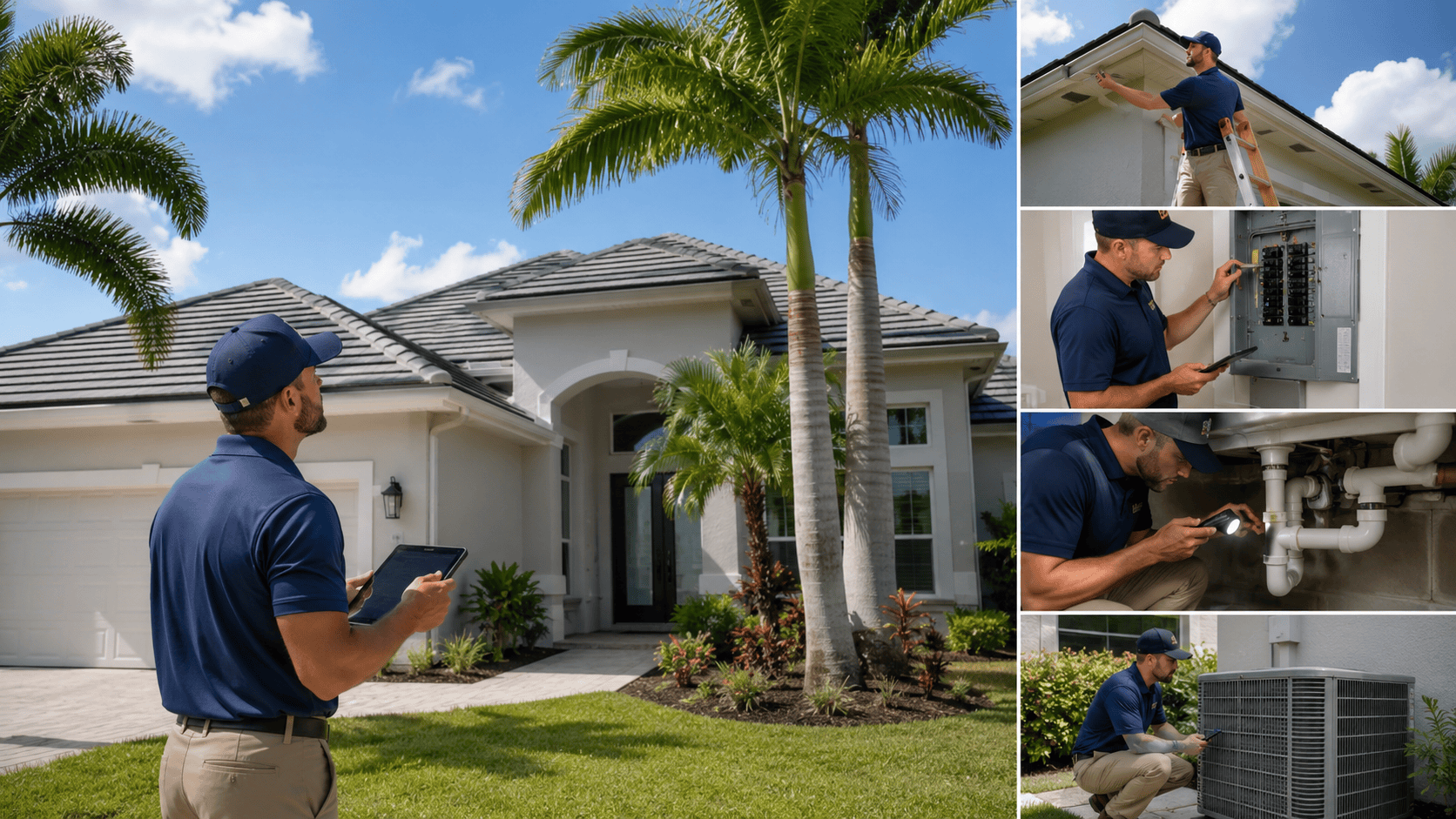
A Florida four-point inspection evaluates the visible condition of the roof, electrical system, plumbing system, and HVAC equipment for insurance underwriting purposes.
Roof Evaluation
The roof is often one of the most closely reviewed parts of a Florida four-point inspection.
The inspector may document:
-
Roofing material
-
Approximate installation date
-
Roof permit information
-
Number of roof sections
-
Overall condition
-
Remaining useful life
-
Missing or damaged materials
-
Visible patches or repairs
-
Active or previous leakage
-
Ceiling stains
-
Sagging or uneven areas
-
Deteriorated flashing
-
Problems near vents, skylights, walls, and penetrations
A home can have more than one roof age or covering. For example, the original structure may have an architectural-shingle roof while an addition has a flat or low-slope covering. Each section may need to be documented separately.
Roof Age Is Not the Only Consideration
Homeowners sometimes assume that a roof automatically passes or fails based on age.
Insurance companies generally consider both age and condition.
A newer roof may still create an underwriting concern when it has:
-
Active leakage
-
Missing shingles or tiles
-
Improper installation
-
Temporary patches
-
Visible deterioration
-
Unresolved repairs
An older roof may be acceptable to some companies when it is in serviceable condition, has sufficient remaining useful life, and meets the insurer’s requirements.
Common Roof Concerns
Frequently documented concerns include:
-
Missing, lifted, torn, or creased shingles
-
Cracked or broken tiles
-
Widespread granule loss
-
Curling or brittle shingles
-
Temporary tar or sealant repairs
-
Active ceiling or attic leakage
-
Water staining from previous leakage
-
Damaged or missing flashing
-
Sagging roof areas
-
Deteriorated decking
-
Tree branches contacting the roof
-
Debris blocking drainage
-
Flat-roof ponding or deterioration
A small repair may be sufficient in some situations. In others, the overall condition, material availability, roof age, or insurance-company guidelines may lead to a broader repair or replacement requirement.
Before authorizing expensive roof work solely for insurance purposes, confirm what documentation the insurer will accept.
Useful documents may include:
-
Roofing contract
-
Paid invoice
-
Permit
-
Final inspection
-
Contractor letter
-
Before-and-after photographs
-
Updated inspection report
For a more detailed explanation, read How Roof Age Affects Homeowners Insurance in Florida.
Electrical System Evaluation
The electrical portion identifies the type, age, capacity, and visible condition of the home’s electrical system.
The inspector may examine:
-
Main electrical service
-
Total amperage
-
Main panel
-
Subpanels
-
Panel manufacturer
-
Breakers or fuses
-
Wiring materials
-
Grounding
-
Visible conductor condition
-
Improper connections
-
Open junction boxes
-
Missing covers
-
Open knockouts
-
Double-tapped breakers
-
Corrosion
-
Evidence of overheating or arcing
-
Other visible hazards
The inspector may remove the electrical panel cover when doing so is safe and permitted. Clear access should be provided before the appointment.
Common Electrical Issues That May Affect Insurance
Exposed wiring
Open splices, missing junction-box covers, and exposed conductors may create shock hazards and increase fire risk.
Double-tapped breakers
A double tap generally occurs when two conductors are attached to a breaker designed for one. Some breakers are specifically listed for two conductors, so a qualified professional should determine whether the installation is actually improper.
Missing panel covers or openings
Missing breaker blanks, knockouts, or panel covers can expose energized components.
Overheating, arcing, or corrosion
Scorch marks, melted insulation, moisture, rust, discolored breakers, or burning may indicate a serious concern requiring prompt professional evaluation.
Fuse panels and older equipment
The presence of an older electrical panel or fuse system does not automatically mean the home is unsafe or uninsurable. Insurance companies may apply different eligibility requirements based on panel type, wiring type, condition, capacity, and other underwriting factors. If the inspection identifies a Federal Pacific Electric (FPE) panel or another older panel type, homeowners should ask the proposed insurer whether it is acceptable and what additional documentation, professional evaluation, repair, or replacement—if any—is required before authorizing expensive work.
Aluminum branch-circuit wiring
Not all aluminum wiring is treated the same. Underwriting concerns often focus on older single-strand aluminum branch-circuit wiring serving outlets, switches, lighting, and similar circuits. Citizens Property Insurance Corporation currently states that properties with multi-strand aluminum wiring are acceptable for coverage, while properties with single-strand aluminum branch-circuit wiring are not acceptable without approved remediation. Citizens identifies complete copper rewiring, COPALUM® crimp connections, and AlumiConn® connectors as acceptable remediation methods and requires documentation of the work. Private insurance-company requirements may differ.
Cloth Wiring and Other Outdated Wiring
Cloth wiring and other outdated wiring should be evaluated based on the wiring type, condition, grounding, modifications, and visible hazards. Exposed conductors, unsafe splices, overheating, or other electrical problems may increase fire risk and may require evaluation or repair by a licensed electrician. Insurance-company eligibility requirements vary.
When an electrical concern is found, an insurer may request:
-
Repair by a licensed electrician
-
Paid invoice
-
Contractor certification
-
Updated photographs
-
An amended inspection report
-
Panel replacement
-
Wiring remediation
-
Additional underwriting review
Do not replace an electrical panel solely because of a general assumption. First confirm the exact panel, wiring, condition, and proposed carrier’s requirements.
Serious electrical hazards should always be evaluated promptly by a properly licensed professional, regardless of the insurance outcome.
Plumbing System Evaluation
The plumbing portion helps the insurer assess the visible condition of the plumbing system and the potential for water damage.
The inspector may document:
-
Water-supply piping material
-
Drain, waste, and vent piping
-
Approximate system age
-
Visible pipes beneath sinks
-
Main water shutoff
-
Fixture shutoff valves
-
Corrosion
-
Active leakage
-
Evidence of previous leakage
-
Temporary repairs
-
Water-heater age and condition
-
Whether repiping was partial or complete
-
Dates and details of system updates
Plumbing Materials
Florida homes may contain:
-
Copper
-
PEX
-
CPVC
-
Galvanized steel
-
Polybutylene
-
PVC
-
Cast iron
-
ABS
-
Other materials associated with the property’s age
The presence of a particular material does not, by itself, determine whether a home qualifies for insurance.
The insurer may consider:
-
Material
-
Age
-
Condition
-
Leakage history
-
Extent of updates
-
Prior claims
-
Percentage replaced
-
Repair documentation
-
Evidence of deterioration
Common Plumbing Concerns
Active leaks
Examples include:
-
Dripping pipes
-
Leaking valves
-
Leaky faucets or fixture connections
-
Moisture under sinks
-
Leakage near toilets
-
Wet cabinetry
-
Water around appliances
-
Leaking water-heater connections
Even a small active leak should generally be corrected before submitting the report.
Evidence of previous leakage
Ceiling stains, swollen cabinets, damaged drywall, rust, deteriorated baseboards, or patched areas may cause the underwriter to request proof that the source was found and corrected.
Painting over a stain without repairing the cause will not resolve the underlying concern.
Corroded valves and connections
Severe corrosion may indicate deterioration, prior leakage, or a connection that could be more likely to fail.
Temporary repairs
Tape, improvised clamps, excessive sealant, unsupported connections, or makeshift patches may not satisfy underwriting.
Older piping materials
Some insurers apply restrictive guidelines to galvanized steel, polybutylene, deteriorated cast iron, or other older materials. Another insurer may evaluate the same system differently.
Partial repiping
A renovated kitchen or bathroom does not necessarily mean the entire home was repiped.
Useful proof of a complete or partial repipe includes:
-
Detailed plumbing invoice
-
Scope of work
-
Permit
-
Final inspection
-
Photographs taken during construction
-
Warranty
-
Plumber’s letter
-
Material description
-
Confirmation of the percentage replaced
Water Heater
The inspector may document:
-
Manufacturer
-
Approximate age
-
Fuel source
-
Capacity
-
Location
-
Visible condition
-
Leakage
-
Corrosion
-
Drain pan
-
Supply connections
-
Relief-valve components
-
Electrical or gas connections
Common concerns include rust, leakage, damaged drain pans, improperly installed discharge pipes, exposed wiring, and unsafe gas venting.
The water heater’s age alone may not make the home ineligible. Age combined with leakage, corrosion, or improper installation can create a more significant concern.
HVAC System Evaluation
The HVAC section assesses the home’s installed heating, ventilation, and air conditioning equipment.
The inspector may document:
-
Equipment type
-
Manufacturer
-
Approximate age
-
Indoor and outdoor components
-
Permanent heating source
-
Operational condition
-
Electrical connections
-
Refrigerant lines
-
Condensate drain
-
Drain pan
-
Visible leakage
-
Corrosion
-
Ductwork
-
Missing equipment covers
-
Temporary or portable equipment
-
Apparent hazards
The inspection is not a complete HVAC service call. The inspector generally does not add refrigerant, clean coils, measure efficiency, disassemble internal components, or guarantee future operation.
Common HVAC Concerns
The system does not operate
An inoperative system may require repair, replacement, or contractor certification.
No permanent heat source
A portable space heater is generally not treated the same as a permanently installed heating system. Carrier requirements vary depending on the home and equipment.
Condensate leakage
A clogged, disconnected, or damaged drain can release water into ceilings, walls, flooring, cabinets, or attic spaces.
Damaged or missing drain pan
A missing, rusted, cracked, improperly sized, or disconnected secondary drain pan can create water-damage concerns, especially when the air handler is located above finished space.
Corrosion
Light surface corrosion does not automatically require replacement. Extensive corrosion, leakage, structural deterioration, or damage near electrical components may require further evaluation.
Exposed electrical connections
Missing covers, damaged disconnects, improper splices, exposed conductors, and evidence of overheating should be corrected by qualified professionals.
Damaged ductwork
Visible disconnections, tears, missing insulation, heavy condensation, unsupported ducts, or improvised repairs may be documented.
Temporary equipment
Portable air conditioners, window units powered by extension cords, portable heaters used as the primary heat source, or temporary drainage arrangements can create underwriting concerns.
An older HVAC system may still be acceptable when it is in good working order, provides permanent heat, has no active leakage or visible electrical hazards, and appears professionally installed.
Common Problems That May Affect Insurance
Common underwriting concerns may include active roof or plumbing leaks, deteriorated roofing, exposed or unsafe electrical components, certain older wiring or piping materials, inoperative HVAC equipment, and incomplete or conflicting inspection documentation.
Because each insurance company uses its own guidelines, the significance of a finding depends on the property’s condition, available documentation, and the insurer reviewing the risk.
Four-Point Inspection vs. Wind Mitigation Inspection
These inspections serve different purposes.
Four-Point Inspection
A four-point inspection evaluates the condition and insurability of:
-
Roof
-
Electrical
-
Plumbing
-
HVAC
It is primarily an underwriting document.
Wind Mitigation Inspection
A wind mitigation inspection documents construction features that may help the home resist hurricane and wind damage, including:
-
Roof-deck attachment
-
Roof-to-wall connections
-
Roof shape
-
Secondary water resistance
-
Building-code compliance
-
Impact-rated windows and doors
-
Hurricane shutters
-
Garage-door protection
A wind mitigation inspection may qualify a homeowner for available wind-related credits that can reduce the windstorm portion of the homeowners insurance premium, depending on the home’s qualifying features and the insurer. A four-point inspection serves a different purpose: it helps an insurance company evaluate the condition of the home’s major systems and determine whether the property meets its coverage eligibility requirements.
Read Florida Wind Mitigation Inspection for a detailed explanation of hurricane-resistant construction features and potential insurance credits.
Should You Order Both at the Same Time?
Often, yes.
Potential benefits include:
-
One property appointment
-
Reduced package pricing
-
Faster completion
-
Consistent property information
-
Fewer scheduling delays
-
Earlier identification of underwriting concerns
-
Documentation of possible wind credits
The inspector should provide two separate signed reports.
Four-Point Inspection vs. Full Home Inspection
A four-point inspection does not replace a full home inspection. A 4-point inspection is narrower and focuses on four major systems for insurance purposes, while a full home inspection evaluates a much broader range of the property’s visible components and conditions.
A Four-Point Inspection Focuses On
-
Roof
-
Electrical
-
Plumbing
-
HVAC
-
Insurance underwriting information
A Full Home Inspection May Also Evaluate
-
Structure
-
Foundation
-
Exterior
-
Windows and doors
-
Interior surfaces
-
Appliances
-
Attic
-
Garage
-
Drainage
-
Stairs and railings
-
Safety concerns
-
Other visible property components
A favorable four-point report does not mean the entire property is free from defects.
Similarly, a detailed full home inspection may not replace the four-point report. The insurance company may need a specific form, photographs, system ages, roof-life information, panel documentation, and inspector certifications that are not included in the buyer’s full inspection.
A four-point inspection also does not determine a property’s flood zone, evaluate flood risk, or replace a separate flood insurance policy. Learn more in our Florida Flood Insurance Guide.
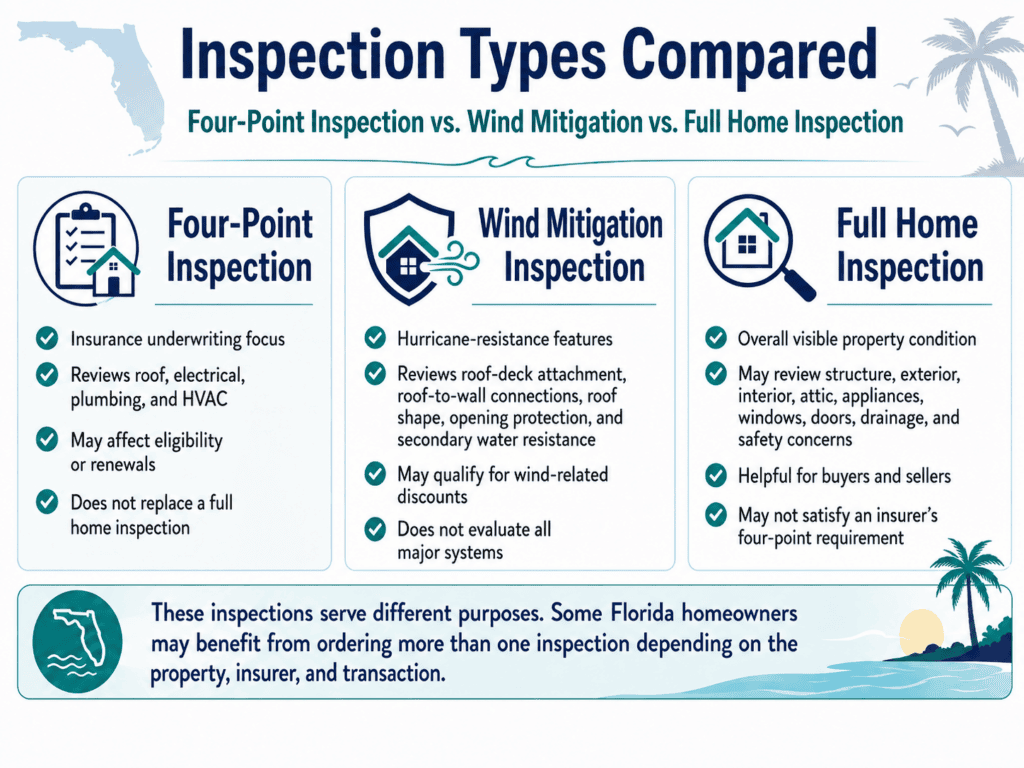
Four-point, wind mitigation, and full home inspections serve different purposes. Depending on the property and insurance company, a Florida homeowner may benefit from obtaining more than one inspection.
How Much Does a Four-Point Inspection Cost in Florida?
Prices vary by inspection professional, location, home size, property complexity, and whether other services are ordered at the same time.
According to the Florida Office of the Insurance Consumer Advocate, a standalone four-point inspection may typically cost approximately $100 to $300. If the inspection is performed together with a full home inspection, wind mitigation inspection, or other services, the inspector may offer package pricing.
Actual fees vary, so homeowners should confirm the price, what is included, and any potential reinspection or report-update fees before scheduling.
Factors affecting the price may include:
-
Square footage
-
Number of stories
-
Roof height and complexity
-
Multiple roof sections
-
Multiple electrical panels
-
Multiple HVAC systems
-
Multiple water heaters
-
Detached structures
-
Difficult attic access
-
Travel distance
-
Permit research
-
Expedited turnaround
-
Whether a return visit is necessary
The applicant or homeowner generally pays for the inspection. The Florida Department of Financial Services identifies it as an applicant-paid expense when an insurer requires one for an older home.
Ask about the full fee, report-delivery time, cancellation policy, and reinspection cost before scheduling.
How Long Does a Four-Point Inspection Take?
According to the Florida Office of the Insurance Consumer Advocate, a four-point inspection performed by a licensed inspection professional should generally take approximately one hour. The actual time may vary depending on the size, configuration, accessibility, and condition of the property.
It may take longer when the home has:
-
Multiple roof sections
-
More than one electrical panel
-
Multiple HVAC systems
-
Several water heaters
-
Additions
-
Difficult attic access
-
Inaccessible equipment
-
Multiple deficiencies requiring photographs
-
Missing property or permit information
The completed report may be delivered the same day, within 24 hours, or within several business days depending on the inspector and property.
Homebuyers should not wait until the day before closing. The report may reveal missing information or repairs requiring additional time.
How Long Is a Four-Point Inspection Valid?
There is no universal period for how long a four-point inspection remains acceptable to every Florida insurance company. Each insurer establishes its own requirements for the age of the report, photographs, property condition, and supporting documentation.
For Citizens Property Insurance Corporation new-business applications, a four-point inspection report generally must be dated within the 12 months before the application submission date. Citizens has shorter time requirements in certain situations, including some applications involving lender-placed coverage and properties with a prior sinkhole claim. Private insurance-company requirements may differ, so homeowners should confirm that an existing report will be accepted before ordering a new inspection or submitting an application.
Even when a report falls within an insurer’s normal acceptance period, updated information or documentation may be needed when:
-
The roof is replaced
-
Plumbing is repiped
-
The electrical panel is changed
-
HVAC equipment is replaced
-
The home is renovated
-
The property sustains damage
-
A system develops a new defect
-
Occupancy changes
-
The insurer identifies conflicting information
Before paying for another inspection:
-
Find the complete existing report.
-
Check the date.
-
Review the photographs.
-
Gather subsequent repair records.
-
Send everything to your insurance agent.
-
Ask whether the proposed company will accept it.
-
Confirm whether only an amendment or updated photograph is needed.
An annual insurance review can help confirm that inspection reports, roof records, system information, discounts, and policy details remain current.
Who Can Perform a Four-Point Inspection in Florida?
The four-point inspection should be completed, signed, and dated by a verifiable Florida-licensed professional who meets the requirements of the insurance company reviewing the report.
For Citizens Property Insurance Corporation, acceptable examples include:
-
Florida-licensed home inspector
-
General contractor
-
Residential contractor
-
Building contractor
-
Building code inspector
-
Registered architect licensed by the State of Florida
-
Professional engineer licensed by the State of Florida
-
Building code official authorized by the State of Florida to verify building code compliance
A trade-specific licensed professional may sign only the section of the four-point inspection form that applies to that professional’s trade. For example, a licensed electrician may sign the electrical section. The completed report must still satisfy the form, documentation, signature, and licensing requirements of the insurance company reviewing it.
Before hiring an inspection professional, homeowners can verify a Florida license through the Florida Department of Business and Professional Regulation. Confirming that the license is current and matches the individual performing or signing the inspection can help prevent delays when the report is submitted for insurance underwriting.
Before hiring an inspector, ask:
-
What Florida license do you hold?
-
What is your license number?
-
Do you regularly perform insurance four-point inspections?
-
Do you use the current form?
-
Is your report accepted by the proposed insurer?
-
Are all required photographs included?
-
Do you photograph the open electrical panel when safe?
-
Do you document each roof section?
-
Do you research permits?
-
How quickly will the report be delivered?
-
Can you amend the report after repairs?
-
What does a return inspection cost?
-
Do you offer package pricing with wind mitigation?
An insurance agent can explain why the inspection is required, review the completed report, and submit it to underwriting. An insurance license alone does not qualify an agent to certify the physical condition of the home.
The homeowner should not complete or alter the form.
What Happens During a Four-Point Inspection?
During a four-point inspection, the inspector will need safe access to several parts of the property to evaluate the four major systems, document visible conditions, and take the photographs needed for the inspection report.
Exterior and Roof
The inspector may photograph each side of the dwelling and each roof slope, review visible roofing materials and damage, and look for evidence of leakage. Roof access methods depend on height, pitch, weather, materials, and safety conditions.
Electrical
The inspector may document the panel manufacturer, electrical capacity, wiring materials, grounding, visible hazards, and required panel photographs. Electrical panels should be safely accessible.
Plumbing
The inspector may review visible supply and drain lines, fixtures, leaks, corrosion, exposed valves, under-cabinet plumbing, and the water heater. The inspection does not normally involve opening walls or inspecting underground pipes with cameras.
HVAC
The inspector may operate accessible controls, identify the permanent heating source, photograph heating and air conditioning equipment and data labels, and document visible drainage, leakage, corrosion, ductwork, or equipment concerns.
Interior
Interior observations may include ceiling or wall stains, moisture, damaged finishes, visible electrical hazards, previous plumbing repairs, and other evidence of water intrusion.
How to Prepare for a Four-Point Inspection
Preparing the home and gathering available documentation before the appointment can reduce delays, missing information, and incomplete inspection reports.
Provide Access
Make sure the inspector can safely reach:
-
Electrical panels
-
Subpanels
-
Plumbing beneath sinks
-
Water heater
-
HVAC air handler
-
Exterior condenser
-
Main water shutoff
-
Attic access
-
Garage
-
Interior ceilings
-
Areas where prior leaks or repairs occurred
Before the appointment, move boxes, furniture, and stored items away from these areas when it can be done safely so the inspector has clear access to the systems and components that need to be documented.
Activate Utilities
When safe and practical, make sure:
-
Electricity is on
-
Water is on
-
Gas service is available when needed
-
HVAC controls are accessible
Do not activate utilities or operate equipment that is damaged, leaking, shut off for safety reasons, or appears unsafe solely to complete the inspection. If electrical, gas, plumbing, or HVAC service needs to be restored or evaluated, use the appropriate utility provider or properly licensed professional when required.
Gather Documentation
Useful records include:
-
Roof contract and permit
-
Final roof inspection
-
Electrical invoices
-
Panel replacement documents
-
Plumbing and repiping invoices
-
Plumbing permits
-
Water-heater receipt
-
HVAC invoices and permits
-
Warranty documents
-
Contractor certifications
-
Prior inspection reports
-
Renovation photographs
-
Closing documents
-
Proof of completed repairs
A verbal statement that a roof or major system was replaced may not be sufficient when an insurance company needs to verify the installation or replacement date. Permits, paid invoices, final inspections, contractor records, and other supporting documentation can help establish when the work was completed.
Address Obvious Active Problems Safely
Before the inspection, obvious active leaks, visible hazards, or incomplete repairs may be worth addressing when practical. Repairs involving electrical, roofing, plumbing, HVAC, or other regulated work should be performed by appropriately licensed professionals when required.
-
Active plumbing leaks
-
Exposed wiring
-
Missing electrical covers
-
Leaking water heater
-
Clogged HVAC drain
-
Active roof leak
-
Missing roof materials
-
Improvised repairs
-
Open junction boxes
-
Damaged shutoff valves
Do not authorize a major roof replacement, repiping project, electrical-panel replacement, or HVAC replacement solely because you assume an insurance company will require it. If the condition does not present an immediate safety concern, first confirm the insurer’s exact requirement and whether repair, additional documentation, professional certification, or complete replacement is actually necessary.
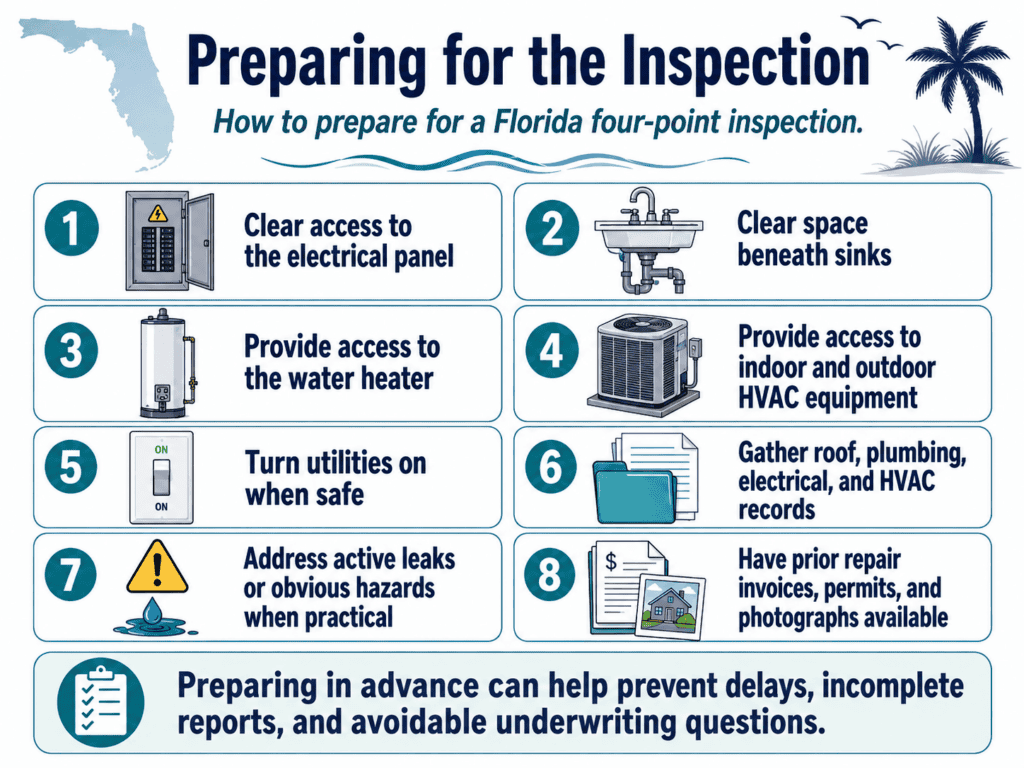
Before a four-point inspection, provide access to the home’s major systems, gather available repair and permit records, turn on utilities when safe, and address obvious active leaks or hazards when practical.
What Happens After the Inspection?
After the inspection, the homeowner should receive a complete copy of the signed inspection report and review it for completeness and obvious factual errors. If information needs to be corrected, the homeowner should ask the licensed inspection professional to make and authenticate the correction rather than altering the report personally.
Review the report for:
-
Correct property address
-
Inspection date
-
Inspector signature
-
License information
-
All report pages are included
-
Roof age
-
Required dwelling and roof photographs
-
Remaining useful life when required
-
Required electrical-panel photographs
-
Wiring type
-
Plumbing materials
-
Water-heater information
-
Required plumbing, water-heater, HVAC, and deficiency photographs
-
HVAC ages
-
System updates
-
All noted deficiencies
-
Explanations of visible stains
-
Consistency between answers and photographs
Send the complete signed inspection report, including the required photographs and any relevant supporting documentation, to your insurance agent rather than submitting only selected pages.
After reviewing the inspection report and any supporting documentation, the insurance company or underwriter may:
-
Accept the property
-
Request clarification
-
Ask for additional photographs
-
Require repair documentation
-
Request contractor certification
-
Require an amended report
-
Require system repair or replacement
-
Offer coverage subject to applicable terms
-
Decline the property under that insurer’s guidelines
A four-point inspection is not a universal pass-or-fail test. The licensed inspection professional documents the property’s visible condition and findings, while the insurance company determines whether the property meets its underwriting and coverage eligibility requirements.
The same property may be accepted by one insurer, require repairs with another, and be ineligible with a third.
Meeting an insurance company’s underwriting requirements does not mean every type of damage involving the roof, electrical, plumbing, or HVAC systems will be covered. Homeowners policies contain exclusions, limitations, and conditions that can affect coverage. Learn more in What Homeowners Insurance Does Not Cover in Florida.
What to Do When a Four-Point Inspection Finds a Problem
1. Identify the exact concern
Identify whether the underwriting concern involves the physical condition of the property, a potential safety hazard, a system characteristic, or missing or inconsistent documentation.
-
Active hazard
-
Physical condition
-
System age
-
Material type
-
Incomplete documentation
-
Missing photograph
-
Conflicting information
-
Insufficient remaining useful life
2. Confirm what the insurance company requires
Do not assume that a complete system replacement is necessary simply because the inspection identifies a concern. First confirm the insurance company’s exact underwriting requirement and whether the issue can be addressed through a repair, additional documentation, professional certification, updated photographs, or an amended inspection report.
The insurer may request:
-
Repair
-
Licensed contractor certification
-
Paid invoice
-
Permit
-
Final inspection
-
Updated photographs
-
Amended four-point report
-
Complete system replacement
3. Use a properly licensed professional when required
When repairs are required, roofing, electrical, plumbing, HVAC, structural, and other regulated work should be performed by appropriately licensed professionals when required by Florida law. Homeowners should keep the contractor’s license information and documentation showing what work was completed.
4. Keep detailed records
Save:
-
Proposals
-
Contracts
-
Paid invoices
-
Permits
-
Final approvals
-
Before-and-after photographs
-
Contractor letters
-
Warranties
-
Proof of payment
-
Product and model information
Keep these records together with the inspection report. Depending on the insurer and the type of work completed, underwriting may request photographs, paid invoices, permits, final inspections, contractor documentation, or other proof that the identified condition was corrected.
5. Have the report amended when necessary
After repairs or corrections are completed, the original inspection professional may need to review the supporting documentation, verify the corrected condition, and update the inspection report when required by the insurance company. Depending on the situation, the inspector may need to:
-
Review invoices
-
Review repair photographs
-
Return to the property
-
Confirm the correction
-
Update the findings
-
Sign and date an amended report
Do not alter, edit, or attempt to correct the signed inspection report yourself. Corrections or amendments should be made and authenticated by the appropriately licensed inspection professional.
Distinguish a Documentation Problem From a Property Problem
Some underwriting concerns are documentation problems—such as a missing photograph, unknown system age, missing permit, or unverified repair—rather than physical defects. These issues may sometimes be resolved by providing the missing information without performing unnecessary construction.
Documentation is not a substitute for correcting an actual hazard. Active leaks, overheating, arcing, unsafe gas venting, standing water near electrical equipment, severe roof deterioration, and similar conditions should be appropriately addressed by qualified professionals regardless of the insurance outcome.
Four-Point Inspections When Buying or Selling a Home
For Buyers
Contact an insurance agent early in the purchase process so there is time to determine whether a four-point inspection is required, review the completed report, address underwriting questions, and secure acceptable homeowners insurance before closing.
The report may affect:
-
Insurance eligibility
-
Available insurers
-
Repair requirements
-
Ability to satisfy the lender’s insurance requirements
-
Closing date
-
Negotiations with the seller
When the purchase contract and timing allow, try to complete any required insurance inspection early enough in the contractual inspection period to identify insurance-related concerns before important inspection, financing, or closing deadlines.
Do not rely on a four-point inspection as your only property inspection. A four-point inspection is designed primarily for insurance underwriting and does not replace a comprehensive full home inspection for the buyer’s broader evaluation of the property.
For Sellers
A seller of an older home may choose to obtain a four-point inspection before listing to identify potential insurance-related concerns and gather useful property documentation before a buyer begins the insurance process.
-
Identify conditions that may create underwriting questions
-
Gather missing permits
-
Correct active leaks
-
Repair visible hazards
-
Document system upgrades
-
Reduce last-minute closing delays
The seller should discuss disclosure obligations with a qualified real-estate professional or attorney.
Using the Seller’s Report
A buyer should review:
-
Report date
-
Inspector qualifications
-
Completeness
-
Whether repairs were made afterward
-
Whether the proposed insurer will accept it
-
Whether the property has changed
-
Whether an independent inspection is appropriate
A seller-provided four-point inspection can be useful, but the buyer should not assume that every insurance company will accept it or that it reflects the property’s current condition. Before relying on the report, have the proposed insurance company or agent confirm that its date, form, photographs, inspector credentials, and supporting documentation meet the insurer’s requirements.
Negotiating Repairs
A four-point inspection or subsequent insurance review may identify a condition that affects the buyer’s ability to obtain acceptable coverage, including:
-
Active roof leak
-
Roof condition or remaining-useful-life concern
-
Electrical hazard
-
Plumbing material restriction
-
Leaking water heater
-
Inoperative HVAC system
-
No permanent heat
A seller credit or price adjustment may help the buyer with the cost of repairs, but it may not resolve an insurance eligibility issue when the proposed insurer requires the work to be completed and documented before coverage can begin.
Buyers should coordinate early with their insurance agent, real-estate professional, lender, inspection professional, and appropriate contractors so insurance requirements, repairs, documentation, financing requirements, and closing deadlines can be addressed together.
Buyers of recently built properties may also find New Construction Insurance in Florida helpful when preparing for closing and comparing coverage.
Frequently Asked Questions About Four-Point Inspections in Florida
1. What is a four-point inspection?
It is a limited insurance inspection of the roof, electrical system, plumbing system, and HVAC system.
2. Why does an insurance company require one?
The insurer uses it to evaluate the visible condition, age, materials, updates, and potential hazards associated with the home’s major systems.
3. At what age does a Florida home need a four-point inspection?
There is no universal age threshold used by every Florida insurance company. Private insurers establish their own underwriting requirements. Citizens currently requires a four-point inspection for new-business submissions involving homes more than 20 years old, while renewal inspections may be requested by Underwriting on a case-by-case basis.
4. Does Citizens require a four-point inspection?
Yes. Citizens currently requires a four-point inspection for new-business submissions involving homes more than 20 years old. The report generally must be dated within the 12 months before the application submission date and completed by a verifiable Florida-licensed inspector. Underwriting may request a four-point inspection for a renewal policy on a case-by-case basis.
5. Does every private insurance company require one?
No. Each company establishes its own age thresholds, forms, photographs, system requirements, and acceptance standards.
6. Can a newer home require one?
Yes. Prior losses, renovations, vacancy, inconsistent records, visible damage, or another underwriting concern may cause an insurer to request one.
7. Does a four-point inspection replace a full home inspection?
No. A four-point inspection is narrower and focuses on four major systems primarily for insurance purposes. A full home inspection evaluates a much broader range of the property’s visible systems and components and is important for a buyer’s broader understanding of the home.
8. Does a full home inspection replace a four-point inspection?
Not necessarily. The insurer may require a specific form, photographs, system ages, roof-life information, and inspector certification.
9. Is a four-point inspection the same as a wind mitigation inspection?
No. A four-point inspection primarily helps an insurance company evaluate property condition and coverage eligibility. A wind mitigation inspection documents qualifying wind-resistant features and may result in credits or discounts affecting the windstorm portion of the homeowners insurance premium.
10. Should I order both inspections together?
If you need both inspections, scheduling them during the same appointment may save time and may reduce the total inspection cost when package pricing is available. The inspector should still provide two separate reports because the inspections serve different purposes.
11. How long does the inspection take?
A four-point inspection performed by a licensed inspection professional should generally take approximately one hour. Larger, more complex, or difficult-to-access properties may take longer.
12. How much does it cost?
According to the Florida Office of the Insurance Consumer Advocate, a standalone four-point inspection may typically cost approximately $100 to $300. Actual prices vary by inspector, property, location, and services requested, and package pricing may be available when multiple inspection services are ordered together.
13. Who normally pays for it?
The homeowner or insurance applicant generally pays. During a home purchase, the buyer and seller may negotiate a different arrangement.
14. Who can perform the inspection?
The insurer generally requires a verifiable Florida-licensed professional. For Citizens, acceptable examples include a Florida-licensed home inspector, general, residential, or building contractor, building code inspector, registered architect, professional engineer, or qualifying building code official. Private insurance-company requirements may differ.
15. Does the home pass or fail?
A four-point inspection is not a universal pass-or-fail test. The licensed inspection professional documents the property’s visible condition and findings, while the insurance company determines whether the home meets its underwriting and coverage eligibility requirements.
16. Can an old roof automatically fail?
No. Roof age alone does not automatically determine the insurance outcome. Florida law generally prohibits a homeowners insurer from refusing to issue or renew a policy solely because a roof is less than 15 years old. For a roof that is at least 15 years old, the insurer must allow the homeowner to obtain an authorized roof inspection before requiring replacement based solely on age. If that inspection shows at least five years of remaining useful life, the insurer generally may not refuse coverage solely because of the roof’s age. Other lawful underwriting considerations may still apply.
17. Will older electrical wiring automatically make the home uninsurable?
Not automatically. The insurer may consider the exact wiring type, condition, grounding, modifications, documentation, and other property characteristics.
18. Does polybutylene, galvanized steel, or cast-iron plumbing automatically disqualify the property?
Not under every insurer. Carrier guidelines differ, although certain materials may receive additional scrutiny or require repairs, replacement, or documentation.
19. Can repairs be completed after the inspection?
Often, yes. If the insurance company allows the identified condition to be corrected after the initial inspection, underwriting may require paid invoices, permits, photographs, contractor certifications, an amended inspection report, or other documentation before the property is accepted.
20. Can the original inspector update the report?
Often, yes. The inspector may review documentation, return to the property, confirm repairs, and issue an amended report.
21. Can I edit the report myself?
No. Corrections should be made and authenticated by the licensed inspector.
22. How long is the report accepted?
For Citizens new-business applications, a four-point inspection report generally must be dated within the 12 months before the application submission date, although shorter time requirements apply in certain situations. Private insurance-company requirements vary.
23. Can I use the same report with several insurance companies?
Possibly. Each insurer decides whether the form, date, photographs, inspector credentials, and content meet its requirements.
24. What should I do immediately after receiving the report?
Review the complete signed report for accuracy and missing information, but do not alter it yourself. Then send the entire report, including the required photographs and any relevant supporting documentation, to your insurance agent promptly.
25. Can First Florida Agency review my inspection?
Yes. First Florida Agency can review the report, identify apparent documentation or underwriting concerns, compare available carrier requirements, and help submit updated materials. Final eligibility decisions belong to the insurance company.
26. Can a four-point inspection lower my homeowners insurance premium?
Not necessarily. A four-point inspection is primarily used for underwriting and coverage eligibility rather than as a premium-discount inspection. A separate wind mitigation inspection may identify qualifying wind-resistant features that can result in credits or discounts affecting the windstorm portion of the homeowners insurance premium.
How First Florida Agency Can Help
A four-point inspection can become confusing when the report contains technical terms, missing information, photographs that raise underwriting questions, or conditions that may require additional documentation or repairs.
At First Florida Agency, we can help you:
-
Determine whether a four-point inspection may be required
-
Review an existing inspection report for apparent documentation or underwriting concerns
-
Identify missing, incomplete, or inconsistent information
-
Help distinguish a documentation issue from a condition that may require repair
-
Review available repair documentation, photographs, permits, and amended reports
-
Confirm whether an existing inspection may meet a proposed insurance company’s requirements
-
Help submit requested inspection or repair documentation to underwriting
-
Discuss whether a wind mitigation inspection may also be beneficial
-
Compare available Florida homeowners insurance options based on the property and individual circumstances
We do not perform property inspections, diagnose construction defects, prescribe repairs, or replace the professional advice of licensed inspectors and contractors.
The insurance company makes the final decision concerning eligibility, required repairs, and report acceptance.
Request Help With a Four-Point Inspection
Whether you are purchasing an older Florida home, changing insurance companies, responding to a nonrenewal, or working through an inspection-related underwriting concern, starting early can provide more time to review the report, gather missing documentation, complete any required repairs, and compare available homeowners insurance options.
Call First Florida Agency at 904-822-8800 or request an insurance quote online if you need help reviewing a four-point inspection, addressing an underwriting concern, or comparing available Florida homeowners insurance options.
First Florida Agency
90 Fort Wade Road, Suite 100
Ponte Vedra, FL 32081
Your Nocatee Neighbor. Your Insurance Advocate.
Nocatee families may also find our Home and Auto Insurance in Nocatee, Florida (2026 Guide) helpful when reviewing their broader personal insurance needs.
About the Author
John Closterides is the Founder and Principal Agent of First Florida Agency and a Florida-licensed 2-20 General Lines insurance agent. Based in Ponte Vedra, Florida, he works with homeowners, families, and business owners throughout Florida.
With more than a decade of insurance industry experience, John helps clients understand coverage options, underwriting requirements, and the practical insurance considerations that can affect their homes, vehicles, and businesses.
John works with homeowners, auto, flood, umbrella, and commercial insurance and regularly helps clients navigate Florida-specific insurance issues involving property underwriting, roof age, four-point inspections, wind mitigation, flood exposure, and changing carrier requirements. As a local independent insurance agent serving Nocatee, Ponte Vedra, Ponte Vedra Beach, St. Johns County, Northeast Florida, and communities throughout the state, he brings practical insurance experience to the topics covered in First Florida Agency’s educational guides.
As an independent insurance agency, First Florida Agency works with a broad range of insurance companies and insurance markets, helping clients compare available coverage options based on their property, insurance needs, and individual circumstances.
Recommended External Resources
For additional information about four-point inspections, Florida insurance requirements, inspection forms, and professional licensing, consult these official resources:
-
Citizens: Who Can Complete and Sign the Four-Point Inspection Form?
-
Florida Office of the Insurance Consumer Advocate: Four-Point Inspection Guide
-
Florida Department of Business and Professional Regulation: Verify a License
Related Articles
Continue learning about Florida homeowners insurance, inspections, underwriting, and coverage with these related guides from First Florida Agency:
Insurance Disclaimer
The information in this article is provided for general educational purposes only and should not be considered insurance, legal, financial, construction, inspection, engineering, electrical, plumbing, roofing, HVAC, or real-estate advice.
Insurance eligibility, inspection requirements, acceptable forms, system-age guidelines, required repairs, premiums, discounts, coverage terms, underwriting decisions, and report-acceptance periods vary by insurance company, property, policy form, and individual circumstances.
A four-point inspection is limited to the systems and conditions observed by the inspector. It does not guarantee that a home is free from hidden defects, safe, code-compliant, insurable, or protected from future damage.
No coverage is created or modified by this article. The terms, conditions, exclusions, endorsements, and declarations of the issued insurance policy control.
Consult a licensed insurance professional and, when appropriate, a properly licensed home inspector, contractor, electrician, plumber, roofer, HVAC professional, engineer, attorney, real-estate professional, or other qualified adviser regarding your specific circumstances.