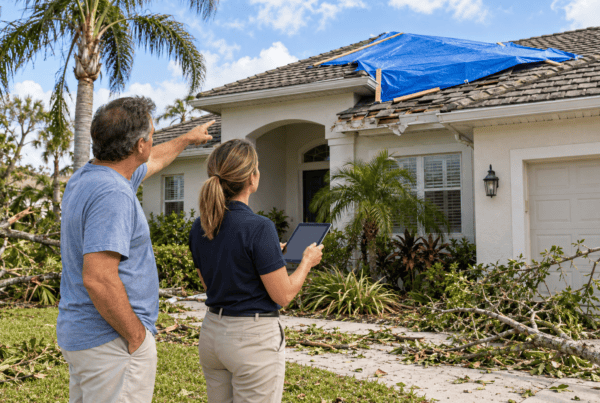

A named tropical storm passes through Northeast Florida, damaging your roof and leaving water stains on the ceiling. You look at your homeowners policy and see a $2,500 All Other Perils deductible. But does that deductible apply, or could a separate storm deductible leave you responsible for thousands more?
The answer depends on more than the storm’s name. A tropical storm can receive an official name without ever becoming a hurricane. Two policies that both show a 2% storm-related deductible can treat the same covered wind loss differently.
As a Florida-licensed insurance agent, one question I encourage homeowners to ask before choosing a policy is: “What deductible would apply if a named tropical storm damaged my roof but never became a hurricane?” The answer tells you something the percentage alone cannot.
Quick Answer: What Is the Difference Between a Named-Storm Deductible and a Hurricane Deductible?
A Florida hurricane deductible applies to covered hurricane losses when the applicable legal and policy conditions are met. A named-storm deductible may have a broader trigger and can apply to a named tropical storm that never becomes a hurricane if the policy includes that event. Not every Florida homeowners policy has a named-storm deductible.
If a tropical storm never becomes a hurricane and your policy has no separate named-storm, windstorm, or other applicable deductible, the All Other Perils deductible may apply to otherwise covered wind damage. Start with your declarations page for the dollar amounts, then check the policy and endorsements to see what triggers each deductible.
What Is a Hurricane Deductible in Florida?
A hurricane deductible is the portion of a covered hurricane loss you are responsible for under your policy. If the amount of covered damage does not exceed the applicable deductible, the insurer generally does not owe a payment for that loss. That does not mean the damage is irrelevant: a covered loss below the deductible may count toward the calendar-year hurricane deductible when the applicable rules are met.
Hurricane deductibles on Florida homeowners policies are often calculated as a percentage of the Coverage A dwelling limit. Some policies use a fixed dollar amount instead.
For example, if the dwelling limit is $500,000 and the hurricane deductible is 2% of that limit, the deductible is $10,000. The percentage is applied to the insured dwelling limit in this example, not to the repair estimate, purchase price, or market value of the home.
For more information on how percentages translate into dollars and how the deductible works after multiple hurricanes, read our guide, Florida Hurricane Deductibles Explained.
What Is a Named-Storm Deductible?
A named-storm deductible is a separate deductible that may apply to covered damage caused by a storm that meets the policy’s definition and triggering conditions. Depending on the wording, those events may include named tropical storms as well as hurricanes. A storm’s name alone does not establish that the deductible applies or that the damage is covered.
Named-storm endorsements can differ in how they define a qualifying storm, when the deductible starts and ends, what property value a percentage is based on, and how often the deductible can apply. Some use a fixed dollar amount. Others use a percentage based on a value specified in the policy.
The National Association of Insurance Commissioners’ guide to named-storm deductibles explains that these deductibles can operate per event, per season, or per calendar year. That is a reason to read the endorsement, not a reason to assume that every arrangement is available or works the same way on every Florida policy.
Named Storm vs. Hurricane Deductible: Side-by-Side Comparison
The following comparison illustrates the general differences homeowners should understand.

The key distinction is what triggers the deductible. A named tropical storm that never becomes a hurricane does not trigger Florida’s statutory hurricane deductible, but it may trigger a named-storm deductible under the policy.
A qualifying hurricane can fall within a policy’s definition of a named storm. That does not mean two deductibles automatically apply to the same loss. The applicable Florida rules, policy wording, cause of damage, and timing must be considered together.
When Does Florida’s Hurricane Deductible Apply?
Section 627.4025, Florida Statutes, defines a hurricane for residential insurance purposes as a storm system the National Hurricane Center has declared to be a hurricane. Under that statute, the Florida hurricane period:
-
Begins when the National Hurricane Center issues a hurricane warning for any part of Florida.
-
Ends 72 hours after the last hurricane watch or hurricane warning for any part of Florida is terminated.
Notice the distinction: a hurricane warning starts the statutory period. The last hurricane watch or warning is used to determine when the period ends. The start is not tied to when the storm receives a name, when it makes landfall, or when warnings are issued for your particular county.
Timing alone is not enough. The damage must also result from the hurricane-related windstorm and otherwise be covered. For example, interior rain damage can fall within hurricane coverage when the windstorm first damages the building and creates an opening through which rain enters. Flooding from rising water or storm surge is a separate issue.
What Happens If a Hurricane Weakens Into a Tropical Storm?
The hurricane deductible may still apply. If the National Hurricane Center declared the system a hurricane, and the covered hurricane-related damage occurs during Florida’s statutory hurricane period, a downgrade to tropical-storm status does not automatically switch the claim to the All Other Perils deductible.
For example, winds in Nocatee or Jacksonville might be below hurricane strength by the time the storm reaches the area. What matters is the official designation of the storm system, the applicable Florida warning period, the cause and timing of the damage, and the policy in force.
Can a Named-Storm Deductible Use a Different Time Period?
Yes. A named-storm provision can define its own triggering conditions, subject to applicable law. It may refer to an official designation, particular watches or warnings, a geographic area, or a specified time window. Do not assume it uses Florida’s statutory hurricane period or that it begins as soon as a storm is named.
Three Florida Storm Scenarios That Show Why the Difference Matters
Scenario 1: A Named Tropical Storm Never Becomes a Hurricane
A named tropical storm brings damaging winds to Ponte Vedra Beach but never reaches hurricane status. On a policy with a hurricane deductible and no other applicable special deductible, the All Other Perils deductible may apply to covered wind damage.
A second homeowner could have a named-storm endorsement that includes this event. The damage could be similar, but that homeowner may owe a different deductible.
Scenario 2: A Hurricane Weakens Before Reaching Northeast Florida
The National Hurricane Center declares a storm a hurricane and issues a hurricane warning for part of Florida. The storm later weakens to a tropical storm and damages a roof in St. Augustine while the statutory hurricane period remains in effect.
The hurricane deductible may apply to the covered hurricane-related wind damage. The fact that the storm was weaker when it reached the home does not, by itself, make the standard deductible applicable.
Scenario 3: An Unnamed Thunderstorm Damages a Roof
An afternoon thunderstorm sends damaging wind gusts through St. Johns County. The storm is not part of a named tropical system or a hurricane. Strong wind alone does not trigger a hurricane or named-storm deductible.
The All Other Perils deductible may apply to covered damage, but a separate windstorm, wind/hail, or roof deductible could change the outcome if the policy and applicable law permit it.
How Much Could the Deductible Difference Cost a Florida Homeowner?
Consider a home with a $600,000 Coverage A dwelling limit, a $2,500 All Other Perils deductible, and $25,000 in wind damage. Both hypothetical policies show a 2% storm-related deductible calculated on the same dwelling limit. In dollars, that 2% is $12,000.
Policy A has a 2% hurricane deductible and no separate named-storm or other windstorm deductible. Policy B has a 2% named-storm deductible that applies to the qualifying named tropical storm in this example. The storm never becomes a hurricane. Assume the wind loss is otherwise fully covered and no other deductible or claim limitation changes the calculation.
Example: Damage From a Named Tropical Storm That Never Becomes a Hurricane
Assume the $25,000 wind loss is otherwise fully covered and no other deductible or claim limitation affects the calculation.
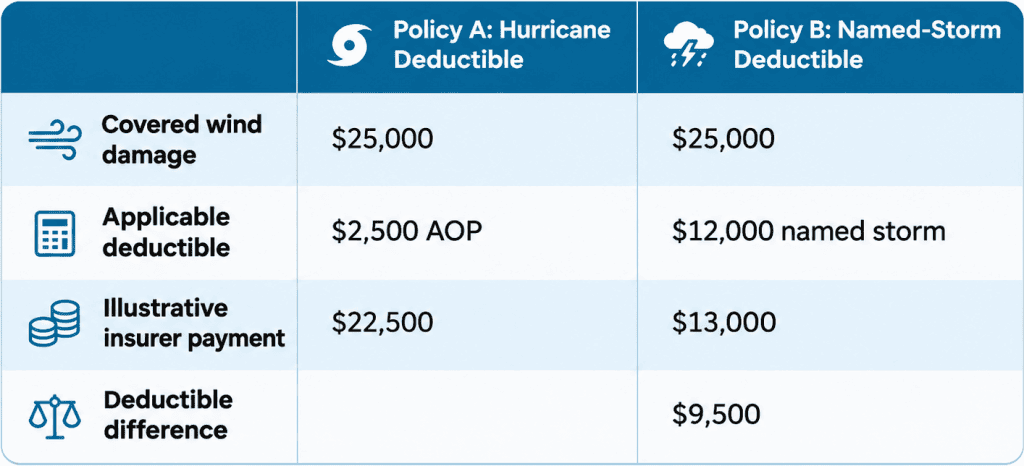
In this example, Policy A leaves the homeowner responsible for $2,500, while Policy B requires the homeowner to absorb $12,000 of the same covered loss. That is a $9,500 difference in out-of-pocket responsibility, even though both policies advertise a 2% storm-related deductible.
These are hypothetical policies, not examples of specific insurer products. The comparison isolates one variable: whether the separate 2% deductible applies to a named tropical storm that never becomes a hurricane.
What If the Storm Qualifies as a Hurricane?
If the same $25,000 covered loss resulted from a qualifying hurricane windstorm during Florida’s statutory hurricane period, Policy A’s $12,000 hurricane deductible would apply if the full deductible were still in effect for that loss.
You cannot determine Policy B’s hurricane treatment from the “named-storm” label alone. Its hurricane and named-storm provisions must be read together with applicable law. The Florida Department of Financial Services’ hurricane deductible guidance explains that when a hurricane deductible is applied, another deductible under the same policy cannot also be applied to that loss.
If the applicable deductible were $12,000 and no other claim provision changed the calculation, the illustrative insurer payment would be $13,000. The useful comparison is not just whether both quotes show 2%, but which events trigger that percentage and whether any part of the deductible has already been satisfied.
Do Storm Deductibles Apply Once Per Year or After Every Storm?
Florida’s Calendar-Year Hurricane Deductible
Under Section 627.701(5), Florida Statutes, the hurricane deductible on qualifying personal lines residential policies applies on a calendar-year basis to covered hurricane losses under policies issued by the same insurer or an insurer in the same group. The calendar year runs from January through December, even if your policy renews in another month.
For a later covered hurricane loss that same calendar year, the insurer may apply the greater of the remaining hurricane deductible or the deductible applicable to perils other than hurricanes. Once the full hurricane deductible has been satisfied, a later covered hurricane claim is not necessarily deductible-free: the applicable nonhurricane deductible can still apply.
For example, suppose your hurricane deductible is $12,000 and your insurer credits $5,000 in covered damage from the first hurricane toward it. That leaves $7,000. If another hurricane causes a covered loss that calendar year, you remain with the same insurer or insurer group, and the applicable nonhurricane deductible is $2,500, the insurer may apply the greater amount: $7,000.

In this example, $5,000 in covered damage from the first hurricane counts toward the annual deductible. If a second hurricane causes a covered loss in the same calendar year with the same insurer or insurer group, the remaining $7,000 is compared with the $2,500 nonhurricane deductible.
Report suspected hurricane damage promptly in accordance with your policy’s notice requirements, even if the first repair estimate appears lower than your deductible. Reporting gives the insurer an opportunity to document covered damage and determine what counts toward the calendar-year deductible. Keep photographs, estimates, and repair records in case additional damage is discovered later.
If you switch to an unrelated insurer during the year, do not assume that the amount credited under your old policy will carry over. For more information on reporting and documenting storm damage, read our Florida Hurricane Insurance Claims Guide for Homeowners.
Does a Named-Storm Deductible Follow the Same Rule?
Not necessarily. The named-storm endorsement may specify a per-event, seasonal, or calendar-year arrangement. If it applies per event, two separate qualifying storms could each trigger a deductible. If the loss qualifies as a hurricane, applicable Florida hurricane-deductible rules must still be considered.
One practical question to ask is: “If two named tropical storms that never become hurricanes damage my home in the same year, would this deductible apply to both?”
How Do Citizens and Private Insurers Handle Storm Deductibles?
Citizens Property Insurance Corporation
Citizens’ published deductible guidance distinguishes among Hurricane, All Other Perils, and Other Windstorm deductibles. Under Citizens’ multiperil policies, covered nonhurricane windstorm damage generally falls under the All Other Perils deductible. A Citizens wind-only policy may instead have an Other Windstorm deductible for covered damage caused by events such as a tropical storm, tornado, or hailstorm that does not qualify as a hurricane loss.
“Other Windstorm” is not another name for “named storm.” An Other Windstorm provision can apply to covered events that do not have an official name. Check your Citizens declarations page and policy form to confirm the deductible that applies to your coverage.
Private Insurance Companies
Private-market policies can differ in how they treat wind and hurricane losses. One policy may use a hurricane deductible and an All Other Perils deductible. Another may contain separate windstorm or named-storm wording. A separate wind-only or surplus-lines policy may use different deductible terms from a standard homeowners policy.
The Florida Department of Financial Services notes that surplus-lines policies may use deductibles that differ from the options described in its hurricane guidance. If you are comparing a standard homeowners policy with a specialty or surplus-lines option, ask for the actual deductible endorsement as well as the quote summary.
For a broader comparison of policy and insurer differences, read our guide, Citizens vs. Private Homeowners Insurance in Florida.
What About Windstorm, Roof, and Flood Deductibles?
Windstorm and Wind/Hail Deductibles
A separate windstorm or wind/hail deductible can be broader than a hurricane or named-storm deductible. Depending on the form, it may apply to covered damage from a thunderstorm, hail, a tornado, or a tropical storm. Check first whether wind is covered under the homeowners policy, insured separately, or excluded. A deductible does not create coverage for an excluded cause of loss.
Separate Roof Deductibles
Florida law places restrictions on separate roof deductibles in personal lines residential policies. Under Section 627.701(10), Florida Statutes, a separate roof deductible cannot apply to a roof loss resulting from a hurricane as defined under Florida law. Other restrictions apply to nonhurricane roof losses, so the presence of a roof deductible on your declarations page does not mean it applies to every roof claim.
Flood and Storm-Surge Deductibles
Neither a hurricane deductible nor a named-storm deductible provides flood coverage. Standard homeowners insurance generally excludes flooding from rising surface water or storm surge. Separate flood insurance may cover qualifying flood damage and has its own terms and deductibles.
For example, winds can damage a home’s roof while storm surge enters the first floor during the same hurricane. Covered wind damage may be handled under homeowners or windstorm insurance. Qualifying flood damage may be handled under a separate flood policy. The fact that one hurricane caused both types of damage does not make them the same insured loss.
For more information on rising water, storm surge, and separate flood coverage, read our Florida Flood Insurance Guide.
How to Find the Storm Deductible in Your Homeowners Policy
Start with the declarations page. Look for the Coverage A dwelling limit and any listed Hurricane, All Other Perils, Named Storm, Windstorm, Wind/Hail, or Roof deductible. Florida law requires the actual dollar amount of a separate hurricane deductible on applicable personal lines residential policies to be displayed prominently on the issuance declarations and on the renewal declarations or premium renewal notice. If your policy has inflation guard, also check whether your deductible could increase when the insured dwelling limit increases.

If your quote lists a storm deductible as a percentage, ask your agent what it equals in dollars and whether it can apply to a named tropical storm that never becomes a hurricane.
The declarations page tells you what amounts are listed. The policy definitions and endorsements tell you when those amounts apply. If you are comparing quotes or reviewing a renewal, ask:
-
Is wind covered under this policy, insured separately, or excluded?
-
What deductible applies to covered wind damage from a named tropical storm that never becomes a hurricane?
-
What deductible applies to a qualifying hurricane? What about an unnamed windstorm?
-
If a deductible is shown as a percentage, what insured value is it based on, and what does it equal in dollars?
-
Can the deductible apply more than once in a calendar year? Are there separate wind, hail, or roof provisions that change the answer?
Ask your agent to point to the policy wording behind the answer. If the proposal lists only “2% storm deductible,” you still need to know which storms activate it.
Why Comparing Storm Deductibles Matters Before You Buy
Start by comparing policies that insure the same property for comparable amounts. Then look at the deductible you would owe in different situations, not just the premium or the largest percentage shown. A lower-priced policy may still be a reasonable choice, but you should know whether it could leave you with a larger out-of-pocket expense after a named tropical storm, an unnamed windstorm, or a hurricane.
Compare the coverage itself as well. A roof settlement provision, wind exclusion, or water-damage limitation can affect payment independently of the deductible. Two policies with identical deductibles can still produce different settlements if they value damaged property differently or cover different causes of loss.
For a broader look at limits, exclusions, and policy options, read our Florida Homeowners Insurance: A Complete Guide.
Frequently Asked Questions About Named-Storm and Hurricane Deductibles in Florida
1. Are named-storm and hurricane deductibles the same in Florida?
No. A Florida hurricane deductible applies to covered hurricane losses under applicable law and policy terms. A named-storm deductible can use a broader trigger, including certain named tropical storms that never become hurricanes.
2. Can a named-storm deductible apply to a tropical storm?
Yes, if the named tropical storm meets the policy’s definition and the loss meets the endorsement’s triggering conditions. The storm does not have to reach hurricane strength if the policy also includes qualifying tropical storms.
3. Can a hurricane deductible apply if the storm weakens before reaching my home?
Yes. A downgrade does not automatically end Florida’s statutory hurricane period. A covered loss caused by the hurricane-related windstorm during that period may still be subject to the hurricane deductible.
4. Does a tropical storm automatically trigger my hurricane deductible?
No. A named tropical storm that never becomes a hurricane does not trigger Florida’s statutory hurricane deductible. Depending on the policy, a named-storm, windstorm, All Other Perils, or other applicable deductible may apply to covered damage.
5. Does a named-storm deductible apply to every storm with a name?
No. The policy may require a particular official designation, timing, warning, geographic area, or connection between the storm and the covered damage. The storm’s name alone is not enough.
6. Is a 2% named-storm deductible calculated the same way as a 2% hurricane deductible?
Not necessarily. A 2% deductible based on a $500,000 dwelling limit would be $10,000. Before comparing two percentages, confirm that both policies calculate them using the same insured value and check which losses trigger each one.
7. Can my policy list both a hurricane deductible and a named-storm deductible?
Some forms may contain multiple storm-related deductible provisions. Their interaction depends on the form and applicable law. Florida DFS explains that when a hurricane deductible is applied, another deductible under the same policy cannot also be applied to that loss.
8. Does a named-storm deductible reset after each storm?
It depends on the policy. Some apply per event, while others apply over a season or calendar year. Do not assume the wording follows Florida’s calendar-year hurricane-deductible rules.
9. Does Citizens use a named-storm deductible?
Citizens’ published guidance distinguishes among Hurricane, All Other Perils, and, for wind-only policies, Other Windstorm deductibles. Other Windstorm is not the same as Named Storm. Check the terms of your specific Citizens policy.
10. Does a named-storm deductible cover flood or storm-surge damage?
No. A deductible does not create coverage. Standard homeowners insurance generally excludes flooding and storm surge. A separate flood policy may cover qualifying damage and apply its own deductible.
11. Can I change a storm deductible when a storm approaches Florida?
Do not count on it. Insurers may restrict new coverage or changes while a storm threatens Florida, and a change cannot be made retroactively for damage that has already occurred. Review deductible options ahead of renewal and before a storm is approaching.
12. Is a hurricane-only deductible better than a named-storm deductible?
A hurricane-only deductible generally has a narrower trigger, but that does not make the entire policy better. Compare the premium, deductibles in dollars, covered causes of loss, roof settlement terms, exclusions, and the amount you could afford to pay after a loss.
Request a Florida Homeowners Insurance Review
If you are deciding between two quotes or reviewing a renewal, bring your declarations page and any wind, hurricane, or named-storm endorsements. First Florida Agency can help you compare the deductibles in dollars and understand which provisions may apply to a named tropical storm, a qualifying hurricane, or another wind event.
First Florida Agency is an independent insurance agency based in Nocatee, Ponte Vedra, Florida. We serve homeowners throughout the state, with a particular focus on Ponte Vedra Beach, Jacksonville, St. Augustine, St. Johns County, and Northeast Florida.
Explore our Florida homeowners insurance coverage page, request a homeowners insurance quote, or call 904-822-8800.
About the Author
John Closterides is the founder and principal agent of First Florida Agency, an independent insurance agency based in Ponte Vedra, Florida. A Florida-licensed 2-20 General Lines insurance agent, John helps homeowners understand their insurance options and compare policy terms, including wind, hurricane, and flood coverage.
Recommended External Resources
-
2026 Florida Statutes, Section 627.4025 — Residential Coverage and Hurricane Coverage Defined: Florida’s definition of hurricane coverage and the statutory hurricane period.
-
2026 Florida Statutes, Section 627.701 — Liability of Insureds; Coinsurance; Deductibles: Hurricane deductible disclosures, calendar-year treatment, and separate roof-deductible restrictions.
-
Florida Department of Financial Services — Florida’s Hurricane Deductible: Consumer guidance, including examples of how the deductible may work after multiple hurricanes.
-
National Association of Insurance Commissioners — What Are Named Storm Deductibles?: How named-storm triggers and deductible periods can vary.
-
Citizens Property Insurance Corporation — Deductibles: Citizens’ Hurricane, All Other Perils, and Other Windstorm deductible categories.
Related Articles
-
Florida Hurricane Deductibles Explained — Learn how hurricane deductibles are calculated and how Florida’s calendar-year rules work.
-
Florida Hurricane Insurance Claims Guide for Homeowners — Learn how to document damage, report a claim, and prepare for the adjustment process.
-
Florida Homeowners Insurance: A Complete Guide — Review homeowners coverage, major exclusions, and Florida-specific considerations.
-
Florida Flood Insurance Guide — Understand why rising water and storm-surge losses generally require separate coverage.
Insurance Disclaimer
This article is for general educational purposes only. It is not legal advice, a claim determination, or a guarantee of coverage or payment. Dollar amounts and policy comparisons are hypothetical and do not represent specific insurance products.
Coverage and deductible treatment depend on the cause and timing of the loss, the policy and endorsements in force, and applicable law. Florida’s statutory hurricane-deductible rules should not be assumed to apply to every named-storm provision, specialty policy, or surplus-lines policy. Review the issued policy and consult your insurance company or licensed insurance agent about your specific coverage.