

A Practical Guide to Florida Workers’ Compensation Coverage, Costs, Exemptions, and Claims
A workplace injury can change the course of an ordinary business day in seconds. A roofing employee falls from a ladder, a restaurant worker suffers a serious burn, or a warehouse employee injures their back while moving inventory. Suddenly, the business owner faces important questions about medical treatment, lost wages, insurance coverage, and legal responsibilities.
For Florida employers, workers’ compensation requirements vary by industry, employee count, business structure, and other circumstances. A construction contractor with one employee may already need coverage, while a non-construction business with three employees may fall below the general statutory threshold.
As a licensed Florida insurance agent, I encourage business owners to understand these requirements before hiring employees, signing contracts, or experiencing a workplace injury. Even when coverage isn’t legally required, operating without it may expose a business to significant financial risks.
This guide explains Florida’s coverage requirements, exemptions, employee classifications, premiums, audits, workplace injury claims, and penalties for noncompliance.
Is Workers’ Compensation Insurance Required in Florida?
Florida generally requires workers’ compensation insurance for construction businesses with one or more employees and non-construction businesses with four or more employees. Agricultural employers have separate requirements. Full-time and part-time workers count, and applicable business owners may count unless a valid exemption or statutory exclusion applies. Subcontracting arrangements can create additional responsibilities.
These requirements are established primarily under Chapter 440, Florida Statutes, and administered by the Florida Department of Financial Services, Division of Workers’ Compensation.
The important distinction is that Florida does not apply one employee threshold to every business.
Before determining whether coverage is required, an employer must understand how its operations are classified, which individuals qualify as employees, and whether any recognized exemptions apply.
For an overview of available coverage options, visit our Florida Workers’ Compensation Insurance page.
What Are Florida’s Workers’ Compensation Coverage Requirements?
Florida’s workers’ compensation requirements generally fall into four employer categories: construction, non-construction, agriculture, and government.
Construction Businesses: One or More Employees
Construction industry employers generally must maintain Workers’ Compensation Insurance when they have one or more employees, including applicable non-exempt business owners.
This requirement can affect roofing contractors, electricians, plumbers, HVAC contractors, general contractors, remodeling companies, and other trades classified as construction under Florida law.
Consider a plumbing contractor in Jacksonville who hires one employee to assist with residential installations.
Even if that employee works only part-time, the contractor may already be required to maintain workers’ compensation coverage.
The rule also applies to qualifying owners who are considered employees unless they have valid exemptions.
Florida identifies construction classifications under Rule 69L-6.021 of the Florida Administrative Code. A business should not assume its classification based solely on its company name or the type of license it holds.
For a broader discussion of insurance requirements affecting construction businesses, visit our Florida Contractor Insurance page.
Non-Construction Businesses: Four or More Employees
Most non-construction employers generally must maintain workers’ compensation coverage when they have four or more employees.
This can include restaurants, retail stores, professional offices, administrative businesses, and many service companies.
Part-time employees count toward the four-employee threshold.
For example, a Ponte Vedra professional office with two full-time employees and two part-time employees may meet the coverage requirement even though only two employees work full-time schedules.
Corporate officers and LLC members may also count toward the requirement unless an applicable exemption changes their status.
An important exception involves non-construction sole proprietors and partners. Florida generally does not treat these individuals as employees for workers’ compensation purposes unless they elect to be included through the applicable procedure.
Agricultural Businesses: Separate Employee Thresholds
Florida agricultural employers have different requirements.
Coverage is generally required when an agricultural employer has six or more regular employees or twelve or more seasonal employees who satisfy Florida’s applicable work-duration requirements.
The seasonal employee provisions address workers employed for more than thirty days during a season or more than forty-five days during the same calendar year.
Agricultural businesses should carefully review how regular employees, seasonal workers, and particular employment arrangements affect their obligations.
State and Local Government Employers
Florida state and local government employers generally must provide workers’ compensation coverage under the applicable statutory requirements.
Some workers, including certain federal employees, are covered through separate federal compensation systems rather than Florida’s standard workers’ compensation program.
What About Businesses Operating in More Than One State?
Out-of-state employers performing work in Florida must also consider Florida’s coverage requirements.
For example, an out-of-state construction company sending employees to a Florida project generally must ensure its workers’ compensation insurance satisfies Florida law. Florida typically must be specifically listed in Item 3.A. of the policy’s Information Page, unless an applicable temporary-work reciprocity provision permits otherwise.
Out-of-state employers should notify their insurance carrier before beginning operations in Florida and verify whether any reciprocal coverage arrangement applies.
Likewise, Florida businesses employing people in other states should verify whether additional state-specific coverage requirements apply.
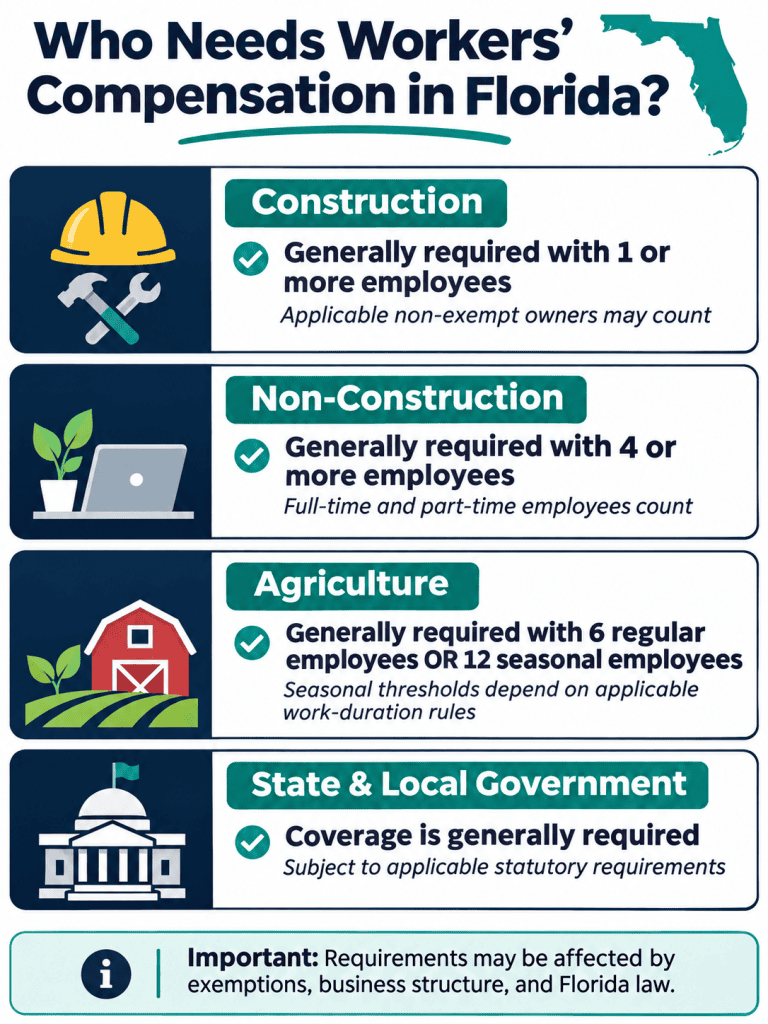
Florida workers’ compensation requirements vary by industry, employee count, business structure, and applicable exemptions.
Who Counts as an Employee Under Florida Workers’ Compensation Law?
One of the most expensive compliance mistakes a business owner can make is assuming that everyone labeled an independent contractor, part-time worker, or business owner is automatically excluded from workers’ compensation requirements.
Florida law considers the actual employment relationship and applicable statutory definitions.
The amount of time someone works each week is not, by itself, a reason to exclude that individual from the employee count.
Similarly, an employee who works from home may still count toward a non-construction employer’s coverage requirement.
Business owners are treated differently depending on their entity structure.
Corporate officers and LLC members may be considered employees unless they have valid exemptions. Non-construction sole proprietors and partners generally are not considered employees unless they elect coverage through the appropriate procedure.
Construction sole proprietors and partners are treated differently under Florida’s statutory definition of employee.
The important question is whether the person is legally considered an employee—not simply whether the business issues a W-2 or Form 1099.
A business should review its employee count and classifications whenever it hires workers, reorganizes ownership, changes operations, or begins using subcontractors.
How Do Workers’ Compensation Exemptions Work in Florida?
Florida permits certain qualifying corporate officers and LLC members to elect exemption from workers’ compensation coverage.
However, an exemption is frequently misunderstood.
A workers’ compensation exemption applies to an eligible individual, not automatically to the entire business.
When an individual receives a valid exemption, that individual is generally excluded from being treated as an employee for purposes of Florida workers’ compensation coverage.
The individual also gives up the right to receive workers’ compensation benefits while the exemption is effective.
Other non-exempt employees may still need to be covered.
Construction Industry Exemptions
Florida’s construction exemption requirements are relatively strict.
Eligible corporate officers and LLC members generally must have at least a ten-percent ownership interest in the company.
The business must be properly registered and active with the Florida Department of State, and applicable officers must satisfy the state’s registration and eligibility requirements.
Construction exemptions are generally limited to three qualifying officers or LLC members, subject to applicable affiliated-entity rules.
The state charges a fifty-dollar application or renewal fee for each construction exemption. These certificates generally have a two-year validity period and must be renewed to remain effective.
An approved exemption does not eliminate the business’s obligation to insure other non-exempt employees.
Non-Construction Industry Exemptions
Non-construction exemptions operate differently.
An eligible corporate officer may apply for an exemption when the corporation is registered and active and the individual is properly listed as an officer.
Unlike construction corporate officers, non-construction corporate officers are not subject to the same general ten-percent ownership requirement.
For a non-construction LLC, an eligible member generally must own at least ten percent of the company. Florida permits up to ten qualifying LLC members to elect exemption.
Non-construction exemptions generally do not carry the construction industry’s fifty-dollar application fee.
Non-construction sole proprietors and partners are a separate situation. They generally are excluded from the statutory definition of employee unless they elect coverage, rather than needing the same exemption certificate used by qualifying corporate officers and LLC members.
Should a Florida Business Owner Elect to Be Exempt?
An exemption should not be treated as an automatic cost-saving opportunity.
Consider the owner of a small roofing company who personally performs installation work.
Electing exemption may reduce the payroll exposure included in the workers’ compensation premium, but it also means the exempt owner generally cannot receive workers’ compensation benefits for their own workplace injury.
That decision deserves careful consideration when the individual regularly works at heights, operates machinery, performs heavy physical labor, or faces other occupational hazards.
Health insurance, personal disability insurance, and other coverage should not automatically be assumed to provide equivalent benefits.
Business owners should evaluate their actual duties, financial circumstances, and available protection before applying.
For official eligibility details, visit the Florida Division of Workers’ Compensation Exemptions page.
Do Florida Contractors Need to Verify Their Subcontractors’ Workers’ Compensation?
Yes. Contractor and subcontractor relationships are one of the most important areas of Florida workers’ compensation compliance.
A subcontractor may be responsible for maintaining insurance for its own employees, but the primary contractor has additional legal responsibilities.
Under Florida law, contractors generally must make sure subcontractors have legally required workers’ compensation coverage before beginning work.
If a subcontractor fails to secure required coverage, the primary contractor may become responsible for workers’ compensation benefits involving the subcontractor’s employees.
Consider a St. Augustine general contractor who hires a subcontractor to perform roofing work.
The subcontractor supplies a business card and signs an agreement identifying itself as an independent business. However, the contractor never verifies the subcontractor’s workers’ compensation coverage.
An employee of that subcontractor is later seriously injured.
The paperwork identifying the subcontractor as an independent business does not automatically eliminate the general contractor’s potential responsibility.
What Documentation Should Contractors Obtain?
Florida Rule 69L-6.032 identifies acceptable documentation for verifying subcontractor coverage.
Depending on the subcontractor’s arrangement, verification may involve a workers’ compensation policy information page, proof of active coverage from the Division’s database, or an insurance certificate accompanied by the required written coverage confirmation.
When an employee leasing arrangement is involved, additional documentation identifying covered leased employees may be necessary.
For qualifying exempt owners, the contractor should obtain or verify the applicable exemption documentation.
A Certificate of Insurance should not be treated as a substitute for every other document Florida requires.
Contractors should also monitor policy expiration dates and verify that required coverage remains in effect throughout the project.
Does a Form 1099 Make Someone an Independent Contractor?
No. Paying someone using Form 1099 does not automatically establish independent-contractor status under Florida workers’ compensation law.
The statutory definition includes specific criteria, and the treatment of individuals performing construction work can differ from arrangements outside construction.
Misclassification can create unexpected benefit obligations, insurance premium adjustments, and enforcement consequences.
Employers should have questionable relationships reviewed before work begins rather than waiting until an injury or compliance inspection occurs.

Florida contractors should verify required workers’ compensation coverage or applicable exemptions before subcontractors begin work.
What Does Workers’ Compensation Insurance Cover in Florida?
Workers’ Compensation Insurance is designed to provide benefits for qualifying injuries and occupational illnesses arising out of and in the course and scope of employment.
The benefits are governed by Florida law and depend on the facts of the injury, medical findings, eligibility requirements, and other applicable conditions.
Medical Treatment
For a compensable injury, workers’ compensation can provide authorized and medically necessary treatment related to the workplace condition.
Depending on the circumstances, this may include physician visits, diagnostic testing, hospitalization, surgery, prescription medication, physical therapy, and rehabilitation.
The employee generally must follow the authorized medical treatment process established under Florida workers’ compensation law, except where applicable exceptions, such as emergency treatment, apply.
Wage-Replacement Benefits
Employees who cannot work or whose earning capacity is reduced because of a compensable injury may qualify for disability benefits.
Florida recognizes several forms of disability benefits, including temporary total disability, temporary partial disability, impairment income benefits, and permanent total disability benefits.
Temporary total disability benefits generally replace two-thirds of the employee’s average weekly wage, subject to applicable statutory limits and eligibility requirements.
Florida also has waiting-period rules that can affect when disability benefits become payable.
The amount and duration of benefits depend on the employee’s condition, earnings, medical restrictions, and applicable law.
Permanent Impairment and Rehabilitation
A serious workplace injury may cause lasting physical impairment.
Depending on the medical findings and statutory requirements, an employee may qualify for additional impairment or disability benefits.
Certain reemployment or rehabilitation services may also be available in qualifying circumstances.
Death Benefits
When a compensable workplace injury or occupational illness causes an employee’s death, Florida workers’ compensation law provides certain benefits for eligible dependents and may include funeral-related expenses.
The benefits are subject to statutory qualifications and limits.
Employers Liability Insurance
Workers’ compensation policies commonly include an Employers Liability coverage part.
Workers’ compensation benefits and Employers Liability Insurance serve different purposes.
Employers Liability coverage may address certain legal liability claims involving employee bodily injury or occupational disease that fall outside the statutory workers’ compensation benefits system, subject to exclusions, policy conditions, and coverage limits.
Business owners should review their Employers Liability limits rather than assuming the statutory benefit provisions and liability coverage provide identical protection.
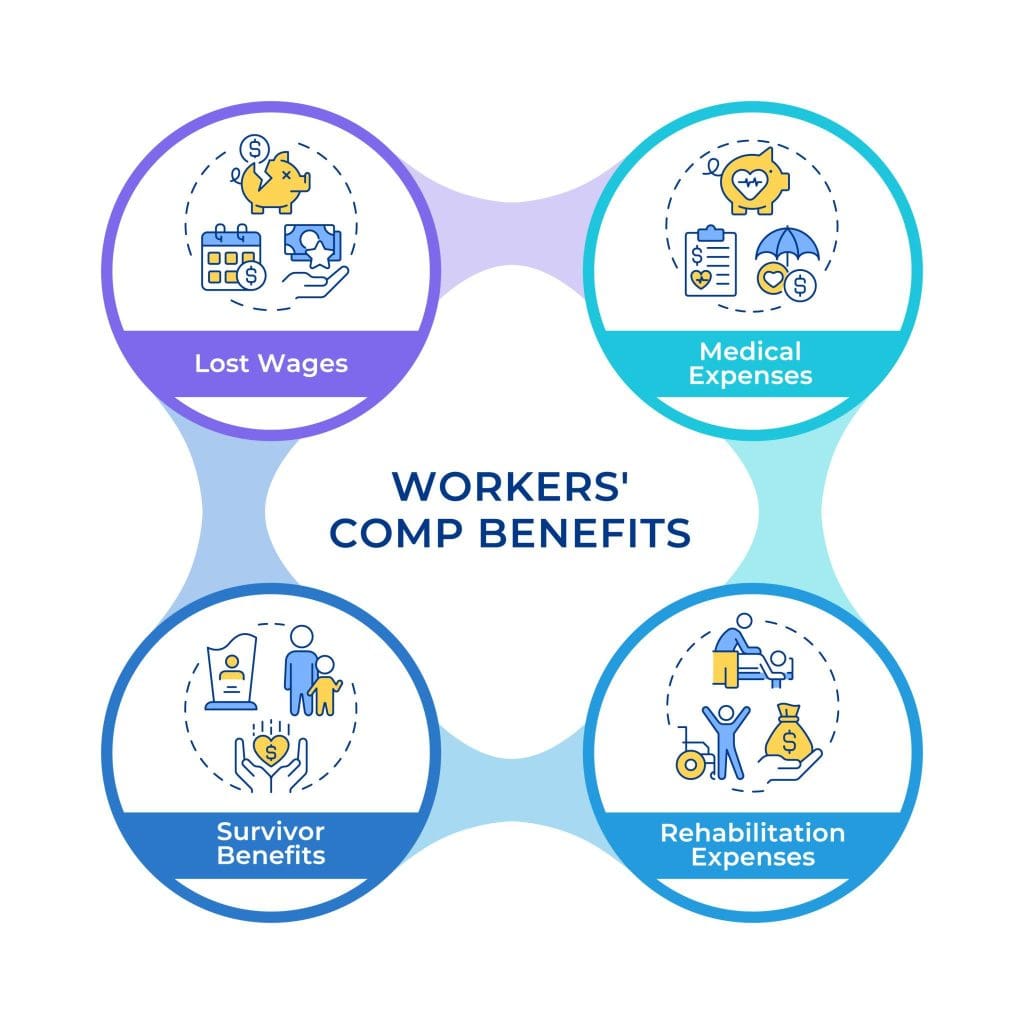
Florida workers’ compensation may provide medical, wage-replacement, disability, rehabilitation, and death benefits for qualifying work-related injuries or illnesses.
What Does Workers’ Compensation Insurance Not Cover?
Not every injury occurring during a workday automatically qualifies for workers’ compensation benefits.
For a claim to be compensable, the injury or occupational illness generally must satisfy Florida’s work-relatedness and other statutory requirements.
Certain personal activities, ordinary commuting situations, intentionally self-inflicted injuries, and injuries involving specified statutory exclusions may not qualify.
Claims involving intoxication, misconduct, personal medical conditions, or activities outside normal work responsibilities can require additional investigation under Florida law.
For example, an employee injured while performing assigned duties may present a different situation from an employee injured while pursuing an entirely personal activity unrelated to work.
However, these questions can be fact-specific.
Employers should report claimed workplace injuries even when they question whether the injury is compensable. The carrier should evaluate the claim using the applicable facts and law.
Is General Liability Insurance a Substitute for Workers’ Compensation?
No. General Liability Insurance primarily addresses certain third-party bodily injury, property damage, and other covered claims, while Workers’ Compensation Insurance addresses qualifying work-related injuries and occupational illnesses involving employees.
For example, a restaurant employee who suffers a compensable kitchen burn may qualify for workers’ compensation benefits.
A customer who slips on the restaurant floor may instead have a liability claim involving the restaurant’s General Liability Insurance.
Many businesses need to evaluate both types of coverage because they protect against different risks.
Our General Liability Insurance for Florida Businesses article explains third-party liability exposures and how business owners can evaluate that protection.
How Are Workers’ Compensation Classification Codes Determined?
Workers’ compensation classification codes help insurers categorize business operations and determine the appropriate premium rates.
The type of work employees perform is an important factor because injury exposure varies significantly among occupations.
A clerical office operation generally has different risks from roofing, electrical installation, tree removal, commercial landscaping, or manufacturing.
Florida uses approved classifications and rating rules, with the National Council on Compensation Insurance, commonly called NCCI, playing an important role in classification and experience rating.
Why Job Duties Matter More Than Job Titles
A company should accurately describe its operations and the work employees actually perform.
For example, a contractor may employ office personnel, field supervisors, and skilled tradespeople.
Different classifications may apply when permitted under the governing rating rules. However, an employer cannot automatically assign every job title to a separate classification.
Some classifications apply to particular business operations, while others may involve specific employee duties and restrictions.
Accurate payroll records and operational descriptions help support the appropriate classifications.
Can Incorrect Classifications Affect Premiums?
Yes.
Misclassification may result in inaccurate premiums, unexpected audit adjustments, and other complications.
A business should not identify employees as performing primarily office duties when they regularly perform higher-risk fieldwork.
Intentional or material misrepresentation of employee duties to avoid appropriate premiums can also create regulatory enforcement consequences.
The goal is not to obtain the lowest possible classification rate. It is to apply the correct classification to the work being performed.
How Much Does Workers’ Compensation Insurance Cost in Florida?
The cost of Workers’ Compensation Insurance depends primarily on employee payroll, the classifications assigned to business operations, and the employer’s applicable claims experience.
Two businesses with similar payrolls may pay very different premiums because the work performed carries different levels of risk.
A roofing business, for example, may have substantially different workers’ compensation exposure from a professional office.
How Are Premiums Calculated?
A simplified manual-premium calculation begins with:
Annual Payroll ÷ 100 × Applicable Classification Rate = Estimated Manual Premium
If multiple classifications apply, payroll and premium may need to be calculated separately for each classification.
This simplified formula is only a starting point. The final premium may also reflect experience modification, approved credits, discounts, assessments, rating rules, and other applicable adjustments.
What Is an Experience Modification Factor?
An Experience Modification Factor, commonly called an E-Mod, compares a qualifying business’s workers’ compensation loss experience with expected losses under the applicable experience-rating plan.
Employers with more favorable experience than expected may receive a rating factor below one. Employers with less favorable experience may receive a factor above one.
However, not every business qualifies for experience rating.
Eligibility depends on applicable premium or exposure requirements and the governing rating rules.
A new business, for example, may not yet have sufficient historical experience to qualify.
Can Safety Programs Reduce Workers’ Compensation Premiums?
Florida recognizes certain premium credits for employers that establish qualifying workplace programs.
Employers with approved workplace safety programs may qualify for a two-percent premium credit.
Businesses with qualifying, certified drug-free workplace programs may qualify for a five-percent premium credit.
These programs have specific statutory and administrative requirements. Applicable certification and renewal procedures must be followed.
A business should not assume that simply maintaining a written safety policy or requiring drug testing automatically qualifies it for a premium reduction.
Did Florida Workers’ Compensation Rates Decrease in 2026?
Yes.
The Florida Office of Insurance Regulation approved an overall statewide average workers’ compensation rate decrease of 6.9 percent for applicable new and renewal policies effective January 1, 2026.
However, a statewide average rate decrease does not guarantee that every employer’s premium will decrease by the same percentage.
Individual costs still depend on the business’s payroll, classification codes, claims experience, experience modification when applicable, and other rating factors.
Rate changes for different classifications may also vary.
Business owners should compare their renewal calculations rather than assuming a statewide announcement determines their final premium.

Florida workers’ compensation premiums are influenced by employee payroll, job classifications, claims history, and applicable rating adjustments. Understanding these factors can help business owners make informed insurance decisions.
What Happens During a Workers’ Compensation Premium Audit?
Many workers’ compensation policies are initially priced using estimated annual payroll.
At the end of the policy period, the insurer may conduct an audit to determine whether the exposure used to calculate the original premium accurately reflects the business’s actual operations.
An audit can involve reviewing payroll records, employee job duties, classification codes, overtime, subcontractor payments, and supporting coverage documentation.
For businesses with multiple types of operations, accurate records become especially important.
If actual payroll was higher than estimated, the business may owe additional premium.
If payroll was lower, the audit may result in an adjustment or credit, subject to policy conditions and any applicable minimum premium.
Why Subcontractor Documentation Matters During an Audit
A contractor that hires subcontractors throughout the year should maintain records showing who performed the work, when the work occurred, and whether required coverage or exemptions were properly documented.
Payments to subcontractors without adequate documentation may create additional premium exposure under applicable rating rules.
A certificate obtained after the policy period may not resolve questions about whether coverage existed when the work was performed.
Keeping accurate subcontractor records throughout the year is far easier than trying to reconstruct them during an audit.
How Can Employers Avoid Audit Surprises?
Employers should begin with realistic payroll estimates and update their insurance representative when significant changes occur.
Hiring additional employees, adding a new trade, expanding operations, or substantially increasing payroll can affect workers’ compensation exposure.
Maintaining payroll records by applicable classification, preserving subcontractor documents, and reviewing changes during the policy period can help reduce unexpected adjustments.
How Can Florida Businesses Help Control Workers’ Compensation Costs?
A business owner cannot control every factor used in workers’ compensation pricing, but several operational practices can help manage costs over time.
Accurate employee classifications, reliable payroll records, and proper subcontractor documentation establish a stronger foundation for the insurance program.
Workplace safety is equally important.
A roofing contractor may emphasize fall protection, ladder procedures, equipment inspection, and jobsite supervision.
A restaurant may focus on preventing slips, reducing burns, handling sharp equipment safely, and maintaining clean work areas.
A warehouse business may prioritize material handling, forklift safety, employee training, and preventing lifting-related injuries.
When an injury does occur, timely reporting and appropriate communication can help the injured employee receive necessary attention while allowing the insurer to begin evaluating the claim.
A structured return-to-work program may also help qualifying employees return to suitable duties when medically appropriate.
For employers subject to experience rating, claims history can influence future premiums, making consistent safety and injury-management practices particularly important.
The long-term goal should be fewer workplace injuries, accurate insurance pricing, and a well-managed workers’ compensation program—not merely the lowest initial quote.

Employee training, safe work practices, and consistent supervision can help Florida businesses reduce preventable workplace injuries.
What Should a Florida Employer Do After an Employee Is Injured?
When an employee reports an injury, the employer’s first priority should be ensuring the employee receives appropriate attention.
Emergency injuries require immediate assistance. For nonemergency care, the employer should follow the workers’ compensation carrier’s procedures concerning authorized medical treatment.
Florida employers should have established injury-reporting procedures before an accident occurs.
When a workplace injury is reported, the employer should:
-
Address immediate medical needs. Arrange emergency care when appropriate and follow the carrier’s procedures for other medical treatment.
-
Document the incident. Record the employee’s account, location, time, reported injuries, and relevant circumstances.
-
Notify the workers’ compensation carrier promptly. Florida generally requires reporting within seven days after the employer learns of the injury.
-
Provide required documentation. Complete the applicable First Report of Injury or Illness, provide the employee with a copy of the report as required by Florida law, and submit wage or other supporting information when requested or legally required.
-
Maintain appropriate communication. Coordinate with the insurer and injured employee concerning work restrictions, recovery, and possible return-to-work arrangements.
Employers should not delay reporting because they believe an injury is minor or may not be covered.
Reporting the injury does not automatically mean the claim will qualify for benefits.
How Long Does an Employee Have to Report an Injury?
Florida generally requires an employee to notify their employer within thirty days after a workplace injury or its initial manifestation. Certain exceptions may apply, including situations where the work-related cause could not be identified without a medical opinion. Employees should report injuries as soon as possible rather than assuming an exception or waiting until the deadline.
How Long Does an Employer Have to Notify the Insurance Carrier?
Florida generally requires the employer to report a known workplace injury to the workers’ compensation carrier within seven days.
The carrier’s established claim-reporting process should be followed.
Employers can obtain more information through the Florida Division of Workers’ Compensation Employer FAQs.
What if the Employee Cannot Return to Regular Duties?
An injured employee may receive temporary work restrictions from an authorized medical provider.
When suitable modified duties are available, an employer may be able to offer work consistent with those restrictions.
For example, a construction employee recovering from an injury may temporarily be unable to perform physically demanding fieldwork but may be capable of certain administrative or supervisory tasks.
Return-to-work decisions should be consistent with medical restrictions and applicable employment laws.
An employer should not pressure an injured worker to perform duties that conflict with authorized medical restrictions.
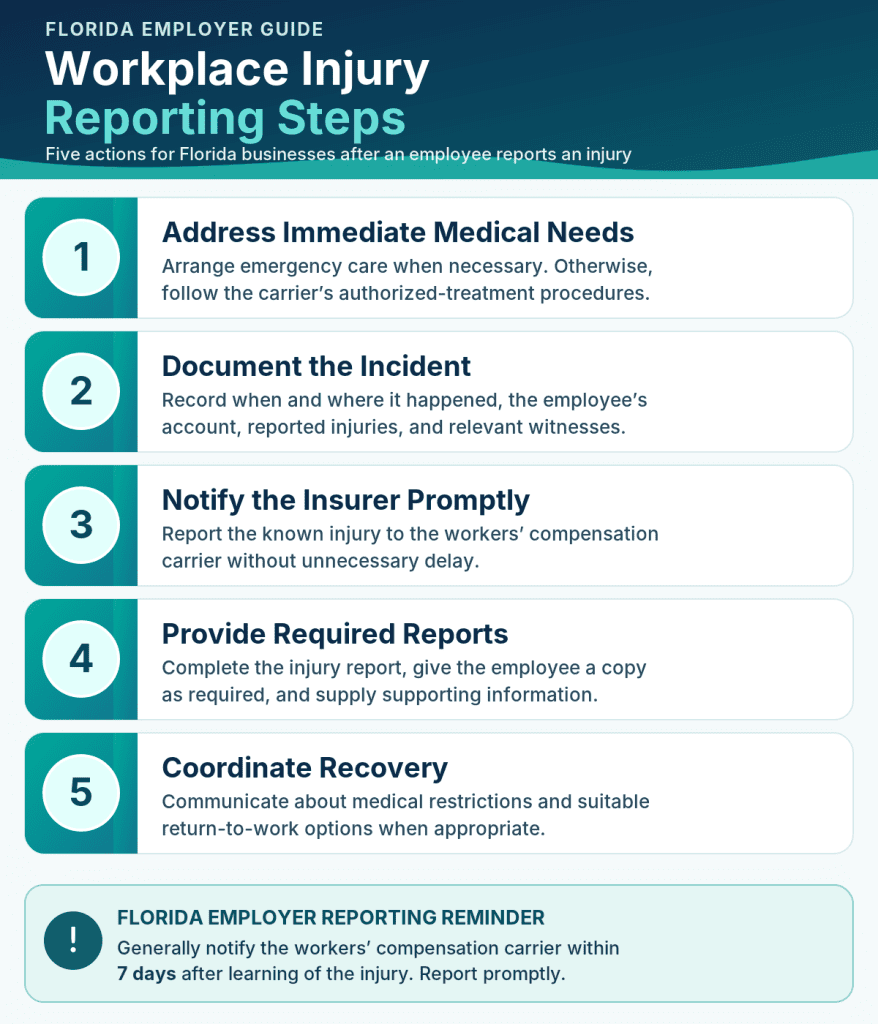
Florida employers should respond promptly to workplace injuries, document incidents, notify their workers’ compensation insurer, and follow required reporting procedures.
What Are the Penalties for Not Having Workers’ Compensation Insurance in Florida?
Operating without legally required Workers’ Compensation Insurance can lead to serious financial and operational consequences.
The Florida Department of Financial Services, Division of Workers’ Compensation, investigates employer compliance and conducts jobsite inspections.
When an employer fails to maintain required coverage, the department may issue a Stop-Work Order requiring business operations to cease until the applicable conditions for release are met.
For a contractor, this could interrupt active projects, affect employees, delay contractual obligations, and create additional financial problems.
How Are Penalties Calculated?
Under Section 440.107, Florida Statutes, an employer that fails to secure required workers’ compensation coverage may be assessed a penalty generally calculated as twice the manual premium that would have applied during the relevant noncompliance period.
The law generally uses a preceding twelve-month period.
A preceding twenty-four-month calculation period can apply in certain circumstances, including specified repeat violations or material payroll understatement or concealment.
The statute establishes a minimum penalty of one thousand dollars.
It also provides certain credits and penalty reductions for qualifying employers that meet specific requirements and deadlines. Those provisions should not be assumed to apply automatically.
What Happens if an Employer Ignores a Stop-Work Order?
Florida law establishes an additional penalty of one thousand dollars per day when an employer conducts business in violation of a Stop-Work Order.
This penalty is separate from the underlying coverage-related assessment.
Can a Business Be Penalized Even if It Has a Workers’ Compensation Policy?
Yes.
Florida law treats certain material misrepresentations as failures to secure proper workers’ compensation coverage.
Examples include materially concealing payroll, misrepresenting employee duties to avoid correct classifications, or misrepresenting information relevant to an experience modification calculation.
Separate penalties may also apply when workers are improperly represented as independent contractors.
Some conduct can result in additional civil or criminal consequences.
Purchasing a policy is only one part of compliance. Employers must also accurately report the workers, payroll, and operations the policy is intended to insure.
For current enforcement information, consult the Florida Division of Workers’ Compensation Enforcement page.
Can a Florida Business Purchase Workers’ Compensation Voluntarily?
Yes.
Some businesses choose to purchase Workers’ Compensation Insurance even when they have fewer employees than the number generally required by Florida law.
For example, a non-construction service business with two employees may not meet the usual four-employee threshold.
However, those employees can still experience workplace injuries.
A business may decide that maintaining coverage is an appropriate way to address those exposures.
Coverage may also be required by certain commercial customers, contracts, or project agreements even when the general statutory threshold has not been reached.
Owners who are not automatically included in coverage should determine whether they can elect coverage under the applicable rules.
Florida employers can obtain workers’ compensation coverage through authorized insurance arrangements. Businesses unable to secure qualifying voluntary-market coverage may need to explore other legally available options.
Companies using employee leasing arrangements or professional employer organizations should verify how workers’ compensation responsibilities are allocated and whether all affected employees are covered.
Workers’ Compensation Insurance is only one part of a business insurance program. Our What Insurance Does a Florida Small Business Need? A Complete Guide explains how different coverages may work together.
What Should Florida Employers Review Before Purchasing Workers’ Compensation Insurance?
Before requesting a quote, business owners should be prepared to explain how their company actually operates.
The insurer or insurance agent may need details about the business’s industry, job duties, employee count, estimated annual payroll, existing coverage, and prior claims.
Ownership information is also relevant, particularly when corporate officers or LLC members have valid exemptions or intend to apply for them.
Contractors may need additional information about subcontractors, trade classifications, and prior insurance experience.
Businesses with an established loss history may be asked to provide prior policy information, loss runs, or an experience modification factor when applicable.
Accurate information at the beginning of the process can reduce classification problems, coverage misunderstandings, and unexpected premium adjustments.
A business should also review the scope of the insurance arrangement, Employers Liability limits, applicable endorsements, insurer services, and policy conditions rather than comparing price alone.
The appropriate coverage should reflect how the business operates today and be revisited as the company grows.

First Florida Agency helps businesses in Nocatee, Ponte Vedra, Jacksonville, St. Augustine, and throughout Florida evaluate workers’ compensation insurance for their employees and operations.
Frequently Asked Questions About Florida Workers’ Compensation Insurance
1. Does a Florida LLC automatically need Workers’ Compensation Insurance?
No. Forming an LLC does not automatically establish whether coverage is required. The applicable rules depend on the business’s industry, employees, ownership structure, and valid exemptions. Construction and non-construction LLCs are subject to different requirements.
2. Do Florida part-time employees count toward Workers’ Compensation requirements?
Yes. Part-time employees generally count toward the applicable employee threshold. Most non-construction employers must maintain coverage when they have four or more employees, while construction employers generally have a one-employee threshold.
3. Can an owner of a Florida construction company be exempt?
Certain eligible corporate officers and LLC members may qualify for an approved exemption. Construction exemptions generally require at least ten-percent ownership and are subject to limits and other eligibility conditions. An exemption does not automatically extend to other employees.
4. Can a Florida business owner revoke a Workers’ Compensation exemption?
Yes. Florida provides procedures for revoking an election of exemption. The individual should follow the Division of Workers’ Compensation’s requirements and coordinate with the insurer or agent to determine how the change affects coverage.
5. Is Workers’ Compensation Insurance required for Florida independent contractors?
Not every person described as an independent contractor is legally excluded from workers’ compensation requirements. Florida applies specific statutory definitions, and construction work presents additional considerations. The actual relationship must satisfy applicable law.
6. Does Workers’ Compensation cover an employee injured while working from home?
It may. An employee working remotely can experience a compensable injury when the facts establish the required connection to covered employment. The employee’s location alone does not determine compensability.
7. Does Workers’ Compensation Insurance cover employee injuries in company vehicles?
It may when the injury arises out of and occurs in the course and scope of covered employment. The circumstances of the trip, the employee’s duties, and any applicable statutory exclusions or exceptions matter.
8. Who pays for Workers’ Compensation Insurance in Florida?
The employer is responsible for workers’ compensation premiums. Florida law prohibits employers from deducting the cost of required workers’ compensation insurance from employees’ wages.
9. Is Workers’ Compensation included in a Business Owners Policy?
Generally, no. A standard Business Owners Policy combines certain business property and liability protections but does not automatically include Workers’ Compensation Insurance. The employer usually needs a separate workers’ compensation insurance arrangement.
10. Can a Florida employee choose their own Workers’ Compensation doctor?
Florida generally uses an authorized medical-provider system for workers’ compensation treatment. Employees should follow applicable carrier procedures, subject to emergency treatment provisions and other rights established by law.
11. Does a workers’ compensation claim automatically increase the employer’s premium?
No. A claim does not guarantee a specific premium increase. Its effect depends on factors such as experience-rating eligibility, loss experience, classification rates, and applicable rating rules.
12. Can a Florida business carry Workers’ Compensation Insurance even when it is not required?
Yes. Voluntary coverage may be available for qualifying businesses below the general statutory thresholds. Some employers choose coverage to address employee injury exposures or satisfy contractual requirements.
Request a Florida Workers’ Compensation Insurance Quote
Understanding Florida’s workers’ compensation requirements is an important part of operating a responsible business.
Whether you’re hiring employees, reviewing exemptions, working with subcontractors, preparing for a premium audit, or evaluating your next policy renewal, the right insurance arrangements begin with an accurate understanding of your operations.
First Florida Agency helps business owners throughout Florida explore Workers’ Compensation Insurance options based on their employee classifications, payroll, operations, and coverage needs.
Request a Florida Workers’ Compensation Insurance quote or call (904) 822-8800 to discuss your business insurance needs.
Our independent insurance agency serves businesses throughout Florida, including Nocatee, Ponte Vedra, Ponte Vedra Beach, Jacksonville, St. Augustine, St. Johns County, and surrounding Northeast Florida communities.
About the Author
John Closterides is the founder and principal agent of First Florida Agency, an independent insurance agency based in Ponte Vedra, Florida.
As a Florida-licensed 2-20 General Lines insurance agent, John helps business owners evaluate commercial insurance options, understand coverage considerations, and make informed decisions about protecting their businesses.
Through First Florida Agency, he focuses on practical insurance education, personalized guidance, and helping Florida businesses understand the risks associated with their operations.
Recommended External Resources
The following official resources provide additional information about Florida workers’ compensation laws, employer responsibilities, coverage requirements, exemptions, insurance premiums, and workplace injury claims.
-
Florida Division of Workers’ Compensation — Coverage Requirements — Official guidance on which Florida employers must maintain coverage, including construction, non-construction, agricultural, and out-of-state businesses.
-
Florida Division of Workers’ Compensation — Exemptions — Information about exemption eligibility and application procedures for qualifying corporate officers and LLC members.
-
Florida Division of Workers’ Compensation — Employer FAQs — Answers to common employer questions involving subcontractors, premiums, injury reporting, classifications, and statutory responsibilities.
-
Florida Division of Workers’ Compensation — Enforcement — Information about compliance inspections, Stop-Work Orders, penalties, and prohibited employer practices.
-
Florida Division of Workers’ Compensation — Injured Worker FAQs — Official guidance on reporting injuries, obtaining medical treatment, and understanding employee rights and responsibilities.
-
Florida Office of Insurance Regulation — 2026 Workers’ Compensation Rate Approval — Official announcement of the statewide average workers’ compensation rate decrease effective January 1, 2026.
-
Florida Statutes — Section 440.107 — Florida’s statutory provisions addressing employer compliance enforcement, Stop-Work Orders, and penalties.
For employer coverage and compliance questions, the Florida Division of Workers’ Compensation’s Bureau of Compliance can be contacted at (850) 413-1609.
Employees seeking help understanding their rights or benefits may contact the Division’s Employee Assistance and Ombudsman Office at (800) 342-1741.
Related Articles
Explore these additional First Florida Agency resources to better understand how Workers’ Compensation Insurance fits into a Florida business insurance program.
-
Florida Workers’ Compensation Insurance — Explore Workers’ Compensation Insurance coverage options, employer considerations, and ways to evaluate protection for your business.
-
What Insurance Does a Florida Small Business Need? A Complete Guide — Understand how Workers’ Compensation, General Liability, Commercial Auto, Commercial Property, and other insurance coverages work together.
-
Business Owners Policy in Florida: BOP Coverage Explained — Learn what a Business Owners Policy generally includes, which coverages may be added, and why certain protections—including workers’ compensation—typically require separate arrangements.
Insurance Disclaimer
This article is provided for general educational purposes only and does not constitute legal, tax, accounting, employment, insurance claims adjusting, or individualized risk-management advice.
Florida workers’ compensation requirements, employee classifications, exemptions, employer obligations, injury-reporting requirements, claim eligibility, benefits, penalties, and compliance procedures depend on applicable law and the specific circumstances involved.
Insurance availability, premiums, experience modification, classification codes, audits, endorsements, exclusions, and policy conditions vary by insurer, business operations, and underwriting requirements.
The applicable insurance policy and Florida law govern coverage and benefits. Examples are illustrative and do not guarantee coverage, exemptions, particular premiums, claim payments, or compliance outcomes.
Business owners should verify current requirements with the Florida Division of Workers’ Compensation and consult qualified insurance, legal, tax, or other professional advisers concerning their particular circumstances.
Laws, regulations, approved rates, classification rules, and administrative guidance may change. Requesting an insurance quote or submitting an application does not bind coverage.