Published November 5, 2026
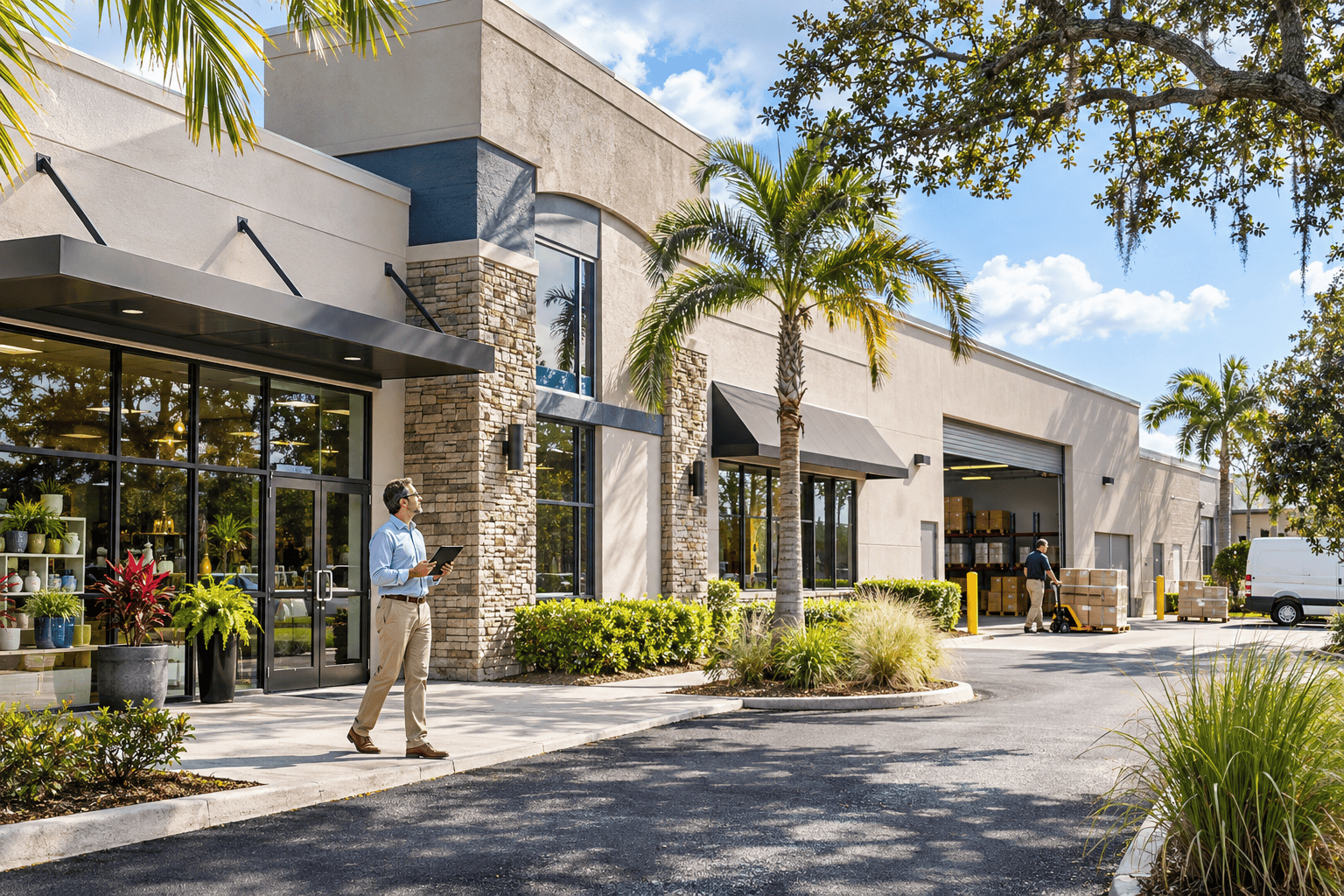
A fire, hurricane, burst pipe, theft, or equipment failure can damage more than a Florida business building. The same event may affect inventory, furniture, machinery, tenant improvements, records, customer property, and the company’s ability to generate income.
Commercial property insurance can help a business repair or replace qualifying property after covered direct physical loss or damage. The protection may be written as a stand-alone policy, within a Commercial Package Policy, or as the property component of an eligible Business Owners Policy.
The phrase “commercial property insurance” does not describe one universal contract. Policies can differ significantly in the property insured, covered causes of loss, valuation, limits, deductibles, coinsurance provisions, wind treatment, water exclusions, business-income coverage, and endorsements.
This guide explains what Florida commercial property insurance may cover, which losses commonly require separate protection, how hurricanes and flooding affect coverage, how property values should be determined, and what business owners should compare before selecting a policy.
Quick Answer: What Does Commercial Property Insurance Cover in Florida?
Florida commercial property insurance may cover a business building and eligible property at an insured location, including furniture, equipment, machinery, inventory, supplies, fixtures, and tenant improvements. Depending on the policy, it may also provide business income and extra expense coverage after covered property damage interrupts operations.
Coverage applies only when the damaged property, cause of loss, location, valuation, limit, deductible, and other circumstances satisfy the policy. Fire, lightning, theft, vandalism, wind, and certain accidental water losses may be covered under some forms. Flood, storm surge, wear and tear, deterioration, mechanical breakdown, and other causes may be excluded or require separate coverage.
For a personalized review of buildings, business personal property, wind exposure, valuation, and income-protection options, visit our Florida Commercial Property Insurance coverage page.
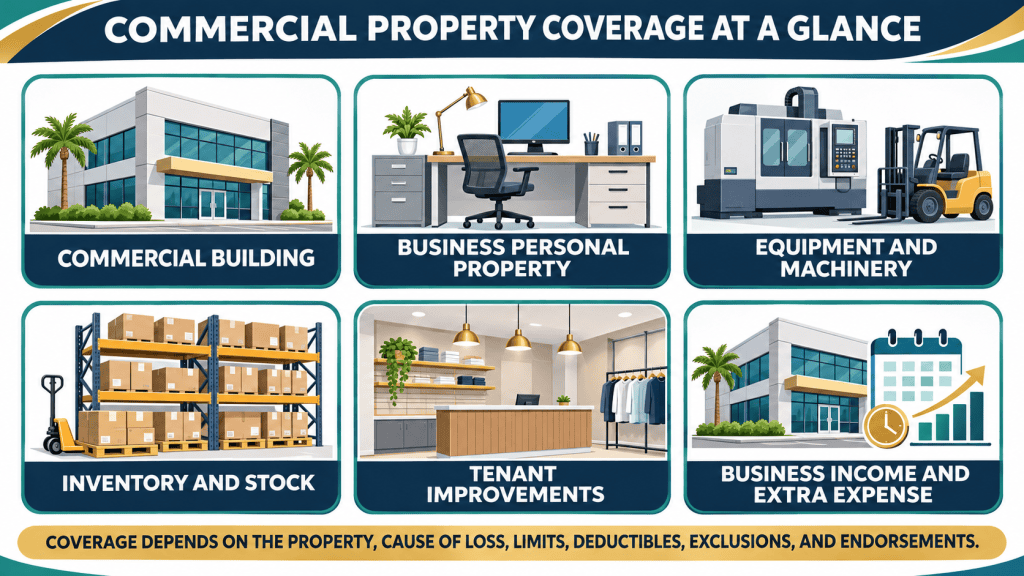
Commercial property insurance may help protect an insured building and business property—including equipment, machinery, inventory, and tenant improvements—and may provide business income and extra expense coverage after covered physical loss or damage.
Table of Contents
-
What Is Commercial Property Insurance?
-
What Business Property Can Be Covered?
-
Which Causes of Loss May Be Covered?
-
What Does Commercial Property Insurance Commonly Exclude?
-
Replacement Cost vs. Actual Cash Value
-
How Do Limits, Coinsurance, and Deductibles Work?
-
How Do Hurricanes and Windstorms Affect Florida Businesses?
-
Does Commercial Property Insurance Cover Flooding?
-
How Does Business Income and Extra Expense Coverage Work?
-
Which Additional Coverages Should a Business Consider?
-
Commercial Property Insurance Examples by Industry
-
How Much Does Commercial Property Insurance Cost in Florida?
-
How Much Commercial Property Coverage Does a Business Need?
-
Admitted vs. Surplus Lines Insurance in Florida
-
How to Compare Commercial Property Insurance Quotes
-
Information Needed for a Commercial Property Quote
-
What to Do After a Commercial Property Loss
-
When to Review or Update Coverage
-
Commercial Property Insurance Across Florida and Northeast Florida
-
Frequently Asked Questions
-
Request a Florida Business Insurance Review
-
About the Author
-
Recommended External Resources
-
Related Articles and Coverage Guides
-
Insurance Disclaimer
What Is Commercial Property Insurance?
Commercial property insurance is first-party coverage designed to protect eligible physical property a business owns, leases, uses, or is responsible for insuring.
“First-party” means the coverage generally addresses covered loss or damage to the insured business’s own property. This differs from general liability insurance, which primarily addresses certain claims alleging that the business caused bodily injury, property damage, or personal and advertising injury to someone else.
Commercial property coverage may be arranged in several ways:
-
As a stand-alone commercial property policy
-
As part of a Commercial Package Policy
-
As the property component of a Business Owners Policy
-
Under a specialized industry or property program
The Florida Department of Financial Services explains that a commercial property policy generally includes declarations, one or more coverage forms, a causes-of-loss form, commercial property conditions, and applicable endorsements. Each part matters because the declarations alone do not contain every coverage limitation or condition.
For a broader explanation of the policies a Florida company may need, read What Insurance Does a Florida Small Business Need? A Complete Guide.
Building Owners and Tenants Have Different Responsibilities
A business that owns its building may need to insure the structure, permanently installed fixtures, completed additions, and other property for which it is responsible.
A tenant may not need to insure the entire building, but it can still have a substantial property exposure. Furniture, computers, equipment, inventory, signs, and improvements made to leased space may belong to the tenant or be the tenant’s responsibility under the lease.
Do not assume the landlord’s policy protects the tenant’s property. A commercial lease should be reviewed alongside the insurance proposal to identify who is responsible for the building, glass, HVAC equipment, improvements, signs, utilities, and other property.
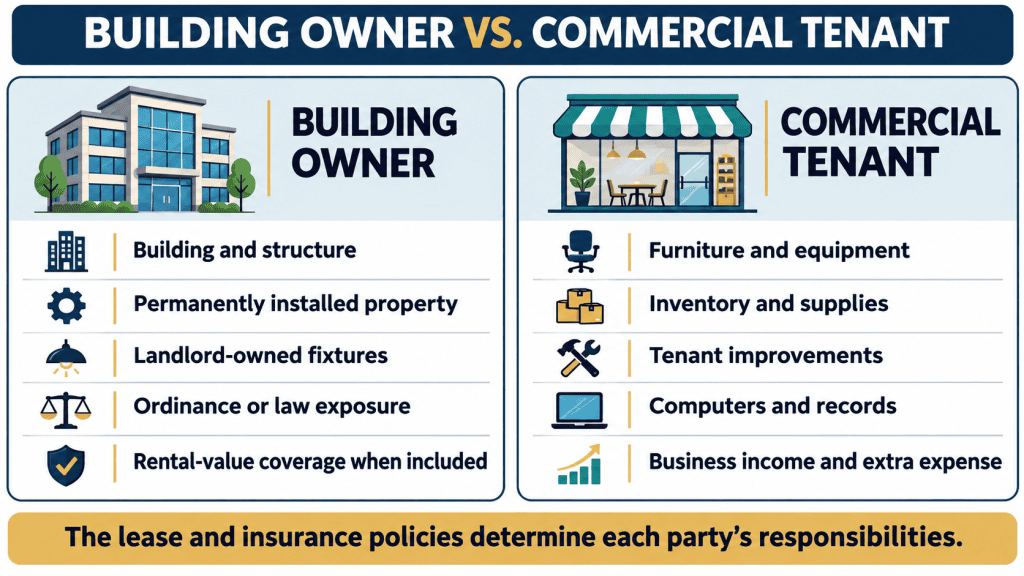
Building owners and commercial tenants may be responsible for insuring different property. The lease and applicable insurance policies should be reviewed together.
Commercial Property Is Not the Same as General Liability
Commercial property insurance may respond when covered property belonging to the insured business is damaged by a covered cause of loss.
General liability may respond when the business is legally responsible for certain third-party injuries or damage. It does not ordinarily replace the business’s own damaged inventory, equipment, or building.
For more information about third-party injury, property damage, products-completed operations, defense costs, and policy limits, read General Liability Insurance for Florida Businesses.
What Business Property Can Be Covered?
The insured property should be identified before coverage is selected. Owning no building does not mean a company has little property to protect.
Buildings and Structures
Building coverage may include the insured structure and certain permanently installed property, depending on the form. Examples can include:
-
The main commercial building
-
Completed additions
-
Permanently installed fixtures and machinery
-
Certain outdoor fixtures
-
Property used to service or maintain the building
-
Certain construction materials intended for repairs or alterations
Detached structures, canopies, fences, retaining walls, paved surfaces, outdoor signs, antennas, and similar property may be excluded, subject to sublimits, or require specific scheduling.
Business Personal Property
Business personal property may include eligible property located in or near the insured premises, such as:
-
Furniture and fixtures
-
Computers and office equipment
-
Machinery and production equipment
-
Tools used at the insured location
-
Inventory and stock
-
Raw materials and finished goods
-
Supplies
-
Commercial kitchen equipment
-
Shelving and displays
-
Records and documents
-
Property used in the business
The coverage form, property description, distance from the insured premises, and applicable limits determine what qualifies.
Tenant Improvements and Betterments
A tenant may invest significantly in flooring, walls, cabinetry, lighting, electrical work, plumbing, counters, built-in equipment, or other improvements to leased space.
Those improvements may not be insured automatically by the landlord’s policy. The lease and policy should be reviewed to determine ownership, repair obligations, valuation, and the amount the tenant should insure.
Inventory and Stock
Retailers, restaurants, wholesalers, manufacturers, and other businesses may have inventory values that change throughout the year.
A limit based on an ordinary month may be inadequate during a holiday season, major contract, special event, or peak purchasing period. Seasonal-increase provisions, value-reporting forms, or updated limits may be appropriate when values fluctuate materially.
Property of Others
A business may hold customer, vendor, employee, or leased property for repair, storage, processing, sale, or another purpose.
Standard property coverage may provide little or limited protection for property belonging to others. Bailee coverage, inland marine coverage, legal-liability coverage, equipment leasing requirements, or other specialized protection may be necessary.
Property Away From the Insured Location
Commercial property insurance commonly focuses on property at scheduled premises. Tools, equipment, materials, samples, or inventory that travel between jobs, remain in vehicles, or are stored temporarily elsewhere may require inland marine, contractors equipment, installation, cargo, or another specialized form.
The vehicle itself generally requires commercial auto insurance. Property carried inside it should be reviewed separately rather than assumed to be included with the vehicle’s physical-damage coverage.
Which Causes of Loss May Be Covered?
Commercial property insurance covers qualifying direct physical loss or damage only when the cause is insured and no exclusion or limitation eliminates coverage.
Policies commonly use Basic, Broad, Special, or another causes-of-loss form. The name of the form is only a starting point.
Basic and Broad Causes-of-Loss Forms
Basic and Broad forms generally identify the causes of loss that are covered. Broad coverage typically includes additional causes beyond those listed in a Basic form.
If a cause is not included, the loss may not be covered unless another endorsement or policy applies.
Special Causes-of-Loss Forms
A Special form generally covers direct physical loss unless the cause is excluded or limited. “Special” does not mean every loss is covered.
Exclusions, property limitations, valuation provisions, protective-safeguard requirements, vacancy conditions, water limitations, wind restrictions, and endorsements still apply.
Examples of Causes That May Be Covered
Depending on the policy, covered causes may include:
-
Fire
-
Lightning
-
Windstorm or hail
-
Smoke
-
Explosion
-
Vandalism
-
Certain theft losses
-
Certain vehicle or aircraft damage
-
Certain accidental water discharge
-
Certain falling objects
-
Certain collapse losses
Never rely on a general list to determine coverage for a specific policy or claim. The forms and endorsements issued by the insurance company control.
What Does Commercial Property Insurance Commonly Exclude?
Commercial property insurance does not protect a business from every source of damage or every financial loss.
Common exclusions or limitations may involve:
-
Flood and storm surge
-
Earth movement
-
Wear and tear
-
Rust, corrosion, decay, or deterioration
-
Insects, rodents, or nesting animals
-
Repeated seepage or leakage
-
Defective design, materials, or workmanship
-
Mechanical or electrical breakdown
-
Off-premises utility failure
-
Sewer or drain backup
-
Pollution or contamination
-
Cyber events and electronic data
-
Employee theft or dishonest acts
-
Ordinance or law costs
-
War, nuclear hazard, and governmental action
-
Vacancy
-
Property outside or away from the insured premises
Some excluded or limited exposures can be addressed through endorsements or separate policies. Others remain business risks that must be prevented, reduced, transferred by contract, or retained.
Maintenance Is Not Insurance
Commercial property insurance is not a maintenance contract or warranty.
Replacing a worn roof, corroded pipe, deteriorated electrical component, or failed part is generally different from repairing resulting damage caused by a sudden covered event. Even resulting damage is not automatically covered; the facts, cause of loss, forms, exclusions, and endorsements must be reviewed.
Equipment Breakdown Requires Special Attention
A standard commercial property form may not cover certain sudden mechanical, electrical, or pressure-system failures. Equipment breakdown coverage may help with qualifying damage involving HVAC systems, refrigeration, boilers, electrical panels, generators, production equipment, and other covered systems.
Depending on the form, it may also include related business income, extra expense, spoilage, or expediting expenses. For more information, visit our Florida Equipment Breakdown Insurance page.
Replacement Cost vs. Actual Cash Value
The valuation method can have a major effect on a commercial property settlement.
Replacement Cost
Replacement-cost coverage generally values qualifying damaged property using the cost to repair or replace it with property of like kind and quality without deducting for depreciation, subject to the policy.
The insurance company may initially pay an actual-cash-value amount and release additional replacement-cost benefits after repairs or replacement are completed within the required period. The policy may also limit payment to the amount actually spent, the cost of comparable property, or the applicable limit.
Actual Cash Value
Actual cash value generally reflects depreciation. Older roofing, furniture, equipment, finishes, and machinery can therefore produce a lower settlement than replacement-cost valuation.
A policy with a lower premium may rely on actual cash value, special roof valuation, or another restrictive settlement provision. The valuation method should be compared before price.
Other Valuation Provisions
Depending on the property and policy, valuation may involve:
-
Functional replacement cost
-
Agreed value
-
Selling price for certain stock
-
Manufacturers’ selling price
-
Stated amount
-
Market value
-
Special provisions for glass, signs, awnings, or outdoor property
The building’s market value, tax assessment, mortgage balance, accounting value, and replacement cost are not interchangeable. A building may cost substantially more to reconstruct than its real-estate value suggests.
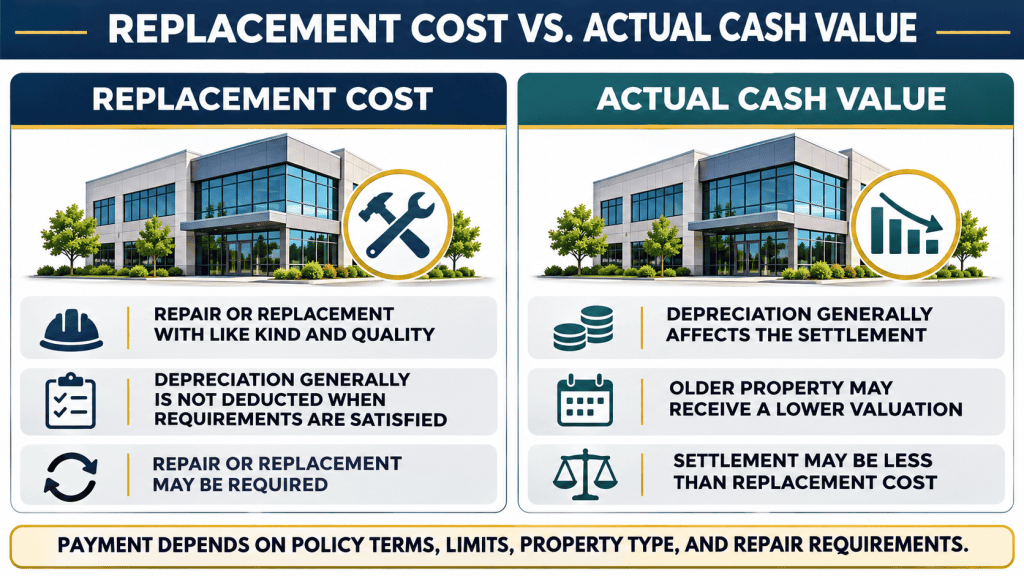
Replacement cost and actual cash value can produce substantially different property settlements. The applicable valuation method should be reviewed before a loss.
How Do Limits, Coinsurance, and Deductibles Work?
The policy limit is the maximum potentially available for covered property, subject to the policy. It is not a promise that every loss will be paid in that amount.
Specific and Blanket Limits
A specific limit applies to particular property or a particular location. A blanket limit may apply across more than one property category, building, or location, depending on the policy wording.
Blanket coverage can provide flexibility when values shift between insured locations, but it does not eliminate valuation requirements, reporting conditions, deductibles, sublimits, or exclusions.
Coinsurance
A coinsurance provision may require the business to insure covered property to a stated percentage of its value. If the limit carried is below the required amount when a loss occurs, the insurance company may reduce payment—even for a partial loss.
A simplified coinsurance calculation works as follows:
-
Determine the property value at the time of loss.
-
Multiply that value by the coinsurance percentage.
-
Compare the required amount with the limit actually carried.
-
Divide the amount carried by the amount required.
-
Apply that percentage to the covered loss, then account for the deductible and other policy provisions.
For example, a property valued at $1,000,000 with an 80% coinsurance requirement generally needs at least $800,000 of coverage to satisfy that requirement. Carrying $600,000 could create a partial-loss penalty.
This example is simplified and does not determine an actual claim. Agreed-value provisions, blanket limits, valuation disputes, deductibles, and policy-specific language can change the analysis.
Deductibles
A commercial property policy may include more than one deductible:
-
All-other-perils deductible
-
Windstorm or hail deductible
-
Hurricane or named-storm deductible
-
Percentage deductible
-
Flood deductible under a separate policy
-
Equipment breakdown deductible
-
Waiting period for business income
Convert every percentage deductible into dollars. A 2% deductible applied to a $2,000,000 insured building equals $40,000. The percentage may be applied differently depending on the policy, location, property, and event.
How Do Hurricanes and Windstorms Affect Florida Businesses?
A Florida hurricane can cause several types of damage at the same property. Wind may damage the roof, windows, doors, or exterior. Rain may enter through a storm-created opening. Storm surge or rising surface water may enter at ground level. Power failure may damage perishable stock or interrupt operations.
Those losses may be handled by different coverages.
Is Windstorm Coverage Included?
Depending on the insurance company, location, building, and policy:
-
Wind coverage may be included
-
Wind may be limited or excluded
-
A separate wind policy may be required
-
A named-storm, hurricane, or windstorm deductible may apply
-
Roof coverage may use a separate valuation method
-
Wind-driven rain coverage may depend on how the water entered
-
Outdoor property may have limited coverage
-
Protective-safeguard requirements may apply
Do not assume a Florida commercial property policy includes wind merely because it covers fire or is described as “special form.” Confirm the covered causes of loss and every wind-related endorsement.
Percentage Deductibles Can Be Substantial
A percentage deductible can create a significant out-of-pocket obligation when applied to a high property limit.
Ask which value the percentage applies to, whether the calculation is per building or location, what event activates it, and whether separate deductibles apply to building, contents, business income, or other coverage.
Business Income Depends on the Underlying Cause
Business income coverage generally should not be assumed to respond merely because a hurricane caused the company to close.
If the property policy excludes wind, business income arising from wind damage may also be excluded or restricted. A precautionary closure, loss of customers, utility outage, or evacuation without qualifying covered physical damage may be treated differently.
The Florida Department of Financial Services’ Commercial Insurance Coverage Disaster FAQs explains that business interruption treatment depends on the policy and that excluding wind can also affect business-income protection tied to wind loss.
Does Commercial Property Insurance Cover Flooding?
Standard commercial property insurance generally excludes flooding caused by rising surface water, storm surge, overflowing waterways, or widespread water accumulation.
The fact that a hurricane caused the flood does not convert storm surge or rising water into wind damage.
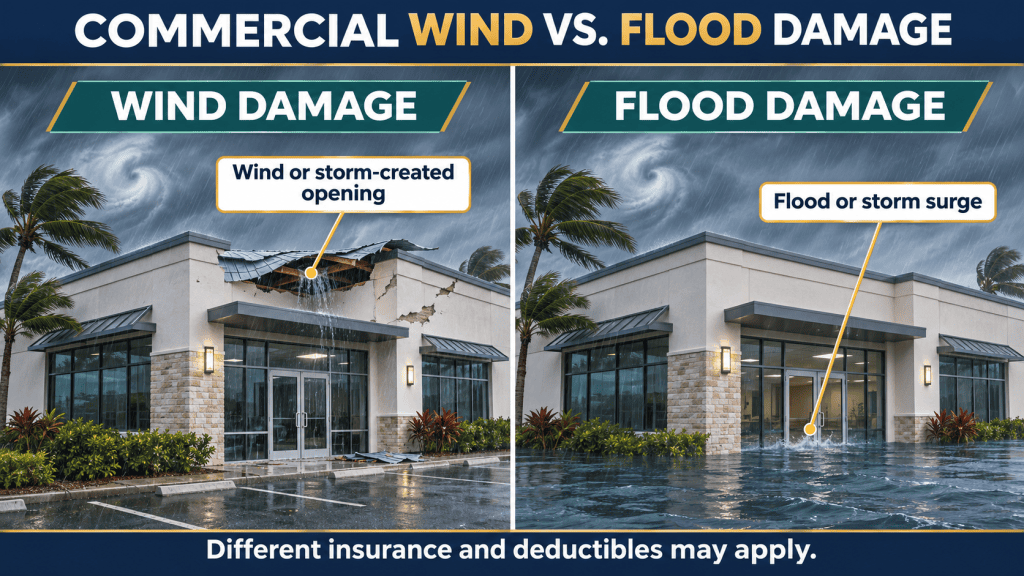
Wind and flood damage can occur during the same hurricane but may be insured differently. Coverage depends on the cause of loss and applicable policy terms.
Separate Commercial Flood Insurance
Commercial flood insurance may be available through the National Flood Insurance Program or private insurers. Building coverage and contents coverage should be evaluated separately.
The NFIP currently offers eligible non-residential properties up to $500,000 in building coverage and up to $500,000 in contents coverage. The NFIP generally values non-residential losses on an actual-cash-value basis and does not cover business interruption or loss of use. Private commercial flood policies may offer different limits, valuation, deductibles, or business-income options, but those features are not universal.
For more information about NFIP and private options, waiting periods, building and contents coverage, and flood claims, visit our Florida Commercial Flood Insurance page and the NFIP’s Protecting Businesses with Flood Insurance resource.
Flood Risk Exists Outside High-Risk Zones
A property outside a designated Special Flood Hazard Area can still flood.
Evaluate elevation, drainage, nearby waterways, storm-surge potential, rainfall patterns, building openings, finished-floor height, stored property, and the financial consequences of water entering the premises.
The FEMA Flood Map Service Center is the official source for NFIP flood maps and related hazard information, but a mapped zone should be treated as one part of a broader property-risk review.
How Does Business Income and Extra Expense Coverage Work?
Repairing property is only part of recovering from a major loss. A business may also lose revenue while continuing to owe payroll, rent, loans, taxes, and other operating expenses.
Business income coverage may help replace qualifying lost income and continuing expenses when covered direct physical loss or damage causes a necessary suspension or reduction of operations.
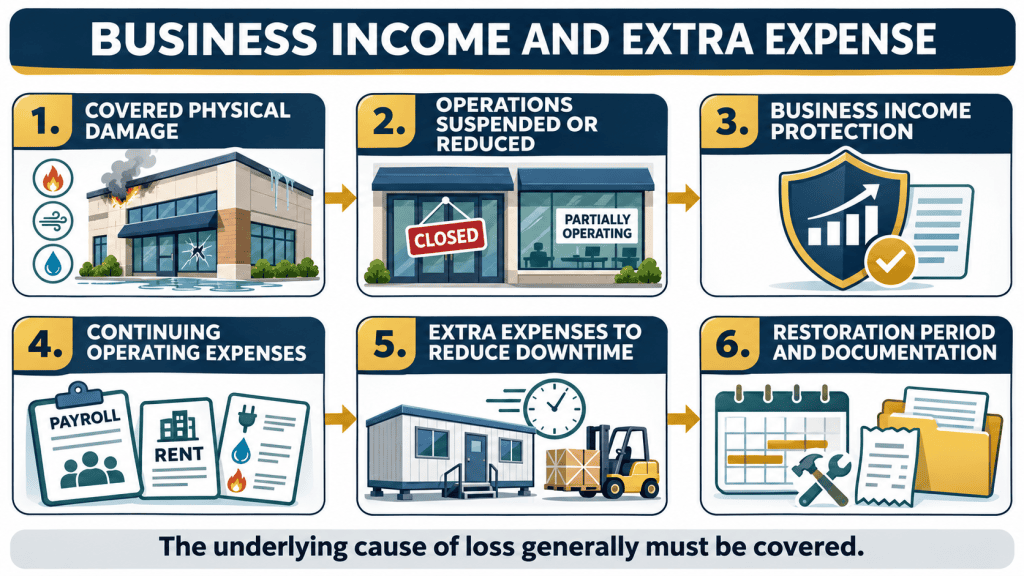
Business income and extra expense coverage may help a company manage qualifying income loss, continuing expenses, and additional recovery costs after covered property damage.
Extra expense coverage may help pay reasonable additional costs incurred to avoid or reduce the interruption, such as:
-
Renting temporary space
-
Leasing replacement equipment
-
Paying expedited shipping
-
Moving undamaged property
-
Using temporary utilities
-
Paying overtime or temporary labor
-
Communicating a temporary location to customers
A Covered Trigger Is Essential
A decline in revenue alone does not establish a business-income claim.
Traditional coverage generally requires qualifying physical loss or damage from a covered cause at property described by the form. Waiting periods, restoration provisions, limits, payroll treatment, and documentation requirements may also apply.
If flood is excluded from the underlying property policy, standard business income coverage generally should not be assumed to cover a shutdown caused by flood.
Important Business Income Extensions
Depending on the policy, a business may need to review:
-
Extended business income
-
Civil authority
-
Utility services
-
Dependent property or contingent business interruption
-
Ingress and egress
-
Extra expense
-
Newly acquired locations
-
Alterations and new buildings
-
Ordinance or law
Each extension has its own trigger, limit, waiting period, distance requirement, time provision, or covered-cause requirement.
Financial Records Are Critical
Business-income claims are commonly evaluated using records such as profit-and-loss statements, tax returns, payroll reports, sales history, bank statements, contracts, invoices, expense records, inventory information, and seasonal projections.
Maintain current backups away from the insured premises. Coverage cannot replace records the business never created, and unsupported projections may be difficult to establish.
For a detailed explanation of covered triggers, restoration periods, utility interruptions, civil authority, extra expense, and dependent properties, visit our Florida Business Interruption Insurance page.
Which Additional Coverages Should a Business Consider?
Commercial property coverage may be the foundation, but the policy may require endorsements or companion policies to address important exposures.
Ordinance or Law
After a covered loss, current building codes may require demolition of an undamaged portion, upgrades to the damaged property, or more expensive reconstruction.
Ordinance or law coverage may help address qualifying demolition, increased construction, and related expenses. The selected limit should reflect the age, construction, occupancy, and code requirements of the building.
Equipment Breakdown
Equipment breakdown coverage may address qualifying sudden mechanical, electrical, or pressure-system failures that ordinary property coverage may not cover.
Spoilage
Restaurants, grocers, pharmacies, florists, and other businesses with temperature-sensitive stock should review spoilage coverage, refrigeration breakdown, utility-service treatment, deductibles, and documentation requirements.
Sewer or Drain Backup
Water backing up through a sewer or drain may be excluded or limited. An endorsement may be available, but it is not a substitute for flood insurance when widespread surface water or another excluded flood condition causes the loss.
Crime and Employee Dishonesty
Commercial property insurance may not adequately cover employee theft, forgery, fraudulent transfer, computer fraud, or other crime losses.
Crime coverage should be coordinated with cyber insurance, internal controls, banking procedures, and vendor-verification practices. For more information, visit our Commercial Crime Insurance page.
Inland Marine
Inland marine coverage may be appropriate for movable property, tools, equipment, installation materials, valuable records, property in transit, or other items away from the scheduled premises.
Builders Risk
A building under construction or undergoing a major renovation may require builders risk coverage. An ordinary commercial property form may not properly insure new construction, major structural work, materials in transit, or changes in occupancy during the project.
Cyber and Electronic Data
Commercial property policies often provide limited or no protection for ransomware, privacy liability, fraudulent transfer, data restoration, network interruption, or breach-response expenses.
Technology-dependent businesses should evaluate cyber coverage separately rather than relying on limited electronic-data extensions.
Commercial Property Insurance Examples by Industry
The following simplified scenarios illustrate why the same policy is not appropriate for every business. They do not determine coverage for an actual claim.
Restaurant Kitchen Fire
A cooking fire damages the kitchen, refrigeration equipment, interior finishes, furniture, and food inventory. Smoke affects the dining room, and the restaurant closes for repairs.
Potentially relevant coverage may include building or tenant improvements, business personal property, food stock, equipment breakdown, spoilage, business income, extra expense, ordinance or law, and debris removal.
The cause of the fire, protective-safeguard requirements, property limits, valuation, deductibles, and restoration period would all matter.
Retail Store Hurricane Loss
Wind damages the roof and rain enters through a storm-created opening, damaging inventory, displays, flooring, and computers. A separate storm surge later enters at ground level.
Wind-related property damage may be evaluated under the commercial property or separate wind coverage. Storm surge would generally require flood insurance. The business-income outcome could differ depending on which cause made the store unable to operate.
Contractor Tools Stolen From a Vehicle
A contractor’s tools are stolen overnight from a locked service vehicle away from the scheduled office.
Commercial auto coverage ordinarily insures the vehicle, not every tool inside it. A commercial property policy may restrict coverage away from the insured premises. Inland marine or contractors equipment coverage may be the more relevant protection, subject to theft provisions and security requirements.
Professional Office Water Loss
A supply line suddenly ruptures and damages flooring, furniture, computers, records, and built-in cabinetry. The office must relocate temporarily.
Potential coverage may include business personal property, tenant improvements, valuable papers and records, electronic data, business income, and extra expense. The source and duration of the water, property valuation, and applicable sublimits would be important.
Commercial Landlord Loss
A fire damages part of a leased retail building and makes several suites unusable.
The building owner may need coverage for the structure, landlord-owned fixtures, ordinance or law, debris removal, and qualifying rental-value loss. Each tenant generally needs its own property, business income, and liability protection.
How Much Does Commercial Property Insurance Cost in Florida?
There is no reliable statewide price that applies to every Florida business. A small professional office and a coastal restaurant with commercial cooking, substantial inventory, and a high building value do not present the same risk.
Pricing can be affected by:
-
Business operations and occupancy
-
Building location
-
Distance from the coast
-
Wind and flood exposure
-
Construction type
-
Building age and condition
-
Roof age, type, and condition
-
Electrical, plumbing, and HVAC systems
-
Square footage
-
Building and personal-property values
-
Inventory type and amount
-
Covered causes of loss
-
Wind inclusion or exclusion
-
Deductibles
-
Valuation method
-
Coinsurance percentage
-
Business-income coverage
-
Fire sprinklers and alarms
-
Security and theft controls
-
Distance to fire protection and hydrants
-
Cooking, manufacturing, or hazardous processes
-
Vacancy or partial occupancy
-
Prior claims
-
Requested endorsements
-
Number of locations
-
Admitted or surplus lines market
A lower premium may reflect a higher deductible, lower limit, actual-cash-value settlement, restricted wind coverage, a coinsurance requirement, broader exclusions, or less business-income protection.
The useful question is not simply, “Which quote costs less?” It is, “What property and causes of loss does each premium insure, and what financial risk remains with the business?”
How Much Commercial Property Coverage Does a Business Need?
The appropriate amount should reflect the cost of repairing or replacing the property the business is responsible for insuring—not the amount the owner would prefer to spend after a loss.
Estimate the Building Rebuilding Cost
Building coverage should consider reconstruction cost rather than market value, purchase price, tax assessment, or loan balance.
The estimate may need to account for:
-
Current labor and material costs
-
Demolition and debris removal
-
Contractor overhead and profit
-
Architectural and engineering services
-
Local code requirements
-
Specialized construction
-
Accessibility requirements
-
Post-disaster demand
-
Permitting and inspection costs
Inventory Business Personal Property
Create a detailed inventory of furniture, equipment, machinery, computers, stock, supplies, improvements, and other property.
Include make, model, serial number, purchase date, replacement cost, photographs, videos, receipts, invoices, and ownership records when available.
Update the inventory after major purchases, renovations, location changes, or seasonal increases.
Estimate Business Income Exposure
The business-income limit or selected time provision should reflect how long a serious covered loss could disrupt operations.
Consider time required for:
-
Damage assessment
-
Engineering and design
-
Permits
-
Demolition
-
Code upgrades
-
Building repair
-
Specialized equipment replacement
-
Inventory replacement
-
Utility restoration
-
Employee return
-
Customer recovery
-
Rebuilding sales volume after reopening
A widespread hurricane can extend recovery because many businesses compete for contractors, materials, equipment, temporary locations, and adjuster resources.
Review Sublimits
Even when the main property limit appears sufficient, lower sublimits may apply to:
-
Outdoor signs
-
Valuable papers
-
Electronic data
-
Accounts receivable
-
Property off premises
-
Property in transit
-
Employee tools
-
Debris removal
-
Pollutant cleanup
-
Spoilage
-
Water backup
-
Newly acquired locations
-
Personal property of others
The main limit does not automatically override those restrictions.
Admitted vs. Surplus Lines Insurance in Florida
Florida commercial property coverage may be written through admitted insurers or eligible surplus lines insurers.
An admitted insurer holds a Florida certificate of authority and uses rates and forms subject to the state’s admitted-market framework. An eligible surplus lines insurer can provide coverage for risks the admitted market may be unable or unwilling to insure, often with greater flexibility in rates, forms, exclusions, and conditions.
That flexibility can be valuable for coastal, high-value, unusual, loss-prone, vacant, specialized, or higher-hazard properties. It also makes form review especially important.
Surplus lines insurers do not participate in the Florida Insurance Guaranty Association in the same way admitted insurers do. Surplus lines policies may also contain minimum-earned-premium provisions, inspection conditions, special deductibles, or unique exclusions.
The correct question is not whether one market label is always better. It is whether the specific insurer, policy, limits, exclusions, financial strength, claims resources, and terms are appropriate for the property and business.
The Florida Department of Financial Services Commercial Property Insurance Overview provides additional information about admitted and surplus lines markets, policy components, endorsements, rating factors, and consumer considerations.
How to Compare Commercial Property Insurance Quotes
Compare proposals using equivalent information. A premium comparison is not meaningful when the policies insure different property, causes of loss, values, or income exposures.
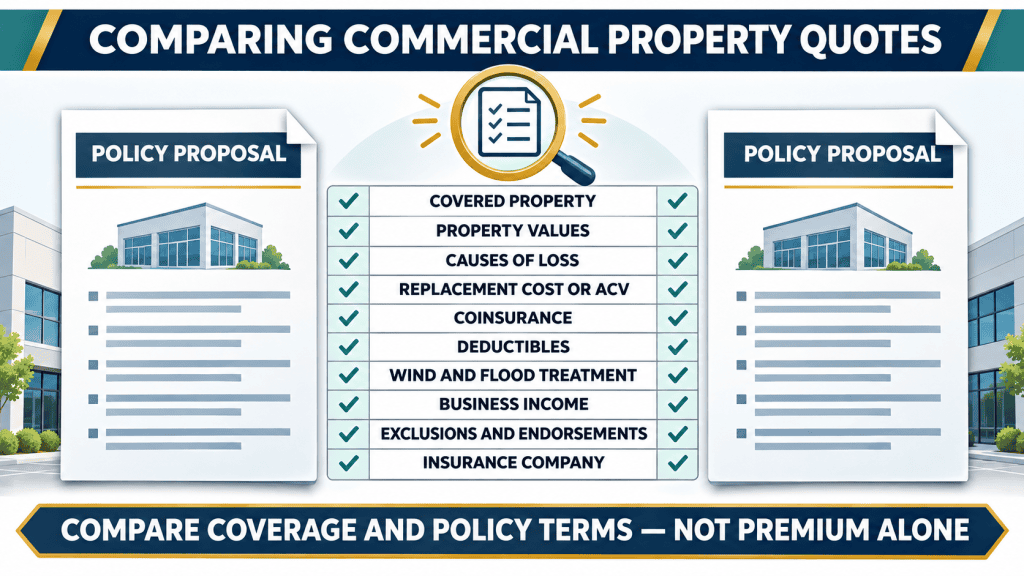
Commercial property quotes should be compared using equivalent property values, valuation, causes of loss, deductibles, business-income protection, exclusions, and insurer terms—not premium alone.
Review:
-
Named insured and legal entity
-
Covered locations
-
Building and business-personal-property limits
-
Property descriptions and classifications
-
Causes-of-loss form
-
Wind, hurricane, and named-storm treatment
-
Flood exclusion and separate flood options
-
Replacement cost or actual cash value
-
Roof valuation
-
Coinsurance and agreed-value provisions
-
Specific or blanket limits
-
All applicable deductibles
-
Business income and extra expense
-
Waiting periods and restoration provisions
-
Ordinance or law
-
Equipment breakdown
-
Utility services
-
Water backup
-
Spoilage
-
Crime
-
Property off premises or in transit
-
Protective-safeguard requirements
-
Vacancy provisions
-
Exclusions and endorsements
-
Inspection requirements
-
Minimum-earned-premium provisions
-
Mortgagee, lender, or landlord requirements
-
Insurer financial strength and claims resources
Read Every Endorsement
An endorsement can add, remove, or change coverage. Important wording may not appear in the proposal summary.
Pay special attention to endorsements involving wind, water, roof valuation, cosmetic damage, protective safeguards, vacancy, theft, ordinance or law, business income, utility services, property of others, and designated premises.
Compare the Entire Insurance Program
Commercial property should be coordinated with general liability, workers’ compensation, commercial auto, cyber, professional liability, flood, crime, equipment breakdown, inland marine, and umbrella coverage as appropriate.
An eligible small or midsize company may be able to combine commercial property, general liability, and business income coverage in a BOP. For more information, read Business Owners Policy in Florida: BOP Coverage Explained.
Information Needed for a Commercial Property Quote
Accurate information improves underwriting and makes quote comparisons more reliable.
An insurance company may request:
-
Legal entity name and ownership
-
Complete business operations
-
Property address and occupancy
-
Building ownership or tenancy
-
Lease or mortgage requirements
-
Year built
-
Square footage
-
Construction type
-
Number of stories
-
Roof age, type, and updates
-
Electrical, plumbing, and HVAC details
-
Fire sprinklers, alarms, and security systems
-
Distance to hydrants and fire protection
-
Building replacement-cost estimate
-
Business personal property values
-
Inventory values and seasonal fluctuations
-
Equipment schedules
-
Tenant improvement values
-
Property belonging to others
-
Business-income worksheet
-
Prior insurance and loss history
-
Desired deductibles and valuation
-
Wind-mitigation or inspection information
-
Flood zone, elevation, and prior flood information
-
Vacancy, renovation, or construction plans
-
Photographs and inspection reports
Disclose material facts accurately. The company name alone does not describe cooking, manufacturing, storage, refrigeration, hazardous materials, public access, off-premises work, or other operations that can affect eligibility and claims.
What to Do After a Commercial Property Loss
The first priority is protecting people. Call emergency services when necessary and do not enter an unsafe building solely to document damage.
Report the Loss Promptly
Notify the insurance company or agent as soon as reasonably possible. Provide the date, location, known cause, visible damage, operational impact, and emergency measures taken.
Do not wait for a final estimate or complete inventory before reporting the claim.
Prevent Additional Damage
Take reasonable temporary steps to protect covered property when it is safe to do so. Examples can include shutting off water, arranging emergency board-up, moving undamaged property away from water, or covering a storm-created opening.
Do not make permanent repairs before the insurance company has a reasonable opportunity to inspect, unless immediate work is necessary for safety or to prevent additional damage. Document conditions before and after temporary measures whenever possible.
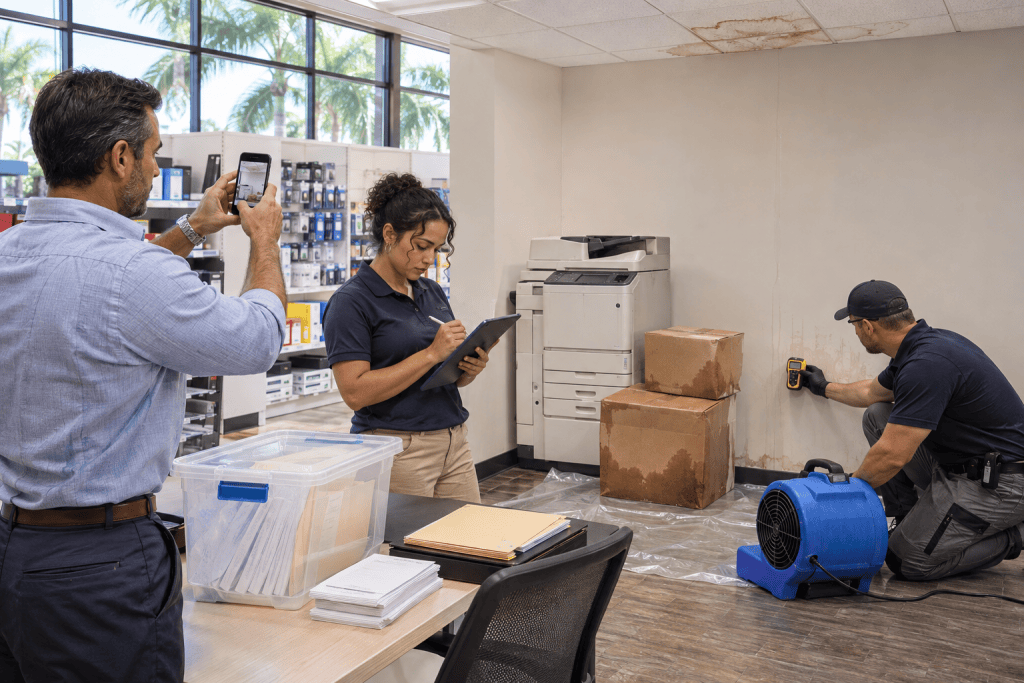
Document the building, equipment, inventory, temporary repairs, and operational impact when it is safe to do so, and preserve relevant records for the claim.
Photograph and Record the Damage
Document:
-
The building exterior and roof from safe locations
-
Interior rooms and affected areas
-
Damaged equipment and inventory
-
Water lines and entry points
-
Serial numbers and model information
-
Damaged and undamaged property
-
Debris patterns
-
Temporary repairs
-
Business interruption and closure conditions
Preserve surveillance footage, alarm records, maintenance records, weather information, and other relevant evidence.
Preserve Damaged Property
Do not discard damaged property until the insurer authorizes disposal or inspection is complete, unless health or safety requires immediate removal.
When disposal is necessary, photograph the item, record identifying information, retain a sample when safe, and document who removed it and why.
Track Every Expense and Operational Impact
Maintain a claim file containing:
-
Claim number and contact information
-
Photographs and videos
-
Inventory lists
-
Receipts and invoices
-
Repair estimates
-
Emergency-service contracts
-
Communications with the insurer
-
Payroll and sales records
-
Temporary-location expenses
-
Equipment-rental costs
-
Customer cancellations
-
Supplier delays
-
Dates the business reduced or suspended operations
Separate Wind and Flood Evidence
When a hurricane causes both wind and flood damage, report the loss to every potentially applicable insurer.
Document roof and exterior damage, storm-created openings, interior rain paths, water lines, ground-level entry, and timing. Do not assume one insurer will evaluate every cause of loss.
When to Review or Update Coverage
Review commercial property insurance before renewal and whenever the business changes materially.
Important review events include:
-
Purchasing or selling a building
-
Signing or renewing a lease
-
Opening or closing a location
-
Renovating the premises
-
Replacing the roof
-
Buying machinery or equipment
-
Increasing inventory
-
Beginning manufacturing or cooking
-
Adding cold storage or refrigeration
-
Changing occupancy
-
Subleasing space
-
Adding outdoor property or signs
-
Changing business operations
-
Creating a seasonal peak
-
Increasing payroll or revenue
-
Acquiring another company
-
Starting construction
-
Experiencing a loss
-
Changing flood or wind exposure
Newly acquired property extensions are often temporary and limited. Report a new location or acquisition promptly rather than relying on automatic coverage.
Commercial Property Insurance Across Florida and Northeast Florida
First Florida Agency serves businesses throughout Florida.
We are based in Ponte Vedra and have local knowledge of Nocatee, Ponte Vedra Beach, Jacksonville, St. Augustine, St. Johns County, and surrounding Northeast Florida communities.

First Florida Agency serves businesses throughout Florida, with local knowledge of Nocatee, Ponte Vedra, Ponte Vedra Beach, Jacksonville, St. Augustine, St. Johns County, and surrounding Northeast Florida communities.
Florida businesses can face property exposures involving coastal wind, hurricanes, heavy rain, flooding, lightning, fire, theft, equipment failure, rapid development, older buildings, construction activity, tourism, seasonal revenue, and extended post-catastrophe repair times.
A retail shop in St. Augustine, restaurant in Jacksonville, professional office in Ponte Vedra, contractor warehouse in St. Johns County, and manufacturer elsewhere in Florida may all need commercial property insurance, but their property, wind, flood, equipment, inventory, and income exposures can differ significantly.
Location matters, but it is only one part of the review. Coverage should reflect what the business owns, leases, stores, transports, and depends on to continue operating.
Frequently Asked Questions
Is Commercial Property Insurance Required in Florida?
Florida does not impose one universal commercial property insurance requirement on every business.
Coverage may be required by a mortgage lender, commercial landlord, equipment lessor, franchise agreement, investor, government contract, or other agreement. A business may also choose coverage to avoid retaining the financial risk of a major property loss.
What Does Commercial Property Insurance Cover?
It may cover eligible buildings, business personal property, equipment, inventory, furniture, fixtures, tenant improvements, and other scheduled property after direct physical loss or damage from a covered cause.
Coverage depends on the declarations, coverage forms, causes-of-loss forms, conditions, exclusions, limits, deductibles, and endorsements.
Does Commercial Property Insurance Cover Hurricanes?
It may cover qualifying wind damage when windstorm or hurricane coverage is included and no exclusion applies.
Some Florida policies exclude or restrict wind, require separate wind coverage, apply percentage deductibles, or use special roof valuation. Confirm the actual forms and endorsements.
Does Commercial Property Insurance Cover Flood or Storm Surge?
Standard commercial property insurance generally excludes flood and storm surge. Separate commercial flood insurance may be available through the NFIP or private insurers.
Building, contents, valuation, deductibles, waiting periods, and business-income options should be reviewed carefully.
Does Commercial Property Insurance Cover Water Damage?
Certain sudden and accidental water losses may be covered, depending on the cause and policy. Flooding, repeated leakage, deterioration, sewer backup, groundwater, and water entering without a covered storm-created opening may be treated differently.
The source, duration, entry path, damaged property, and policy language all matter.
Does Commercial Property Insurance Cover a Roof?
An insured commercial building may include roof coverage, but the settlement can depend on the cause of damage, roof age, maintenance, valuation, wind coverage, deductible, and endorsements.
Wear, deterioration, faulty installation, cosmetic damage, and excluded wind may restrict payment.
Does Commercial Property Insurance Cover Equipment Breakdown?
Not necessarily. Standard property insurance may exclude certain mechanical, electrical, and pressure-system failures.
Equipment breakdown coverage may be available by endorsement or separate policy and can sometimes include related business income, extra expense, or spoilage protection.
Does Commercial Property Insurance Cover Lost Income?
Business income coverage may help replace qualifying lost income and continuing expenses when covered physical damage causes a necessary suspension of operations.
It is not automatically included in every property policy, and the underlying cause of damage must generally be covered.
Does a Landlord’s Policy Cover a Commercial Tenant’s Property?
Usually, the tenant should not assume it does. A landlord’s policy generally protects the landlord’s insured interest, not all furniture, equipment, inventory, improvements, or income belonging to a tenant.
The lease and both parties’ insurance policies should be reviewed together.
Are Tools and Equipment Covered Away From the Business Location?
Coverage away from the scheduled premises may be limited. Tools or equipment that travel, remain in vehicles, or move among jobsites may require inland marine or contractors equipment coverage.
Commercial auto coverage generally insures the vehicle, not every item carried inside it.
What Is the Difference Between Replacement Cost and Actual Cash Value?
Replacement cost generally does not deduct for depreciation when policy requirements are met. Actual cash value generally considers depreciation and may produce a lower settlement for older property.
Payment timing, repair requirements, property type, limits, and special valuation provisions can affect both methods.
What Is Coinsurance in Commercial Property Insurance?
Coinsurance may require the business to carry insurance equal to a stated percentage of the property’s value. If the limit is below the required amount at the time of loss, the claim payment may be reduced.
Coinsurance can affect partial losses, not only total losses.
Is Commercial Property Insurance Included in a BOP?
A Business Owners Policy commonly includes commercial property, general liability, and business income coverage for an eligible business.
Not every company qualifies, and BOP forms, limits, exclusions, valuation, wind treatment, and endorsements vary by insurer.
How Much Does Commercial Property Insurance Cost in Florida?
Cost depends on the business, location, construction, occupancy, roof, wind and flood exposure, property values, causes of loss, valuation, deductibles, protective systems, claims, and optional coverage.
A quote based on accurate property and operational information is more useful than a statewide average.
How Much Commercial Property Coverage Do I Need?
The amount should reflect the cost to repair or replace buildings and business personal property, seasonal inventory changes, tenant improvements, ordinance or law exposure, and the income loss the company could experience during recovery.
Market value, tax assessment, purchase price, loan balance, and accounting value are not substitutes for a proper insurance valuation.
Request a Florida Business Insurance Review
Commercial property insurance should protect more than an address. It should reflect the buildings, equipment, inventory, improvements, income, and operations the company depends on.
First Florida Agency can help Florida businesses review property values, wind and flood exposure, deductibles, valuation, business income, endorsements, and available insurance markets.
Request a Florida business insurance quote or call 904-822-8800 to discuss your commercial property insurance options.
First Florida Agency is located at 90 Fort Wade Road, Suite 100, Ponte Vedra, FL 32081, and serves businesses throughout Florida.
About the Author
John Closterides is the Founder and Principal Agent of First Florida Agency, an independent insurance agency based in Ponte Vedra, Florida. He is a Florida-licensed 2-20 General Lines insurance agent with more than a decade of experience helping individuals, families, and businesses evaluate insurance options.
John works with Florida businesses to review property, liability, commercial auto, workers’ compensation, flood, business income, and other insurance exposures. His approach emphasizes clear explanations, accurate property and operational information, careful comparison of policy terms, and practical protection suited to the business.
Recommended External Resources
-
Florida Department of Financial Services — Commercial Property Insurance Overview
-
Florida Department of Financial Services — Commercial Insurance Coverage Disaster FAQs
-
National Flood Insurance Program — Protecting Businesses with Flood Insurance
Related Articles and Coverage Guides
Insurance Disclaimer
The information in this article is provided for general educational purposes only. It is not intended as individualized insurance, legal, financial, tax, accounting, engineering, construction, valuation, disaster-recovery, or claims advice.
Insurance coverage, eligibility, premiums, deductibles, limits, sublimits, valuation, coinsurance, exclusions, endorsements, definitions, waiting periods, restoration periods, documentation requirements, claim decisions, and availability vary by insurance company, policy form, business, property, operations, location, and individual circumstances.
Laws, regulations, building codes, government programs, insurance-company guidelines, policy forms, and flood maps may change. Current requirements should be confirmed with the appropriate insurance company, government agency, lender, landlord, and qualified professional.
Examples in this article are simplified and illustrative only. They do not establish that coverage applies to a particular property, event, claim, expense, or business. No coverage is created, bound, extended, or modified by this article, a website submission, an insurance proposal, certificate of insurance, or general description of coverage.
The declarations, coverage forms, causes-of-loss forms, definitions, conditions, exclusions, endorsements, and other terms of the issued insurance policy control. Coverage cannot be confirmed without reviewing the actual policy and facts of the loss.